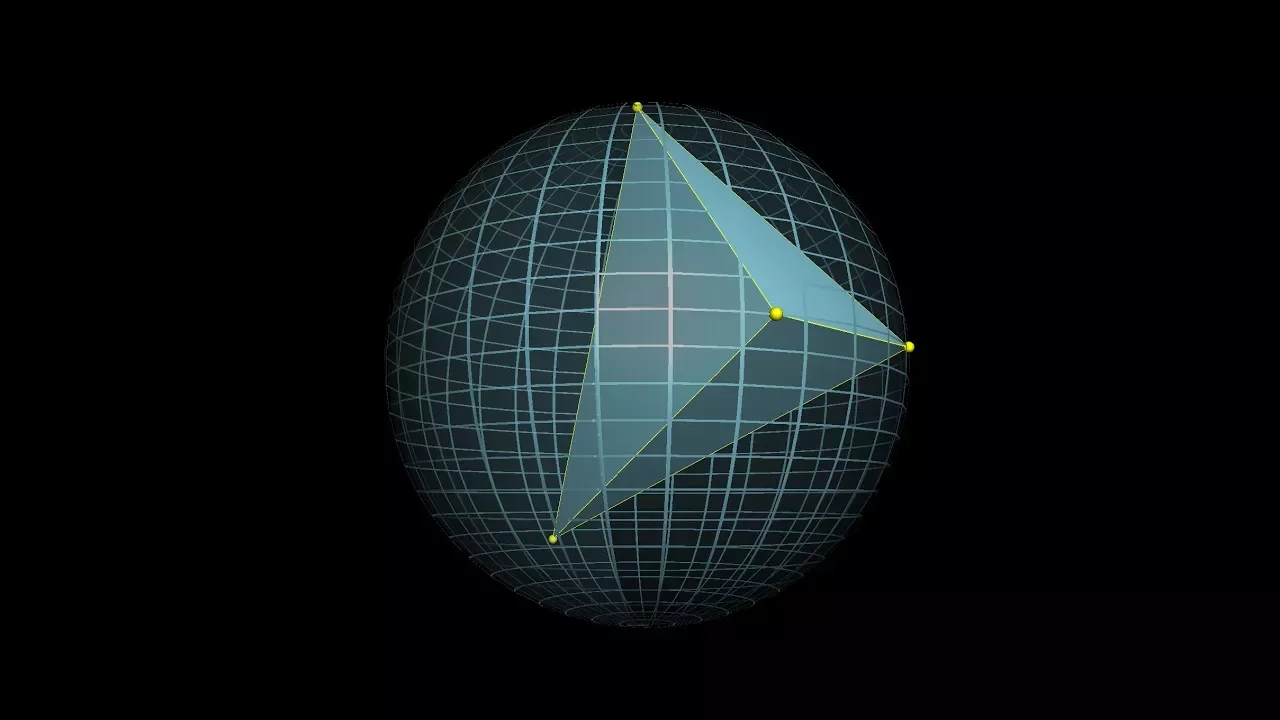
The very first measurement of the ladder is the radius of the Earth, a somewhat classic tale. But to even ask this question presumes that the Earth is a sphere, or at least roughly spherical. So you might wonder how the ancients first deduced the shape of the Earth. The first really convincing proof came from the Moon. And this is the constant theme in the distance ladder. If you want to measure one object, in this case the Earth, you have to use a reference object that is some distance away. See, the thing is that we're stuck on the Earth. Like, if we could step away, if we're looking for many different angles, you could see that it's round. If you only saw from one angle, it could be a flat disc. Flat disc, if you look at it from a different angle, it would look like an ellipse. But you can actually prove there's a nice little geometric argument actually, that if there's a convex body and every single projection is a circle, then it has to be a sphere. I'm going to guess that most of you find this pretty intuitive. After all, if every shadow of a given shape is a circle, what could that shape be other than a sphere? But of course, a mathematician always keeps a keen eye out for those strange counterintuitive exceptions. And he shared with me a nice proof of this fact after the interview, which I'll link to in the description. In two dimensions, what I just said is not true. So there are two shapes which every projection is an interval of the same length, but they're not round. But in 3D, there's enough perspective, as it turns out. If you could look at the Earth and you could always see that it was round, that tells you the Earth is a sphere. NASA can do this, okay, but Aristotle could do this. And he used the Moon because he knew about lunar eclipses. Lunar eclipses happen when the Moon falls onto the Earth's shadow. And the Earth's shadow, as you can just visibly see, it's always a circular arc. So there's a picture I can show you. This is not my photo, but someone took several images of the Moon entering and exiting a lunar eclipse and it composited them together into a single shot. You can see the shadow of the Earth. This is visible proof that the Earth is round. And you don't need telescopes, sextants, spacecraft. You just need to look at the Moon. Something else very cool, revealed by these kinds of compositions, is how you can just see the relative size of the Earth and the Moon. We'll get to that in a moment, but first things first, how do we figure out how big the Earth is? The first person to do this that we know of is Eratosthenes. The way the story goes is that he had read somewhere of this well in this town called Syene where on one day of the year, the summer solstice, you could look down on the well and you could see the Sun reflected in the water underneath. And he said, oh, that's kind of cool. I don't live there, but I have a well in my own town, Alexandria. I'm going to go try the same thing. So he waited until the summer solstice. At noon, he went down and looked at the well and there was no reflection of the Sun. So I think like if you are a regular person at this point, we say, oh, you know, that story is fake news or whatever, whatever the film is at the time. And he knew from Aristotle and the others that the Earth was round. The reason what was happening was that the Sun was not actually vertical. Let's think of the Sun as far enough away from Earth that all of its rays of light are effectively parallel. At any given moment, if you draw a line from the center of the Earth straight to the Sun, it passes through some point on the surface, which must be experiencing this phenomenon where the Sun is directly overhead. But if you were someone in Eratosthenes' time, it would be very difficult to know exactly where this was happening at a given moment. So what makes the summer solstice special is that on that day, the axis of Earth's rotation is tilted directly towards the Sun. And as a result, on this day, as the Earth revolves around that axis over 24 hours, there's a consistent line of latitude where all of the locations on this line predictably experience this phenomenon, where at high noon, it's the highest of all high noons where the Sun is overhead. This line has a special name, it's called the Tropic of Cancer, and the town Syene that Eratosthenes had read about sits on this line. Now Eratosthenes himself was a bit further north than that, in Alexandria. So on that day, at exactly noon, the direction he perceives as straight up, which I'll draw with a pink line here, is not pointed towards the Sun. It sits at some angle with all of those rays. He had what's called a gnomon, which is kind of like an ancient protractor or sundial, portable sundial, basically. He measured that the Sun was actually about 7 degrees off of the vertical. Critically, because he could also know that at this exact moment, down in Syene, many many miles away, the Sun was directly overhead, he deduced that this means the arc length along Earth between Alexandria and Syene is about 7 degrees. This in turn means the ratio between 7 degrees and the full 360 degrees of a circle must be the same as the ratio of the distance between those two towns and the full circumference of the Earth. Now keep in mind, in the records that we have, it's not like he's reporting this distance in miles or kilometers. The units they were using back then were stadia, where a single unit is something like the length of a stadium. So the distance was about 5000 stadia, which is about 500 miles. How accurate is our conversion between stadia and miles? That's a good question. We are not completely certain, so with the conventionally accepted conversions, I think the accuracy of Eratosthenes' estimate is about 10%. You can find sources online that claim his estimate was more accurate than this, but just keep in mind if you selectively choose which of the many possible conversions between stadia and miles to use, you can kind of p-hack your way into a better number here. Still, 10% is pretty good with no technology, but of course all of this hinges on actually knowing the distance between these two towns. So the natural question you might ask is, how would he know that? This is not recorded. There are some theories. One is that there are merchants that go up and down the Nile, and they know that in a certain day that their sailboard can travel so many stadia and it takes them so many days next to Y. And so from that, they have some estimates. The joke is that he basically hired what we would now call a graduate student to pace the distance from a graduate student. Carefully counting the road steps. That 5000 stadia is the only direct measurement. Just from that one graduate student, you can actually get all the way to the measure of the diameter of the universe. Right, now that's not actually what we do nowadays. I mean, because the errors stack up. But in principle, you could do that.
The Sun was trickier. So at the time they thought the Sun went around the Earth. But it actually doesn't matter for the argument whether the Sun goes around the Earth or the Earth goes around the Sun. Again there's these two numbers, there's the size of the Sun and the distance of the Sun. You can compute the ratio again because of eclipses. And there's this weird coincidence, I mean there's no reason why it should be true, but when there's a solar eclipse, the Moon and the Sun are almost exactly the same size. I guess it's not true for lunar eclipses, for lunar eclipses as we saw, Earth's shadow is much bigger. But for some reason they are almost the same size. What this means is that if you look at the ratio between the radius of the Moon and the distance that it is away from the Earth, which is what determines how big it looks to us up in the sky, because of this solar eclipse coincidence, that has to be the same as the ratio between the radius of the Sun and its distance away from the Earth. As we saw, the Greeks already knew that ratio for the Moon. The point is that they could get at least an approximate sense for the size of the Sun if they could figure out how far away it is, or vice versa. The animation I'm showing right now is very grossly not to scale. You and I both know that the Sun is actually much, much farther away than the Moon is. But of course that's not obvious when you just look at it in the sky. And so you might wonder, how could you conclude that it has to be so far away? In ancient times, for all people knew, seeing that it was roughly the same size as the Moon in the sky, it could be, say, twice as far away as the Moon is, and only twice as big. In fact, for the animation I'm going to go ahead and leave it unrealistically close like this, because it helps clarify how the next logical step works. How do you work out the distance to the Sun? You can use the Moon, that's almost the only available object you can use. But you do something else, you look at phases of the Moon. The Sun illuminates half of the Moon. And so we on Earth, we also see half the Moon, but it's a different half. And so because of that we get phases of the Moon. This is also, by the way, why we know the Moon is round. If the Moon was flat, we would not get phases. We would get either a dim Moon or a lit Moon, but we wouldn't get these phases. Sometimes you get a full Moon. If the Moon is over here, you see the whole lit thing. Sometimes you get a new Moon over here. And sometimes you get a half Moon. You can pretty much rediscover for yourself a way to estimate the distance to the Sun by asking when exactly a half Moon occurs. From the name you would guess that it's halfway between a new Moon and a full Moon, but that's actually not true. Half Moon occurs not when the Moon and the Sun make a right angle at the Earth, but actually when the Earth and the Sun make a right angle at the Moon. Hopefully your graph will be better than what I'm drawing here. Hopefully this makes some sense. For us to see a half Moon, it means that the side of the Moon that we see, facing us, overlaps by exactly 90 degrees, with the side of the Moon being illuminated by the Sun. Which in turn means we have a right angle at the spot labelled here. As your lovely illustration will show, half Moons are slightly closer to New Moons than they are to Full Moons. Of course, in this graphic the effect is very exaggerated because the Sun is being drawn so close to the Earth. How far away the Sun is determines when exactly that half Moon occurs. The farther away, the closer it is to the true halfway point. In fact, you can make this a little more quantitative, where if you measure the angle separating that halfway point between New Moons and Full Moons from the point of a half Moon, which again is confusingly not the same thing, then intuitively you can see how a smaller angle means a larger distance to the Sun. And more precisely, when you do the little bit of trigonometry here, you can conclude that the distance to the Sun is the same as the distance to the Moon divided by the sine of that angle. This is where the Greeks started hitting a wall of technology. What they did is that they knew that the Moon took 28 days to go around the Earth, and so they had to measure exactly when a half Moon occurred and what the deviation is. Now Aristarchus, he thought that the distance was 6 hours. Half Moons occurred 6 hours before the midpoint between the Moon and Full Moons. He doesn't write how he came up with this. And it's wrong. The actual discrepancy is half an hour. He's off by a huge factor. So the thing is, well, A, we have clocks, which work in the dark. They had sundials which don't also did not have telescopes. Mathematically the method was sound. Technologically it was just not possible for this method to work. No, but it worked well enough. So he was off by basically a whole order of magnitude. He thought that the Sun was 20 times further away than the Moon. The true answer, based on the slight change to that angle that he was trying to measure
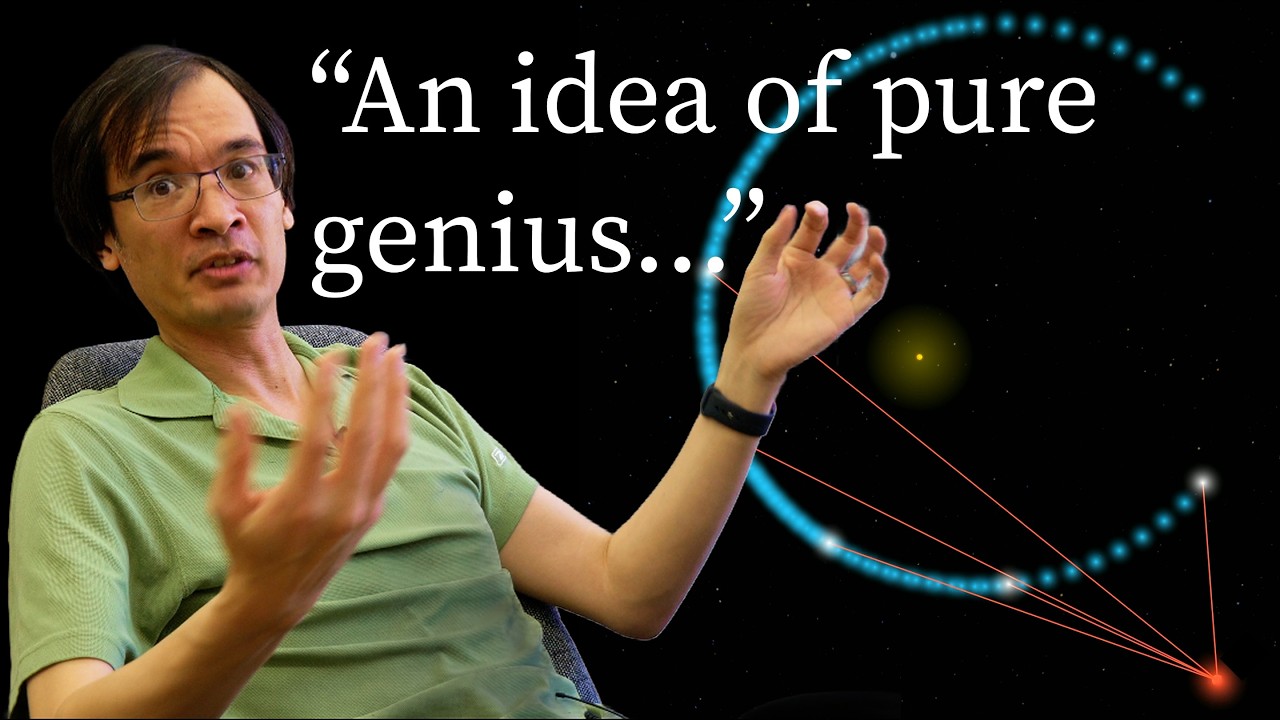
Perhaps the best part of this whole story. This is the most genius step of the ladder. The first time you climb from one step to the next, it's always heroic. Because the first time, you're at the edge of what the data and the math and the technology can give you. Now Kepler was not working from a blank slate. He was building off of the work of others, most notably that of Copernicus. So Copernicus had already worked out that the planets move around the Sun. He said Sun in circular orbits. And he even figured out the period, how long it takes for each planet to go around the Sun. So for example, we know that the Earth takes exactly one year to do a full orbit, and Copernicus had figured out that Mars takes 687 days for its orbit, and likewise for all the other known planets. He gets all the fame because of heliocentrism, but these numbers were arguably his most important contribution. You'll see in a moment why they are critical. The way he computed this was that he had all this Babylonian data. Essentially the way this worked was by compiling centuries of observations for where the planets appear among the stars, then figuring out when those patterns repeat, and then very importantly factoring in the movement of Earth in that time. Kepler was interested in figuring out the relative sizes of all of these orbits. He had this funny little pet theory that was linked to the five platonic solids. The idea was if you imagine a sphere inscribed in an octahedron, and then you fit the smallest possible sphere around that, and then icosahedron around that, then layer on another sphere, and then a dodecahedron, one more sphere, then a tetrahedron, one more sphere, a cube, and then one final sphere, you get these six spheres, and the ratios between the sizes of those spheres, Kepler believed, would match the ratios of the orbits for the six known planets. Since these are the platonic solids, it somehow feels like a very natural or universal set of ratios. It would have been a beautiful theory if this was true. So hungry to prove his very beautiful theory, he needed to look at the historical data for where all the planets appeared in the sky. There was this astronomer at the time, Tycho Brahe, who was this very wealthy, eccentric aristocrat who had an interest in astronomy, and so he convinced the government of Denmark to give him an island, complete with peasants, to build him an astronomy, it's called Uranenburg. And he just made decades and decades of observations of all kinds of things, including all the planets. Kepler wanted his data, but Tycho Brahe wouldn't give it to him. He stole the data. They weren't on the best of terms. Anyway, he took all his data and he wanted to use it to confirm his theory. And it was off by a couple percent. He could not make the theory fit. In fact, not only could he not make his own theory fit, he couldn't even make Copernicus' theory fit. He could not make circular orbits match. It's really important to understand that once you throw out the assumption that orbits are circular, it is very difficult to make sense out of the observational data. It's not like what Tycho Brahe was recording is the exact position in 3D space for all the planets over time. They didn't know the distances to the planets. The only thing that you can see is where in the sky a given planet appears, what constellation it's inside on a given date. From that information alone, just a sequence of angles in the sky, basically, Kepler managed to deduce the shapes of all of these planets' orbits, including the shape of Earth's orbit. The sun is fixed. Earth is moving around in some orbit, not quite circular. And Mars is also moving around by some orbit, not quite circular. And we don't know what the orbit is. About the only thing we can do is at any given time on Earth, you can work out where you are with the sun and you can work out this direction. But you have no notion of distance. You only have direction. Imagine that you had observed Mars night after night. Each night you can see where Mars is with respect to the constellations. And this tells you basically the direction from Earth to Mars with respect to the celestial sphere. But you don't know exactly where Earth is. And you also don't know how far away Mars is. You do know the direction to the sun, even if you can't literally see it in the constellations. You know this because of what date of the year it is, since that tells you how far the Earth has gone around. Keep in mind, although Aristarchus had his estimate for how far away the sun was, people still didn't really have a precise measure for that distance. Aristarchus's method is just too error-prone for anything exact. So all you really know are these two different angles, and you want to figure out these two unknown orbits. That doesn't seem like enough information. Even if you assume everything's on a plane, which you more or less can, all the planets live on a zodiac. So it's pretty much a planar diagram. This looks unsolvable. In math, if you can't solve a problem, you first try to solve a simpler problem. So let's Now suppose Mars doesn't move. Suppose Mars is actually nailed to space. Then you can at least work out the orbit of the Earth. If Mars was fixed in space like this, then these two directions are at least enough to tell you where the Earth is, at least with respect to that fixed location for Mars and the fixed location for the sun. You would essentially draw these two lines and find the intersection. So if you have the data for many different nights in this idealized hypothetical, you could plot where the Earth is on each night and so see how it moves around the sun, at least with respect to these two fixed locations for Mars and the sun. You still don't know absolute distances. So if you had two fixed sun and Mars, then you can work out the orbit of the Earth. But Mars does, of course, move. So how do you triangulate when something moves? So this is the genius thing. Kepler knew because of Copernicus that every 729 days, Mars comes back to where it was before. So if he takes, tackles data, but takes a time series spaced at spacings of 729 days, then in that time series, Mars is a reference point. Brahe observed for 10 years, Mars, there was just enough data in this data set. It is perhaps worth being extra clear about how exactly this works. Like we said, on a given night using these two different directions, you can figure out Earth's location with respect to where Mars happens to be. So if you wait 687 days and Mars is back in that same location, you get another data point for Earth with respect to that same spot. Using 10 years worth of data, this gives you five different locations for where Earth is. But again, this depends on exactly where in space Mars is. If you jiggle it about, it jiggles around the implied five points for Earth. I'll go ahead and give those a slightly different color, and then have you imagine looking just a couple days later to a different location of Mars, and then taking a similar time series, again spaced out by this Martian year, to get five more positions for Earth, but now they're dependent on that different location for Mars. Of course, you don't know exactly how Mars moves, so you don't know exactly where these five points are, but if it's just a day later, Mars only will have moved a little bit, and you know those five points should only have moved a little bit. So what Kepler has is essentially like this massive jigsaw puzzle, where each piece looks like five points for where Earth is, conditioned on a mystery location for Mars. Knowing that all of those pieces have to fit together about a day apart, he was able to piece them all together to get a coherent orbit for Earth, with respect to a certain coherent orbit for Mars. To be clear, nothing about this tells you absolute distances, it's just giving you the shape of the orbit, but even still he was able to see what no one before him had ever seen, which is that this orbit is not a circle, it's an ellipse, and he was even able to find other neat facts, like how the area the Earth sweeps out as it goes along this orbit is the same for a given time period, no matter where on the ellipse it sits. And once you have a sense for the shape of Earth's orbit, it makes it a lot easier to deduce the orbit of Mars, or any other planet. You can do this in reverse, if you take one fixed point of Mars, you can take measurements from Earth, and you can now work out the location of Mars. This angle measurement may not tell you the distance to Mars on one night, but if you take five separate nights spaced out by 687 days, meaning you know that Mars is at the same point in space on those five different days, then you get these five different angles that are more than enough to help you triangulate where Mars is, at least with respect to Earth's orbit. When you do this for many different adjacent time series, you can draw out the exact orbit of Mars over the course of those 687 days. Einstein once wrote an introduction to a book on astronomy, and I think he mentioned this idea, he called it an idea of pure genius. He needed the data, he needed, not just Tycho's data, but Copernicus's data, which came all the way from the Babylonians. So the period of Mars, that was a pain over centuries. But he could put it all together with what we would now call data analysis.