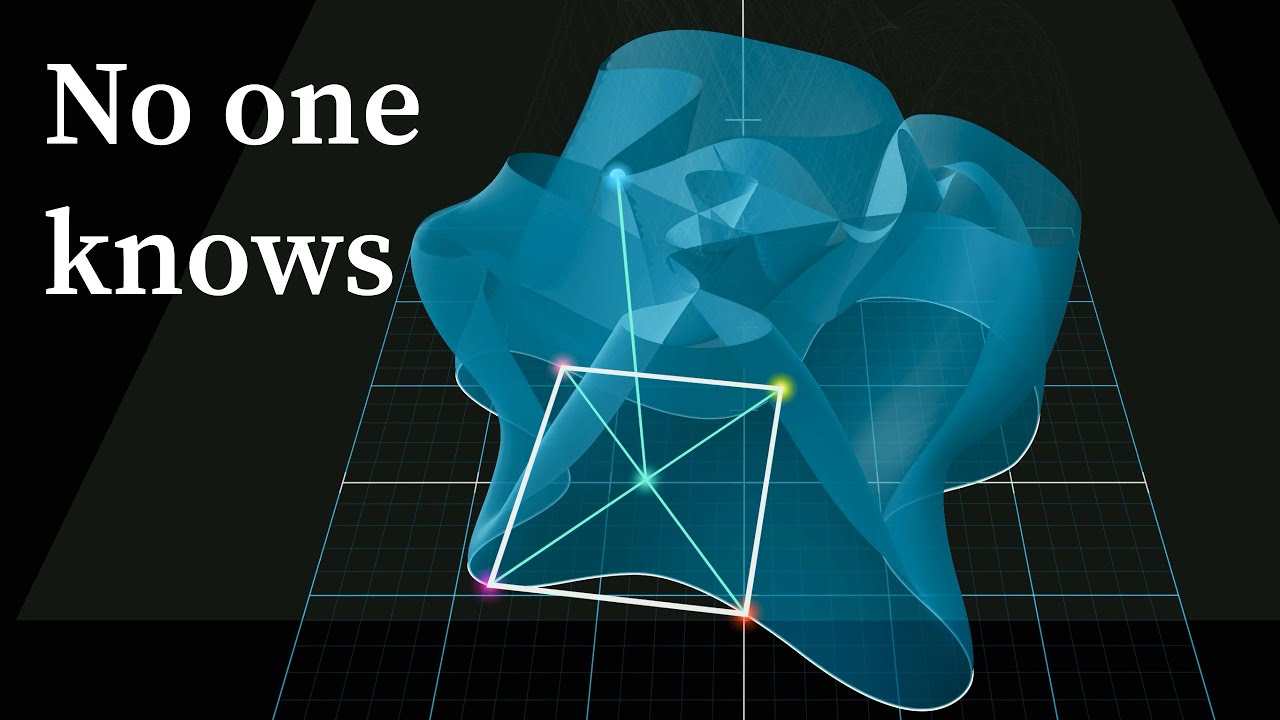
deduction. The first step in proving that any closed loop contains a rectangle is going to be to reframe the question just a little bit. Instead of thinking about four points that are the vertices of a rectangle, think about searching for two distinct pairs of points, such that the lines connecting each pair have the same midpoint and they have the same length. Hopefully it's not too hard to convince yourself that this really is the same thing as searching for a rectangle. If I told you, hey, I found two line segments somewhere out in space, and I further specify that both of them have the same center, and also that both segments have the same length, then the four endpoints of those two different lines have to form a rectangle. If you want, you could try to pause and ponder to rigorously prove this. It's a relatively straightforward geometry exercise. Given some arbitrary closed loop, what you and I are going to do is somehow think about all possible pairs of points on that loop. For any one of these pairs, we care about two things. The first is where its midpoint sits, which you might think of as two numbers worth of data. The xy coordinates on the plane where the loop sits. The other thing we care about is the distance between those points, which is another data point. Now if you're a mathematician and you see three numbers worth of information like this, it is a very natural step to try packaging them together and think of that data as being a single point in a three-dimensional space. In our example, if you imagine the loop sitting on an xy plane inside that space, and its midpoint has some coordinates xy, then this 3d point that we care about, the one packaging x, y, and d, could be thought about as a point directly above that midpoint, such that the distance off the plane matches the distance between the pair of points on the loop. Some other loop would correspond to some other point in three-dimensional space. And in essence, what we have here is a mapping. A mapping from pairs of points on the loop to three-dimensional space. The important feature of this mapping that we're going to rely on is that it's continuous. And essentially what this means is if you just slightly wiggle the input, slightly nudging that pair of points, the output only slightly wiggles as well. There are never any sudden jumps. In our search for inscribed rectangles, with respect to this mapping, it amounts to searching for a kind of coincidence when two distinct pairs of points map to the same output, since by definition that would mean they have to have the same midpoint and be the same distance apart, which, like I said, means they have to form a rectangle. So if you imagine yourself as a mathematician mulling this over, you want to know how you can prove that this kind of collision would happen. Looking over all possible pairs of points on the loop and all their corresponding three-dimensional outputs, how could you know for sure that a collision must happen? You might complain that this all feels like stating the same question just in more complicated language, but where it really starts to feel qualitatively different is if I invite you to think about the set of all possible outputs of this map, every possible point in 3D space that corresponds to some pair of loop points like this. Taken together, they form this kind of wild surface, which looks like some incredibly beautiful but complicated Frank Gehry architectural design. Even when I render this out, personally I find it kind of hard to even wrap my mind around what exactly I'm looking at. What I found helpful was to look at cross-sections. Near the bottom, the cross-sections of this surface look approximately like the loop itself, which is a surprisingly important fact that we'll get back to. And then let me pull up those two pairs of points again and position them so that they sit on some rectangle vertices. Then if I bring up the cross-section to the height of that corresponding output, notice what it looks like. Around that point, it kind of feels like the surface is crossing through itself. And in fact, for the example I'm showing, there's not just one point of intersection, there's this continuous curve of self-intersection points corresponding to a continuous family of inscribed rectangles in the loop. This is a really cool way to think about inscribed rectangles. Every point you see in the surface that feels like self-intersection in this way corresponds to some inscribed rectangle in the loop. So far, all of this has just been illustrated with a single example loop, but keep in mind, every possible loop that you could draw on the plane has its own corresponding unique surface sitting above it. Proving that this kind of self-intersection has to happen no matter what loop you start with really comes down to getting to know this surface and who it really is and what it's all about. In the first edition of this lesson, many commenters asked, what would this surface look like for a circle? And in this case, the result is deceptively simple. It looks something like a dome. And at first, this might seem like it has no self-intersection. But the imperfections with how the surface is being rendered do give a little bit of a hint that something funny is happening near the very top of that dome. And if you think about it, a circle certainly has inscribed rectangles. In fact, it has infinitely many of them. And all of them have a midpoint at the center of that circle. And the length of the diagonal for those rectangles is always equal to the circle's diameter. So what this means is that the function we define from pairs of loop points into 3D space maps many different points, infinitely many, onto this single point on the top of the dome. So we certainly have the collision that we're looking for, infinitely many in fact. But for this example, it doesn't have that same look of a ghostly sheet kind of passing through itself in space. If I squish the circle to become an ellipse, you can see how that single point of many intersections becomes a vertical line of self-intersections. And I'll invite you to pause and ponder to think about why that might be the case. The point is, just keep in mind when I use this phrase, self-intersection, what I'm really getting at is the idea of two different pairs of points mapping to the same output. In almost all cases, that looks like a surface passing through itself, but it's possible for it to look different. Another point that's maybe worth emphasizing is that the surface you're looking at is not a function graph. A function graph in three dimensions comes from functions that have two numbers as an input and one number as the output. Right here we have something notably more complicated. The inputs of the function are pairs of points on the loop, and the outputs are triplets of numbers, full points in 3D space. What you're looking at is the set of all outputs, it's not a graph. There's a famous quote from the author Anton Chekhov giving advice about writing, where he says, if in the first act you have hung a pistol on the wall, then in the following one it should be fired. His main point is about only including strictly necessary information, but another principle, implicit, is that the seeds for dramatic action should be planted early. In our story here about topology and proving inscribed rectangles, I want to draw your attention to a certain gun hanging on the wall. I mentioned how near the plane of the curve, the cross sections of the surface look approximately like the curve itself. Why is that? Well, think about a pair of points that are really close together. Because the distance between them is small, the output has a very small z-coordinate, and the midpoint is close to both of those points themselves. In the extreme, if you have a pair of points that's really just the same spot on the curve, listed twice, then the output of this mapping is that same point on the curve. Remember that. All pairs that look like x, x correspond to points on the curve itself. So we have this wild surface, we're trying to prove self-intersections, and the next step for how we're going to do this is to come up with a second, very natural way to associate pairs of points on a loop with a certain other surface. The final argument is then going to come down to understanding how this other mystery surface can or cannot be embedded into three dimensions without self-intersection.
deduction. The first step in proving that any closed loop contains a rectangle is going to be to reframe the question just a little bit. Instead of thinking about four points that are the vertices of a rectangle, think about searching for two distinct pairs of points, such that the lines connecting each pair have the same midpoint and they have the same length. Hopefully it's not too hard to convince yourself that this really is the same thing as searching for a rectangle. If I told you, hey, I found two line segments somewhere out in space, and I further specify that both of them have the same center, and also that both segments have the same length, then the four endpoints of those two different lines have to form a rectangle. If you want, you could try to pause and ponder to rigorously prove this. It's a relatively straightforward geometry exercise. Given some arbitrary closed loop, what you and I are going to do is somehow think about all possible pairs of points on that loop. For any one of these pairs, we care about two things. The first is where its midpoint sits, which you might think of as two numbers worth of data. The xy coordinates on the plane where the loop sits. The other thing we care about is the distance between those points, which is another data point. Now if you're a mathematician and you see three numbers worth of information like this, it is a very natural step to try packaging them together and think of that data as being a single point in a three-dimensional space. In our example, if you imagine the loop sitting on an xy plane inside that space, and its midpoint has some coordinates xy, then this 3d point that we care about, the one packaging x, y, and d, could be thought about as a point directly above that midpoint, such that the distance off the plane matches the distance between the pair of points on the loop. Some other loop would correspond to some other point in three-dimensional space. And in essence, what we have here is a mapping. A mapping from pairs of points on the loop to three-dimensional space. The important feature of this mapping that we're going to rely on is that it's continuous. And essentially what this means is if you just slightly wiggle the input, slightly nudging that pair of points, the output only slightly wiggles as well. There are never any sudden jumps. In our search for inscribed rectangles, with respect to this mapping, it amounts to searching for a kind of coincidence when two distinct pairs of points map to the same output, since by definition that would mean they have to have the same midpoint and be the same distance apart, which, like I said, means they have to form a rectangle. So if you imagine yourself as a mathematician mulling this over, you want to know how you can prove that this kind of collision would happen. Looking over all possible pairs of points on the loop and all their corresponding three-dimensional outputs, how could you know for sure that a collision must happen? You might complain that this all feels like stating the same question just in more complicated language, but where it really starts to feel qualitatively different is if I invite you to think about the set of all possible outputs of this map, every possible point in 3D space that corresponds to some pair of loop points like this. Taken together, they form this kind of wild surface, which looks like some incredibly beautiful but complicated Frank Gehry architectural design. Even when I render this out, personally I find it kind of hard to even wrap my mind around what exactly I'm looking at. What I found helpful was to look at cross-sections. Near the bottom, the cross-sections of this surface look approximately like the loop itself, which is a surprisingly important fact that we'll get back to. And then let me pull up those two pairs of points again and position them so that they sit on some rectangle vertices. Then if I bring up the cross-section to the height of that corresponding output, notice what it looks like. Around that point, it kind of feels like the surface is crossing through itself. And in fact, for the example I'm showing, there's not just one point of intersection, there's this continuous curve of self-intersection points corresponding to a continuous family of inscribed rectangles in the loop. This is a really cool way to think about inscribed rectangles. Every point you see in the surface that feels like self-intersection in this way corresponds to some inscribed rectangle in the loop. So far, all of this has just been illustrated with a single example loop, but keep in mind, every possible loop that you could draw on the plane has its own corresponding unique surface sitting above it. Proving that this kind of self-intersection has to happen no matter what loop you start with really comes down to getting to know this surface and who it really is and what it's all about. In the first edition of this lesson, many commenters asked, what would this surface look like for a circle? And in this case, the result is deceptively simple. It looks something like a dome. And at first, this might seem like it has no self-intersection. But the imperfections with how the surface is being rendered do give a little bit of a hint that something funny is happening near the very top of that dome. And if you think about it, a circle certainly has inscribed rectangles. In fact, it has infinitely many of them. And all of them have a midpoint at the center of that circle. And the length of the diagonal for those rectangles is always equal to the circle's diameter. So what this means is that the function we define from pairs of loop points into 3D space maps many different points, infinitely many, onto this single point on the top of the dome. So we certainly have the collision that we're looking for, infinitely many in fact. But for this example, it doesn't have that same look of a ghostly sheet kind of passing through itself in space. If I squish the circle to become an ellipse, you can see how that single point of many intersections becomes a vertical line of self-intersections. And I'll invite you to pause and ponder to think about why that might be the case. The point is, just keep in mind when I use this phrase, self-intersection, what I'm really getting at is the idea of two different pairs of points mapping to the same output. In almost all cases, that looks like a surface passing through itself, but it's possible for it to look different. Another point that's maybe worth emphasizing is that the surface you're looking at is not a function graph. A function graph in three dimensions comes from functions that have two numbers as an input and one number as the output. Right here we have something notably more complicated. The inputs of the function are pairs of points on the loop, and the outputs are triplets of numbers, full points in 3D space. What you're looking at is the set of all outputs, it's not a graph. There's a famous quote from the author Anton Chekhov giving advice about writing, where he says, if in the first act you have hung a pistol on the wall, then in the following one it should be fired. His main point is about only including strictly necessary information, but another principle, implicit, is that the seeds for dramatic action should be planted early. In our story here about topology and proving inscribed rectangles, I want to draw your attention to a certain gun hanging on the wall. I mentioned how near the plane of the curve, the cross sections of the surface look approximately like the curve itself. Why is that? Well, think about a pair of points that are really close together. Because the distance between them is small, the output has a very small z-coordinate, and the midpoint is close to both of those points themselves. In the extreme, if you have a pair of points that's really just the same spot on the curve, listed twice, then the output of this mapping is that same point on the curve. Remember that. All pairs that look like x, x correspond to points on the curve itself. So we have this wild surface, we're trying to prove self-intersections, and the next step for how we're going to do this is to come up with a second, very natural way to associate pairs of points on a loop with a certain other surface. The final argument is then going to come down to understanding how this other mystery surface can or cannot be embedded into three dimensions without self-intersection.
To set this up, it helps to give the loop a kind of internal coordinate system, let's say associating each point on the loop with a number between 0 and 1. Geometrically, an association like this is a little bit like snipping the loop at some point and then flattening it out onto the unit interval of the number line. Every point of the loop is associated with a unique number from 0 to 1, and vice versa, with the single exception of the fact that both 0 and 1 map to the same point of the loop. So for this to be a continuous association in both directions, something we're going to care a lot about, you might imagine wanting to glue that number 0 to the number 1. You'll see in a moment why this is important. Now of course we don't care about single points on the loop, our whole study here is about pairs of points on the loop, and if you have some second point, naturally you might think of a second unit interval maybe along a y-axis. So here the x-axis gives a coordinate for the first point, and the y-axis gives a coordinate for that second point, and the pair of points taken together would correspond to a single point in this unit square, where the two-dimensional coordinates of that point essentially encode which two points on the loop we're talking about. This association between individual points in the square and pairs of points on the loop is almost a continuous one-to-one map, but again there's some awkwardness around the edges based on the fact that the coordinates 0 and 1 really describe the same thing. For example, look at all of the points on the left here where the x-coordinate is 0, corresponding to this vertical line. All those points really represent the same loop pair as the ones on the right side, where the x-coordinate is 1, this other vertical line here. I'll color both of them blue and I'll put some arrows on there to help remember the orientation. Similarly, all of the points whose y-coordinate is 0, this bottom line here, represent the same loop pairs as the point whose y-coordinate is 1, up at the top. If you're thinking topologically, you don't just want to record this, you want to somehow represent it geometrically. And the way we'll do this is to glue both of those blue lines together, which you might think of as giving this tube. The green lines have now turned into these circles at the end of the tube, and to glue those together it requires curling the tube around on itself, giving us this surface of a donut shape, which is commonly called a torus. And I want to point out it's not like we landed here because of some random pondering about donuts and coffee cups. The surface seems to be a really natural representation of all possible pairs of points on the loop. And what I mean when I say natural here is essentially two things. First of all, the mapping goes both ways. Every point of the torus corresponds to a unique pair of points on the loop, and each loop gives us a unique point on the torus. Secondly, the association is continuous, meaning if I wiggle some point on the torus, it results in only a slight wiggle to the corresponding pair of points on the loop, and vice versa, there are never any sudden jumps. But actually, the torus is not quite the right surface for our purposes. Remember why we're doing any of this. We're looking for two distinct pairs of points on an arbitrary loop that have the same midpoint and the same distance apart. But it matters whether we care about the order of a pair of points. If you consider the pair a, b to be distinct from the pair b, a, then that would give you a trivial example of two distinct pairs of points that have the same midpoint and the same distance apart. But this is like saying that you can always find an inscribed rectangle as long as you're okay with an infinitely thin rectangle. Clearly what we want is to prove that there are non-trivial rectangles, and for that you need to think of the pair of points as being unordered, in the sense that a, b and b, a should really refer to the same thing. Looking back at our unit square, you now want to somehow record the fact that every point with coordinates x, y should really be considered the same as the point with coordinates y, x. If you take a moment to think about it, what you essentially want here is that all of the points on the square that are reflected along this diagonal line should be considered as representing the same pair of points on the loop. And again, you can think of this with a kind of gluing, where we're going to fold the square along that diagonal line, kind of like a grilled cheese sandwich. And when you do this, I want to draw your attention again to that gun hanging on the wall. Every pair of points that looks like x, x corresponds to a point somewhere on the crease of this fold, this diagonal line, which from this point on I'm going to be coloring in red. You still need to glue the edges together, as a way to remember that 0 and 1 really map to the same point on the loop. But after our diagonal fold, we're faced with a real puzzle here. Notice the orientation. How exactly to do this is puzzling enough to almost feel contradictory. But sometimes with topology, you have to take a step back in order forward. The trick here is to cut this piece along another diagonal, and we're going to add some new arrows to remember to glue that cut back together in a moment. Doing this lets you glue together the original two arrows, which gives us this square with two edges that still need to be glued. But notice that the orientation of the remaining arrows are reversed. So to glue those back together, what you need to do is somehow introduce a single half twist, and this is exactly the construction for a Möbius strip. That is really cool to me. And again, I want to emphasize this is not some arbitrary play task with construction paper. This shape arose for us very naturally. It's a way to geometrically represent all possible unordered pairs of points on a loop. And again, what I mean by natural here is that each point of the strip corresponds to a unique pair on the loop, and vice versa, and the relationship is continuous. Small nudges on one side correspond to small nudges on the other. The other thing I want to draw your attention to is the red edge of that Möbius strip. Originally, this is what came from the diagonal in that unit square. It represents all pairs of points that look like x comma x. That is, pairs that are really the same point but just listed twice.
To set this up, it helps to give the loop a kind of internal coordinate system, let's say associating each point on the loop with a number between 0 and 1. Geometrically, an association like this is a little bit like snipping the loop at some point and then flattening it out onto the unit interval of the number line. Every point of the loop is associated with a unique number from 0 to 1, and vice versa, with the single exception of the fact that both 0 and 1 map to the same point of the loop. So for this to be a continuous association in both directions, something we're going to care a lot about, you might imagine wanting to glue that number 0 to the number 1. You'll see in a moment why this is important. Now of course we don't care about single points on the loop, our whole study here is about pairs of points on the loop, and if you have some second point, naturally you might think of a second unit interval maybe along a y-axis. So here the x-axis gives a coordinate for the first point, and the y-axis gives a coordinate for that second point, and the pair of points taken together would correspond to a single point in this unit square, where the two-dimensional coordinates of that point essentially encode which two points on the loop we're talking about. This association between individual points in the square and pairs of points on the loop is almost a continuous one-to-one map, but again there's some awkwardness around the edges based on the fact that the coordinates 0 and 1 really describe the same thing. For example, look at all of the points on the left here where the x-coordinate is 0, corresponding to this vertical line. All those points really represent the same loop pair as the ones on the right side, where the x-coordinate is 1, this other vertical line here. I'll color both of them blue and I'll put some arrows on there to help remember the orientation. Similarly, all of the points whose y-coordinate is 0, this bottom line here, represent the same loop pairs as the point whose y-coordinate is 1, up at the top. If you're thinking topologically, you don't just want to record this, you want to somehow represent it geometrically. And the way we'll do this is to glue both of those blue lines together, which you might think of as giving this tube. The green lines have now turned into these circles at the end of the tube, and to glue those together it requires curling the tube around on itself, giving us this surface of a donut shape, which is commonly called a torus. And I want to point out it's not like we landed here because of some random pondering about donuts and coffee cups. The surface seems to be a really natural representation of all possible pairs of points on the loop. And what I mean when I say natural here is essentially two things. First of all, the mapping goes both ways. Every point of the torus corresponds to a unique pair of points on the loop, and each loop gives us a unique point on the torus. Secondly, the association is continuous, meaning if I wiggle some point on the torus, it results in only a slight wiggle to the corresponding pair of points on the loop, and vice versa, there are never any sudden jumps. But actually, the torus is not quite the right surface for our purposes. Remember why we're doing any of this. We're looking for two distinct pairs of points on an arbitrary loop that have the same midpoint and the same distance apart. But it matters whether we care about the order of a pair of points. If you consider the pair a, b to be distinct from the pair b, a, then that would give you a trivial example of two distinct pairs of points that have the same midpoint and the same distance apart. But this is like saying that you can always find an inscribed rectangle as long as you're okay with an infinitely thin rectangle. Clearly what we want is to prove that there are non-trivial rectangles, and for that you need to think of the pair of points as being unordered, in the sense that a, b and b, a should really refer to the same thing. Looking back at our unit square, you now want to somehow record the fact that every point with coordinates x, y should really be considered the same as the point with coordinates y, x. If you take a moment to think about it, what you essentially want here is that all of the points on the square that are reflected along this diagonal line should be considered as representing the same pair of points on the loop. And again, you can think of this with a kind of gluing, where we're going to fold the square along that diagonal line, kind of like a grilled cheese sandwich. And when you do this, I want to draw your attention again to that gun hanging on the wall. Every pair of points that looks like x, x corresponds to a point somewhere on the crease of this fold, this diagonal line, which from this point on I'm going to be coloring in red. You still need to glue the edges together, as a way to remember that 0 and 1 really map to the same point on the loop. But after our diagonal fold, we're faced with a real puzzle here. Notice the orientation. How exactly to do this is puzzling enough to almost feel contradictory. But sometimes with topology, you have to take a step back in order forward. The trick here is to cut this piece along another diagonal, and we're going to add some new arrows to remember to glue that cut back together in a moment. Doing this lets you glue together the original two arrows, which gives us this square with two edges that still need to be glued. But notice that the orientation of the remaining arrows are reversed. So to glue those back together, what you need to do is somehow introduce a single half twist, and this is exactly the construction for a Möbius strip. That is really cool to me. And again, I want to emphasize this is not some arbitrary play task with construction paper. This shape arose for us very naturally. It's a way to geometrically represent all possible unordered pairs of points on a loop. And again, what I mean by natural here is that each point of the strip corresponds to a unique pair on the loop, and vice versa, and the relationship is continuous. Small nudges on one side correspond to small nudges on the other. The other thing I want to draw your attention to is the red edge of that Möbius strip. Originally, this is what came from the diagonal in that unit square. It represents all pairs of points that look like x comma x. That is, pairs that are really the same point but just listed twice.
As a final step, connect this with what we were doing earlier, where we constructed that strange Frank Gehry-looking surface, encoding all of the loop pair data that we cared about. Now, you also know that unordered pairs of points have this natural correspondence with a Möbius strip, in the sense that you have a two-way continuous association. What that means is there's necessarily a continuous function from the Möbius strip onto this surface in 3D space. To animate this, let me show you what it looks like if I move every point of that surface back to its corresponding point on the Möbius strip, the one associated with the same pair of loop points. And here it is going the other way, very explicitly showing the map from the Möbius strip onto this surface. But it's not just any map. Focus one last time on the gun hanging on the wall. The edge of this Möbius strip, which, remember, corresponds to all the pairs that look like x comma x, that has to land on the loop itself, meaning it has to end up confined to the xy-plane. And if you take a moment and play around with the idea in your head of Möbius strips and how they can fit into 3D space, you might find it entirely believable that it's impossible to embed a Möbius strip into 3D in such a way that its edge stays confined to a plane like this, at least not without somehow crossing through itself. If this claim is true, we have our desired result. Self-intersection in this context means two distinct points from the strip have to land on the same point of the surface. And in turn, that means there's two distinct pairs of points that have the same midpoint and the same distance, and hence they form a rectangle. While this claim is very believable, proving this kind of statement from scratch can be a little bit tricky. In fact, not only is it tricky, but stated so far the claim is not even true. After the first edition of this lesson, the mathematician Dan Asimov reached out to me, a construction that he made for embedding a Möbius strip into three dimensions in such a way that its boundary not only ends up on a plane, but it ends up equaling a circle. Here, that's a little bit of a mind warp. Let me play it for you one more time. For me at least, I find this very trippy to think about, and even after seeing the transition, I have trouble getting my brain to parse that what I'm looking at is a Möbius strip. But that's what it is. The more familiar strip-with-a-twist shape that we often see is just one out of infinitely many ways that you could represent what this mathematical object really is. This bizarre snail-shell looking thing is no less valid. The existence of an embedding like this would provide a fatal counterexample to our desired result, but notice how in this example, the interior of the surface goes both above and below the circle. But in the surface we constructed with the loop pairs, all of the points are necessarily above the xy plane, by definition. So what we really want to prove is that it's impossible to map a Möbius strip into 3D in such a way that its edge is confined to the xy plane, and the interior of the strip is strictly above the plane. If that's impossible, at least not without self-intersection, we have our result. Again, proving this rigorously from scratch can be tricky, but what I can do is offer a connection to something that many of you might have seen before. So far, what we know is that this strange surface is really a Möbius strip, and I want you to consider the reflection of the surface underneath the plane. Taken together, this surface and its reflection underneath form some new closed surface. Essentially, it's whatever you get if you glue the edge of one Möbius strip to the edge of another. So this raises the question, what do you get when you glue together the edges of two Möbius strips? Well, one really nice way to think about this is to look back at the diagram that we had earlier, the one that we eventually cut and glued to be the strip itself. If you take a reflection of that, giving us another thing that will become a Möbius strip, you can nicely glue these together along that red edge. To figure out what surface this represents, you basically do the same trick that we did earlier. You first cut along this other diagonal, recording the new cut with some new colored arrows, reminding us how we're going to glue later. This lets you flip one of the pieces so that we could glue, for example, the teal edges together. And what you're left with is something very similar to the torus diagram. You can start the same way, where you curl it around to glue, for example, those pink edges together, making a tube. But the difference between this and a torus is that those circular ends have opposite orientations, which makes it kind of awkward to glue them together, maintaining that orientation. One way that you could do this is to pass one side of that tube through the tube itself so that it can meet up with the other end kind of coming from the other direction. What you get as a result is known as a Klein bottle. This is kind of a celebrity shape in math, very famous because of the bizarre way that it has no clear interior or exterior. Any point that seems to be on the inside could be moved around in some way to end up on the outside. If you know about Klein bottles, one of the main things you might know is that it's impossible to properly represent them in three dimensions without somehow having the surface intersect itself. In higher dimensions, it can live much more comfortably, but down here there's just no way to make it work. This is a more general fact about any closed, non-orientable surface. And what's very satisfying in my opinion is how, for us, right here, this fact is relevant for an actual proof. If you believe that Klein bottles can't be represented in 3D without self-intersection, it means that the surface we constructed over our loop, viewed together with its reflection, must have some kind of self-intersection. And based on the construction of the surface, that means we have two distinct pairs of points with the same midpoint and the same distance apart, and hence a rectangle. For the extra curious among you, I'll leave up on screen an argument for why exactly any closed, non-orientable surface cannot exist in 3D without intersecting itself.
As a final step, connect this with what we were doing earlier, where we constructed that strange Frank Gehry-looking surface, encoding all of the loop pair data that we cared about. Now, you also know that unordered pairs of points have this natural correspondence with a Möbius strip, in the sense that you have a two-way continuous association. What that means is there's necessarily a continuous function from the Möbius strip onto this surface in 3D space. To animate this, let me show you what it looks like if I move every point of that surface back to its corresponding point on the Möbius strip, the one associated with the same pair of loop points. And here it is going the other way, very explicitly showing the map from the Möbius strip onto this surface. But it's not just any map. Focus one last time on the gun hanging on the wall. The edge of this Möbius strip, which, remember, corresponds to all the pairs that look like x comma x, that has to land on the loop itself, meaning it has to end up confined to the xy-plane. And if you take a moment and play around with the idea in your head of Möbius strips and how they can fit into 3D space, you might find it entirely believable that it's impossible to embed a Möbius strip into 3D in such a way that its edge stays confined to a plane like this, at least not without somehow crossing through itself. If this claim is true, we have our desired result. Self-intersection in this context means two distinct points from the strip have to land on the same point of the surface. And in turn, that means there's two distinct pairs of points that have the same midpoint and the same distance, and hence they form a rectangle. While this claim is very believable, proving this kind of statement from scratch can be a little bit tricky. In fact, not only is it tricky, but stated so far the claim is not even true. After the first edition of this lesson, the mathematician Dan Asimov reached out to me, a construction that he made for embedding a Möbius strip into three dimensions in such a way that its boundary not only ends up on a plane, but it ends up equaling a circle. Here, that's a little bit of a mind warp. Let me play it for you one more time. For me at least, I find this very trippy to think about, and even after seeing the transition, I have trouble getting my brain to parse that what I'm looking at is a Möbius strip. But that's what it is. The more familiar strip-with-a-twist shape that we often see is just one out of infinitely many ways that you could represent what this mathematical object really is. This bizarre snail-shell looking thing is no less valid. The existence of an embedding like this would provide a fatal counterexample to our desired result, but notice how in this example, the interior of the surface goes both above and below the circle. But in the surface we constructed with the loop pairs, all of the points are necessarily above the xy plane, by definition. So what we really want to prove is that it's impossible to map a Möbius strip into 3D in such a way that its edge is confined to the xy plane, and the interior of the strip is strictly above the plane. If that's impossible, at least not without self-intersection, we have our result. Again, proving this rigorously from scratch can be tricky, but what I can do is offer a connection to something that many of you might have seen before. So far, what we know is that this strange surface is really a Möbius strip, and I want you to consider the reflection of the surface underneath the plane. Taken together, this surface and its reflection underneath form some new closed surface. Essentially, it's whatever you get if you glue the edge of one Möbius strip to the edge of another. So this raises the question, what do you get when you glue together the edges of two Möbius strips? Well, one really nice way to think about this is to look back at the diagram that we had earlier, the one that we eventually cut and glued to be the strip itself. If you take a reflection of that, giving us another thing that will become a Möbius strip, you can nicely glue these together along that red edge. To figure out what surface this represents, you basically do the same trick that we did earlier. You first cut along this other diagonal, recording the new cut with some new colored arrows, reminding us how we're going to glue later. This lets you flip one of the pieces so that we could glue, for example, the teal edges together. And what you're left with is something very similar to the torus diagram. You can start the same way, where you curl it around to glue, for example, those pink edges together, making a tube. But the difference between this and a torus is that those circular ends have opposite orientations, which makes it kind of awkward to glue them together, maintaining that orientation. One way that you could do this is to pass one side of that tube through the tube itself so that it can meet up with the other end kind of coming from the other direction. What you get as a result is known as a Klein bottle. This is kind of a celebrity shape in math, very famous because of the bizarre way that it has no clear interior or exterior. Any point that seems to be on the inside could be moved around in some way to end up on the outside. If you know about Klein bottles, one of the main things you might know is that it's impossible to properly represent them in three dimensions without somehow having the surface intersect itself. In higher dimensions, it can live much more comfortably, but down here there's just no way to make it work. This is a more general fact about any closed, non-orientable surface. And what's very satisfying in my opinion is how, for us, right here, this fact is relevant for an actual proof. If you believe that Klein bottles can't be represented in 3D without self-intersection, it means that the surface we constructed over our loop, viewed together with its reflection, must have some kind of self-intersection. And based on the construction of the surface, that means we have two distinct pairs of points with the same midpoint and the same distance apart, and hence a rectangle. For the extra curious among you, I'll leave up on screen an argument for why exactly any closed, non-orientable surface cannot exist in 3D without intersecting itself.