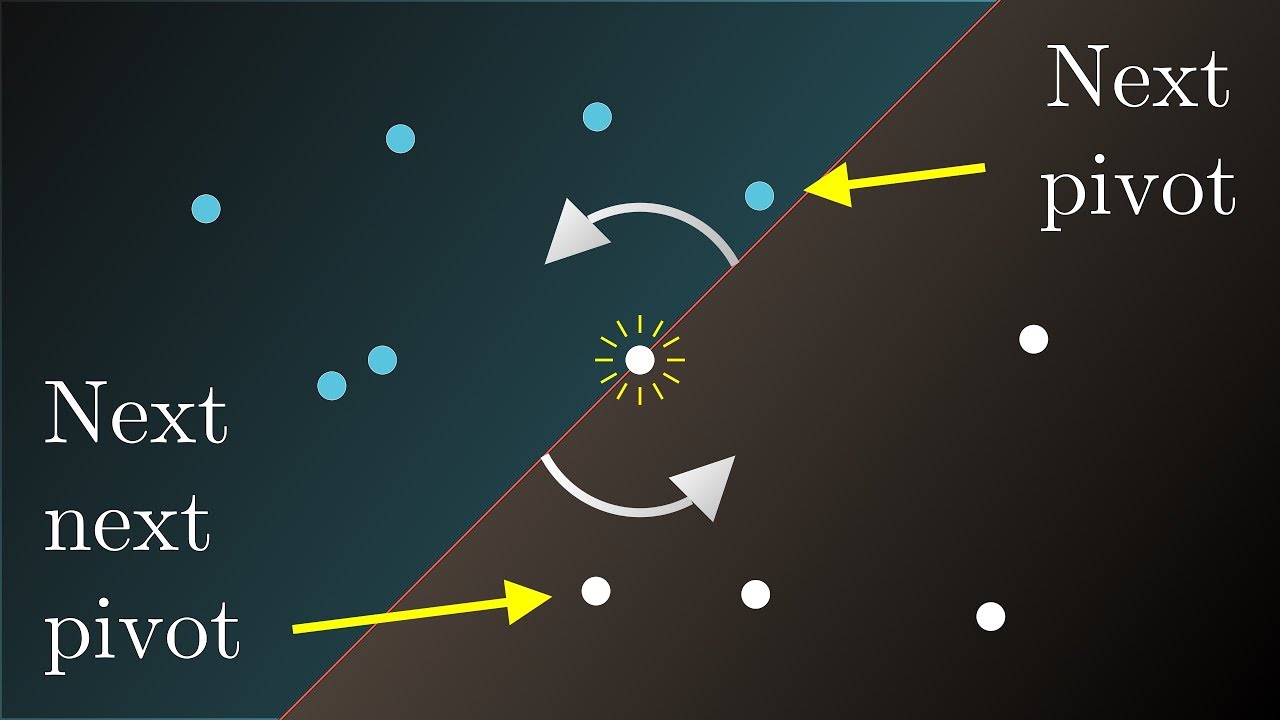
and it's always good to start simple and slowly get more complicated from there. The simplest case would be two points, where the line trades off between each point. That works well enough. Adding a third point, it's pretty clear that the line will just rotate around them. It might not be entirely clear how you would phrase this as a rigorous proof yet, but right now we're just getting a feel for things. The fourth point is where it gets interesting. In some places, your windmill will go around the four points just like it did with the triangle, but if we put it inside that triangle, it looks like our windmill never hits it. Looking back at the problem, it's asking you to show that for some starting position of the line, not any position, the process will hit all the points infinitely many times. So for an example like this, if you start with the line going through that troublesome middle point, what happens? And again, at this point we're just playing around, perhaps moving your pencil among dots that you've drawn on a piece of scratch paper. You want to believe a result before you try too hard to prove it. Here you'd see that your windmill does indeed bounce off of all the points as it goes through a cycle, and it ends up back where it started. The worry you might have is that in some large sets of points, where some are kind of inside the others, you might be able to start off on the inside, but maybe something about this windmill process takes the line to the outside, where as time goes on to infinity it'll be blocked off from those inner points. If you play around, and mind you it can take some time to draw out many examples and think this through, you would notice that when the line starts off passing through the middle of the points, it tends to stay there. It never seems to venture off to the outside. But can you guarantee that this will always happen? Or rather, can you first make this idea of starting in the middle a little more rigorous, and from there prove that all the points will be hit infinitely many times? As a general problem-solving tip, whenever you have a vague idea that feels productive, you should of course find a way to be more exact about what you're saying, but preferably put numbers to it, and then see if you can ask questions about those numbers. In our example, one way to formalize this idea of a middle is to count how many points are on either side of the line. If you give the line some orientation, you can reasonably talk about a left half, say coloring all the points on the left blue, and a right right brown. And what it means for a line to be in the middle is that there are as many blue points as there are brown points. For the moment, let's say that the total number of points is an odd number, and the point that the line passes through is colored white, sort of a neutral color. So for example, if there were 11 points, you would have 5 blue ones on the left, 5 brown ones on the right, and the single white point as the pivot. The case with an even number of points will be similar, just slightly less symmetric. What this gives us is a new question to ask. What happens to the number of blue points and brown points as the process plays out? In the example on screen now, you might notice it's always 5 and 5, never changing. Playing around with other examples, you would find that the same is true. Take a moment to pause right now, and see if you can think through why exactly that would happen. Why would these numbers not change? Well, the key is to think through what happens as the line changes its pivot. Having given the line an orientation, we can talk reasonably about which half is above the pivot, and which one is below. If the line hits a blue point on its left, it must happen below the pivot. So then when it changes the pivot and continues rotating clockwise a bit, that old pivot, now above the new one, ends up to the left, meaning it ends up in the blue region. And entirely symmetrically, when it hits a brown point, it happens above the pivot, meaning that the old pivot ends up in the brown region. So no matter what, the number of points on a given side of the line cannot change, except for the instances where the line is passing through two points at once. When you lose a blue point, you gain a new one. When you lose a brown And that is our key insight number one. So why would this imply that the line must hit every point infinitely many times, no matter what weird set of points you could dream up? The second key is to think about letting this process go until the line has turned 180 degrees around. What that means is that it's parallel to the starting position, and because it has to remain the case that half the points are on one side and the other, it must be passing through the same point it started on. I mean, think about it, if it ended up on some other point, it would change the number on a given side. Additionally, since the line has rotated halfway around, everything that was blue has become brown, and everything which was brown has become blue, and the only way to change the color is if you get hit by the line. So for our odd-numbered case, that means that after a half rotation, the line is back where it started, and it's hit all of the other points. So as time goes forward, it repeats this exact set of motions over and over, hitting all of those points infinitely many times. For the case with an even number of points, we need to alter the scheme slightly, but only slightly. To make it so that the number of blues can equal the number of browns, let's say that the pivot counts now as a brown point. So to define our initial condition, we still say for a given angle of the line, select an initial point so that half of the points are blue, all on the left, and half of them are brown, now either meaning they're on the right, or the pivot. The same argument from before implies that after a 180° turn, everything has swapped colors, but this time the line will be passing through a different point after that first half turn, specifically one that used to be blue, but after another 180° it has to be passing through the one that it started on. Again, the logic is that it's parallel to its starting position, and if it was passing through any other point, the number of points on a given side would have to be different. So once more, we have a cycle which hits all of the points, and which ends in the same position where it started. This time it takes 360°, but that doesn't matter, as the cycle continues it'll hit all the points infinitely many times.