e^(iπ) in 3.14 minutes, using dynamics | DE5
4:08

e^(iπ) in 3.14 minutes, using dynamics | DE5

3Blue1Brown 07.07.2019 3 300 705 просмотров 81 574 лайков

Machine-readable: Markdown · JSON API · Site index

Поделиться Telegram VK Бот
Транскрипт Скачать .md
Анализ с AI
Описание видео
Euler's formula about e to the i pi, explained with velocities to positions. Help fund future projects: https://www.patreon.com/3blue1brown An equally valuable form of support is to simply share some of the videos. Special thanks to these supporters: https://www.3blue1brown.com Not familiar with the calculus referenced in this video? Try taking a look at this one: https://youtu.be/m2MIpDrF7Es Another perspective on this formula, from Mathologer: https://youtu.be/-dhHrg-KbJ0 Another perspective from this channel: https://youtu.be/mvmuCPvRoWQ And yet another from the blog Better Explained: https://betterexplained.com/articles/intuitive-understanding-of-eulers-formula/ I'm not sure where the perspective shown in this video originates. I do know you can find it in Tristan Needham's excellent book "Visual Complex Analysis", but if anyone has a sense of the first occurrence of this intuition do feel free to share. It's simple and natural enough, though, that it's probably a view which has been independently thought up many times over. Thanks to these viewers for their contributions to translations Hebrew: Omer Tuchfeld Vietnamese: @ngvutuan2811 ------------------ These animations are largely made using manim, a scrappy open source python library: https://github.com/3b1b/manim If you want to check it out, I feel compelled to warn you that it's not the most well-documented tool, and it has many other quirks you might expect in a library someone wrote with only their own use in mind. Music by Vincent Rubinetti. Download the music on Bandcamp: https://vincerubinetti.bandcamp.com/album/the-music-of-3blue1brown Stream the music on Spotify: https://open.spotify.com/album/1dVyjwS8FBqXhRunaG5W5u If you want to contribute translated subtitles or to help review those that have already been made by others and need approval, you can click the gear icon in the video and go to subtitles/cc, then "add subtitles/cc". I really appreciate those who do this, as it helps make the lessons accessible to more people. ------------------ 3blue1brown is a channel about animating math, in all senses of the word animate. And you know the drill with YouTube, if you want to stay posted on new videos, subscribe: http://3b1b.co/subscribe Various social media stuffs: Website: https://www.3blue1brown.com Twitter: https://twitter.com/3blue1brown Reddit: https://www.reddit.com/r/3blue1brown Instagram: https://www.instagram.com/3blue1brown_animations/ Patreon: https://patreon.com/3blue1brown Facebook: https://www.facebook.com/3blue1brown
Оглавление (5 сегментов)

Properties

One way to think about the function e to the t is to ask what properties does it have? Probably the most important one, and from some points of view the defining property, is that it is its own derivative. Together with the added condition that inputting 0 returns 1, it's actually the only function with this property. And you can illustrate what this means with a physical model. If e to the t describes your position on a number line as a function of time, then you start at the number 1, and what this equation is saying is your velocity, the derivative of position, is always equal to that position. The farther away from 0 you are, the faster you move. So even before knowing how to compute e to the t exactly, going from a specific time to a specific position, this ability to associate each position with a velocity paints a very strong intuitive picture of how the function must grow. You know that you'll be accelerating, and at an accelerating rate, with an all-around feeling of things getting out of hand quickly.

Chain rule

And if you add a constant to that exponent, like e to the 2 times t, the chain rule tells us that the derivative is now 2 times itself. So at every point on the number line, rather than attaching a vector corresponding to the number itself, first double the magnitude of the position, then attach it. Moving so that your position is always e to the 2t is the same as moving in such a way that your velocity is always twice your position. The implication of that too is that our runaway growth feels all the more out of control.

Negative constant

If that constant was negative, say negative 0. 5, then your velocity vector is always negative 0. 5 times your position vector, meaning you flip it around 180 degrees and scale its length by a half. Moving in such a way that your velocity always matches this flipped and squished copy of your position vector, you go the other direction, slowing down in an exponential decay towards 0.

Vector field

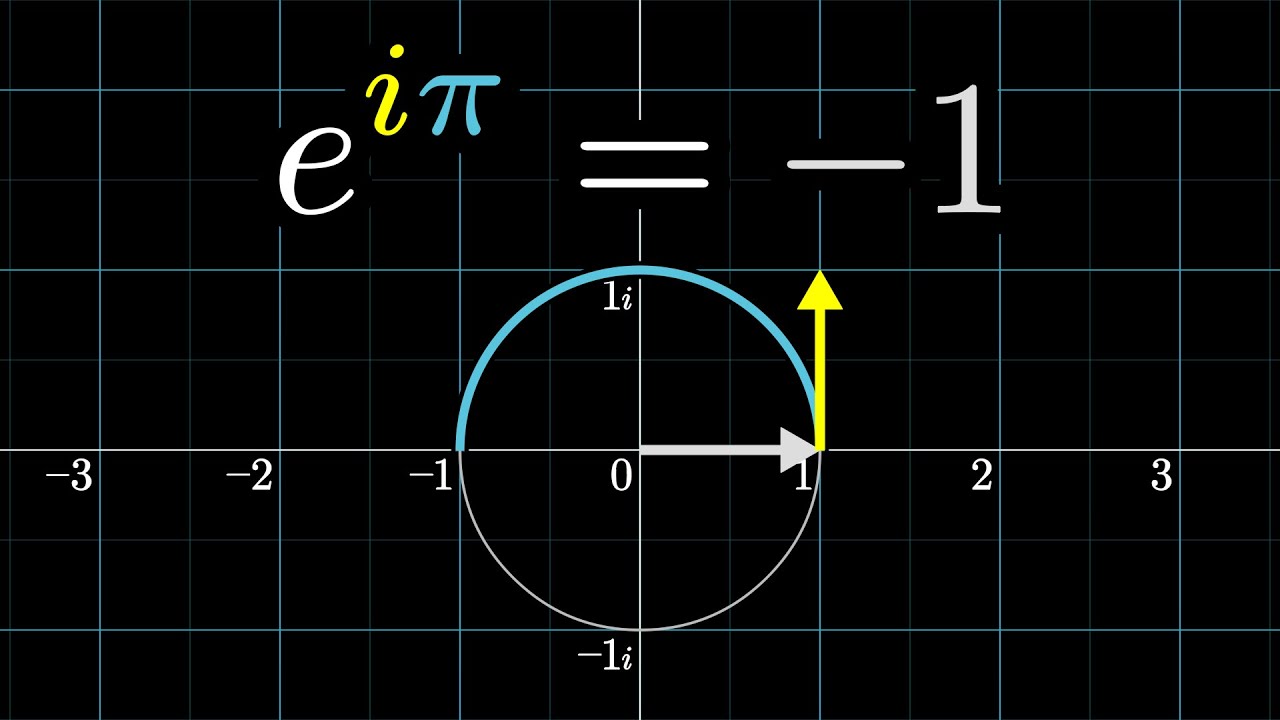
But what about if that constant was i, the square root of negative 1? If your position was always e to the i t, how would you move as the time t ticks forward? Well now the derivative of your position will always be i times itself, and multiplying by i has the effect of rotating numbers 90 degrees. So as you might expect, things only make sense here if we start thinking beyond the number line and in the complex plane. So even before you know how to compute e to the i times t, you know that for any position this might give for some value of time, the velocity at that time will be a 90 degree rotation of that position. Drawing this for all possible positions you might come across, you get a vector field, where as usual with vector fields you shrink things down to avoid clutter. At time t equals 0, e to the i t will be 1, that's our initial condition, and there's only one trajectory starting from that position where your velocity is always matching the vector that it's passing through, a 90 degree rotation of the position. It's when you go around a circle of radius 1 at a speed of 1 unit per second. So after pi seconds you've traced a distance of pi around, so e to the i times pi should be negative 1. After tau seconds you've gone full circle, e to the i times tau equals 1, and more generally e to the i times t equals a number that's t radians around this unit circle in the complex plane.

Outro

Nevertheless, something might still feel immoral about putting an imaginary number up in that exponent, and you would be right to question that. What we write as e to the t is a bit of notational disaster, giving the number e and the idea of repeated multiplication way more emphasis than they deserve. But my time is up, so I'll spare you the full rant until the next video.

Методичка по этому видео

Структурированный конспект

e^(iπ) за 3 минуты: Динамика экспоненты в комплексной плоскости

Изучаем функцию e^t через её производную. Как экспонента растёт в реальном и комплексном мире, и почему e^(iπ) = -1.

Другие видео автора — 3Blue1Brown

Ctrl+V

Экстракт Знаний в Telegram

Экстракты и дистилляты из лучших YouTube-каналов — сразу после публикации.

Подписаться

Дайджест Экстрактов

Лучшие методички за неделю — каждый понедельник