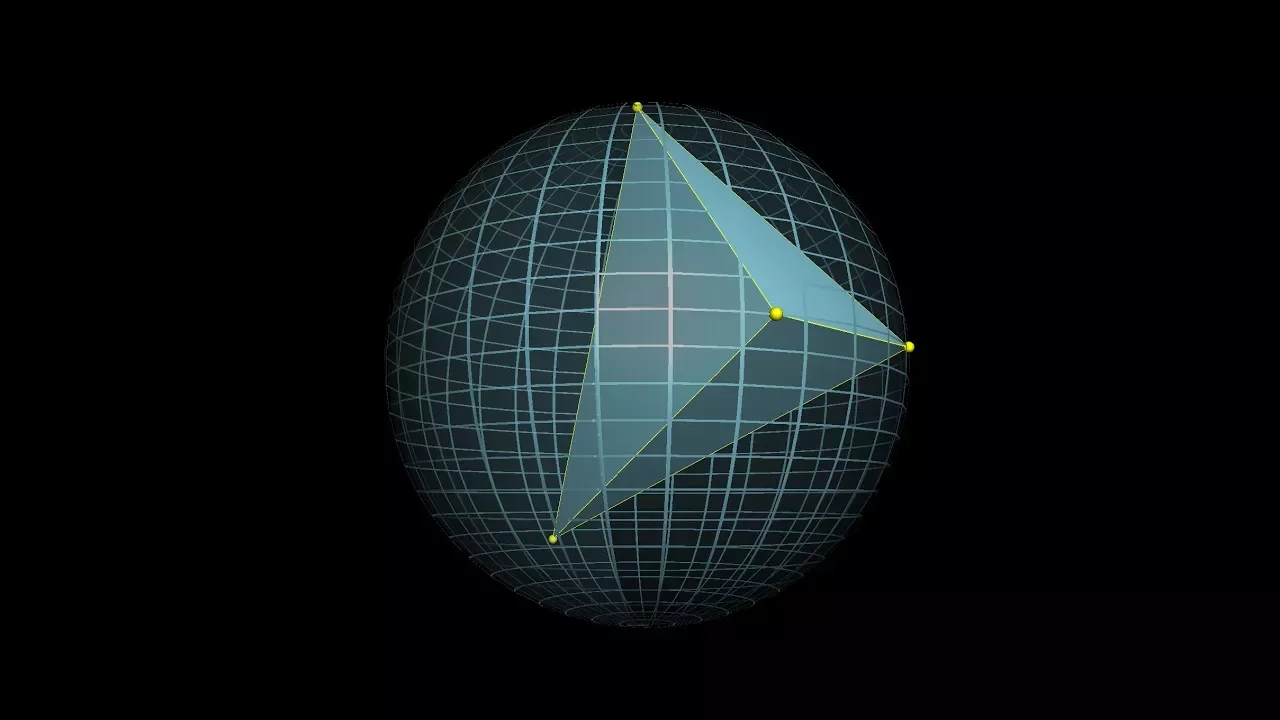
The more pressing question is, why on earth should the sphere be related to the cylinder in this way? The way I'm animating it is already suggestive of how this might work. The idea is to approximate the area of the sphere with many tiny rectangles covering it, and to show how if you project these rectangles directly outward, as if casting a shadow by little lights positioned on the z-axis, pointing parallel to the xy-plane, the projection of each rectangle onto the cylinder, surprisingly, ends up having the same area as the original rectangle. But why should that be? There are two competing effects at play here. For one of these rectangles, let's call the side along the latitude lines its width, and longitude lines its height. On the one hand, as the rectangle is projected outward, its width will get scaled up. For rectangles towards the poles, that length is scaled up quite a bit, since they're projected over a longer distance. But for those closer to the equator, the effect might be close to nothing. But on the other hand, because these rectangles are at a slant with respect to the z-direction, during this projection, the height of each rectangle will get scaled down. Think about holding some flat object and looking at its shadow. As you reorient that object, the shadow looks more or less squished for some angles. Take a look, those rectangles towards the poles are quite slanted this way, so their height will get squished down by a lot. For those closer to the equator, oriented somewhere closer to parallel to the z-axis, the effect is not as much. It will turn out that these two effects of stretching the width and squishing the height cancel each other out perfectly. Already, as a rough sketch, wouldn't you agree that this is a very pretty way of reasoning? Of course, the meat here comes from showing why these two competing effects cancel each other out, and in some ways the details fleshing this out are just as pretty as the zoomed out structure of the full argument. So let's dig in. Let me go ahead and cut away half of the sphere so that we can get a better look. For any mathematical problem solving, it never hurts to start by giving things names. So let's say that the radius of the sphere is r, and for one specific rectangle, let's call the distance between that rectangle and the z-axis d. You could rightfully complain that the distance d is a little ambiguous, depending on which point of that rectangle you're going from. But for tinier and tinier rectangles, that ambiguity will become negligible, and tinier is when this approximation with rectangles gets closer to the true surface area anyway. To choose an arbitrary standard, let's say that d is the distance from the bottom of the rectangle. To think about projecting this out to the cylinder, we'll picture two similar triangles. The first one shares its base with the base of the rectangle on the sphere, and has a tip at the same height but on the z-axis, a distance d away. The second triangle is a scaled-up version of this, scaled so that it just barely reaches the cylinder, meaning its long side now has a length R. So the ratio of their bases, which is how much our rectangle's width gets stretched out, is R divided by d. What about the height? How precisely does that get scaled down as we project? Again, let's slice a cross-section for a cleaner view. In fact, why don't we go ahead and completely focus our view to this two-dimensional cross-section. To think about the projection, let's make a little right triangle, like this, where what was the height of our spherical rectangle is the hypotenuse, and the projection is one of the legs. Pro tip, any time you're doing geometry with circles or spheres, keep in the forefront of your mind that anything tangent to the circle is perpendicular to the radius drawn to that point of tangency. It's crazy just how helpful that one little fact can be for making progress. In our case, once we draw that radial line, together with the distance d, we have another right triangle. And often in geometry, I like to imagine tweaking the parameters of a setup and imagining how the relevant shapes change. This helps to make guesses about what the relations might be. In this case, you might predict that the two triangles I've drawn are similar to each other, since their shapes seem to change in concert with each other. This is indeed true, but as always, don't take my word for it. See if you can justify this for yourself. Again, it never hurts to give more names to things. Maybe let's call this angle alpha, and this other one beta. Since this is a right triangle, we know that alpha plus beta plus 90 degrees must be 180 degrees. Now let's zoom in on our little triangle and see if we can figure out what its angles might be. Notice this 90 degree angle, which comes from the radius being perpendicular to the tangent, and how when it's combined with this beta here and some other little angle, it forms a straight line. So that other little angle must be alpha. This lets us fill out a few more values, which reveals that this little triangle also has angles alpha, beta, and 90 degrees, so it is indeed similar to the big one. Deep in the weeds like this, it's sometimes easy to forget why we're doing this. Remember, what we want to know is how much the height of the sphere rectangle gets squished down as we project it out, and that's the ratio of this little hypotenuse to the leg on the right side. By the similarity with the big triangle, the ratio of those two sides is again R divided by d. So indeed, as this rectangle gets projected outward, the effect of stretching out the width is perfectly cancelled out by how much that height is getting squished due to the slant. As a fun side note, you might notice that it looks like the projected rectangle is a 90 degree rotation of the original. This would not at all be true in general, but by a lovely coincidence, the way I'm parameterizing the sphere results in rectangles where the ratio of the width to the height starts out as d to r. So for this very specific case, rescaling the width by r over d, and rescaling the height by d over r, actually does have the effect of a 90 degree rotation. And this lends itself to a rather bizarre way to animate the relation, where instead of projecting each rectangular piece as if casting a shadow, you can rotate each one of them 90 degrees, and rearrange them all to make the cylinder.
The more pressing question is, why on earth should the sphere be related to the cylinder in this way? The way I'm animating it is already suggestive of how this might work. The idea is to approximate the area of the sphere with many tiny rectangles covering it, and to show how if you project these rectangles directly outward, as if casting a shadow by little lights positioned on the z-axis, pointing parallel to the xy-plane, the projection of each rectangle onto the cylinder, surprisingly, ends up having the same area as the original rectangle. But why should that be? There are two competing effects at play here. For one of these rectangles, let's call the side along the latitude lines its width, and longitude lines its height. On the one hand, as the rectangle is projected outward, its width will get scaled up. For rectangles towards the poles, that length is scaled up quite a bit, since they're projected over a longer distance. But for those closer to the equator, the effect might be close to nothing. But on the other hand, because these rectangles are at a slant with respect to the z-direction, during this projection, the height of each rectangle will get scaled down. Think about holding some flat object and looking at its shadow. As you reorient that object, the shadow looks more or less squished for some angles. Take a look, those rectangles towards the poles are quite slanted this way, so their height will get squished down by a lot. For those closer to the equator, oriented somewhere closer to parallel to the z-axis, the effect is not as much. It will turn out that these two effects of stretching the width and squishing the height cancel each other out perfectly. Already, as a rough sketch, wouldn't you agree that this is a very pretty way of reasoning? Of course, the meat here comes from showing why these two competing effects cancel each other out, and in some ways the details fleshing this out are just as pretty as the zoomed out structure of the full argument. So let's dig in. Let me go ahead and cut away half of the sphere so that we can get a better look. For any mathematical problem solving, it never hurts to start by giving things names. So let's say that the radius of the sphere is r, and for one specific rectangle, let's call the distance between that rectangle and the z-axis d. You could rightfully complain that the distance d is a little ambiguous, depending on which point of that rectangle you're going from. But for tinier and tinier rectangles, that ambiguity will become negligible, and tinier is when this approximation with rectangles gets closer to the true surface area anyway. To choose an arbitrary standard, let's say that d is the distance from the bottom of the rectangle. To think about projecting this out to the cylinder, we'll picture two similar triangles. The first one shares its base with the base of the rectangle on the sphere, and has a tip at the same height but on the z-axis, a distance d away. The second triangle is a scaled-up version of this, scaled so that it just barely reaches the cylinder, meaning its long side now has a length R. So the ratio of their bases, which is how much our rectangle's width gets stretched out, is R divided by d. What about the height? How precisely does that get scaled down as we project? Again, let's slice a cross-section for a cleaner view. In fact, why don't we go ahead and completely focus our view to this two-dimensional cross-section. To think about the projection, let's make a little right triangle, like this, where what was the height of our spherical rectangle is the hypotenuse, and the projection is one of the legs. Pro tip, any time you're doing geometry with circles or spheres, keep in the forefront of your mind that anything tangent to the circle is perpendicular to the radius drawn to that point of tangency. It's crazy just how helpful that one little fact can be for making progress. In our case, once we draw that radial line, together with the distance d, we have another right triangle. And often in geometry, I like to imagine tweaking the parameters of a setup and imagining how the relevant shapes change. This helps to make guesses about what the relations might be. In this case, you might predict that the two triangles I've drawn are similar to each other, since their shapes seem to change in concert with each other. This is indeed true, but as always, don't take my word for it. See if you can justify this for yourself. Again, it never hurts to give more names to things. Maybe let's call this angle alpha, and this other one beta. Since this is a right triangle, we know that alpha plus beta plus 90 degrees must be 180 degrees. Now let's zoom in on our little triangle and see if we can figure out what its angles might be. Notice this 90 degree angle, which comes from the radius being perpendicular to the tangent, and how when it's combined with this beta here and some other little angle, it forms a straight line. So that other little angle must be alpha. This lets us fill out a few more values, which reveals that this little triangle also has angles alpha, beta, and 90 degrees, so it is indeed similar to the big one. Deep in the weeds like this, it's sometimes easy to forget why we're doing this. Remember, what we want to know is how much the height of the sphere rectangle gets squished down as we project it out, and that's the ratio of this little hypotenuse to the leg on the right side. By the similarity with the big triangle, the ratio of those two sides is again R divided by d. So indeed, as this rectangle gets projected outward, the effect of stretching out the width is perfectly cancelled out by how much that height is getting squished due to the slant. As a fun side note, you might notice that it looks like the projected rectangle is a 90 degree rotation of the original. This would not at all be true in general, but by a lovely coincidence, the way I'm parameterizing the sphere results in rectangles where the ratio of the width to the height starts out as d to r. So for this very specific case, rescaling the width by r over d, and rescaling the height by d over r, actually does have the effect of a 90 degree rotation. And this lends itself to a rather bizarre way to animate the relation, where instead of projecting each rectangular piece as if casting a shadow, you can rotate each one of them 90 degrees, and rearrange them all to make the cylinder.
The more pressing question is, why on earth should the sphere be related to the cylinder in this way? The way I'm animating it is already suggestive of how this might work. The idea is to approximate the area of the sphere with many tiny rectangles covering it, and to show how if you project these rectangles directly outward, as if casting a shadow by little lights positioned on the z-axis, pointing parallel to the xy-plane, the projection of each rectangle onto the cylinder, surprisingly, ends up having the same area as the original rectangle. But why should that be? There are two competing effects at play here. For one of these rectangles, let's call the side along the latitude lines its width, and longitude lines its height. On the one hand, as the rectangle is projected outward, its width will get scaled up. For rectangles towards the poles, that length is scaled up quite a bit, since they're projected over a longer distance. But for those closer to the equator, the effect might be close to nothing. But on the other hand, because these rectangles are at a slant with respect to the z-direction, during this projection, the height of each rectangle will get scaled down. Think about holding some flat object and looking at its shadow. As you reorient that object, the shadow looks more or less squished for some angles. Take a look, those rectangles towards the poles are quite slanted this way, so their height will get squished down by a lot. For those closer to the equator, oriented somewhere closer to parallel to the z-axis, the effect is not as much. It will turn out that these two effects of stretching the width and squishing the height cancel each other out perfectly. Already, as a rough sketch, wouldn't you agree that this is a very pretty way of reasoning? Of course, the meat here comes from showing why these two competing effects cancel each other out, and in some ways the details fleshing this out are just as pretty as the zoomed out structure of the full argument. So let's dig in. Let me go ahead and cut away half of the sphere so that we can get a better look. For any mathematical problem solving, it never hurts to start by giving things names. So let's say that the radius of the sphere is r, and for one specific rectangle, let's call the distance between that rectangle and the z-axis d. You could rightfully complain that the distance d is a little ambiguous, depending on which point of that rectangle you're going from. But for tinier and tinier rectangles, that ambiguity will become negligible, and tinier is when this approximation with rectangles gets closer to the true surface area anyway. To choose an arbitrary standard, let's say that d is the distance from the bottom of the rectangle. To think about projecting this out to the cylinder, we'll picture two similar triangles. The first one shares its base with the base of the rectangle on the sphere, and has a tip at the same height but on the z-axis, a distance d away. The second triangle is a scaled-up version of this, scaled so that it just barely reaches the cylinder, meaning its long side now has a length R. So the ratio of their bases, which is how much our rectangle's width gets stretched out, is R divided by d. What about the height? How precisely does that get scaled down as we project? Again, let's slice a cross-section for a cleaner view. In fact, why don't we go ahead and completely focus our view to this two-dimensional cross-section. To think about the projection, let's make a little right triangle, like this, where what was the height of our spherical rectangle is the hypotenuse, and the projection is one of the legs. Pro tip, any time you're doing geometry with circles or spheres, keep in the forefront of your mind that anything tangent to the circle is perpendicular to the radius drawn to that point of tangency. It's crazy just how helpful that one little fact can be for making progress. In our case, once we draw that radial line, together with the distance d, we have another right triangle. And often in geometry, I like to imagine tweaking the parameters of a setup and imagining how the relevant shapes change. This helps to make guesses about what the relations might be. In this case, you might predict that the two triangles I've drawn are similar to each other, since their shapes seem to change in concert with each other. This is indeed true, but as always, don't take my word for it. See if you can justify this for yourself. Again, it never hurts to give more names to things. Maybe let's call this angle alpha, and this other one beta. Since this is a right triangle, we know that alpha plus beta plus 90 degrees must be 180 degrees. Now let's zoom in on our little triangle and see if we can figure out what its angles might be. Notice this 90 degree angle, which comes from the radius being perpendicular to the tangent, and how when it's combined with this beta here and some other little angle, it forms a straight line. So that other little angle must be alpha. This lets us fill out a few more values, which reveals that this little triangle also has angles alpha, beta, and 90 degrees, so it is indeed similar to the big one. Deep in the weeds like this, it's sometimes easy to forget why we're doing this. Remember, what we want to know is how much the height of the sphere rectangle gets squished down as we project it out, and that's the ratio of this little hypotenuse to the leg on the right side. By the similarity with the big triangle, the ratio of those two sides is again R divided by d. So indeed, as this rectangle gets projected outward, the effect of stretching out the width is perfectly cancelled out by how much that height is getting squished due to the slant. As a fun side note, you might notice that it looks like the projected rectangle is a 90 degree rotation of the original. This would not at all be true in general, but by a lovely coincidence, the way I'm parameterizing the sphere results in rectangles where the ratio of the width to the height starts out as d to r. So for this very specific case, rescaling the width by r over d, and rescaling the height by d over r, actually does have the effect of a 90 degree rotation. And this lends itself to a rather bizarre way to animate the relation, where instead of projecting each rectangular piece as if casting a shadow, you can rotate each one of them 90 degrees, and rearrange them all to make the cylinder.
The more pressing question is, why on earth should the sphere be related to the cylinder in this way? The way I'm animating it is already suggestive of how this might work. The idea is to approximate the area of the sphere with many tiny rectangles covering it, and to show how if you project these rectangles directly outward, as if casting a shadow by little lights positioned on the z-axis, pointing parallel to the xy-plane, the projection of each rectangle onto the cylinder, surprisingly, ends up having the same area as the original rectangle. But why should that be? There are two competing effects at play here. For one of these rectangles, let's call the side along the latitude lines its width, and longitude lines its height. On the one hand, as the rectangle is projected outward, its width will get scaled up. For rectangles towards the poles, that length is scaled up quite a bit, since they're projected over a longer distance. But for those closer to the equator, the effect might be close to nothing. But on the other hand, because these rectangles are at a slant with respect to the z-direction, during this projection, the height of each rectangle will get scaled down. Think about holding some flat object and looking at its shadow. As you reorient that object, the shadow looks more or less squished for some angles. Take a look, those rectangles towards the poles are quite slanted this way, so their height will get squished down by a lot. For those closer to the equator, oriented somewhere closer to parallel to the z-axis, the effect is not as much. It will turn out that these two effects of stretching the width and squishing the height cancel each other out perfectly. Already, as a rough sketch, wouldn't you agree that this is a very pretty way of reasoning? Of course, the meat here comes from showing why these two competing effects cancel each other out, and in some ways the details fleshing this out are just as pretty as the zoomed out structure of the full argument. So let's dig in. Let me go ahead and cut away half of the sphere so that we can get a better look. For any mathematical problem solving, it never hurts to start by giving things names. So let's say that the radius of the sphere is r, and for one specific rectangle, let's call the distance between that rectangle and the z-axis d. You could rightfully complain that the distance d is a little ambiguous, depending on which point of that rectangle you're going from. But for tinier and tinier rectangles, that ambiguity will become negligible, and tinier is when this approximation with rectangles gets closer to the true surface area anyway. To choose an arbitrary standard, let's say that d is the distance from the bottom of the rectangle. To think about projecting this out to the cylinder, we'll picture two similar triangles. The first one shares its base with the base of the rectangle on the sphere, and has a tip at the same height but on the z-axis, a distance d away. The second triangle is a scaled-up version of this, scaled so that it just barely reaches the cylinder, meaning its long side now has a length R. So the ratio of their bases, which is how much our rectangle's width gets stretched out, is R divided by d. What about the height? How precisely does that get scaled down as we project? Again, let's slice a cross-section for a cleaner view. In fact, why don't we go ahead and completely focus our view to this two-dimensional cross-section. To think about the projection, let's make a little right triangle, like this, where what was the height of our spherical rectangle is the hypotenuse, and the projection is one of the legs. Pro tip, any time you're doing geometry with circles or spheres, keep in the forefront of your mind that anything tangent to the circle is perpendicular to the radius drawn to that point of tangency. It's crazy just how helpful that one little fact can be for making progress. In our case, once we draw that radial line, together with the distance d, we have another right triangle. And often in geometry, I like to imagine tweaking the parameters of a setup and imagining how the relevant shapes change. This helps to make guesses about what the relations might be. In this case, you might predict that the two triangles I've drawn are similar to each other, since their shapes seem to change in concert with each other. This is indeed true, but as always, don't take my word for it. See if you can justify this for yourself. Again, it never hurts to give more names to things. Maybe let's call this angle alpha, and this other one beta. Since this is a right triangle, we know that alpha plus beta plus 90 degrees must be 180 degrees. Now let's zoom in on our little triangle and see if we can figure out what its angles might be. Notice this 90 degree angle, which comes from the radius being perpendicular to the tangent, and how when it's combined with this beta here and some other little angle, it forms a straight line. So that other little angle must be alpha. This lets us fill out a few more values, which reveals that this little triangle also has angles alpha, beta, and 90 degrees, so it is indeed similar to the big one. Deep in the weeds like this, it's sometimes easy to forget why we're doing this. Remember, what we want to know is how much the height of the sphere rectangle gets squished down as we project it out, and that's the ratio of this little hypotenuse to the leg on the right side. By the similarity with the big triangle, the ratio of those two sides is again R divided by d. So indeed, as this rectangle gets projected outward, the effect of stretching out the width is perfectly cancelled out by how much that height is getting squished due to the slant. As a fun side note, you might notice that it looks like the projected rectangle is a 90 degree rotation of the original. This would not at all be true in general, but by a lovely coincidence, the way I'm parameterizing the sphere results in rectangles where the ratio of the width to the height starts out as d to r. So for this very specific case, rescaling the width by r over d, and rescaling the height by d over r, actually does have the effect of a 90 degree rotation. And this lends itself to a rather bizarre way to animate the relation, where instead of projecting each rectangular piece as if casting a shadow, you can rotate each one of them 90 degrees, and rearrange them all to make the cylinder.
Now that's pretty satisfying, but you might nevertheless be wondering if there's some way to relate this sphere directly to a circle with the same radius, rather than going through this intermediary of a cylinder. I do have proof for you to this effect, leveraging a little trigonometry, though I have to admit I still think the comparison to the cylinder wins out on raw elegance. Now I'm a big believer that the best way to really learn math is to do problems for yourself, which is a bit hypocritical coming from a channel essentially consisting of lectures, so I'm going to try something a little different here, and present the proof as a heavily-guided sequence of exercises. Yes, I know that's less fun, and it means you have to pull out some paper to do a little work, but I guarantee you will get more out of it this way. At a high level, the approach will be to cut the sphere into many thin rings parallel to the xy-plane, and compare the area of these rings to the area of their shadows on the xy-plane. All of the shadows of the rings from, say, the northern hemisphere, make up a circle with the same radius as the sphere, right? The main idea will be to show a correspondence between these ring shadows and every second ring on the sphere. Challenge mode here is to pause now and see if you can predict how that comparison might go. Let's label each one of these rings based on the angle theta between a line from the sphere's center to that ring, and the z-axis. So theta ranges from 0 at the north pole all the way up to 180 degrees at the south pole, which is to say from 0 to pi radians. And let's call the change in the angle from one ring to the next d-theta, which means the thickness of those rings will be the radius R times d-theta. All right, structured exercise time. We'll ease in with a warm-up. Question number one, what is the circumference of this ring, say, at the inner edge, in terms of R and theta? Once you have that, go ahead and multiply the answer by the thickness, R times d-theta, to get an approximation for the ring's area, an approximation that will get better and better as you chop up the sphere more and more finely. At this point, if you know your calculus, you could integrate, but our goal is not just to find the answer, it's to feel the connection between the sphere and its shadow. So question number two, what is the area of the shadow of one of these rings on the x-y plane, again expressed in terms of R, theta, and d-theta? For this one, it might be helpful to think back to that tiny little right triangle we were talking about earlier. Question number three, and this is really the heart of it, each one of these rings' shadows has precisely half the area of one of the rings on the sphere. It's not the one that's an angle theta straight above it, but another one. The question is, which one? As a hint, you might want to reference some trig identities for this one. Question number four, I said at the outset that there's a correspondence between all of the shadows from the northern hemisphere, which make up a circle with radius R, and every second ring on the sphere. Use your answer to the last question to spell out what exactly that correspondence is. And for question five, bring it on home. Why does this imply that the area of the circle is exactly one-fourth the surface area of the sphere, particularly as we consider thinner and thinner rings? If you want answers or hints, I'm quite sure that people in comments and on Reddit will have them waiting for you.
Now that's pretty satisfying, but you might nevertheless be wondering if there's some way to relate this sphere directly to a circle with the same radius, rather than going through this intermediary of a cylinder. I do have proof for you to this effect, leveraging a little trigonometry, though I have to admit I still think the comparison to the cylinder wins out on raw elegance. Now I'm a big believer that the best way to really learn math is to do problems for yourself, which is a bit hypocritical coming from a channel essentially consisting of lectures, so I'm going to try something a little different here, and present the proof as a heavily-guided sequence of exercises. Yes, I know that's less fun, and it means you have to pull out some paper to do a little work, but I guarantee you will get more out of it this way. At a high level, the approach will be to cut the sphere into many thin rings parallel to the xy-plane, and compare the area of these rings to the area of their shadows on the xy-plane. All of the shadows of the rings from, say, the northern hemisphere, make up a circle with the same radius as the sphere, right? The main idea will be to show a correspondence between these ring shadows and every second ring on the sphere. Challenge mode here is to pause now and see if you can predict how that comparison might go. Let's label each one of these rings based on the angle theta between a line from the sphere's center to that ring, and the z-axis. So theta ranges from 0 at the north pole all the way up to 180 degrees at the south pole, which is to say from 0 to pi radians. And let's call the change in the angle from one ring to the next d-theta, which means the thickness of those rings will be the radius R times d-theta. All right, structured exercise time. We'll ease in with a warm-up. Question number one, what is the circumference of this ring, say, at the inner edge, in terms of R and theta? Once you have that, go ahead and multiply the answer by the thickness, R times d-theta, to get an approximation for the ring's area, an approximation that will get better and better as you chop up the sphere more and more finely. At this point, if you know your calculus, you could integrate, but our goal is not just to find the answer, it's to feel the connection between the sphere and its shadow. So question number two, what is the area of the shadow of one of these rings on the x-y plane, again expressed in terms of R, theta, and d-theta? For this one, it might be helpful to think back to that tiny little right triangle we were talking about earlier. Question number three, and this is really the heart of it, each one of these rings' shadows has precisely half the area of one of the rings on the sphere. It's not the one that's an angle theta straight above it, but another one. The question is, which one? As a hint, you might want to reference some trig identities for this one. Question number four, I said at the outset that there's a correspondence between all of the shadows from the northern hemisphere, which make up a circle with radius R, and every second ring on the sphere. Use your answer to the last question to spell out what exactly that correspondence is. And for question five, bring it on home. Why does this imply that the area of the circle is exactly one-fourth the surface area of the sphere, particularly as we consider thinner and thinner rings? If you want answers or hints, I'm quite sure that people in comments and on Reddit will have them waiting for you.
Now that's pretty satisfying, but you might nevertheless be wondering if there's some way to relate this sphere directly to a circle with the same radius, rather than going through this intermediary of a cylinder. I do have proof for you to this effect, leveraging a little trigonometry, though I have to admit I still think the comparison to the cylinder wins out on raw elegance. Now I'm a big believer that the best way to really learn math is to do problems for yourself, which is a bit hypocritical coming from a channel essentially consisting of lectures, so I'm going to try something a little different here, and present the proof as a heavily-guided sequence of exercises. Yes, I know that's less fun, and it means you have to pull out some paper to do a little work, but I guarantee you will get more out of it this way. At a high level, the approach will be to cut the sphere into many thin rings parallel to the xy-plane, and compare the area of these rings to the area of their shadows on the xy-plane. All of the shadows of the rings from, say, the northern hemisphere, make up a circle with the same radius as the sphere, right? The main idea will be to show a correspondence between these ring shadows and every second ring on the sphere. Challenge mode here is to pause now and see if you can predict how that comparison might go. Let's label each one of these rings based on the angle theta between a line from the sphere's center to that ring, and the z-axis. So theta ranges from 0 at the north pole all the way up to 180 degrees at the south pole, which is to say from 0 to pi radians. And let's call the change in the angle from one ring to the next d-theta, which means the thickness of those rings will be the radius R times d-theta. All right, structured exercise time. We'll ease in with a warm-up. Question number one, what is the circumference of this ring, say, at the inner edge, in terms of R and theta? Once you have that, go ahead and multiply the answer by the thickness, R times d-theta, to get an approximation for the ring's area, an approximation that will get better and better as you chop up the sphere more and more finely. At this point, if you know your calculus, you could integrate, but our goal is not just to find the answer, it's to feel the connection between the sphere and its shadow. So question number two, what is the area of the shadow of one of these rings on the x-y plane, again expressed in terms of R, theta, and d-theta? For this one, it might be helpful to think back to that tiny little right triangle we were talking about earlier. Question number three, and this is really the heart of it, each one of these rings' shadows has precisely half the area of one of the rings on the sphere. It's not the one that's an angle theta straight above it, but another one. The question is, which one? As a hint, you might want to reference some trig identities for this one. Question number four, I said at the outset that there's a correspondence between all of the shadows from the northern hemisphere, which make up a circle with radius R, and every second ring on the sphere. Use your answer to the last question to spell out what exactly that correspondence is. And for question five, bring it on home. Why does this imply that the area of the circle is exactly one-fourth the surface area of the sphere, particularly as we consider thinner and thinner rings? If you want answers or hints, I'm quite sure that people in comments and on Reddit will have them waiting for you.
Now that's pretty satisfying, but you might nevertheless be wondering if there's some way to relate this sphere directly to a circle with the same radius, rather than going through this intermediary of a cylinder. I do have proof for you to this effect, leveraging a little trigonometry, though I have to admit I still think the comparison to the cylinder wins out on raw elegance. Now I'm a big believer that the best way to really learn math is to do problems for yourself, which is a bit hypocritical coming from a channel essentially consisting of lectures, so I'm going to try something a little different here, and present the proof as a heavily-guided sequence of exercises. Yes, I know that's less fun, and it means you have to pull out some paper to do a little work, but I guarantee you will get more out of it this way. At a high level, the approach will be to cut the sphere into many thin rings parallel to the xy-plane, and compare the area of these rings to the area of their shadows on the xy-plane. All of the shadows of the rings from, say, the northern hemisphere, make up a circle with the same radius as the sphere, right? The main idea will be to show a correspondence between these ring shadows and every second ring on the sphere. Challenge mode here is to pause now and see if you can predict how that comparison might go. Let's label each one of these rings based on the angle theta between a line from the sphere's center to that ring, and the z-axis. So theta ranges from 0 at the north pole all the way up to 180 degrees at the south pole, which is to say from 0 to pi radians. And let's call the change in the angle from one ring to the next d-theta, which means the thickness of those rings will be the radius R times d-theta. All right, structured exercise time. We'll ease in with a warm-up. Question number one, what is the circumference of this ring, say, at the inner edge, in terms of R and theta? Once you have that, go ahead and multiply the answer by the thickness, R times d-theta, to get an approximation for the ring's area, an approximation that will get better and better as you chop up the sphere more and more finely. At this point, if you know your calculus, you could integrate, but our goal is not just to find the answer, it's to feel the connection between the sphere and its shadow. So question number two, what is the area of the shadow of one of these rings on the x-y plane, again expressed in terms of R, theta, and d-theta? For this one, it might be helpful to think back to that tiny little right triangle we were talking about earlier. Question number three, and this is really the heart of it, each one of these rings' shadows has precisely half the area of one of the rings on the sphere. It's not the one that's an angle theta straight above it, but another one. The question is, which one? As a hint, you might want to reference some trig identities for this one. Question number four, I said at the outset that there's a correspondence between all of the shadows from the northern hemisphere, which make up a circle with radius R, and every second ring on the sphere. Use your answer to the last question to spell out what exactly that correspondence is. And for question five, bring it on home. Why does this imply that the area of the circle is exactly one-fourth the surface area of the sphere, particularly as we consider thinner and thinner rings? If you want answers or hints, I'm quite sure that people in comments and on Reddit will have them waiting for you.