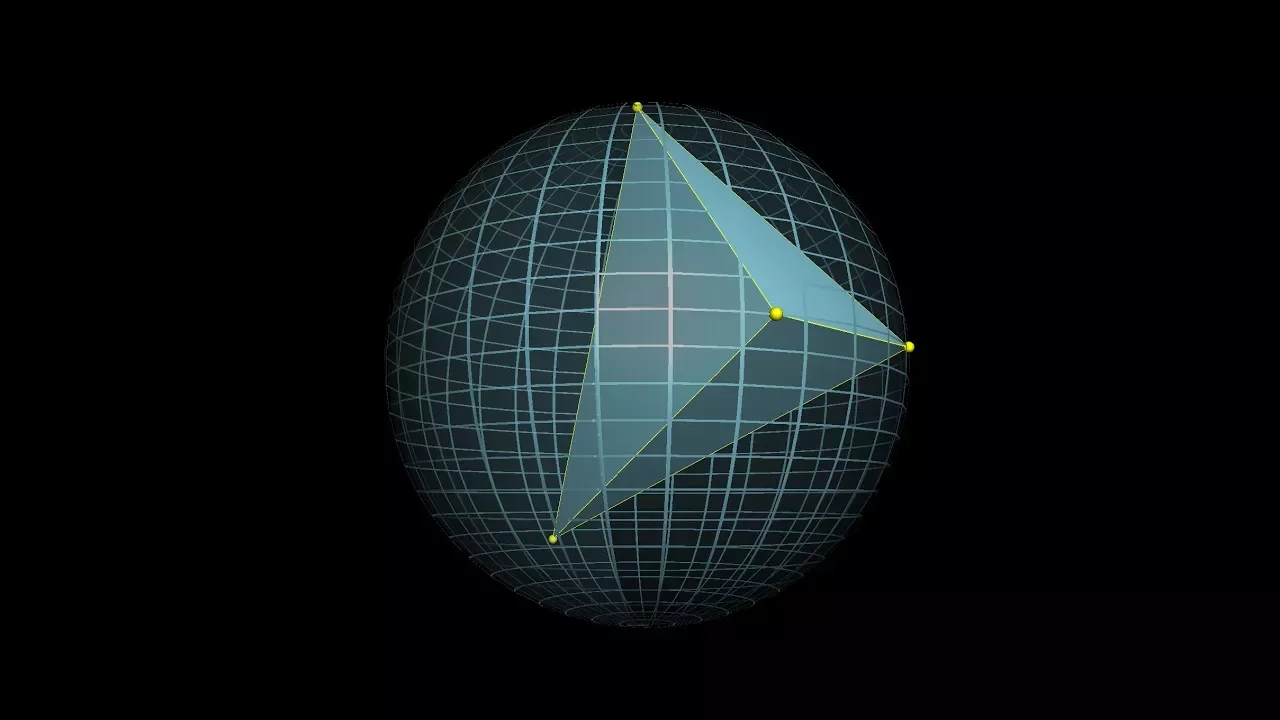
Why you would think to do this, of all things, is a tricky question to answer, and one that we'll turn back to. For right now, let's just say that you have a particularly playful mind that loves engaging with how different geometric objects all fit together. But once these spheres are sitting here, I actually bet that you could prove the target result yourself. Here, I'll help you step through it, but at any point if you feel inspired, please do pause and try to carry on without me. First off, these spheres have introduced two special points inside the curve, the points where they're tangent to the plane. So a reasonable guess might be that these two tangency points are the focus points. That means that you're going to want to draw lines from these foci to some point along the ellipse, and ultimately the goal is to understand what the sum of the distances of those two lines is, or at the very least to understand why that sum doesn't depend on where you are along the ellipse. Keep in mind, what makes these lines special is that each one does not simply touch one of the spheres, it's actually tangent to that sphere at the point where it touches. And in general, for any math problem, you want to use the defining features of all the objects involved. Another example here is what even defines the spheres. It's not just the fact that they're tangent to the plane, but that they're also tangent to the cone, each one at some circle of tangency points. So you're going to need to use those two circles of tangency points in some way. But how exactly? One thing you might do is just draw a line straight from the top circle down to the bottom one along the cone. And there's something about doing this that feels vaguely reminiscent of the constant sum thumbtack property, and hence promising. You see, it passes through the ellipse, and so by snipping that line at the point where it crosses the ellipse, you can think of it as the sum of two line segments, each one hitting the same point on the ellipse. And you can do this through various different points of the ellipse, depending on where you are around the cone, always getting two line segments with a constant sum, namely whatever the straight line distance from the top circle to the bottom circle is. So you see what I mean about it being vaguely analogous to the thumbtack property, in that every point of the ellipse gives us two distances whose sum is a constant. Granted, these lengths are not to the focal points, they're to the big and the little circle, but maybe that leads you to making the following conjecture. The distance from a given point on this ellipse, this intersection curve, straight down to the big circle is, you conjecture, equal to the distance to the point where that big sphere is tangent to the plane, our first proposed focus point. Likewise, perhaps the distance from that point on the ellipse to the small circle is equal to the distance from that point to the second proposed focus point, where the small sphere touches the plane. So is that true? Well, yes! Here, let's give a name to that point we have on the ellipse, q. The key is that the line from q to the first proposed focus is tangent to the big sphere, and the line from q straight down along the cone is also tangent to the big sphere. Here, let's look at a different picture for some clarity. If you have multiple lines drawn from a common point to a sphere, all of which are tangent to that sphere, you can probably see, just from the symmetry of the setup, that all of these lines have to have the same length. In fact, I encourage you to try proving this yourself, or to otherwise pause and ponder on the proof I've left on the screen. But, looking back at our cone slicing setup, your conjecture would be correct. The two lines extending from the point q on the ellipse tangent to the big sphere have the same length. Similarly, the line from q to the second proposed focus point is tangent to the little sphere, as is the line from q straight up along the cone, so those two also have the same length. And so, the sum of the distances from q to the two proposed focus points is the same as the straight line distance from the little circle down to the big circle along the cone, passing through q. And clearly, that does not depend on which point of the ellipse you chose for q. Bada-boom-bada-bang, slicing the cone is the same as the thumbtack construction, since the resulting curve has the constant focal sum property. Now this proof was first found by Germenal, Germenal, who cares, Dandelin, a guy named Dandelin in 1822, so these two spheres are sometimes called Dandelin spheres. You can also use the same trick to show why slicing a cylinder at an angle will give you an ellipse, and if you're comfortable with the claim that projecting a shape from one plane onto another tilted plane has the effect of simply stretching out that shape, this also shows why the definition of an ellipse as a stretched circle is the same as the other two. More homework. So why do I think this proof is such a good representative for math itself? That if you had to show just one thing to explain to a non-math enthusiast why you love the subject, why this would be a good candidate. The obvious reason is that it's substantive and beautiful without requiring too much background, but more than that, it reflects a common feature of math that sometimes there is no single most fundamental way of defining something, that what matters more is showing equivalences. And even more than that, the proof itself involves one key moment of creative construction, adding the two spheres, while most of it leaves room for a nice systematic and principled approach. And this kind of creative construction is, I think, one of the most thought-provoking aspects of mathematical discovery, and you might understandably ask where such an idea comes from. In fact, talking about this particular proof, here's what Paul Lockhart says in Measurement. I agree, but I think we can say at least a little something more about this. While it is ingenious, we can perhaps decompose how someone who has immersed themselves in a number of other geometry problems might be particularly primed to think of adding these specific spheres. First, a common tactic in geometry is to relate one length to another, and in this problem, you know from the outset that being able to relate these two lengths to the foci to some other two lengths, especially ones that line up, would be a useful thing, even though at the start you don't even know where the focus points are. And even if it's not clear exactly how you'd do that, throwing spheres into the picture isn't all that crazy. Again, if you've built up a relationship with geometry through practice, you would be well acquainted with how relating one length to another happens all the time when the circles and spheres are in the picture, because it cuts straight to the defining feature of what it even means to be a circle or a sphere. This is obviously a specific example, but the point I want to make is that you can often view glimpses of ingeniousness not as inexplicable miracles, but as the residue of experience. And when you do, the idea of genius goes from being mesmerizing to instead being actively inspirational.