How pi was almost 6.283185...
5:53

How pi was almost 6.283185...

3Blue1Brown 14.03.2018 1 762 689 просмотров 45 085 лайков

Machine-readable: Markdown · JSON API · Site index

Поделиться Telegram VK Бот
Транскрипт Скачать .md
Анализ с AI
Описание видео
In some of his notes, Euler used π to represent 6.28... So why did we adopt 3.14...? Help fund future projects: https://www.patreon.com/3blue1brown An equally valuable form of support is to simply share some of the videos. Home page: https://www.3blue1brown.com The idea for this video, as well as the live shots, came from Ben Hambrecht, with the writing and animating done by Grant Sanderson. Special thanks to: - University Library Basel, for letting us rummage through their historical collection - Martin Mattmüller from the Bernoulli-Euler center for helpful discussion - Michael Hartl, author of the Tau Manifesto, for pointing us to obscure references - Library of the Institut de France Cinematographer: Eugen Heller Music by Vincent Rubinetti: https://vincerubinetti.bandcamp.com/album/the-music-of-3blue1brown Thanks to these viewers for their contributions to translations Hebrew: Omer Tuchfeld Korean: tebaioioo ------------------ 3blue1brown is a channel about animating math, in all senses of the word animate. And you know the drill with YouTube, if you want to stay posted on new videos, subscribe, and click the bell to receive notifications (if you're into that). If you are new to this channel and want to see more, a good place to start is this playlist: http://3b1b.co/recommended Various social media stuffs: Website: https://www.3blue1brown.com Twitter: https://twitter.com/3Blue1Brown Patreon: https://patreon.com/3blue1brown Facebook: https://www.facebook.com/3blue1brown Reddit: https://www.reddit.com/r/3Blue1Brown
Оглавление (10 сегментов)

Intro

I'm sure you're already familiar with the whole pi vs. tau debate. A lot of people say that the fundamental circle constant we hold up should be the ratio of a circle's circumference to its radius, which is around 6. 28, not the ratio to its diameter, the more familiar 3. 14. These days we often call that larger constant tau, popularized by Michael Hartle's tau manifesto, although personally I'm quite partial to Robert Palace's proposed notation of a pi with three legs. In either of these manifestos, and on many other places of the internet, you can read to no end about how many formulas look a lot cleaner using tau, largely because the number of radians describing a given fraction of a circle is actually that fraction of tau. That dead horse is beat, I'm not here to make that case further. Instead, I'd like to talk about the seminal moment in history when pi as we know it became the standard. For this, one fruitful place to look is at the old notes and letters

Intro

I'm sure you're already familiar with the whole pi vs. tau debate. A lot of people say that the fundamental circle constant we hold up should be the ratio of a circle's circumference to its radius, which is around 6. 28, not the ratio to its diameter, the more familiar 3. 14. These days we often call that larger constant tau, popularized by Michael Hartle's tau manifesto, although personally I'm quite partial to Robert Palace's proposed notation of a pi with three legs. In either of these manifestos, and on many other places of the internet, you can read to no end about how many formulas look a lot cleaner using tau, largely because the number of radians describing a given fraction of a circle is actually that fraction of tau. That dead horse is beat, I'm not here to make that case further. Instead, I'd like to talk about the seminal moment in history when pi as we know it became the standard. For this, one fruitful place to look is at the old notes and letters

Leonardo Euler

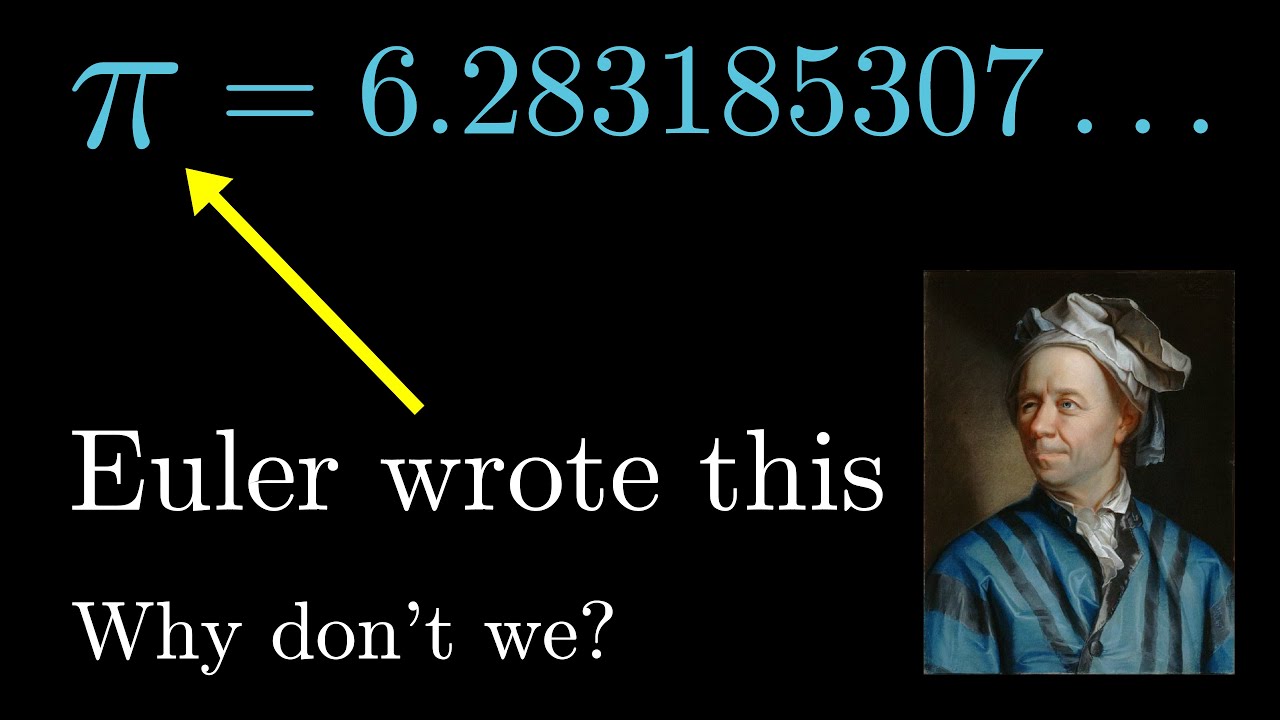
by one of history's most influential mathematicians, Leonhard Euler. Luckily, we now have an official 3b1 brown Switzerland correspondent, Ben Hambrecht, who was able to go to the library in Euler's hometown and get his hands on some of the original documents. And in looking through some of those, it might surprise you to see Euler write, Let pi be the circumference of a circle whose radius is 1, that is, the 6. 28 constant we would now call tau, and it's likely he was using the Greek letter pi as a p for perimeter.

Leonardo Euler

by one of history's most influential mathematicians, Leonhard Euler. Luckily, we now have an official 3b1 brown Switzerland correspondent, Ben Hambrecht, who was able to go to the library in Euler's hometown and get his hands on some of the original documents. And in looking through some of those, it might surprise you to see Euler write, Let pi be the circumference of a circle whose radius is 1, that is, the 6. 28 constant we would now call tau, and it's likely he was using the Greek letter pi as a p for perimeter.

Who is the villain

So was it the case that Euler, genius of the day, was more notationally enlightened than the rest of the world, fighting the good fight for 6. 28? And if so, who's the villain of our story, pushing the 3. 1415 constant shoved in front of most students today? The work that really established pi as we now know it as the commonly recognized circle constant was an early calculus book from 1748. At the start of chapter 8, in describing the semi-circumference of a circle with radius 1, and after expanding out a full 128 digits of this number, one of them wrong, by the way, the author adds, which for the sake of brevity I may write pi. There were other texts and letters here and there with varying conventions for the notation of various circle constants, but this book, and this section in particular, was really the one to spread the notation throughout Europe, and eventually the world. So what monster wrote this book with such an unprincipled take towards circle constants? Well, Euler again. In fact, if you look further, you can find instances of Euler using the symbol pi to represent a quarter turn of the circle, what we would call today pi halves, or tau fourths. In fact, Euler's use of the letter pi seems to be much

Who is the villain

So was it the case that Euler, genius of the day, was more notationally enlightened than the rest of the world, fighting the good fight for 6. 28? And if so, who's the villain of our story, pushing the 3. 1415 constant shoved in front of most students today? The work that really established pi as we now know it as the commonly recognized circle constant was an early calculus book from 1748. At the start of chapter 8, in describing the semi-circumference of a circle with radius 1, and after expanding out a full 128 digits of this number, one of them wrong, by the way, the author adds, which for the sake of brevity I may write pi. There were other texts and letters here and there with varying conventions for the notation of various circle constants, but this book, and this section in particular, was really the one to spread the notation throughout Europe, and eventually the world. So what monster wrote this book with such an unprincipled take towards circle constants? Well, Euler again. In fact, if you look further, you can find instances of Euler using the symbol pi to represent a quarter turn of the circle, what we would call today pi halves, or tau fourths. In fact, Euler's use of the letter pi seems to be much

Euler and pi

more analogous to our use of the Greek letter theta. It's typical for us to let it represent an angle, but no one angle in particular. Sometimes it's 30 degrees, maybe other times it's 135, and most times it's just a variable for a general statement. It depends on the problem and the context before us. Likewise, Euler let pi represent whatever circle constant best suited the problem before him, though it's worth pointing out that he typically framed things in terms of unit circles with radius one, so the 3. 1415 constant would almost always have been thought of as the ratio of a circle's semi-circumference to its radius, none of this circumference to its diameter nonsense. And I think Euler's use of this symbol carries with it a general lesson about how we should approach math. The thing you have to understand about Euler is that this man solved problems, a lot of problems. I mean, day in, day out, breakfast, lunch, and dinner, he was just churning out puzzles and formulas and having insights and creating entire new fields, left and right. Over the course of his life, he wrote over 500 books and papers, which amounted to a rate of 800 pages per year, and these are dense math pages. And then after his death, another 400 publications surfaced. It's often joked that formulas and math have to be named after the second person to prove them, because the first is always going to be Euler. His mind was not focused on what circle constant we should take as fundamental, it was on solving the task sitting in front of him in a particular moment, and writing a letter to the Bernoullis to boast about doing so afterwards. For some problems, the quarter circle constant was most natural to think about, for others the full circle constant, and for others still, say at the start of chapter 8 of his famous calculus book, maybe the half circle constant was most natural to think about. Too often in math education, the focus is on which

Euler and pi

more analogous to our use of the Greek letter theta. It's typical for us to let it represent an angle, but no one angle in particular. Sometimes it's 30 degrees, maybe other times it's 135, and most times it's just a variable for a general statement. It depends on the problem and the context before us. Likewise, Euler let pi represent whatever circle constant best suited the problem before him, though it's worth pointing out that he typically framed things in terms of unit circles with radius one, so the 3. 1415 constant would almost always have been thought of as the ratio of a circle's semi-circumference to its radius, none of this circumference to its diameter nonsense. And I think Euler's use of this symbol carries with it a general lesson about how we should approach math. The thing you have to understand about Euler is that this man solved problems, a lot of problems. I mean, day in, day out, breakfast, lunch, and dinner, he was just churning out puzzles and formulas and having insights and creating entire new fields, left and right. Over the course of his life, he wrote over 500 books and papers, which amounted to a rate of 800 pages per year, and these are dense math pages. And then after his death, another 400 publications surfaced. It's often joked that formulas and math have to be named after the second person to prove them, because the first is always going to be Euler. His mind was not focused on what circle constant we should take as fundamental, it was on solving the task sitting in front of him in a particular moment, and writing a letter to the Bernoullis to boast about doing so afterwards. For some problems, the quarter circle constant was most natural to think about, for others the full circle constant, and for others still, say at the start of chapter 8 of his famous calculus book, maybe the half circle constant was most natural to think about. Too often in math education, the focus is on which

Conclusion

of multiple competing views about a topic is right. Is it correct to say that the sum of all positive integers is negative 1 12th, or is it correct to say that it diverges to infinity? Can the infinitesimal values of calculus be taken literally, or is it only correct to speak in terms of limits? Are you allowed to divide a number by zero? These questions in isolation just don't matter. Our focus should be on specific problems and puzzles, both those of practical application and those of idle pondering for knowledge's own sake. Then, when questions of standards arise, you can answer them with respect to a given context. And inevitably, different contexts will lend themselves to different answers of what seems most natural. But that's okay. Outputting 800 pages a year of dense transformative insights seems to be more correlated with a flexibility towards conventions than it does with focusing on which standards are objectively right. So on this Pi Day, the next time someone tells you that, you know, we should really be celebrating math on June 28th, see how quickly you can change the topic to one where you're actually talking about a piece of math.

Conclusion

of multiple competing views about a topic is right. Is it correct to say that the sum of all positive integers is negative 1 12th, or is it correct to say that it diverges to infinity? Can the infinitesimal values of calculus be taken literally, or is it only correct to speak in terms of limits? Are you allowed to divide a number by zero? These questions in isolation just don't matter. Our focus should be on specific problems and puzzles, both those of practical application and those of idle pondering for knowledge's own sake. Then, when questions of standards arise, you can answer them with respect to a given context. And inevitably, different contexts will lend themselves to different answers of what seems most natural. But that's okay. Outputting 800 pages a year of dense transformative insights seems to be more correlated with a flexibility towards conventions than it does with focusing on which standards are objectively right. So on this Pi Day, the next time someone tells you that, you know, we should really be celebrating math on June 28th, see how quickly you can change the topic to one where you're actually talking about a piece of math.

Методичка по этому видео

Структурированный конспект

Эволюция числа Пи: как мы пришли к 3.14

История становления числа Пи как общепринятой константы. Как Леонард Эйлер использовал символ 'пи' и почему его трактовка отличалась от современной.

Другие видео автора — 3Blue1Brown

Ctrl+V

Экстракт Знаний в Telegram

Экстракты и дистилляты из лучших YouTube-каналов — сразу после публикации.

Подписаться

Дайджест Экстрактов

Лучшие методички за неделю — каждый понедельник