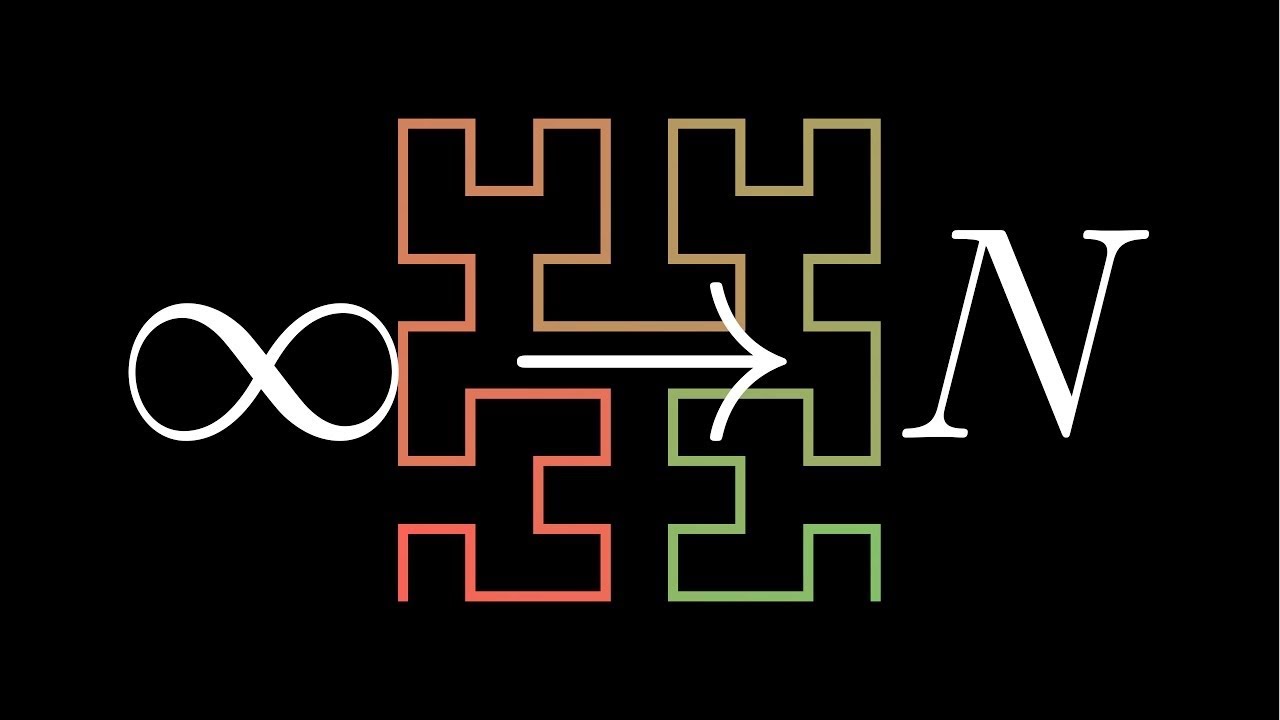
The intuition behind continuity is that you don't want the output of your function to suddenly jump at any point when the input is only changing smoothly. And the way this is made rigorous in math is actually pretty clever, and fully appreciating space-filling curves requires digesting the formal idea of continuity, so it's definitely worth taking a brief side-step to go over it now. Consider a particular input point, a, and the corresponding output of the function, b. Draw a circle centered around a, and look at all the other input points inside that circle, and consider where the function takes all those points in the output space. Now draw the smallest circle you can centered at b that contains those outputs. Different choices for the size of the input circle might result in larger or smaller circles in the output space. But notice what happens when we go through this process at a point where the function jumps, drawing a circle around a, and looking at the input points within the circle, seeing where they map, and drawing the smallest possible circle centered at b containing those points. No matter how small the circle around a, the corresponding circle around b just cannot be smaller than that jump. For this reason, we say that the function is discontinuous at a if there's any lower bound on the size of this circle that surrounds b. If the circle around b can be made as small as you want, with sufficiently small choices for circles around a, you say that the function is continuous at a. A function as a whole is called continuous if it's continuous at every possible input point. Now with that as a formal definition of curves, you're ready to define what an actual Hilbert curve is. Doing this relies on a wonderful property of the sequence of pseudo-Hilbert curves, which should feel familiar. Take a given input point, like 0. 3, and apply each successive pseudo-Hilbert curve function to this point. The corresponding outputs, as we increase the order of the curve, approaches some particular point in space. It doesn't matter what input you start with, this sequence of outputs you get by applying each successive pseudo-Hilbert curve to this point always stabilizes and approaches some particular point in 2D space. This is absolutely not true, by the way, for snake curves, or for that matter most sequences of curves filling pixelated space of higher and higher resolutions. The outputs associated with a given input become wildly erratic as the resolution increases, always jumping from left to right, and never actually approaching anything. Now because of this property, we can define a Hilbert curve function like this. For a given input value between 0 and 1, consider the sequence of points in 2D space you get by applying each successive pseudo-Hilbert curve function at that point. The output of the Hilbert curve function evaluated on this input is just defined to be the limit of those points. Because the sequence of pseudo-Hilbert curve outputs always converges no matter what input you start with, this is actually a well-defined function in a way that it never could have been had we used snake curves. Now I'm not going to go through the proof for why this gives a space-filling curve, but let's at least see what needs to be proved. First, verify that this is a well-defined function by proving that the outputs of the pseudo-Hilbert curve functions really do converge the way I'm telling you they do. Second, show that this function gives a curve, meaning it's continuous. Third, and most important, show that it fills space, in the sense that every single point in the unit square is an output of this function. I really do encourage anyone watching this to take a stab at each one of these. Spoiler alert, all three of these facts turn out to be true. You can extend this to a curve that fills all of space just by tiling space with squares and then chaining a bunch of Hilbert curves together in a spiraling pattern of tiles, connecting the end of one tile to the start of a new tile with an added little stretch of line if you need to. You can think of the first tile as coming from the interval from 0 to 1, the second 1 to 2, and so on, so the entire positive real number line is getting mapped into all of 2D space. Take a moment to let that fact sink in. A line, the platonic form of thinness itself, can wander through an infinitely extending and richly dense space and hit every single point. Notice, the core property that made pseudo-Hilbert curves useful in both the sound-to-sight application and in their infinite origins is that points on the curve move around less and less as you increase the order of those curves. While translating images to sound, this was useful because it means upgrading to higher resolutions doesn't require retraining your senses all over again. For mathematicians interested in filling continuous space, this property is what ensured that talking about the limit of a sequence of curves was a meaningful thing to do. And this connection here between the infinite and finite worlds seems to be more of a rule in math than an exception. Another example that several astute commenters on the Inventing Math video pointed out is the connection between the divergent sum of all powers of 2 and the way that the number of 1 is represented in computers with bits. It's not so much that the infinite result is directly useful, but instead the same patterns and constructs that are used to define and prove infinite facts have finite analogs, and these finite analogs are directly useful. But the connection is often deeper than a mere analogy. Many theorems about an infinite object are often equivalent to some theorem regarding a family of finite objects. For example, if during your sound-to-sight project you were to sit down and really formalize what it means for your curve to stay stable as