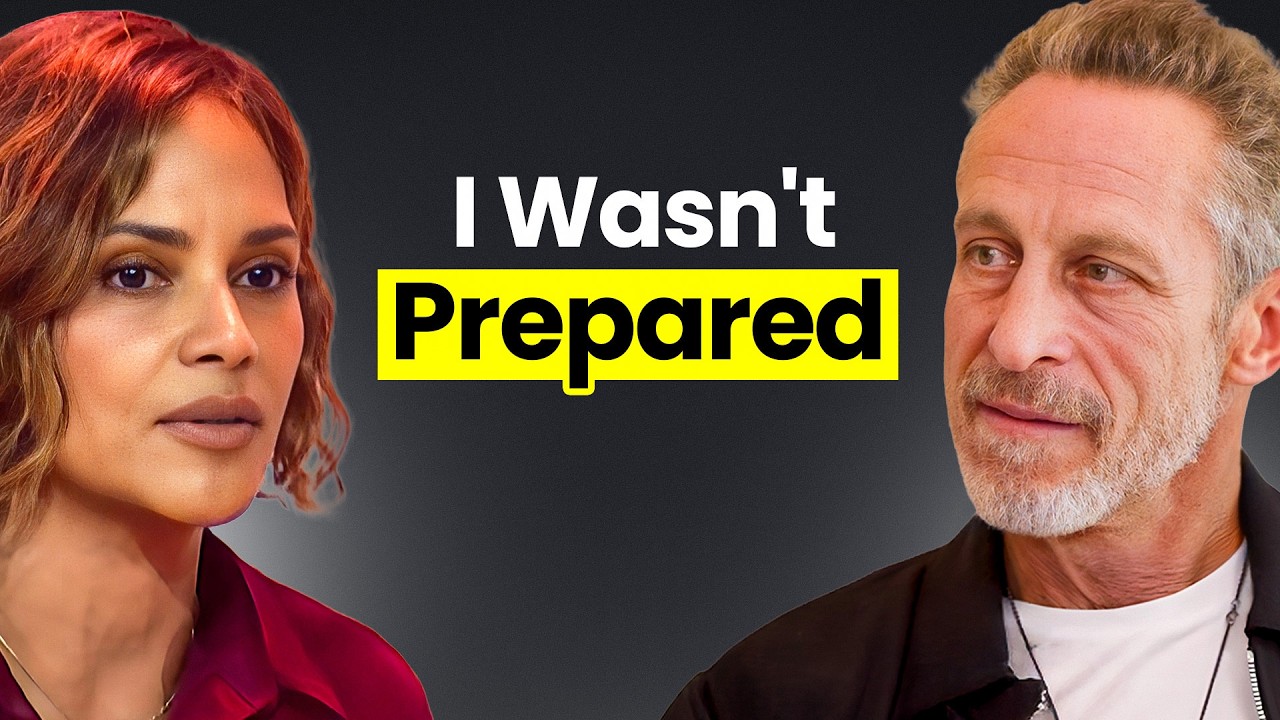
Halle Berry was misdiagnosed with a permanent STI—only to find out it was actually menopause. 🤯 Discover why 60M women are being failed by medicine and how to reclaim your "Second Act." ⚡️.
In this raw and unfiltered episode, Halle Berry joins Dr. Mark Hyman at the Eudaimonia Summit to break the silence on the 100+ symptoms of perimenopause that doctors often miss. From being told she had a severe case of herpes—which turned out to be extreme vaginal dryness—to battling "mental belly" and "brain fog," Halle shares the "excruciating" reality of a healthcare system that provides only half a day of menopause training to physicians. They explore why sixty million women in America are currently being neglected and how to navigate the "root cause" of symptoms like night sweats and low libido.
The conversation shifts from "sucking it up" to a strategy of Hormone Optimization Therapy. Dr. Hyman breaks down the "Personalized Roadmap" for midlife, including the truth about bioidentical hormones, the impact of alcohol on estrogen, and why lifting heavy weights is non-negotiable for bone protection. Whether you're dealing with "insulin chaos," cortisol spikes, or the fear of "shriveling up," this episode provides evidence-based strategies to ensure your second act is an upgrade, not a decline
If you liked my previous videos on longevity and cellular health, this conversation takes it a step further by exposing the "medical blind spot" affecting millions of women. While we often talk about general aging, today we’re diving deep into the hormonal shifts that specifically trigger brain fog, metabolism changes, and bone loss.
This conversation was recorded live at the Eudēmonia Summit.
View Show Notes From This Episode
https://drhyman.com/blogs/content/podcast-ep1121
Get Free Weekly Health Tips from Dr. Hyman
https://drhyman.com/pages/picks?utm_campaign=shownotes&utm_medium=banner&utm_source=podcast
Sign Up for Dr. Hyman’s Weekly Longevity Journal
https://drhyman.com/pages/longevity?utm_campaign=shownotes&utm_medium=banner&utm_source=podcast
Join the 10-Day Detox to Reset Your Health
https://drhyman.com/pages/10-day-detox
Join the Hyman Hive for Expert Support and Real Results
https://drhyman.com/pages/hyman-hive
This episode is brought to you by Seed, BIOptimizers, PerfectAmino, BON CHARGE, Made In Cookware and Maui Nui.
Go to https://seed.com/hyman and use code 20HYMAN to get 20% off your first month.
Head to https://bioptimizers.com/hyman and use promo code HYMAN at checkout to save 15%.
Go to https://bodyhealth.com and use code HYMAN20 to get 20% off your first order.
Upgrade your routine. Head to https://boncharge.com/hyman and use code HYMAN for 15% off.
Head to https://madeincookware.com and use the code DRHYMAN for 10% off your order.
Learn more about the health benefits of venison and how to get yours, head over to https://mauinuivenison.com/hyman.
#Menopause #WomensHealth #HalleBerry #DrMarkHyman #HormoneOptimization #longevity
(0:00) Halle Berry's personal health experience and menopause discussion
(1:17) Introduction to the Eudaimonia Summit
(3:52) Halle Berry's advocacy and menopause journey
(7:08) Misdiagnosis and the need for better menopause education
(10:27) Hormone replacement therapy and FDA changes
(12:45) Challenges with bioidentical hormones
(13:53) Menopause symptoms and personal experiences
(17:33) Holistic approach to menopause and comprehensive health testing
(20:27) Lifestyle factors affecting hormones
(22:45) Long-term benefits of hormone optimization therapy
(25:27) Testosterone's role in women's health and sexual health discussions
(29:17) Introduction to ReSpin and its mission
(32:39) Audience Q&A: Environmental toxins, lifestyle, genetics, and menopause
(37:41) Audience Q&A: Menopause awareness and medical education
(39:37) Audience Q&A: Vaginal health products and the future of psychedelic psychiatry
Оглавление (15 сегментов)
Halle Berry's personal health experience and menopause discussion
I wake up in the morning and I cannot go to the bathroom. I'm sitting there and I just can't go. It's like h it's the most excruciating pain I've ever felt. So, the first thing of course you do, you go to the doctor. He said, "Well, this is the worst case of herpes I think I've seen. " So, my guy Van is downstairs in the car cuz he had driven me to the doctor's office. I get in the car and I'm looking at him and I'm like, "Hey, so uh you got herpes? " So then an hour later, my doctor calls me and says, "No, you do not have herpes. " I said, "Then what is it? " And he said, "I don't know. " And he hung up the phone. I realized that what I was suffering from was dry vagina syndrome because in pmenopause over 50% of women get dry everything, dry eyes, dry mouth, and dry vagina. And all of those were dry on me. Nobody had ever mentioned the word menopause. I was so ignorant, Mark. I thought I would skip it. As a physician, I learned almost nothing about menopause in medical school except that it happens. There's 60 million women in America who are in menopause and they're not being well taken care of by the healthcare system. — I had to be loud. unafraid to tell this very kind of embarrassing story because we had to start the conversation.
Introduction to the Eudaimonia Summit
— Welcome to a special episode of the Dr. Heyman show recorded live at the Udeonia Summit. Udemonia is a three-day gathering designed to elevate human health and potential. Here, over a 100 leading scientists, clinicians, and wellness innovators come together to share the most advanced evidence-based strategies for longevity and well-being. And I'm thrilled to bring you a conversation from the heart of this transformative event. Thrilled to be here, thrilled to have hi here. Thrilled to talk about something that is kind of a taboo subject and mostly ignored by medicine. Menopause. As a doctor, I've come to learn that most of women's health problems and most of women's problems in general start with men. Menopause, menstrual cramps, mental anxiety. So — why is that? — Men in general. I don't know. But you know that the truth is that you know as a physician I learned almost nothing about menopause in medical school except that it happens and that we should give preman and provera which unfortunately have a lot of side effects uh and are not the best hormone replacement therapy. You know as a physician I had the privilege of working in a place called Kenya ranch where for almost 10 years I treated a population of women between you know late 30s and late 50s. So I really got to see what was going on in the whole continuum from reproductive life to pmenopause through menopause and after. And I just realized how much suffering there was, how much unnecessary suffering there was and how neglected it was. There's 60 million women in America who are in menopause and they're not being well taken care of by the health care system. Um, and I also realized that it's sort of accepted that women have to suffer, that they have to have PMS. Uh, you know what that stands for? Punish my spouse. Um, and the uh, you know, PMS, 75% of women have some degree of it. Some have a severe form called PMDDD which is premenstrual dysphoric disorder, bad menstrual cramps or dismen dismenorhea, heavy bleeding, irregular cycles, infertility, dysfunctional uterine bleeding, endometriosis. So many different problems that have come to be seen as just a normal part of being a woman. They're not. They're a result of things that are eminently treatable if you understand how to get to the root cause.
Halle Berry's advocacy and menopause journey
And you know why I'm thrilled to be here with Hie is because she's had an epiphany that this was an area of health and healthcare and medicine that was neglected that she was a victim of I would say and has made her life and her second act in life about addressing this on a cultural level on a healthcare level on an empowerment level for women which I think is amazing. So let's give it up for Hie. — Thank you. Um so with that prelude um you know tell us about your origin story with this because you're America's sex symbol right and menopause is not thought of something — it's not sexy — sexy right so you know you were going through a lot of healthcare changes and you got misdiagnosed you were told you had a very uh embarrassing condition that ended up being not actually true uh and it was something else and you began to realize how much you were failed by medicine so tell us about that story and how you all got started in this. — But when I was 54, thank you. — Doesn't she look great? — But when I was 54, nobody had ever mentioned the word menopause. I was so ignorant, Mark. I thought I would skip it. I thought whatever that thing is, I'm going to skip it. Right? I got myself off insulin. I knew that food was medicine and I thought, well, I'm going to sail through whatever the hell that is. Well, no. We all are going to face it if we're lucky enough to get there. But finally, I met, you know, I've been like you, married and divorced few times. — I'm a relationship expert. I've been married three times. — Me too. Times and divorced three times. — There you go. — Uh, so I finally met my man, right? And I knew that this was my man after three divorces. You kind of know when you meet your person. I met my person and we were having the best sex two people could have. Everything was functioning the way it should. We were on fire and I thought, "Wow, this is the best time of my life. We have a year of great sex. All of a sudden, at the end of that year, we're having great sex. I wake up in the morning and I cannot go to the bathroom. I'm sitting there and I just can't go. It's like h it's the most excruciating pain I've ever felt. And I thought, what the heck is going on? I look down there, it's blown up. It looks like something it's never looked like before. And I thought, my god, what has happened to me? So, the first thing, of course, you do, you go to the doctor. I go to the doctor that I've known a long time, and I say, "What what is happening here? " And he's like, "Well," he looks up there and he says, "Well, I know what this is. " And I'm like, "You do? What is it? " He said, 'Well, this is the worst case of herpes I think I've seen. And I'm like, herpes? — What do you mean herpes? And not that herpes is a bad thing, but you think that's something you want to tell a girl you got herpes? I said, oh my god. He said, yeah, it's herpes. I'll do the test. It'll come back in 72 hours, but yeah, I'm pretty sure this is herpes. So, my guy Van is downstairs in the car cuz he had driven me to the doctor's office. He's down there in the car. I get in the car and I'm looking at him and I'm like, "Hey, so uh you got herpes. "
Misdiagnosis and the need for better menopause education
— Oh god. — And he's like, "I don't have herpes. " I'm like, "No, you do have herpes because I have herpes now and I didn't have herpes before I knew you. So you have herpes. " And he's like, "No, — that's a fun conversation. — It's a fun a very fun conversation with the love of your life of a year. " And I said, "No, you do. " And he said, "Nobody's ever told me that. " So I'm like, "Well, let me be the first to tell you, man. You have herpes. and now you've given it to me. And so we're in the car and we're driving and we're just mad and we don't know what to say to each other. So I say to him, look, you need to go get a test. We need to see what's going on here. So he runs right to the doctor. He gets a test. So for 72 hours as a new couple, we are just not that herpes is the end of the world because it's not, but you should tell each other that. So we had issues with trust. We didn't know who had the herpes, who gave the herpes. So 72 hours he gets his results back first. He doesn't have herpes. So he's looking at me like, "Well, looks like you gave me herpes. " And I'm like, "Damn, think I gave him herpes, but how did that happen? " So then an hour later, my doctor calls me and says, I said, "I know. I know I got herpes. " He said, "No, you do not have herpes. " And I said, "I don't. " He's like, "No. " And this was my aha moment that changed the second act of my life because he I said, ' Then what is it? And he said,"I don't know. " And I thought, "How can you not know? You're the doctor. You don't know what this is. " And he said, "I truly don't. " And that's all he said. And he hung up the phone. And I sat there with myself and with my new man. And I thought, "This is not okay. I have to go on my own mission to figure out what this is and educate myself. And that's when I realized that what I was suffering from was dry vagina syndrome. Because in perry menopause over 50% of women get dry everything. Dry eyes, dry mouth, and dry vagina. And all of those were dry on me. And that's when I realized if I had this little information, and I argue I've have one of the best doctors, and he is doctors in California, but it's not his fault. He wasn't educated. He had a chapter of studying the menopausal body in medical school. One chapter, half a day, right? So, he didn't know. Not his fault really at the time. But that's when I realized I had to use my platform, use my voice. I had to not only educate myself, but I had to sort of start to be able to help other women understand. And I had to break open this conversation. I had to start talking about it. I had to be loud, right? unafraid to tell this very kind of embarrassing story because we had to start the conversation and I had to make women okay to talk about it as well. — Yeah. Thank you, Hie, for sharing that. — And by the way, when I said I was going to have this conversation, all the people in my life that, you know, helped me manage my career, they all were like, "Oh, I don't know if you want to go talking about menopause. That's going to like just end your whole shit. " And I thought, well, then I my whole [ __ ] will end, but I'm going to talk about what's important to me as a woman and I'm going to talk about this time of my life. And if my movie career ends, I've had a good one. It's okay. — It's okay.
Hormone replacement therapy and FDA changes
— I think people always appreciate people who are authentic and tell the truth. And uh that's what matters. One of the things that happened during my career as a doctor is that there was a big study called the Nurses Health Study, which was a observational study that showed that women who took hormones did better. Um, and it was not proving cause and effect, but correlation. It turned out the women who were doing better were just healthier in general. They went to their doctor, they exercised, they ate better, they took their vitamins, they didn't smoke, and that's why they had better health outcomes, not necessarily because they took the hormones. when they did a big study was a billion-d dollar study commissioned by Bernardon Healey who was the first head of the NIH as a woman and called the women's health initiative and that study showed and there was problems with it but that study showed that there were some adverse outcomes from women who took hormones like heart attacks and strokes and increased cancer risk and all of a sudden boom overnight it was I remember I think it was 2002 the study came out and overnight there were 50 million women that stopped hormones which was a disaster — single worst thing I think to happen for women's health. — It was a disaster. Just last week there was a big change. You want to share about it? — The FDA lifted that blackbox warning and I think that's one of the best things to happen uh in women's health. But the truth is there are still going to be those women that afraid because that stigma is still alive and well and women are holding on to that. It's still, I feel, going to be very hard to get women to have faith that these bioididentical hormones will not cause them cancer. — Yeah. — Really? I think it is. And I know this because since that happened, I still talk to women and they still say, "Oh, but I don't know. " So my question is, what will it take for us to really start doing our own investigation and advocating for oursel and deciding for ourselves what's right for us that do understand the menopausal body that can give us real information so that we can make those educated decisions, right? Not just, you know, what our friends tell us that their mothers have told them, but how do we come into 2025 and really start investigating for ourselves? That's what we have to start.
Challenges with bioidentical hormones
— It's really important. And I think the thing that has to happen and probably won't happen at scale is because the way drug companies make money is they modify a substance and make it proprietary and then they can patent it make money from it. But what you said was bioididentical. I mean it's what nature made. You can't pat patent what nature made like a vitamin or a hormone. And so it's cheap and it it's not going to make the money and so they're not going to do big studies on this. And that's a fundamental problem unless the government takes a hold of this and does this and they have very different effects on the women's body than these other hormones. Premarine increases the risk of inflammation and causes high triglycerides. It increases cancer risk. It's pregnant Mar's urine. That's what it stands for. Pregnant mar's urine. Premorin come. That's how they get it. And provera is the other hormone they use which is a form of synthetic progesterone that actually makes women gain weight, have facial hair and be depressed. So it's not a lot of fun. But the bio identical ones don't do that. So can you talk about the kinds of symptoms that women suffer from? You mentioned vaginal dryness. You mentioned dry eyes, dry mouth, but there's a whole host of things that happen or can happen. Not to everybody, but what did you
Menopause symptoms and personal experiences
experience and what are you seeing in your company respin which is really designed to help women through this process? It's a whole platform of education and support and coaching and hormone access to hormone therapy and doctors that provides a pathway where there's been none for women. — Yes. Exactly. What blew my mind when I started to do my research, there are over 100 symptoms that are now attributed to pmenopause and menopause and I think the most common ones and many of you in this room are probably experiencing them. The worst ones I have of course is dry everything. I have dry mouth and dry eyes. Doctors don't know. My rheatologist tried to tell me that my dry mouth was Shoggrren's disease. Why? Because he had only really studied the research that came back to him from men. And if I were a man and I was complaining about the things that I was complaining about, probably would be Shoggun's disease and he would put me on steroids for probably the rest of my life. I said disease. Yeah. — Right. And I said, "No, I don't I I do not accept this. I do not have Shogrin's dis. " I just didn't believe it. Another one of my doctors because I have dry eyes which I suffer from. Uh he has been my doctor for a while. My my glands in my eyes almost dried up because he could not say the word menopause to me. He said, "I can't tell Halib Berry she's in menopause. " And I thought, "Then who's going to tell me? You're my doctor. We have to talk about this. " So, you see, doctors can't even talk about it. So, those are my major symptoms. I also had uh brain fog. You know, nothing's worse than sitting in a meeting or on a phone call or on the set and I can't remember. I can't have word recall. Right in the middle of a sentence, I just lose my whole train of thought. Night sweats, up all night. You know, sleep deprivation is a form of torture. And we know this ladies, we wake up at 3:00 in the morning. We try to solve all the world's problems. We can't go back to sleep. When we finally get to sleep, it's morning. We have to get our kids off to school. Then we go into work and we're like a bear and we're so angry and everybody's like, "Well, what the [ __ ] is wrong with you? I've been up all night. You'd be this way, too. " You know, it just never stops. And I felt like I was all alone. I felt afraid. And I thought, I'm just getting old and now I'm going to just shrivel up and I'm going to go off to pasture and nobody's going to care. That's how I felt very depressed. I felt that alone and like that nobody heard my feelings. And when I tried to talk to health care professionals, I was just told, you know what, this is a part of getting old. That's all it is. you're in your late 50s and this is what this is and you just have to suck it up and deal with it. And that was not okay. And that's why at Respin we have doctors there and coaches there that no, we don't have to just suck it up. We deserve support. We deserve scientific information about what's happening with our body. We deserve a community of like-minded women because I've learned most of the things about what I'm going through other women. That's right. through the things that they've tried and what has worked for them and what hasn't worked for them. I've learned about all the symptoms based on what other women tell me they're experiencing. I'm not experiencing these things, but I learned about frozen shoulder and all these other itchy feet and itchy legs and ears and ringing in your head. Like I learned — low libido — and low libido. Well, yeah, had that, too. But now I'm better. I got on some testosterone. I got found my libido. We don't have to, you know, sort of trail off into pasture. Like there are ways like we know that if you know the right things to do. When you know better, you do better. When you know the right foods to eat because food is medicine. When you know that if hormones are right for you, if you feel comfortable doing that, that can be a game changer. Like we have the right to figure out what works for us.
Holistic approach to menopause and comprehensive health testing
— I think that's really important because what you're hitting on is it's not just about hormone replacement therapy. And at Respin, you do a comprehensive holistic approach which includes lifestyle, diet, exercise, stress management, sleep, relationships, all the things that matter, nutritional support, and you know, we don't really pay attention to that. And you know, at Function Health, we do deep diagnostics that help women understand where they are hormonally, where they are metabolically, where they are nutritionally, and you can start to see the patterns. And one of the things that I think, you know, I don't know if you focus on this much, but what I noticed when women go through this late 40s, early 50s transition is there's basically a whole set of hormones that go right. It's not just sex hormones like estrogen, progesterone, and testosterone. It's insulin. And women get increased belly fat. It's cortisol, which also — the men belly. — Men belly. — Mento belly. Yeah. — Who's got the men belly? — The mento belly. It's — people. Yeah. And it's cortisol goes up. The stress goes up. and you're often in the sandwich generation. Your career is peaking, your kids are in teenagers, your parents are older. It's like a whole it's a whole pressure cooker. And then you get thyroid dysfunction is very common, too. So, you've got insulin, cortisol, thyroid, sex hormones, four different hormones that go ary and are all interacting to cause a lot of chaos. And they're all treatable and women don't have to suffer if you understand what to look at and what to test for and what to diagnose. And that's really why we created function health to empower women and everybody to be able to access their data and figure out what's going on. — And that's the beauty of function. I just did my function test. You guys sent someone in my house. I swear they took every ounce of blood out of my body. She said, "I'm going to take 17 vials of blood. " I said, "Excuse me, what? — You want to know everything? " — She said, "Yeah, that's what I'm doing. " But you know what? Thank God she did because I learned so much. I got back such a comprehensive report and some things I think I already knew learned and it was really eyeopening and what women can do if they can get their functional report they can bring it over to us at Respin and we can help them function can help them make sense of what that means too but we at Respin can hold their hand to make sure they follow through with all of these protocols that can actually change their life and help them understand it because some of us need to ask the same question like 10 times before we get it and we understand that at Respin, you know, some of it can be very confusing and it can be daunting and you really need someone to sit with you and break it down until you finally understand it, — you know. Can you talk, Kelly, about what are those lifestyle factors and things that women experience that cause hormones to go wacky? It often feels like it's happening randomly to you, but it it's not. It's the effect of everything washing over your biology, everything you eat, all those things. Can you kind of break that down for us and what you're learning about the things that are actually causing hormonal dysregulation? It's not just about giving hormone replacement
Lifestyle factors affecting hormones
therapy. It's about addressing the whole package. — Yeah, you need so much. I mean, I've been on hormones now for almost four years and I can say that took me about 50 or 60% of the way. It certainly in the beginning, you know, helped me sleep a little bit better. I was a little less moody. I could remember things a little bit more. But it didn't just do the trick either. I had to realize that like you said, the hormones only were as effective as my body was healthy, right? So, I had to change the way I ate. Being a type two diabetic, I used to be very much in the ketogenic diet. And I learned that at this time of my life, that was no longer working for me. I needed a little carbs. I needed to eat more fiber. I needed to have more protein. I used to I've worked out my whole life. I was a gymnast as a kid. I couldn't do as much cardio. I didn't need as much cardio as I used to need to do. I now needed to lift heavy weights and I never did that before, you know, that was not something that I felt I needed. And now I had to change all that about how I was operating my everyday life. So I realized that this new body was the better version of myself. We often think, oh, we're getting older and we're sort of downgrading, but we're not downgrading. When we know the things to do, we're upgrading. We're spiraling into the best version of ourselves, right? We just have to know how to support this new body, this new place we find ourselves. And it's not a sickness. It's a natural life transition that just has to be supported by evidence-based therapies and information. — Yeah. And it's also things like alcohol and nicotine. Yeah. Bring it up. Um, you know, it's also things like alcohol and nicotine and caffeine that also can cause problems. So, you've got to pay — to stop drinking alcohol. — Yeah, — that was a really hard one. — Well, alcohol really screws up estrogen. In fact, one glass of wine or alcohol a day increases women's risk of breast cancer by 40%. Why? Because it interrupts estrogen metabolism in the liver and increases estrogen levels. You literally can see rising estrogen levels and high estrogen can cause all these problems. So, — and your sleep, it can really mess with your sleep. We often think, oh, have a nice glass of wine and go to sleep. It'll put you to sleep, but it's going to wake you up at 3:00 a. m. — Yeah. Exactly. — So, it's not worth it.
Long-term benefits of hormone optimization therapy
— Yeah. And so, there's so many things that are involved in sort of understanding how to optimize your health. And there's also, you know, the risk of diseases. And I think, you know, the things like the short-term symptoms are important, but when we're talking about longevity and we're talking about having a healthy lifespan and living to 100 healthy years, it's more than just, you know, getting rid of hot flashes or improving your sleep or vaginal dryness. It's interesting things that you're include your risk of Alzheimer's and osteoporosis, which are and Alzheimer's is, you know, affects women far greater rate than men. So, can you talk a little about the benefits there? — And here's some Yes. And here's something I learned too that also blew my mind. We have hot flashes. That's part of it. And so many people have said, "Well, it's just hot flash. Just deal with it. " Like, get a fan and carry it around with you. Like, what's the problem? Well, it's more than a hot flash, first of all, because every time you have a hot flash, there um ramifications to your brain, right? And what I learned with Dr. Mackey, who's also one of our our doctors over at Respin, is that every time you have a hot flash, you don't actually know you have a hot flash. Sometimes you heal feel the hot flashes, but sometimes we don't. And Dr. Mackey was doing a study out of um out of Chicago. And she would hook woman women up to a machine and she's able to measure how many hot flashes they have. This one woman that she was studying while I was there with her, this woman thought she had high five hot flashes, but in fact, she had 50 hot flashes in a 24-hour period. And every time you have a hot flash, there's adverse effects to your brain, right? And so it's not just getting rid of hot flashes so we're we don't feel physical discomfort. It's really trying to minimize the hot flashes to protect our brain. And when I realized that it was hot flashes are not just hot flashes, then I really started to realize, oh, this is really serious. And I never let anybody tell me anymore. It's just a hot flash. Like, you know, just deal with it. No, it's it's not as simple as that. And you know, one of the things that we now understand is that there's a therapeutic window right after menopause that's important to start hormone replacement therapy or you can call it hormone optimization therapy if you want to prevent Alzheimer's. So if you start when you're 65, it may not actually have the benefit. And the same thing with your bones, you start to lose your bones, you know, even in your 40s and earlier. And that needs also a long-term support with hormone therapy. And if you don't protect your bones, we all know when you have an accident, you break a bone in your 50s and 60s, it can be lights out. Many women within a year of that are no longer here. — Yeah. 50% of women who or anyone who breaks their hip are dead in a year.
Testosterone's role in women's health and sexual health discussions
— Yeah. — It's worse than getting a terminal cancer diagnosis. So, and that's 100% preventable through strength training, through the proper diet, through support with hormones. And you know, let's talk a little bit about testosterone because that's a male hormone. So, what are women doing taking testosterone? — Are they going to grow mustaches? And — well, that's what I thought the deal when I first heard. You should take a little bit of testosterone. Like, I don't need hair on my chest. No, I'm not going to do that. But, you know, that's the ignorance talking, right? We I didn't know. I did my research and now I'm on a little bit of testosterone. And I'm telling you, it changed everything. I got my libido back and I also got my drive back. There was a certain period of time when I felt very depressed and I didn't even want to get out of bed and I thought, "Oh, I don't want to go to work. I'm done with all of this. " But when I started taking a little bit of testosterone with my estrogen and my progesterone, I got my drive back. I got my there back, right? And it's really been transformative. — Yeah. And the only way to know what's going on is you've got to test. You've got to measure what's going on because some women are fine, some women are not. And you know, I found as a doctor practicing in this whole age group, you know, you want to be careful not to overload a women with too much testosterone because it can have adverse effects. And so you have to be careful. And there there's dozens of preparations for men out there that are, you know, FDA approved, that are prescriptions that are formulated, that are regulated. There's almost none for women. And so, you know, as a doctor, I had to kind of figure out how to use compoundingies and create the right formulas. And you know, one of the things I came upon was using clitoreral testosterone drops that you apply two drops every night and it has profound benefits. And I know this because women keep calling for refills. — Wait, now what is this? — Okay, we can talk after. — I know about these literal drops. — Yeah, it's amazing. So, like you don't have to have the full systemic effect. This the key to hormone replacement therapy is it's got to be personalized. It's there's not like a one-izefits-all. There's creams, there's drops, there's lozenes, there's all sorts of ways to deliver this, but it should be in the lowest dose possible to get the benefit. It should be topically, ideally, not orally. And it should be, you know, for the right amount of time for what a woman needs. And sometimes it's long term, but it's really something that has to be personalized. And again, most physicians have no clue how to do this. And it's not like you can just look up in your drug prescription book and see how to prescribe this because it doesn't exist in there. So you can look how to prescribe preman or promea but not these formulations. So it's a really interesting learning curve as a physician to try to understand this. — And you know what else I think is important to talk about when we think about our sexual health, not only things like these cleral drops, but I think as women, we have to start talking to our partners about it, right? That's how we destigmatize it and we make it less taboo. Uh we can take all the drops and take all the you know vaginal estrogen we want and we can use all the lubes we want but we have to start talking because 50% of marriages end at this time of life right because women our vaginas just dry up and men go get a young hot 25year-old get a red car and they go on with their life and we're stuck there just be you know getting old. So we have to talk about it. We have to have the courage to say to our partner, I'm in menopause or pmenopause and this is what is happening to my body. And I found that when we talk to our partners, talk to men about it, they're very receptive. You know, they're embarrassed at first. They don't want to talk about it. But when we force them to, I think men are right there. They're right there. And they feel relieved that you're talking with them. They feel relieved. They're understanding that there's not a breakdown in their marriage, but that you are just going through something that will pass. And you can go through it together. You don't have to go through this all by yourself. Ladies, we have to start the conversation with
Introduction to ReSpin and its mission
them. — So, you know, because of, you know, your personal experience and this is usually how great things start in the world is somebody has a problem and they want to solve it and that's what happened to you and you started to respin. So, can you give us the reader judges version of what is respin and how members of the audience can actually join and — it is hands down my second life passion. I am determined before I leave this planet to do everything I can to change the life for women, especially in midlife. And why? Because we deserve it. And at Respin, we've got, like he said earlier, we've got expert doctors that are experts in our menopausal bodies. We've got access to the latest in science. We've got coaches that will hold your hand, walk you through your function uh studies that you get, help you be accountable to your optimal good health. We've got a beautiful community of women that are there to also laugh with you, cry with you, hold you up, hold you down. Um it's a 360 approach to wellness because we know and if you want hormones, we have a clinic that can also get you on hormones, help you dose those hormones, help you regulate. It's it it's if we get this right for me before I leave this planet, it will be a menopause one-stop shop where women can come to a trusted place where they know that we've got you. And I'm learning every day. That's why I'm at this conference. I mean, I'm learning every day. I've been shot up with so many peptides here since I've been here. Ozone's up my nose and like all these things. And I'm all about trying to figure out how I can live my longest and healthiest life. And thank you for creating Respend which really gives women hope in a time that often can be very hopeless and very discouraging and very depressing. I mean you shared you were having suicidal thoughts. So what's a moment of hope or a word of hope you can give to women listening who are in this position in your life and how do they have agency and take control? — Well, I'll tell you one good way we can have agency. Besides all the things you've heard us say today, I have this belief that in order for us as women to really start taking care of our health and feeling good about that, we have to change culture. the way we feel about ourselves at this time. And we have to do this, ladies. You know, so many of us have, we've had the Kool-Aid, too. We have to change our ticker tape. We have to have agency over this time of our life. And we have to force and I do say this force our family to celebrate us just like we have now understand that we celebrate our children with their bar mitzvah and their bach mitzvah. We have sweet 16 birthdays. We have baby showers and wedding showers like you know bachelorette parties. We celebrate these milestone times in our life. I think as women we have to start being celebrated when we are in the menopause with a shiesta. a shiesta — shiesta because we deserve it, right? We are deserving of being celebrated, right? We are the matriarchs of our family. We are the wisest ones in our family. I'm going to have to tell you. And in other cultures, we are revered at this time of life. In our country, not so much anymore. And we have to change that. And I think a good way to change that is we make our families give us a shiesta and celebrate us and all that we are. It's one good thing we can start doing.
Audience Q&A: Environmental toxins, lifestyle, genetics, and menopause
— Amazing. So, it's Shiesta time in America. Let's go. — Shiesta. — So, uh, now we have a little bit of time for Q& A. Oh, go ahead. Over here. — What do you think about adding into the matrix is low toxing the the food in your home, the air quality, the products that you're using to add extra support on top of that as another layer? — Yeah. You want to take it? You want me to? I think this is such an important question and we didn't have time to touch on it but it's a huge issue which is industrial petrochemicals which are in everything from makeup to household cleaners uh to skinare products — to our food to pesticides are what we call xenoestrogens. They're foreign estrogens and they're highly bioactive and they're not just additive, they're synergistic. So 1 plus one doesn't equal two, it equals a thousand. And this is why we're seeing such increasing rates of breast cancer and uterine cancer and ovarian cancer. And I think it's not really well appreciated, but is a huge issue. And I think learning how to detox your life is so important. That's why I'm in the board of the environmental working group and it's a great resource ewg. org. It's a nonprofit that actually investigates all the products that are in use in our household products and our skincare products and our cleaning products and our uh food and everything. And how do we reduce that burden? And it can be by you know just simple things like watching which food you eat organically and filtering your water and having an air filter in your house and using skincare products that are non-toxic and using household cleaning products that are non-toxic. it it you don't have to be doing everything overnight, but it's important to start to do that and just start to shift the products you're using so that you're not adding to the load because the they're really a big factor. And then there's a whole process of biological detoxification which is a big part of functional medicine. So I could talk about that for hours, but we got only got a few minutes. So I encourage people to check that out, but it's it's a very important question. Thank you for bringing that up. I was wondering if you uh considered uh a part of uh us women going through life which is energetic and it has to do with dissociation whether this is something that is being included in the consideration of uh taking women back to — you mean like psychosspiritual integration is that what you're talking about — to me it's energetic structural it's not the psychospiritual it's kind of flawless. — Yeah. I mean, sure. I mean, it's all part of it. Energy medicine and all of that is part of realigning yourself with, you know, nature and your life in a way that helps align your biology. And I think there's a lot of data on that, but it's a little woowoo, but I think there's a lot of reality to it. My question very simply, how common is it to miss to to not have the symptoms to miss the premenopause, the everything we're talking about here? Is it genetic? Is it is there lot people that miss it a percentage? I think that's a good question. That's why we need more research and more studies to really find that out. But I know that there are people that have said to me, I have had no symptoms of menopause. But that's when I go back and I say to them, you might be having hot flashes that are causing adverse effects to your braids, but you just don't feel it. And I think there are many symptoms of menopause that people don't associate yet with menopause because we're still uncovering what those symptoms actually are. Right? So, some women do say they don't suffer very much and they say they sail through it, but I'm not so sure that they haven't had some symptoms that have caused them some adverse effect. So that's why more research is I think very necessary to keep understanding what are symptoms and you know what we are suffering from that we don't even know. — That's true. And I also think you're right. I mean there's a wide variety of experiences that women have. Some women have very minimal symptoms or no symptoms. Some women have a lot of symptoms. And it can be partly genetic. It can be environmental. But also it's lifestyle. It's one of the biggest drivers. In Japan they don't even have a word for hot flashes, — right? You know, and it's because, you know, diet is full of soy and fermented foods and other things that change hormones. So, your hormones just food is medicine. So, your hormones are regulated by what you're eating, — by stress, by environmental toxins, by your gut microbiome, by the level of activity you have, by your sleep patterns, by your circadian rhythms, and I could go on and on. So, so we know how to modify those systems in the body and create optimal health. There is a transition and things do happen and there are symptoms that can happen over time but they can be minimal for many women. — Yeah. And also black and brown women suffer exponentially more. — A lot more. Yeah. — And I would wonder I'm curious to know why that is. We need more resources.
Audience Q&A: Menopause awareness and medical education
— I think your question is important because you know in America in the 1960s African-American populations were far healthier than white populations. And I remember watching this documentary about Artha Franklin, Amazing Grace. And you look in the church in Oakland. It was in a single overweight African-American in that movie. And then what happened was that they got targeted by the food industry in a very malicious and deliberate way. And they then consume far more soda, far more junk food, far more processed food. And uh that's why they have now far higher rates of diabetes, kidney failure, hypertension, cardiovascular disease, early death, mortality, morbidity. Why we're 30% of the population in New Orleans in Chicago were 70% of the COVID deaths. That's why because it's not some genetic abnormality is because of our embedded I call it kind of food racism. — Where do you see medical schools in America updating curriculum to include menopause and other things that we have seen here this weekend? Well, I know that I've been to Washington several times now to pass a bill, a $265 million bill that will do just that. It will arm schools with the funding so that doctors can go back and be re retoled and that more programs can be implemented in schools. And I think we are starting that slowly as we keep having this conversation and we keep talking about menopause and bringing it to the forefront. I think it's putting a lot of pressure on institutions to, you know, further education. — Yeah, I think that's really important. And I'm also involved in medical education reform in Washington right now, which is finding ways to use our existing laws to mandate medical schools and post-graduate medical education programs, residencies, and fellowships to include mandatory nutrition education, change our licing exams because unless those change, nothing will change.
Audience Q&A: Vaginal health products and the future of psychedelic psychiatry
Can you also speak about sexual health and how Joy Lux came to be? — Joy Lux. Yes. um because that was my entry into realizing that I was in uh pmenopause and um I was trying to you know fix my own problem and I came across Joy Lux and their red light therapy device um which is a vaginal device that sort of helps build collagen and moisture and you know and that worked for me. So I reached out to the head of the company and I said hey what is this company? This actually moved my needle. What is this? And so she allowed me to get involved. And the next product I needed was some sort of lubrication product. So I teamed up with them and we came up with this I think a beautiful product called Let Spin. It's clean. It's hyaluronic acid aloe vera. Um it's not sticky. It's you know it's uh if you are very sensitive in that area, it's clean for you. So uh that's been a beautiful partnership and we're working on other products. — Thank you so much. — Yeah. — Hi Mark. Talia from beyond Ibang. You just came from us. Um just want to talk about psychedelics and the mind body connection where this is heading in wellness in general. — You know, I've spoken about this a few times at the conference, but I think we're in a twin psychiatric revolution. Uh mental health is a massive crisis. Diabetes, you know, causes more hospitalizations and deaths, but mental health causes far more loss of what we call quality of life years and more disability and more dysfunction and more disruption in families and work and social life. And I it it's incredibly poorly dealt with in America and across the globe. And the twin psychiatric revolutions are metabolic and nutritional psychiatry and functional medicine psychiatry and psychedelic psychiatry. And uh Rick Doblin was here and there was a talk today on ibeane. And I think these are going to unlock a lot of things that deal with both the biology of what causes uh mental health issues which is often from the body, right? I mean, you were depressed, hie, not cuz you were inherently depressed, because your hormones were out of whack. It was biological. You have to treat the body in order to treat the brain. And I wrote a book about this 15 years ago called the ultra mind solution. How to fix your broken brain by fixing your body first. So that's really important and that's what's happening right now across the science world. At Stanford and Harvard, there's departments of metabolic nutritional psychiatry. terms of psychedelic psychiatry, that's also advancing, which deals with a lot of our deep wounds and traumas and the operating systems that get installed when we're kids that drive our life and cause us to be, you know, seven-year-olds or 10-year-olds in relationships that really disrupt our life. Whether it's relationships with oursel or with our partners or with work or with friends or our families, those are really hard things to change. And I think psychedelic medicine is a powerful tool to help unlock that source code that drives a lot of our lives and can free us from the burden of those things we carry around from us with us for our lifetime. So I think those twin revolutions are really emerging rapidly and I think hopefully over the next 5 to 10 years are going to become more mainstream and more accessible and more um paid for by healthcare and insurance. Thanks to Hie for sitting down with me for this conversation and thanks to you, our listeners, for continuing to take charge of your health. And I'll see you in the next episode. If you loved that last video, you're going to love the next one. Check it out here.