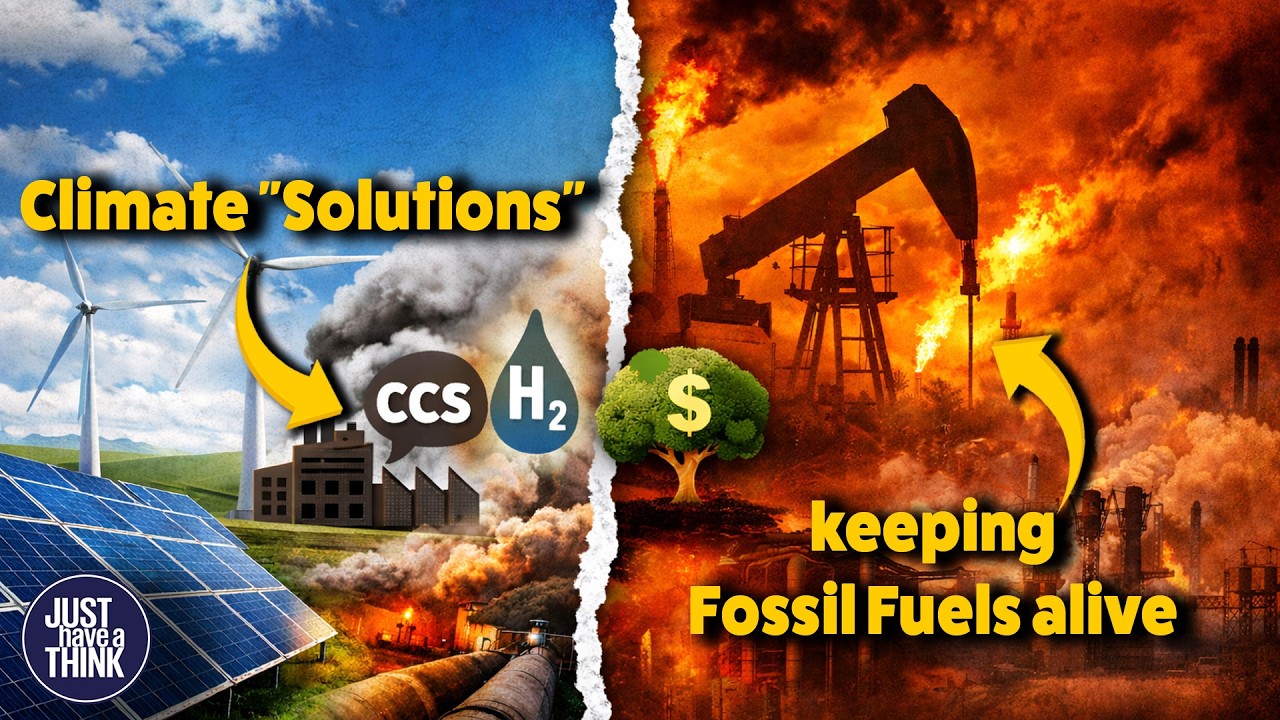
If you’ve been paying even casual attention to energy news over the past year or so, you will, no doubt, have noticed that a number of major fossil fuel companies have been quietly — and in some cases not so quietly — pivoting away from renewables, clean energy ventures, and low-carbon side projects, and back towards what they still see as their core mission to expand oil and gas exploration and production. That shift hasn’t happened in a vacuum of course. It’s been encouraged by a political and economic environment that once again prioritises energy security, domestic production, and short-term affordability, almost always at the expense of long-term climate goals. So, if you’re thinking, “Hang on, aren’t these the same companies that were talking about becoming energy transition leaders a few years ago? ” — you’re not wrong. And yet, despite this very visible retrenchment, the public relations language of apparent climate responsibility is still chuntering away. Fossil fuel companies still talk about reaching net zero – at least within their own operations anyway. Banks still publish glossy transition plans. And governments still announce vast new investments in “clean energy”. Well, not all governments, but most anyway. In fact, in some ways, the rhetoric has only intensified. The trouble with all this sort of stuff is that, for most people, it’s very difficult to pin down what the reality is, isn’t it? Claims are made very confidently, often using technical language, and unless you’ve got the time and data to hand, it’s hard to know what’s real progress and what’s just PR BS. There are of course some brilliant websites that analyse and debunk some of the worst nonsense that we’re subjected to nowadays, and they’re all certainly worth a visit. Now a new research paper has gone to the trouble of assembling all the evidence in one place. And when you look at it altogether — all the technologies, the infrastructure, the finance, and the outcomes — it makes for some fairly unsettling reading. Because what this research suggests is that many of the climate “solutions” being promoted today may not be accelerating the transition away from fossil fuels at all. They might not even be simply ineffective or neutral. They may actually be deliberately designed to keep us all well and truly entrenched in the current energy monopoly for decades to come. Hello and welcome to Just Have a Think The paper I’m referring to has been produced by researchers at the Institute of Environmental Science and Technology at the Autonomous University of Barcelona, and also at the University of Sussex here in the UK The paper’s core insight is surprisingly straightforward. For any proposed climate solution, we just need to ask one simple question: Will that proposal result in a genuine, real-world reduction in fossil fuel production and combustion —or will it facilitate its continued use? Sounds a bit obvious when you say it out loud, doesn’t it? But it’s a distinction that’s often lost in all the noise of publicity and propaganda. The point is, there are loads of projects that purport to reduce emissions PER UNIT, like per barrel or per kilowatt-hour or per tonne of product or whatever, when in reality, they’re actually enabling MORE TOTAL fossil fuel activity overall. From a climate emergency perspective, that’s not helpful. It’s just more delay. And that’s what this paper sets out to document systematically, using dozens of real-world cases from around the world. Before we dive in though, I wonder if I could prevail upon you to take a couple of seconds to click the like and subscribe buttons just down here. It’s a simple thing to do but it really helps the channel remain visible in the ever- increasing noise of click-bait and AI slop that’s swamping social media right now. If you’ve already subscribed then you’re a total legend, and if you haven’t yet subscribed then you’d really make my day if you could. Anyway, back to this new research paper. The authors looked at forty-eight individual projects from all over the world, including a number of solar and wind projects that have been identified as perpetuating fossil fuel dominance instead of doing what they supposed to, which is to help phase fossil fuels out. WHY? Well, I should first of all make it absolutely clear here that the authors are in no way suggesting that wind and solar are inherently bad technologies. Instead, they’re focussing on where, why and by whom those technologies are sometimes being deployed. So, for example the study found contested offshore wind projects in Norway that have been built solely to power existing oil extraction operations, effectively delaying decarbonisation by locking-in fossil extraction infrastructure. Similar thing in Scotland, where licences for oil and gas exploration are being granted to Shell, Equinor, BP and TotalEnergies on areas of seabed that have actually been demarcated for offshore wind provisioning, mainly because Shell and BP spotted the potential for decarbonising fossil fuel extraction in the North Sea with offshore wind energy. I mean it’s so ironic, you couldn’t make it up, could you? Chevron and ExxonMobil are at it as well. They’ve invested in renewable projects close to their own oil extraction
Segment 2 (05:00 - 10:00)
activities, so that they can use the cheaper green energy to support their oil and gas drilling and increase profits, all while claiming to be seeking “climate-friendly energy” solutions. And as the global map shows, this is going on all over the world, and not just with solar and wind but with all sorts of other so-called green technological solutions. I recently spoke with Geoff Dembicki, Global Managing Editor at DeSmog to get an idea of what his investigations have revealed. “The investigations that we've done at De-Smog, the evidence suggests that there is a very coordinated strategy among oil and gas producers to use some of their small but genuine investments in false solutions to portray the entire industry as being on board with fixing climate change. And some of the clearest evidence of that comes from a congressional investigation a few years ago in the US, where thousands of emails were obtained by investigators from various oil and gas companies where they talk about the climate solutions that they're invested in in very sort of clear and stark terms. And just to give you one example, there's one email where BP talked about the sponsored content it produces, which loudly touts its investments in various climate technologies. And in the email, BP says, ‘sponsored content advertising is a powerful way to reach an audience focused on specific issues. We use this as a tool to push our messages directly to Washington DC elites who set and influence energy policy and can decide whether we keep our license to operate. ’ And I think that's kind of the clearest example of why an oil company might want to loudly proclaim that it's investing in some sort of solution. At the end of the day, these companies are deathly afraid that society and policymakers and investors are going to turn against them. And so they have to use all of their promotional might to convince the broader society that they actually do care about climate change, even while they're the prime reason that global temperatures are spiralling out of control. ” The problem faced by our political leaders is that fossil fuels are no longer socially or morally defensible in a warming world. At least not in most countries anyway. That’s obviously changed a bit in the USA since January twenty-twenty-five, and there are of course several other nations around the world who are still holding up their metaphorical and political middle fingers to the whole climate crisis debate. But most national leaders can see the problem and do, I suspect, feel a genuine obligation to demonstrate that they’re doing something about it. But that’s the point isn’t it – politicians are always looking for ways to ‘DEMONSTRATE’ that they’re tackling something in a way that’s politically acceptable. That doesn’t always mean they’re ACTUALLY solving a problem in the most effective way. Basic, proven, incontrovertible physics tells us that the problem with fossil fuels is that their combustion causes warming in our atmosphere and oceans and significantly destabilises our planet’s climate. It’s really that simple. False solutions help corporations, institutions and politicians to solve the challenge of legitimacy — while leaving the real problem largely intact. “So these aren't just theoretical discussions we're having about the dangers of false solutions. We can see this playing out in very real material terms right now in Canada. And last year, Prime Minister Mark Carney, former Bank of England governor, he struck a deal with the oil industry where He agreed that the Canadian government would support a huge new oil pipeline to the west coast of Canada that could carry a million barrels of oil per day. And in exchange, the oil industry through this group they set up called Pathways Alliance would start moving to implement some carbon capture and storage at their oil operations in Alberta. And this is just like a horrible trade-off from a climate perspective because you're gonna get, even if carbon capture is successful in this application, which is not a guarantee, it's hugely expensive. And in the best case scenario, you get some sort of marginal impact on the oil industry's carbon emissions at the same time that they have this huge new pipeline where they're going to be shipping out millions and millions
Segment 3 (10:00 - 15:00)
of barrels of oil every month. Those barrels are going to be burned and the climate impacts of that are far going to outweigh any gains that come from this carbon capture and storage. ” It IS true to say that there may be limited roles for carbon capture in a genuinely rapid transition. There may be legacy emissions that need addressing and some industrial processes may be difficult to decarbonise without it, although even those processes are starting to find better alternative solutions. Anyway, the point is the problem is not the EXISTENCE of CCS. The problem is its strategic role. If CCS is used to mop up residual emissions AFTER fossil fuel production and combustion has been aggressively reduced, that’s one thing. But if it’s used to justify continued expansion BEFORE reductions have occurred, that’s something else altogether. The evidence in this new research paper shows overwhelmingly that we’re seeing the latter, not the former. So, that’s carbon capture and storage. What about the other old chestnut – HYDROGEN. Hydrogen sits in a similar category to CCS. Again, you’ll often hear statements like “Hydrogen is essential for decarbonising heavy industry and long-distance transport. ” But much of today’s hydrogen enthusiasm isn’t about new systems built for new purposes. It’s about repurposing existing gas infrastructure. Pipelines become “hydrogen-ready”. Gas terminals become “future hydrogen hubs”. Gas fields become “bridges” to a hydrogen economy that conveniently keeps them open for decades. All of which creates infrastructure lock-in. Once that infrastructure exists, there’s enormous pressure to keep it economically viable — regardless of whether green hydrogen has any chance at all of ever materialising at scale. Which many industry experts and analysts argue it hasn’t. And when hydrogen leaks — which, as the element with the smallest atomic structure in the known universe, it does magnificently well—it indirectly worsens global warming by extending methane’s lifetime in the atmosphere. So, a poorly governed hydrogen rollout risks reinforcing the very gas system it claims to replace. “Infrastructure lock-in is one of the key things that the oil industry is trying to do by advancing false solutions. Because once the oil companies, along with the huge subsidies they get from governments, invest billions and billions of dollars in the infrastructure of some type of false solutions, it's very, very difficult for regulators to then come and shut that infrastructure down. ” The third option investigated by our intrepid research team is carbon offsets. Another doozy! And arguably the most familiar of all the false solution propagated by fossil fuel operators and enthusiastically adopted by lazy corporations all over the world. Carbon offsets are attractive because they’re cheap, flexible, and easy to explain. ‘Yes’, say the corporations, ‘we DO emit over here but look over there at all that offsetting we’re doing’. The trouble is, as we’ve discovered in several previous videos on this channel, many offset schemes don’t actually deliver anything like what they promise. Emissions reductions are often overstated and permanence is uncertain. There have been instances where farmers grow trees to get paid for carbon credits, then chop them down to get paid for timber and them grow them back again to get paid a second time for carbon credits in a different scheme. Absolutely bonkers, and very difficult to police. Some carbon offset projects even offer credits for apparently ‘protecting’ forestry areas that in reality were never at serious risk in the first place. The result, once again, is that offsets simply become a way of postponing real action. Companies can approve new oil and gas projects, or build thousands of new data centres or whatever, while claiming climate responsibility because they’re apparently paying for a bunch of trees to be grown somewhere far away. From the point of view of the crazy world that our financial systems operate in, all of this makes perfect logical sense. The books balance. Everyone’s happy. From the climate’s point of view, it’s an absolute clusterfing catastrophe. But the paper’s authors point out that there’s another layer to this conundrum that often goes unmentioned. CCS plants, CO2 pipelines and industrial hubs are frequently sited near to vulnerable communities that are already suffering with problems of air and water pollution. CO2 pipelines can fail causing asphyxiation risks and emergency response issues. CO2 injection into subterranean strata can cause local seismic activity, and processing plants can cause groundwater contamination and exposure to co-pollutants like nitrogen dioxide and sulphur dioxide. Crucially, many CCS projects are attached to existing fossil fuel or industrial sites, which means they extend the operational
Segment 4 (15:00 - 17:00)
lifetime of polluting facilities, locking communities into exposure for decades longer than they otherwise would be. All impacts that are experienced immediately and locally. Meanwhile the global benefits are all couched in ambiguous language like ‘contributing to global emissions trajectories’, or ‘aligning with future scenarios’ or enabling long-term net-zero accounting’ And large offset projects in poorer regions can displace communities or restrict land use — effectively exporting the costs of continued emissions elsewhere. So, according to the authors of this paper, false solutions don’t just delay climate action. They also redistribute harm. They’re NOT anti-technology, these folks, they’re anti-avoidance. They explain that a genuine climate solution does three things: 1. It directly displaces fossil fuel production or use 2. It reduces total emissions, not just emissions intensity 13:04 3. It doesn’t rely on speculative future fixes to justify present-day expansion That means renewables REPLACING fossil fuels, not supplementing them. It means electrification REPLACING combustion. And it means the planned, managed phase-down of fossil fuel extraction. Because there is now no credible pathway to climate stability that avoids that conclusion. I’ve left a link in the description to the open-source research paper so you can digest it in more detail at your leisure, and I’m sure you’ve got your own strong views on this one, so as always, the place to leave your thoughts is in the comments section below. That’s it for this week though Thanks, as always, to the amazing group of people over at Patreon dot com forward slash just have a think, who enable me to keep ads and sponsorship messages out of all my videos, and an extra special thank you to the folks whose names are scrolling up the screen beside me here, all of whom celebrate an anniversary of Patreon support in March Don’t forget to like and subscribe to help get us to seven hundred thousand subscribers. And most important of all, Thanks for watching all the way to the end of the video. Have a great week, and remember to Just Have a Think