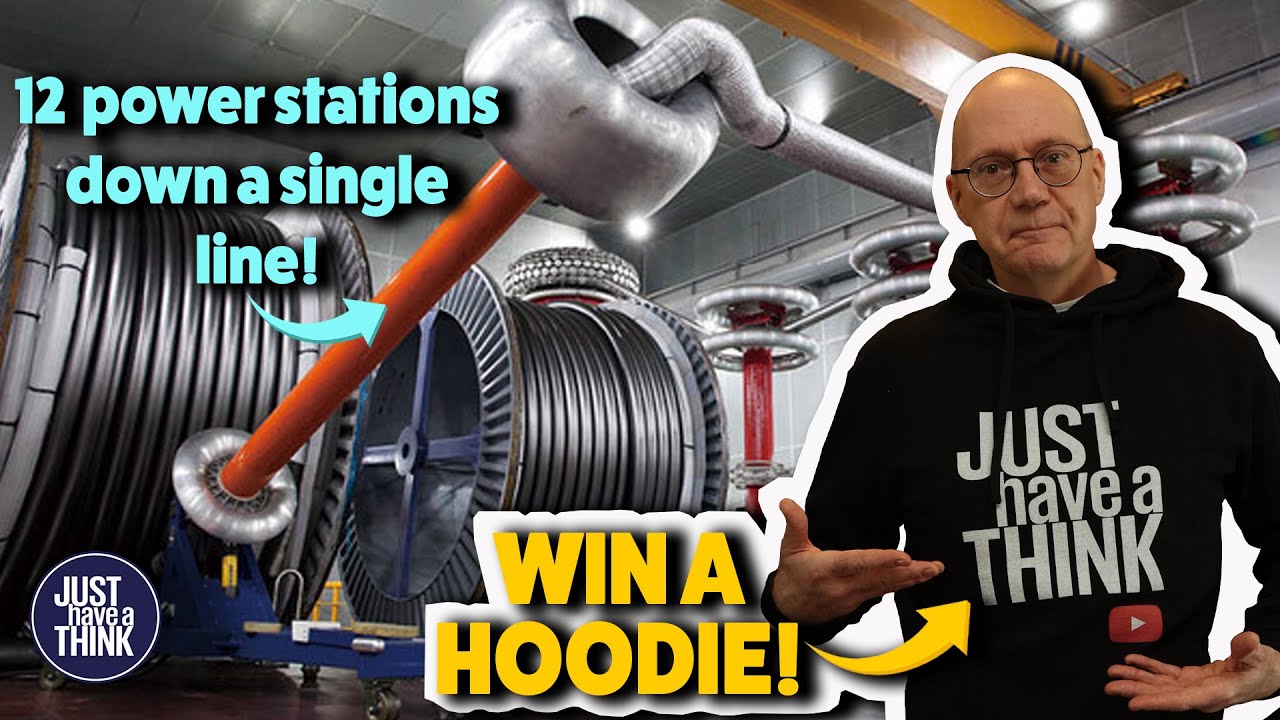
So, you’ve built your wind and the solar farms, and now all you need to do is hook them up to the grid network. But what if the network near you isn’t up to the job and your electrons can’t get to where they’re needed? It’s definitely a bit of a wrinkle. And it’s a wrinkle that is bedevilling many clean-energy rollouts, including ours here in the UK. Renewable generation capacity is growing at a pretty eye-watering pace now, as you know. But without robust transmission infrastructure, much of that potential is sitting idle and its operators are being paid ridiculous amounts of money to NOT produce any energy. It probably won’t surprise you to learn that China is leading the way on this challenge, just as it’s all the challenges involved in the energy transition. Back in twenty-twenty I made a video about a one-point-one-million-volt direct current transmission line sending renewable power from wind farms and solar parks in the Northwest of China to the urban and industrial hubs of the Anhui province more than three thousand kilometres away on the other side of the country which, just for a bit of scale, is roughly the distance from Seattle to Chicago. That was more than five years ago, and China generally tends to get quite a lot done in a five-year period, doesn’t it? So, I thought I’d go back and have a look at how things have progressed in the interim. And, you know…yeah…things have progressed Hello and welcome to Just Have a Think, So, in this little follow up video I’m going to have a look at how well this one-million volt ultra-high-voltage or UHVDC line has stood up over time, and I’ll be checking out how China is incorporating UHVDC technology into its overall national renewable energy transition initiative. Before we look at that though, I’m hoping you can help me get the channel off to a flying start when we hit the New Year. At the time of recording this video, we’re pushing towards seven hundred thousand subscribers, and I’ve rather ambitiously set myself a target to reach eight hundred thousand by the end of twenty-twenty-six. So, I had a bit of a rush of blood to the head, and I’ve decided that once we get to seven hundred thousand, I’m going to give away ten of these rather stylish hoodies to randomly chosen viewers. To be in with a chance, all you need to do is leave a comment down there in the comments section suggesting a topic you’d really like me to cover on the channel. Leave that comment either on this video, or on any video published between now and when we hit that seven hundred thousand milestone. Entry is completely free, and you don’t even have to subscribe if you don’t want to — but obviously, if you do subscribe, it helps us reach the milestone a bit more quickly so we can pick the winners. Those winners will be chosen at random from the qualifying comments, and I’ll contact them by replying to their comment or via the Community tab. I’ll only use your details to send out the prizes, and I promise I will delete them immediately afterwards. This draw is open to viewers aged eighteen and over, and just for clarity, it's not sponsored by YouTube in any way. And then, when we hit EIGHT hundred thousand subscribers, I’ll do the whole thing again! This isn’t some cheap rubbish made in a far-eastern sweat shop either by the way. It’s made in a renewable-energy factory on the Isle of Wight that’s regularly audited for a wide range of social and sustainability criteria. It’s made from fifty percent post-consumer remanufactured organic cotton fifty percent …’normal’ organic cotton. It’s GM-free, it’s vegan-friendly, and it’s made to be remade. In other words when it’s finally worn out, you can scan the QR code in the care label and send it back to the factory to be recycled. So, get typing your ideas — and if you feel you CAN subscribe as well, that really would be an added bonus for me. Now then… the concept of ultra-high voltage transmission, both as alternating current or direct current, has been central to China’s When you’re trying to push electricity over very long distances, the single most important trick is to crank up the voltage. If you don’t increase the voltage, the current has to rise instead to deliver the same amount of power. High current is bad news over long distances because it causes the wires to heat up. That wasted heat is literally useful electrical energy being converted to warm air. By ramping up the voltage, you keep the current low, you keep the wires cool, and you keep your losses down to a minimum. Over short distances, operators tend to use alternating current, because AC voltage can easily be stepped up and down using transformers. …using TRANSFORMERS!. Thank you It’s all to do with electromagnetic induction. I looked at how that works in the first video, so I won’t delve into here, but you can click up there somewhere if you want to jump back and have a look. The thing is though, the ‘sloshing’ of alternating current combined with electromagnetic radiation leads to energy losses in power lines, and as distances get longer those losses reach a point where the economics of direct current, which doesn’t have any of those issues, start to become a bit more convincing, even after you add on the
Segment 2 (05:00 - 10:00)
cost of converting from AC to DC at the supply end and from DC back to AC at the consumer end. And that’s why all the record-breaking mega-links like the three-thousand-kilometre monsters in China that carry gigawatts across deserts and mountains, all transmit in DC, not AC. The Changji–Guquan project that I looked at in my original video remains the world’s longest and most powerful UHVDC transmission line. It’s rated at eleven hundred kilovolts with a maximum carrying capacity of twelve gigawatts. That’s roughly equivalent to the generating capacity of the entire electricity grid of a country the size of Ireland. Down a single transmission line! The operators of the Changji–Guquan line say the connection provides enough power to meet the needs of tens of millions of households. And it really can operate at close to that maximum capacity too. According to this article on the China Daily website, during a peak load period in twenty-twenty-four, the line sustained a high load of ten-point-eight gigawatts for over twelve hours while delivering daily power transmission exceeding two-hundred and fifty million kilowatt-hours. By late twenty-twenty-four the line had cumulatively delivered more than three hundred billion kilowatt-hours of energy from the vast wind and solar farms in the Northwest, which is about the equivalent of a hundred and twenty million tonnes of coal burnt in a power station. And of course, Chinese engineers are not prone to resting on their laurels, are they? According to this twenty-twenty-five research article, improvements in transformers and converter valves, and innovations like gas-insulated transmission lines, and external insulation for ultra-high voltages are being refined to improve reliability, reduce losses, and manage electromagnetic and environmental impacts. So much so that ultra-high voltage transmission is becoming a mature technology in China, which likely means more new lines will become the norm in that country, while the rest of the world still views them as exceptional feats of engineering. Another enormous project is in the pipeline right now in fact. This one will stretch some two-thousand-six-hundred and eighty-one kilometres from the vast Tibetan plateau all the way to the Guangdong-Hong Kong-Macao region in the Southeast of China. It’s budgeted to cost the equivalent of around seven and a half billion US dollars, and it’ll have a carrying capacity of ten gigawatts. As this recent article in the New York Times points out, the high Tibetan plateau is already home to a truly gargantuan amount of renewables, from solar PV and concentrated solar power plants covering an area about four times the size of the city of Paris, to wind turbines right across the horizon and hydroelectric facilities that take advantage of the precipitous drop of rivers at the plateau’s edges. There’s already high voltage transmission supplying power to local regions around the plateau, but this new line will bring a whole new dimension to the network. When it comes into operation in twenty-twenty-nine, which of course it actually WILL do because it’s a Chinese project, it’ll displace enough coal combustion in the Greater Bay Area to save roughly thirty-three million tonnes of carbon dioxide emissions per year. The Chinese government reckons the project will lead to a further fourteen billion dollars’ worth of investment in secondary power equipment and the wider industrial chain, creating more than a hundred thousand jobs. By twenty-fifty, the plan is for more than ten HVDC and UHVDC power corridors to be coming out of the Tibetan corridor, exporting more than five hundred billion kilowatt-hours of electricity every year. UHVDC systems like this show what’s technically possible at continental scale, but the engineering challenges are enormous. Moving from conventional High Voltage transmission of between five hundred and eight hundred kilovolts, like the interconnectors we already have in Europe and the USA, up to a thousand or more kilovolts requires a lot of extremely expensive specialised equipment like converter transformers that can be almost forty metres or a hundred and thirty feet long, weighing hundreds of tonnes. That makes transport and installation quite the challenge. But many of those components are actually already made by European firms like ABB and Siemens. So, that’s OK, we can definitely manage that. Do we have the geographical terrain to justify it though? China has those enormous expanses of sparsely populated territory in the west and northwest that enable long overhead corridors with relatively few social, environmental or right-of-way conflicts. By contrast, both Europe and the U. S. face dense settlement patterns, complex land-rights regimes, and lengthy permitting processes. Long-distance transmission corridors in those regions often encounter strong public resistance, making multi-gigawatt overhead lines far harder to approve and build. And of course, China has the dubious luxury of a non-democratic authoritarian regime that can set long term goals and stick to them without worrying about the periodic inconvenience of elections.
Segment 3 (10:00 - 12:00)
Mammoth projects like these only make economic sense if there’s sustained surplus generation at one end and predictable long-term demand at the other. If either of those parameters changes, then the financial return on investment can vanish into thin air very quickly. That risk is particular prevalent in Europe and the U. S., where electricity markets are fragmented across many regulatory bodies and system operators. Cross-border or interstate transmission lines require alignment on standards, pricing, governance and maintenance responsibilities. That’s a non-technical barrier that often exceeds the technical one. Would we trade our democratic way of life for technological progress though? I suspect not. But technological progress is certainly what’s required, so is it conceivable that our rapacious Western capitalist economies might find a way to work together to achieve levels of national and international development policy, supported by unified standards, dedicated manufacturing capacity, and coordinated operations across regions, similar to those they have in China? It’s not exactly been our Trump card so far, has it? If you’ll excuse the very deliberate pun. As always, let me know your thoughts in the comments section below, but that’s it for this week. I’m taking a few days off for the Christmas break now, so there’s no video next week. But I’ll be back on Sunday 4th January with more news from the world of climate and sustainable energy. Don’t forget to leave a comment to get yourself a chance to win one of these tops, and while your there, please do hit the subscribe button to get us to our target as soon as possible. You can also directly support me by joining the fantastic folks over at Patreon dot com forward slash just have a think who keep everything going around here, AND help me keep ads and sponsorship messages out of your way. And I must just give a quick Christmas shout out to some folks who joined recently with pledges of ten dollars or more a month, They are Charles Denham, Peter Beaman, Arman Diello, Dewsound, Doug Eltoft, Glen Hogan and Annie Nielsen And of course, a huge thank you to everyone else who’s joined recently too. Most important of all though, thanks very much for watching the channel over the course of twenty-twenty-five! Have a very happy and peaceful holiday period. And remember to just have a think. See you next year!