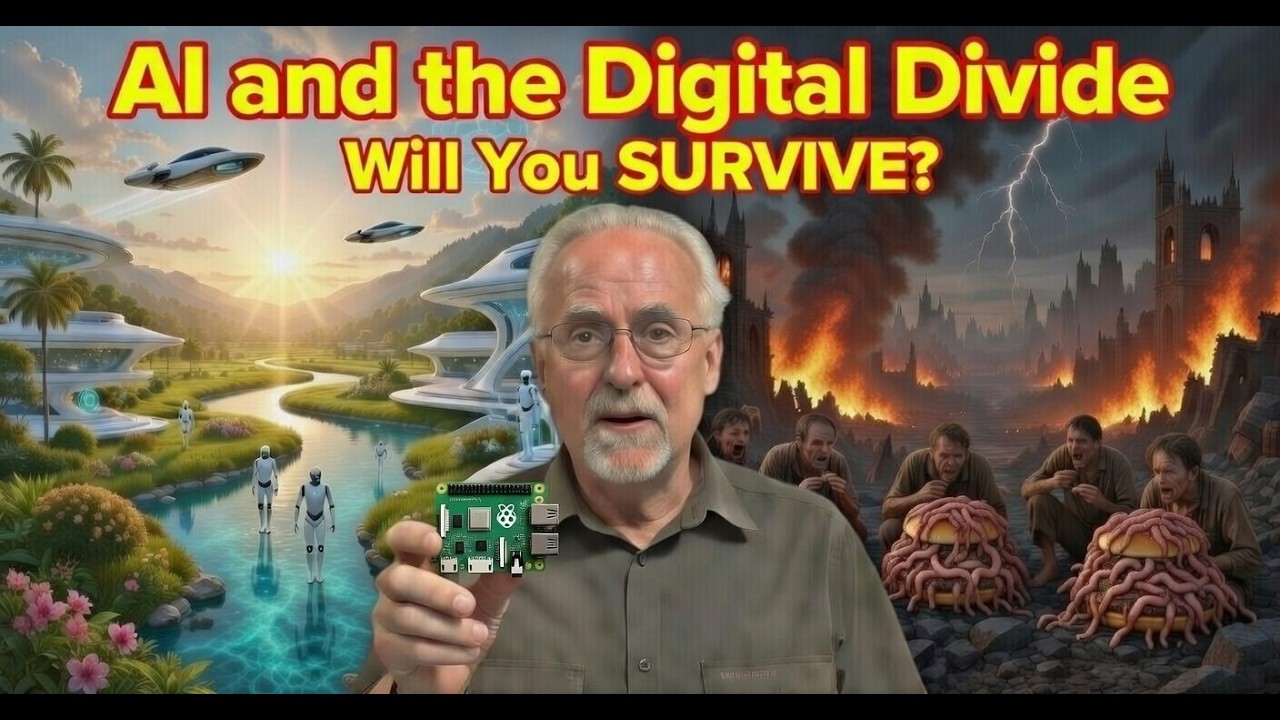
Hello guys, this is Paul McCarter with topteboy. com and we're here today to talk about surviving the AI apocalypse. Now, this is actually a follow on video to the video that I released last week that was called AI in the digital divide. Will you survive? Now, in that video, I presented my analysis of how AI is going to be extremely disruptive and in the next 18 months to two years, there's a very good chance that a lot of people are going to be displaced from their jobs. And so, I got quite a response to that and quite a lot of feedback from that and a lot of people asking me to make another video about, okay, you got my attention. Now, what do I do? And that is what I'm going to be talking about today. How do you futureproof your career to the drastic changes, the existential changes that are going to be coming about due to the incorporation of artificial intelligence, the deployment of artificial intelligence into the workforce. So what I will need you to do is pour yourself a nice tall glass of ice cold coffee. that straight up black coffee poured over ice. No sugar, no sweeteners, none needed. I'm going to need you to buckle up and as you're pouring your coffee, let me just give a brief review of my analysis and my hypothesis of some things that we'll be seeing in the future that I presented in last week's video. Now in that video I suggested that there were going to be kind of two groups of people moving forward in the future. Those people who are driving AI and they will be enjoying a sort of utopian type of future as being one of those on the leading edge of artificial intelligence. And then the other people are going to be the people that are going to be consumed by artificial intelligence. they're going to be displaced by artificial intelligence. And kind of the hypothesis that I presented is if you're not driving AI, if you're not developing it and you're just using it, it's very likely that you could find yourself unemployed. Now, the idea being if I'm using if I'm working in a cubicle and I'm using AI to do my job, then it's going to be very easy instead of me typing the prompts, it's going to be very easy for my boss to type the prompts and I can be displaced very quickly. Or if there's 10 people doing the job without AI, everyone starts using AI, then you would just need one person using AI instead of 10 people. And so we're looking at the possibility and I would say probability that a lot of people in the next two years could very easily find themselves out of work because of the incorporation of artificial intelligence. They are in effect replaced by artificial intelligence. Now I got a huge amount of blowback from that video and I kind of got three different responses. The first response was from people like I specifically were saying that the people that were the most in danger in this next 18 months were people who worked in cubicles. If your job is sitting in a cubicle doing something on the computer back and forth between you and the computer, you're really one of those that's very much at risk of getting replaced by artificial intelligence. The second group that is very vulnerable to being replaced by artificial intelligence is the people whose job involves sort of being a walking database, right? Like a doctor. You go to the doctor, you describe the symptoms. He then looks at those symptoms. He sends you to the lab for tests. Then he looks at those lab results. And what he does is he gives you a diagnosis. And then he maps that on to pharmaceuticals. So what is he? He's a walking database that maps symptoms to tests that you need and then the test results to uh to pharmaceuticals. Now, that could very well be done much better by AI because AI has complete command of every medical paper that has ever been written, much more than you could cram into a human brain. So that mapping process between your symptoms, the test you get, and then the treatment you get for your general practitioner, AI could do that job much better. Now, what I suggested is it's not like you're not going to have doctors, but you're going to probably have a new health care system that emerges through something like
Segment 2 (05:00 - 10:00)
Costco or Walmart where you go in, the kiosk asks you for your symptoms, then uh those s the AI determines what test you need, you get those tests, you come back, and then AI analyzes those results, writes a report, gives a recommendation, then that goes to the physician, and then the physician looks it over, signs it off. But in that model, you could have one physician doing the work of 10 physicians. So I said, these jobs that are walking databases, doctors, lawyers, accountants, they're going to be hit the hardest. So the people that should be the most worried are cubicle workers and people whose job is to kind of have command of a whole lot of literature that is out there. Okay. So the response that I got back from people I got basically three different responses and they were very animated if I can say that the first group of responses I got were from people who were in those jobs that I said were at risk and it's like I touched a nerve with that video and they responded in a very angry way. Now, as I looked at all the comments, there were probably like o over half the comments I couldn't even publish. You know, I moderate all my comments. I couldn't publish them because they were just angry, uh, full of vitriol against me. Okay? But they didn't say anything against my arguments. They said things about me. Well, you're just ignorant and you're just cranking out garbage and you're this, you're that. The responses were not thoughtful and analytic. They were personal attacks on me. Why? Because I touched a nerve. Uh they kind of convince themselves that everything was going to be okay and then you sort of rattle that a little bit and then it kind of shakes their confidence and then they attack you. Okay. And some of those were so nasty I couldn't even publish them. Okay. So the first response that I got was one of just anger against what it was that I said, but very few logical analysis of what I said. Did they go out and read the papers that I'd referenced at PubMed? No. Did they go out and read the documents that I'd referenced? No. They just blindly started attacking me for saying something that either threatened them, offended them, or made them feel uncomfortable. So that was the first group of responses that I got. The second got were people who were working in cubicles, maybe a doctor, a lawyer or an accountant, and they were terrified. They were frightened. They saw the logic of my analysis. It's like I'm doomed. What do I do? And a lot of those people came back with the question of what do I do? And those people I'm going to give a response to that if you are in one of those jobs that very well could be you could be displaced by artificial intelligence or you could have one person with AI doing the work of 10 people. What should you do? I'm going to answer that question today. Now, the third group of responses that I got were old people, people towards the end of their career are people that were retiring. And those people were saying, "Yeah, I' I've seen this coming. I absolutely understand what you were saying and I saw it coming and I'm just thankful that I'm retired and I'm going to be dead. " Okay. But to those people, what I would say is, "What about your children? What about your grandchildren? " Yeah, you had a good run. You lived in that sweet spot of the history of the world where things were relatively good for professionals, but what about your children and what about your grandchildren? What advice should you give them so that they have a chance of futureproofing their career? So, I'm going to be talking to that group uh to that group as well. Okay. So, I got a huge blowback, but again, I'm not here to make you feel good. tell you what you want to hear, but I'm here to tell you what my analysis is. Now, you're free to ignore me. You're absolutely It does not impact my life at all. If you disagree and ignore me, great. You know, wish you the best. Okay? But, you know, I'm a scientist. I'm an engineer. I'm an analyst. And if you look back at my career, I've been right a lot of times. Another response I got from a lot of people is, "Oh, well, everybody's always saying this. Remember, all these people said we were going to die in Y2K. " I didn't say that. Everyone said the Mayan calendar, we're all going to I didn't say that. And then they give historical examples. Well, it was the same thing with the horse and buggy and the car was going to replace the horse and buggy.
Segment 3 (10:00 - 15:00)
And they gave give that example to say because people still had jobs after the car replaced the horse and buggy or after the computer replaced the typewriter. People always landed in a new job. But that is fundamentally different. Artificial intelligence is an existential threat. It's a completely new thing because the car replacing the horse and buggy is completely different than artificial intelligence replacing a human. It's a completely different thing. So those examples that people are giving from history are completely irrelevant. Okay? Just because there's always been people warning of bad things happening, I wasn't the one doing this. This is something new. And this is the first time that I've come on YouTube and say and said, "Hey, I see an existential threat for people working in cubicles and people who are professionals that are just simply walking databases. " Okay? So, I kind of think you got to be a little bit mindful. All right? I'm an analyst. Ignore me if you want to ignore me. Okay. Now, what do we do? So, now we're to the question of what do we do? Let's start by people that are maybe working in the high-tech field, maybe working as a computer programmer or working in a job where you're sitting in front of the computer and the job involves you're sitting in a computer a cubicle and you're working on a computer. And those people who are doing that and were frightened, they asked me what they should do. So let me try to address that. tell you what I would do if I'm if I was in that situation. The first thing I would try to do is in your existing job in your existing company, try to redefine your job or find a different role where instead of sitting in the cubicle all day, you try to spend more time in the lab. Okay? There's a lot of things that are going on in the lab. You want to be spending less time in the cubicle and more time in the lab or more time on the manufacturing floor or more time in the field or in more time in being in front of customers because the people in the lab, field, the people in front of customers are less likely to get replaced by AI than the person who just simply every day is sitting in the cubicle. Now, let me give you an example. When I was an engineer, along the way, long before AI was a threat, there were two types of engineers. There were those that sat in their office all day and then would come up with instructions and then send them to the manufacturing floor and then those things would get built and then they would be sitting there on the computer. I was not like that. I'll give you an example. My job early in my career was to develop radiation hardened integrated circuits to be used in satellites like the original GPS satellite system or to be used in nuclear weapons. And both of those applications required integrated circuits that would not be damaged, would not cease to function in a radiation environment. Now your typical integrated circuit will die very quickly with just even a small amount of radiation. And so what you have to do is you have to create a new generation of integrated circuits that is not susceptible to radiation damage. And a lot of people think, oh well you just shield it, just put it in lead. Well, for certain types of things like neutron uh neutron strikes, there is not enough lead that you can stop a neutron. And so the idea of shielding just doesn't work. And in fact, there's something called dose enhancement. If you try to shield it, if something like a neutron comes in, it hits an atom in the shield and it generates more neutrons and you end up with more radiation coming out of the shield than you had going in. What did you have to do? You had to develop integrated circuits that were hardened to radiation that were not susceptible to that gamma radiation or the alpha radiation or the neutrons coming in. Okay. And did I just sit there and come up with a process for uh you know for a new manufacturing flow, a new sequence of steps to make the integrated circuits. Yeah, that was my job. to make an integrated circuit is about 400 steps and you have to specify every single step parameter that goes
Segment 4 (15:00 - 20:00)
in the computer. Then you start with blank wafers and then it goes through the fabrication facility step by step. But I didn't just turn that in and sit and wait 3 months for the integrated circuits to go to come back to me. Every single day I was in on the manufacturing floor talking to the individuals that would be doing the steps, getting feedback from them, interacting with the people who were working on the line. Then also I would then be in the lab. I would go from the manufacturing floor, I would go to the lab and in the lab I would start putting together the text test fixtures, the tech uh test rigs, the you know assembly of things that would allow me to test that when that integrated circuit came out. And then I would be setting up to go out into the field like we had a gamma reactor that in my lab I could do the gamma radiation testing. But then I'd need a linear accelerator to do different types of radiation testing. So then I would be setting those tests up and then when the integrated circuits came out I would test them. I would then go into my lab and then I would go from my lab to a remote facility in the field where I would do other testing. So, how much time did I spend in the cubicle? You know, maybe 10% of my time. 90% of my time was on the manufacturing floor. It was in the test lab and field. That job that I just described, you know, if I had that job today and did things in the way that I did them, that job would not be replaced by uh by AI. So you guys that are in the cubicle, look at your job. Ask yourself, how can I redefine or change my role or move to a different job within my same company where I am working in the lab, field, I am working on the I am interacting on the manufacturing line or the other one that I mentioned was I am in front of customers because I think whatever you're doing there's going to be those people that are subject matter experts, engineers, technicians who spend time with customers. And what I find is the people that have relationships with customers are many times the very last people to go. So working in a cubicle, try to redefine your position or find a different position in your company that puts you in the lab, on the manufacturing line, in the field or in front of customers. Okay, that is what I am suggesting. Also, if you could re redefine your job where you're not just in that cubicle, but could you find something where you are doing repair or maintenance? A person that goes in and troubleshoots and for a complex system, troubleshoots, debugs, finds the problem, changes it, fixes it, maybe feed that back to improving the design. Okay, that's a good thing to do. So, you don't have to quit your job. wait till you get fired. Just see if you can more futureproof the work that you are doing. Inspection is another big one. You know, AI is not going to be able to do inspection. If you have a job that is inspecting or testing a product that is coming out, I think you're going to be a lot safer. So, number one, try to redefine the job that you're doing. Number two, I think it's really smart if you're worried about getting displaced by AI before it happens right now today, can you start getting side gigs going? Are there things that you can do that you can begin doing now on the side while you're hoping your present job lasts as long as it can? Let me give you an example. Well, I had a student, and I'll talk more about him later, uh, one of my very good engineering students. He went on to, uh, he went on to get a job at a very well-known high-tech company. But while he was sitting there doing his high-tech work, he developed a side gig. What was his passion? His passion was totally unrelated to his job. It had to do with heavy equipment. He grew up on a farm and he always had a fascination and love and knowledge of heavy equipment. and he became an auctioneer. And what he would do on the side, you know, in the evening when he got home, he would arrange auctions of big heavy equipment like a used uh Caterpillar excavator or something, you know, something that's like a $2 million piece of equipment new. And a lot of guys, a lot of small companies are looking for used equipment. So he took his knowledge and
Segment 5 (20:00 - 25:00)
his passion for heavy equipment and he found big companies that were selling off their big heavy equipment or some of it and then he connected them to buyers who were looking for it. And as he was doing that he got to the point that he was making almost as much money in his side gig as he was in his main gig. So how do you pick a side gig? Well let me ask you what's your passion? What is it that you really love to do? Can you turn your passion into a side gig and try to build that side gig up to be a fallback position when if or when the AI displaces you from your job? So this guy auctioneer of heavy equipment. How about this? If you're a technical kind of guy, an electrical engineer kind of guy, what if you started doing solar installations on the site? It's very hard to find a very knowledgeable and competent solar installer for small operations like home installs. And so could you develop a side gig where you are doing solar installations on the side or how about just repair of solar installations on the site? You know, right now in the solar in industry, there's millions of contractors who will come in and install the system, but then there's no one who will come and repair it or do maintenance on it. Now, the guys that are in solar, they want the big job. They want to get that huge profit and markup that comes with the in the sale and the installation of the system, and then they go on to their next big sales job and installation job. Nobody wants to come and fix a system that is not working that is already in the field. So, you know, solar installation, repair work. Is there something that you're really interested in that you know about that you could repair? Okay, I'll give you an example. If you think of your air conditioning system, the compressor that sits outside that runs your air conditioner, those break all the time. And when they break, you know what? it's almost always the capacitor in there. So, there is a huge need for people to repair air conditioning uh compressors and it's a very simple job if you just know a few basic things. There like three things that could be wrong and it's very easy to go out and then be paid to fix air conditioners. Now, I'm not saying you should be an air conditioner repairman, but I'm just trying to get you to think in the way what do you know? What is your passion and how could you today start building a side gig? Okay. Auctioneers, solar install, repair work. How about if you're really interested in cars or motorbikes? What if you on the side started doing motorbike customization where you take a, you know, you take a uh offtheshelf motorcycle and you really trick it out or a truck, you know, you trick out somebody's truck for them. Okay. So, things that you could do on the side in the evening, in the weekend that you have a passion for that you could develop in a business as you are becoming obsolete or in danger of getting replaced at work. Okay. So, those working in the cubicle, that's what I recommend. Get in the lab, the field, the manufacturing line, or in front of customers. And as you're doing that, develop a side gig that could become your career. Now the second group of people I want to talk to are those young people who are choosing a career. How do you choose a career that you will remain relevant and will you know a lot of guys by the time they finish their 4-year college degree that field is already going to be obsolete. There's going to be no jobs for them by the time they graduate. So choose your career very carefully. Now, what do I see as careers that are very much futureproof? And you've got to change your thinking, right? Our thinking today is the guy that goes to the four-year university and gets a business degree or this degree or that degree. That's the prestige thing. You go to college, it's those dumb kids that go into the trades, okay? Go into the trades. But that is going to get turned upside down. and it's already getting turned upside down. The jobs that are going to be future proof, good careers, the jobs that are going to be highpaying are going to be in the trades. Like, let me give you examples of the trades. The trades would be a plumber. Okay? It doesn't matter what other problems you have. If your toilet is stopped up, you're going to call the plumber. And
Segment 6 (25:00 - 30:00)
when that plumber comes, you're going to pay him whatever he asks because you don't want the poop continue to build up in your toilet. Okay? You've got to have plumbers. Similarly, electricians work with their hands, install things, fix things, design things. Electricians, mechanics, welders, okay, solar maintenance people. Well, again, like I said earlier, there's a whole field of solar installers and solar maintainers that is not going to be replaced by AI. And so the jobs that typically we look down on, they are going to have the brightest future moving forward. Now, traditionally, something I always liked, I mean, a truck driver, truck drivers make a lot of money and they had a very secure position, but I really think that we're on the verge of self-driving trucks. So, I don't think right now a good trades career to go into would be truck driving, but I think the other things that I listed, those are going to be there for a long time. Also things like electronic technicians, the guy who repairs the MRI machine, the guy that does maintenance on the lab equipment in a hospital, the field technicians, electronic technicians are going to have a very good and futureproof career. Those are the trades. Let's say you're interested in going into the medical field. I think the worst thing you could do right now would be to say I'm going to be a doctor because then people will call me doctor and I have the white coat and you know people have this strange attitude that somehow we've elevated doctors above everyone else and that's the thing we should strive towards. But instead of being a medical doctor, a general practitioner, I think a much better career would be a chiropractor. Think about a chiropractor. Sometimes I get up and I just even just doing the simple thing, not lifting something heavy, but I just twist my back in a certain way and ah immense pain where I can't even walk. I can't even move because of this lower back pain. I go to the chiropractor. I have a chiropractor here. She pops my back. She does this. She does that. And I pop off the little table feeling like new. that job a chiropractor is not going to be replaced by AI. I think also physical therapist again the manipulation the human manipulation of the human body a chiropractor or a physical therapist I think that's going to be good for a long time now you could say what about robots well we'll burn that bridge when we come to it right now the problem is not so much robotics the problem is artificial intelligence and I think there's a lot of jobs that it's going to be a long long time before robots combined with AI can replace a chiropractor or a physical therapist because that's even more than a science. It's a knack. You know, you got to twist that back just right where you get that solid pop, but you don't, you know, twist the person in half. And I think that human touch, that feel, that knack is going to be something that it's a long time before robots and AI are able to do that. I think also if you wanted to go into the medical field, I think the nurse or the nurse practitioner is going to have a brighter future than the general practitioner. And I'm going to let you guys know something. Nurses make a lot of money. Okay? And a good nurse, nurse practitioner can make just about as much as a general practitioner can. And I think a lot of the work is AI is replacing the general practitioner. I think a lot of the hands-on work is going to be moved down to the nurse practitioner things. So, I think if you're interested in medical, those are uh good things. I think there's a growing interest in alternative medicine. you know, someone who uses more the uh, you know, the naturopath types of things, herbs and traditional Chinese medicine and acupuncture and those types of things are really growing as a lot of people are feeling like the mainstream medical industry is just uh, it's just a vehicle for selling pharmaceuticals. So, I'm not saying what I think. I'm just saying there is a growing population of people who are very interested in naturopathy and I think that would be something that would be a good type of uh you know medical career that you could go into. Let's say if you really love engineering like if you take my Arduino class and you've taken my Fusion 360 class and you just your passion is engineering what
Segment 7 (30:00 - 35:00)
should you do? You should go into engineering, but you should pick a field that is futurep proof. What's one of them? I've already said solar installation. Going to be a long time before robots and AI are doing the installation and the maintenance of particularly home solar installations. Now, I first got solar about 20 years ago in my home in Texas. And I'll say back then I did it for other reasons, but economically solar did not make sense back then. You could do it from the argument of sustainability. And there's different arguments you could use for going to solar 20 years ago, but man, today the cost of solar panels has dropped and the cost of inverters has dropped and now I really believe without subsidies that solar is economically viable. Okay. So, I think there is still a great opportunity either to work for a solar installation company or to start your own solar installation company. I think there's a lot more solar installers out there, as I've already said, but what we're missing is people that will go in and do maintenance and repair on home solar systems that are already in place. And that's hardcore engineering combined with practical hands-on skills. Like solar is really something that requires engineering skills and electrician skills. And there's really not very many people that can do that. There's the more solely electrician focused people who are just going down a sheet to do the install. They don't really understand the engineering. And then there's engineers who technically understand solar but don't have those practical skills of how do you run wire, conduit and that sort of thing. So I think solar installation is really for someone that's wanting to do engineering based thing. I think it's a great career field. Power distribution, right? We're always going to want power to our house. And you've got lines and you've got transformers and you've got substations. And power distribution, power engineering tends to be a lot more handson type of work. And again, it's one of those things that's hard to reduce down to an AI solution because every substation that you go to that's misbehaving, it's quirky and it's got its own thing. It requires a knack. It's almost more of a craft or an art than it is an engineering science. And so I think power distribution along with solar installation is something that's good. Now more broadly if you want a career in inst uh in engineering you want to focus on areas that are installation maintenance or repair because there again the robotic threat is going to be way far out compared to the artificial intelligence threat that we see right now. And then finally I think that the field of robotics and mechatronics is really good. good because if robots are going to take over the world, you really are going to need humans to do a lot of the maintenance and uh manufacturing of the robots. Now, eventually, you know, you've got the Elon Musk dream where the robots will be building the robots and uh will be repairing the robots. And I think he's a brilliant man and I think he has clarity in the way that he sees the future. But I think his vision will be very far out there. It'll be very long time frame and I think you could enjoy a very good job in robotics and mechatronics for probably decades. Okay. Now one of the things so that's talk I've talked to the people presently working in a cubicle. I've talked to the young people who are choosing a career. This also goes to you old guys that need to give advice to your children or your grandchildren. So, I'm talking to you because you can transfer this and maybe share this video with those people. Okay? You can make a difference for the next generations. But then there's things that I want to talk about to just sort of everybody. And what I would say is either you know if you use AI to do your job, AI is going to replace you. It's going to destroy you. The AI that you're using to do your job is going to replace you. And as you're using the AI, you might know not know this or not, you're actually training the AI. AI is becoming more intelligent as it interacts with humans.
Segment 8 (35:00 - 40:00)
And so you think you got this great deal that AI is doing your job and making you more effective, but really what you're doing is you are training that entity that is going to displace you. So when it comes to AI, you need to either drive it or you need to get out of the way. But if you're sitting there just using it, you will be consumed by it. And so if you're interested in AI and you want to make AI a career, the part of AI that I really like is the AI on the edge. That's where you take, you know, like a Raspberry Pi or a single board computer and you install AI on it and then you create a little mechanical agent that does something very useful. And so you're not out developing the next large language model. You are using AI as a tool to build things on the edge. either working for a company or working for yourself that does something useful. In that case, AI is a tool for you. Just like today, an electrician has a tool belt. He has a screwdriver. He has wire nippers. He has wire strippers. He has digital voltmeters in his tool belt. Well, now a new tool is going to be AI. and you use that AI to build something better that you couldn't do before. And so this is maybe a little bit of a plug for my upcoming class which the lessons should start dropping in March. And that is called AI on the edge. And what we're going to be using is a Pi 5. We're going to install these AI models on it. And then we're going to interact with servos and motors and cameras and all types of mechanical hardware and we're going to build some really cool projects. We're going to be what? We're going to be driving AI. We're going to be doing new things that we couldn't do before AI came along. Okay? So, you either need to be driving it or you need to get out of the way. But you can't let AI, you can't use AI in a way that it is going to displace you. The final advice that I'm going to give you is you really got to think, you got to stop and think where is my passion? What do I have a passion for? And perhaps the most important advice I can do is, you know, do something that you have a passion for. And let me ask you this. Have you ever noticed how hard it is for most people to tell you what they actually do? Like they go to work every day, they get paid. Oh, what do you do? Oh, well, I'm making sure I write the SOPs to make sure that we are compliant with the uh article 7 requirements. And so I take these documents and then I write procedures and then I make sure that we are compliant. It's like you have no idea what they're talking to. Talk to a mechanic. Ask the mechanic, what do you do? He says, "People bring me their car, the car is broken, I fix it, they drive away in the car fixed. " Very clear. So, I think, you know, if you can't describe your job to someone with that level of clarity, I think you're in danger of becoming obsolete. Plus, most of these people that are doing these bureaucratic and paperwork type of jobs, they have no passion for their job. It's the rat race. It's the grind. They go in and they grind it out for eight hours and they're just waiting for the weekend. And then pretty soon, waiting for the weekend isn't enough. It's like all they can think is, I can't wait till I retire. Why? They have no passion for their job because internally they know that their job is kind of meaningless. there's no sense of reward that they get for the work that they're doing. So what I want to tell you guys is the young guys, the old guys, the guys in careers, figure out what's your passion and pursue your passion. Because if you pursue your passion, I really believe that you'll be able to find a career for yourself. So number one, if you're going to use AI, drive it. Don't be consumed by it. Okay. The second thing is pursue your passions. is figure out what your passion is. If you don't have one, develop a passion. Okay? Develop a passion because it's the people with a passion that are always going to find themselves coming out on top. And then the third thing that I would say, and I'm trying to really figure out how to say this, it's like, okay, you want to drive the AI, you want to have
Segment 9 (40:00 - 45:00)
passion, and then what you want to do is you want to be flexible. nimble. This idea of my generation like you finish college, you go to work for a uh IBM, you put your 40 years in at IBM and then you get your retirement and you enjoy your last few decades of life in retirement. That's gone. That model is gone. You've got to be nimble. flexible. As you're doing your job today, you need to already be thinking about what your next job is. You need to be doing your job, getting paid. You need side gigs. You got to figure out where your passion is. You've got to be nimble on your feet because the world is changing so quickly that you've got to be nimble. And so during my career, I started out in radiation hardened micro electronics. From that I was one of the uh founding people doing the pioneering research in nanotechnology. So I went from radiation harden integrated circuits to nanotechnology. I did sensors you know uh inventing and designing new sensors. I went from that to I started a Silicon Valley high-tech company where we were making telecommunication equipment and then we redefined the company where we were making medical implants. I went from that to doing education. Then from education, I started doing YouTube. I've always been pursuing my passion and I've always been nimble and flexible and I've always whatever I'm doing, I think about the next thing that I'm going to be doing. So me today, I'm kind of a YouTube influencer. I see that's going to be going away. replaced. What am I going to be doing next after that? I'm constantly nimble. I'm constantly flexible. I'm constantly dynamic and I'm constantly thinking about that next thing I'm going to do. And you got to be that way because this idea of a 40-year career at the same place, it's just not going to be there anymore. Okay, guys. A lot of you, hundreds of you asked me to create a video of, okay, I got your attention with the first video. I scared you. Now, the question was, what can you do? I think I've told you. If you're interested in AI, I really hope you guys will check out my upcoming video, AI on the Edge, where we're going to be doing some super cool projects using the Raspberry Pi 5. Okay, guys, I mentioned that I got some really, really negative, hateful, vicious comments on the last video, but I understand it because I touched a nerve, right? I made people uncomfortable. I threatened their worldview. I threatened that safe mindset that they had and I didn't mean to deliberately anger people so much. But now that I have your attention, I want you to think about the things that you've said. Now, I want you to do two things. I want you to leave a comment down below. But rather than just attacking me, you know, be logical and be thoughtful and mindful and think about what I said. What is it that I said that made sense? what is it? And you'll give good analysis of the areas I'm wrong and maybe they're solutions that I haven't thought of. I very clearly see the threat and what I've given you today is what I see is the path forward so that you remain employed and remained useful to your family and to society with the skills you had because again I think those there going to be those that prosper in the future. It's a dystopian future. Those that prosper and life's going to never be better for them. And there's those that are going to be dep displaced by artificial intelligence. They're going to get their universal basic income. They'll get tokens every month as long as they maintain the proper uh uh social score and do things right. They'll get their tokens and they can get their worm burgers and they can sit and scroll their phone all day. Okay. Where do you want to be in that dystopian future? You want to be over here. You don't there. And I think I've given you a path to be part of the group that will find the pu future the best that it's ever been for humanity. Okay, I might have missed some of the good ideas. What I hope you guys will do down below is leave a comment. Hey, the opportunity I see is this. And if you say, "I disagree with you. " Say, "Why? " And give a cohent argument instead of just saying that I'm just this, you know, ignorant old man that's cranking out garbage. Okay? Instead of saying that, tell me why you think I'm wrong. Okay? Tell me the things that
Segment 10 (45:00 - 46:00)
I've that I haven't seen. The bright future, the careers that you think have a bright future that maybe I overlooked. Okay, guys. These last two videos have been a little bit different for me and I am right now preparing the AI on the edge class. So don't worry those of you who hate these two videos. I'll get back to my old jovial self, my old grandpa image teaching you how to do useful things on the Arduino or Raspberry Pi or whatever. So I'm getting back to that. But I just really felt like I should share this burden I have for this this like somewhat what could be some somewhat of a frightening future. And so you guys give me your feedback. I really I read every single comment. I really want to see what you guys think. I I'm hoping that some of you guys will have good ideas that I didn't uh that I didn't mention in this video. Okay, guys. Uh let's see. Yeah, guys. I appreciate you tuning in. Uh, share this video with other people, especially I know I got a lot of old codgers that are following me. Share this video with your children or your grandchildren because I think that, you know, I think the things that I'm bringing up here, even if I haven't done things perfectly, I think these are things that we need to be thinking about, talking about, and planning for. Okay guys, really appreciate your attention here. Paul McQuarter, topteboy. com. I will talk to you guys later.