Everyone designing PCB boards needs to watch this - Certification ( FCC & CE )

Everyone designing PCB boards needs to watch this - Certification ( FCC & CE )

Machine-readable: Markdown · JSON API · Site index
Поделиться Telegram VK Бот
Транскрипт Скачать .md
Анализ с AI

Оглавление (25 сегментов)

Segment 1 (00:00 - 05:00)

In this video we are going to talk about uh certification of wireless uh models and boards and we are going to talk about this topic because uh today almost every board uh is some kind of wireless at least Wi-Fi or Bluetooth. So we would like to know what kind of certification we need or if we need a certification is this what we are going to talk about commen. — Oh yeah we're looking at modules in wireless and what they actually mean for your product and we're looking at common pitfalls and misconceptions so you have a better chance of getting your product to the market with a module or without one depends. Perfect. Uh so uh I think just very briefly uh I would like to mention uh we will have some kind of uh slides where we talk generally about this topic and then you have also some examples and some demos some measurements like this one for example and we will also talk about this uh especially uh I think two of them what we are going to mention are for example ESP32 and these Raspberry Pods correct — exactly We are looking at very popular modules, things that people already know from out in the field and we're going to demystify everything about them. — So why we would like to talk about this topic from your point of view why it is important. So there's one thing that you should first know about my approach to this is I'm running a little compliance company specifically focused on open source hardware and makers and so forth. And the one thing that constantly gets sprung up is people mix up the legal requirements in the USA, in the EU, the different frameworks, FCC versus CE, and there's a lot of misinformation out there that is usually a mixup of different systems or uh somebody had a little misunderstanding or things that would apply to one specific case but not generally. And with AI, it's getting worse and worse because what the AI scrapes is basically all the stuff that's already out there that's maybe even outdated and then it mixes it up again and spoos it back. So you're not getting any better information out there and I want to rectify that. — So you mean when someone ask AI for advice in this topic then they may not get like correct answer. Yeah, this is one of the fields where especially like it's hard to get a really perfect answer from an AI model. But in these cases, the answers that an expert would give you is already so complicated and it depends on the very specifics of your particular product. So you can't give a general u explanation. It's basically always it depends on your exact setup and tiny details can make a lot of difference. And the AI model doesn't understand that obviously. So you need to be very aware of what is out there and should not rely on that information at least really check it. — Okay. So uh basically why we need to talk about this topic because if someone design a board with uh wireless uh communication then uh this board always need to have some kind of certification. But uh there is a little bit difference between using modules or basically placing the RF chip and antenna directly on your board. And uh these certifications uh as you mentioned they are different around the world. They are different in European Union. US. So I think we should start with this. So what is difference between US and Europe? — Well there is a lot of difference. I think we should start at the very start. So we're talking about free certified modules for Wi-Fi, Bluetooth, Bluetooth low energy. It also applies to some other wireless modules, this general concept. But we first have to clarify a few things and we have to go through that step by step because some terms that you will hear in this conversation may be used in different ways depending on the legal framework or your location. So the word module means some something different in America and in the EU for example. So we have to clarify all these things first so we know what we're actually talking about. This is where the mixups come in. Okay, — so

Segment 2 (05:00 - 10:00)

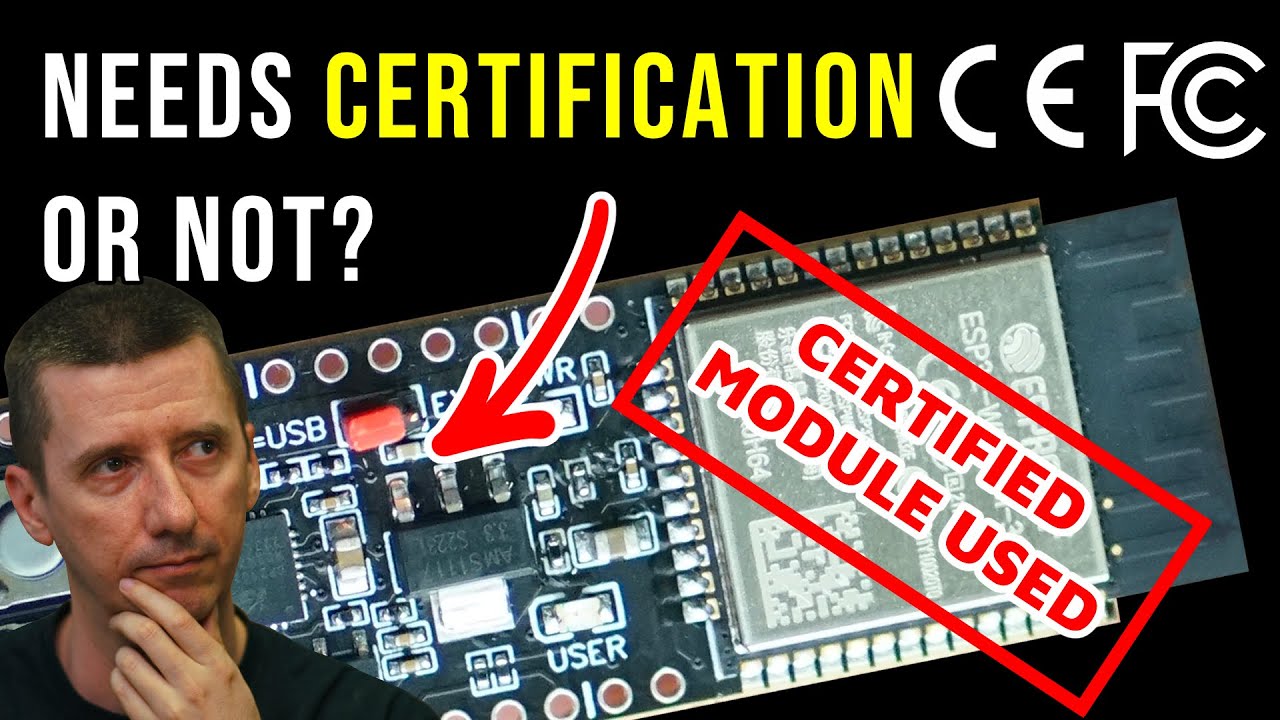
— first we're going to define what even is a pre-certified module so we're all on the same page. Then we look at the general differences between the systems FCC and CE, USA versus EU. Then we talk about when it does actually make sense to use a module. There are cases where you really want to have one and there are cases where you can decide that really based on your application — or you have to basically decide against the module because of your application. — Then we're looking a bit broader into the field of compliance because it's not about RED the radio equipment directive and EMC electromagnetic compatibility. There's more to this. It's these are only parts of the whole picture and if you're not getting the whole picture, you're missing something. That's really important. These are the tiny details that matter. And then we're looking at some real world examples that you might encounter in your daily life and figure out do they need a module? What are the pitfalls? What do you have to look out for? And then I'm gonna uh show you briefly how to figure that out for your product because it always depends on your exact product. Okay? So there's no easy general answer to a very complicated question, but you can give a very complicated answer to an easy sounding question. — That's where the mishaps usually happen. So this is uh what we usually see as a pre-certified module. This is the Raspberry Pi one uh radio module 2 that just came out. This is an ESP 32S3. You can get them ready to be soldered to your board. I have a strip of ESPs right here. So for your assembly needs, this is basically as a component. The same way a pick and place uh places a resistor, it also can place these modules. So for you in your design, you treat this basically like an individual component. There are also things that you would call a module. For example, this is a very old project of mine where we have like an Arduino compatible board and we have a little sensor board. — These look like they are individual PCBs like this thing here. It's just a PCB that you can solder onto another PCB. You would call this a module in general, but these are not modules like the ones we have on screen — because of the missing marking or I don't know. — Well, so here's another module. This one has a shielded can just like the one on screen — and this is a microprocessor. So this is a system on module. It's called module. So it must be a module. Well, that's just something that processes stuff. It's you would call it a module but that is not what the FCC calls a module. — Okay. — module something in a very specific case and that means this thing is its own product so to speak. It has been examined. It has been tested. It has been authorized by the FCC. And now it has something on here an FCC ID number. You can show uh you can use cursor. — Uh I'm on the screen. Do you see my mouse? No. — Okay. It's maybe you can maybe this way. — Yeah, I can see it now. Yeah. — Okay. Yeah. So these numbers here um try to clear that away. Yeah. — So here there are numbers. This is the FCC ID number. — Mhm. — A device only gets this number if it has been tested and approved. — Mhm. — So this is — this is important to watch for when people are selecting wireless modules for their boards. — Yeah. So if you most people come to this topic because they heard oh if I use a pre-certified module I don't have to take care about wireless certification anymore. something along these lines which is — we have to qualify that very much. Yeah. But this is why people in the first place go towards modules. Oh, if I use this I will have an easier time which is true — but we're going to explain why. — Mhm. — If a module is out there and doesn't have any numbers on here. Let's look at the same module but this is on the just clear away the drawings. Uh but this is from the data not from the data sheet this is the EU declaration of conformity for that same module and here's nothing on there. — Mhm. — Why? Because that photo was taken before

Segment 3 (10:00 - 15:00)

it has acquired uh these certifications. There cannot be no markings before you did it. Usually you would now uh replace that image with one that is actually marked. But you have to go through the process first before you can actually mark it. It's a legal thing. But it's the same module. If you don't find anything on there that has an FCC ID on there, you can't call it a module under these regulations. You need to know that number and it has to be on there. So it's actually okay to use it that way. — So this is only for FCC. FCC is in US correct? — Yeah. — Is it same for like CE? Is there also number for — No, here comes the thing. So um the internet is a very USA centric place in a lot of things. you find a ton of content out there especially in electronics engineering in English and the USA is just a huge market and so even in the communication that people put out there here's the sales pitch that you usually get like recently Fern June Evan Opton writes Raspberry Pi radio module uh under you can build your own wireless enabled product around ours without having to reertify the radio saving tens of thousands of dollars Here's one by Nordic. Same thing. Pre-approved modules. We've saved you the time. Blah blah. This is a very Americentric perspective. This modules approach with pre-certified modules can only be done in with two big qualifiers. One, it's under FCC, which means in the USA, nowhere else. And you are not allowed to change anything about the module. — So the the people that built these modules usually they have a big integration guide with them and that says specifically how you have to mount them, solder them, uh the way the antenna has to be uh exposed, very specific sets. If you change any of these parameters, usually they have like we have two different kinds of firmware. If you flash this and that one, both are uh have the FDC ID blah blah. But if you go beyond that, your pres-ertification is void. — Mhm. — So let's look at the very simple case of an ESP 42. You would have your project, you put it on here, and uh people often use an ESP32 not just as a Wi-Fi module that is a co-processor basically to your main processor, — but they use it as the microcontroller itself. — Yeah. — So now what are you doing? You you're flashing custom code on there. You've changed the product. you could potentially change its behavior in uh electromagnetic compatibility in radio compatibility. there is a potential for it not performing the exact same way as it has been tested and now yeah where's your module now — so I always I always thought it's a — uh if you use the part the Wi-Fi or wireless part or you know of the model same as it was used during certification that it will be okay so that's not true — here's the thing can you prove that No, — if you can, you can use it that way. How would you prove that? — So, what does it mean? ESP32 is tricky to use. — That's the thing. So, if you integrate it into your product, you do changes because you okay, you solder it to your product. You maybe have custom code, you leave the Wi-Fi and Bluetooth stack alone, but you're uh you're soldering to this. There's capacitors added onto the pins. There are additional components. There are high frequency signals. Whatever. There's always something changing. If you can prove that it's still okay, then it's okay. But if you're unsure about that, you better get the information somehow. How do you do that? You do the certifications. You do the testing. Once you've done the test, everything is okay. if you leave the module as it is. So there this is one of the cases where it's it really depends on your product because if you use the firmware the module comes with usually these come with AT firmware for example you leave it as is you integrate it the chance that your project still performs the same way that it was tested is pretty high. But if you change something

Segment 4 (15:00 - 20:00)

there's a chance it won't. But — and the — Yeah, go ahead. — Yeah. The big difference like the a general um difference between how this FCC system works and the CE system is that under CE you as the manufacturer have to guarantee that your product fulfills all the requirements that it has. The way you prove that that's on you. There are common and usual ways that you do with harmonized standards with the usual lab tests. This is the way but the actual law is you prove that however you can. Here is a way that we accept. FCC works differently. There's an accredited lab. You send the product there. They test it. They give you back uh something like this here. I'll just put that up on screen. So this is for the ESP32S3 room one module. Uh this has been tested by an authorized lab and now it has uh passed all the requirements and it's now uh basically a module. This is what you get uh from Expressive that you can download on the website. So this is an FCC report and it's an authorization for this specific equipment for this module. If you have a different variant of that module, you would have a different document. — Mhm. I have a question what I wanted to ask. — Yeah. — So if the module has antenna — then placing module in different places in your PCB may modify the parameters of the antenna. Correct. — Exactly. Yeah. And that's the thing you how would I be able to guarantee that this module performs the same way if you integrate it in this or that product. I can't control how you are integrating it. I can just give the guidelines this integration guide. And if you don't adhere to it, well, that's on you. So, I can only tell you how you can integrate it and still keep it the same. But if you change something then it's everybody's game. So you would have to retest it to be exactly sure. So it's a very narrow road that you can take where you can actually say okay this still performs the same way. Usually companies test that with a pre-ompliance check to be sure that the integration is correct before they make that statement that it's still okay and they would um would avoid the more costly uh radio directive tests. So you can in general if you do uh compliance lab tests the uh radio directive tests are usually 10 times more expensive than the EMC tests. So they want to avoid those if possible and if they can be sure uh that the module still performs the same then hooray you have saved a lot of money like they claimed here that only works under FCC rules. Yeah. And why it it's the same module it does perform. And I'm uh I'm going a bit ahead here. If you're looking at the actual lab tests that you have to perform, the limit lines and whatever for FCC and CE requirements are quite similar. — This was my next question. Like which one if you certify in one country can you be quite sure maybe — I am European. I'm Austrian. So I will have a very Euroentric perspective to this but I've put the product on the market uh like in right ways and start with CE. — Mhm. Why? Because that's the most involved process. And once you've cleared that, it's quite easy to clear the rest and you can do the required tests for FCC the at the same time you do the C test. — The requirements are quite similar. — Same goes for UKCA. Would you now do UKCA? Well, it depends. But if from a from now and we have July 2025, I would say go for C. Mhm. — Don't do UKCA because it's accepted for some time now. In the uh UK, you don't have to have UKCA, but if you're like you're a domestic supplier in the United Kingdom, you might want to put that — on your product because people will look for it. So there are certain uh things you have to think about when deciding, but I would always start with CE just because if you have everything in order for CE for the full package, you have a much easier time with everything else.

Segment 5 (20:00 - 25:00)

And Europe is a big market. You want to serve that. — There's a lot of money to be made there. — Okay. I I made these two questions. I made notes about these two questions, but you answered it then. So good. We can move ahead. So um we have a big difference between FCC and C. So I've not noticed already that the way this FCC module approach works doesn't work in Europe — and that's because these systems have very different requirements. They work completely differently. I want you to like make note of a very specific thing. It's not the same They're not connected and there is no replacement. You can't say I'm going to go for the FCC system and then it will be okay everywhere or I'm only going CE. No, — if you're selling your product within Europe and not only the European Union, there are other places that also accept CE. For example, Norway, Iceland, Switzerland, Turkey, all big markets that you may want to serve, they all accept CE. So, it's a bit more than the European Union. And you also don't want to ignore the American market, of course, because that is a very big market. And once you have cleared your product uh in Europe, it's usually not that hard to get it cleared for uh the American market, the — the requirements for safe products are quite similar. So if it's I would always advise people to go for the strictest market that they target first because if you clear that one all the others are a breeze. So go for Germany. That's it's usually restricted except if you want to do twice then go for Poland. Yeah. So uh it's always easier to or better to target the biggest hurdle first. So the uh in the USA just very broadly yeah don't take this as gospel this is a very uh very shallow overview in the USA you have your product category your product falls into there are certain rules that apply to it uh in case of if your product has wireless there will be FCC rules there will be more in other legislation but we're now focusing on these wireless modules there are applicable standards that you have to fulfill and you give your module or your product to an accredited lab that will test that and issues a certification. — Mhm. — What they issue is uh this thing here if I can open it. Yeah. So this is one of the uh of these. — Can you find these on internet if you would like to check someone else's product if it has certification? Oh yeah, you yeah you can uh if like any reputable manufacturer has their data sheet for their parts online of course and the same goes for their modules. They usually have these certifications. So if you go to the expressive website you can download that. I just downloaded that a few days ago — but FCC doesn't have any website where you could find it. — Um I think there's a where you could enter the ID and it will tell you if that product and that ID match. Mhm. — So in case you encounter a counterfeit product or fake one, then you could see, oh, this ID doesn't actually show up with that specific uh name of the product, then you might want to look into a different supplier. — Okay. But um yeah, and there's of course on the same homepage I can also look up another thing and I looked for the C u declaration of conformity and this thing came up and it's also from the expressive homepage and it says EU type examination certificate. That's not the same that we've seen here. This one says EU declaration of conformity. Which one is wrong? — Well, — your camera is gone. — Now it's back. So, EU declaration of conformity. Actually, just declaration of conformity is enough. This is the correct document. Mhm. — This is a page that tells me what this module is, who built it, who is selling it, who's the named EU representative. That's a new thing since last year. So, it's this entity in Ireland that's within the EU. So, that's the EU representative. And we declare under

Segment 6 (25:00 - 30:00)

social responsibility, blah blah. lot of legal jumbo, but it says this thing is compliant with this legislation, this legislation. It even, this is actually a bit of a bonus, it even tells you which standards they use to verify that you actually only have to like say this directive is what is valid for this product and this product is correct. We guarantee that as a manufacturer. It's very common and usual and I like it when people do that. They also tell you which standard they use and I especially like that they use an Etsy standard because these are free. So you can actually look up that standard and don't have to pay for them. Fun fact, you standards. A lot of people don't know that they are quite expensive and sometimes they aren't that big. Um and Etsy standards, these are only for radio equipment. Those are usually free. Do you have some tips where people can download it? I think this would be this will be next question definitely. — Oh yeah. Uh basically when we uh when we do uh the assessment and stuff for clients and stuff, we usually give them links. Usually when they have to buy uh a specific standard, then I'll basically I look for the cheapest source and I give them the link so you can have it. I I'm not allowed to like resell standards or whatever or just download it and give it away. That's illegal copying because it's like a book. You have to buy a book. — But I mean uh I mean like first where they can find out what kind of standard they need and then where they can find the standards to buy them. So you already mentioned there are multiple sources where you can buy it. — Yeah, there are national standardization institutes. — Okay. Can we go on website just for examples? — Oh yeah. Um, so here's my website, but we're going Austrian standard. This, for example, is Austrian standards. This is the Austrian standardization institute. Then there is one that I really like to use is the Estonian one. — Mhm. This is uh they have a very good search which is not really loading at the moment but yeah that's basically uh Austrian and uh the German din these are usually the most common ones u but I especially like the Estonian one because they have everything not just in Estonian they also have it in English and they usually are um they have I think this is a bit going into the deep end but the uh usually you have standards and then you have amendments to them. So there's a main document and additional documents and with a lot of the institutes you have to buy them all separately and if there are amendments then the Estonian one always has one package where everything is in there. — So you can download that in one PDF. It's much better — my opinion. You're not missing out on a specific new thing that they added. Okay. — Yeah. So but then how do you figure out which one you need? you're coming a lot ahead of us. This is basically the biggest question that everybody has and the first thing that they have to think about is when you start your product. Yeah, you have to make an assessment. So, the first thing you have to do, this would be the perfect thing for a CE 101 video, but you first have to figure out what rules apply to your product. And once you know that, you can figure out which standards you can use to assess conformity to those rules. So the laws are what you have to follow and the standards are recipes to fulfill that law. Standards are not laws. That's very important. Like the the rules actually don't tell you have to use this specific standard. They tell you these are the requirements here are harmonized standards. Harmonized means they are valid across the whole EU. If you use these standards are usually like the EMC testing procedures. Those are harmonized standards. For example, if you do it that way, we will just accept that and say okay that's okay. We know that if you did it that way, it will be okay. Mhm. — And what these modules do basically they have to apply all the rules that apply to them. They have to do the tests according to the standards and then they can mark them. And what they mark them with is the CE mark. So you have the FCC logo on there because it has an FCC ID and you have the C mark because they had to run through the whole process.

Segment 7 (30:00 - 35:00)

— Mhm. — That is for their product that they're selling. company is selling me these modules. This is a product from their perspective. I am the customer. They can only put this to market if it uh if it follows all the rules that apply to it. So now it falls under C. So it has to be C marked and certified. They did that. Now they can sell it legally to me. Now I have a thing with a C mark on there and I put that on my project again. Now there's a CE mark on this whole thing. Does that mean my product is now Ccertified? — No. It's the same as if you put a sticker on something else. The sticker is not snob like overruling the rest of it. — But I'm sorry for interrupting. Still I still would like to ask like so for example if there is a website where I can uh describe or I can find like based on the board what I'm designing like I'm designing a toy electronic toy. So is there a website where I say I'm designing electronic toy what kind of standards I need to follow or what kind of rules? — We're drifting away from the topic but it's a good question. The thing is there are depending on where you are. For example, I know the uh like I'm for example I'm registered with the Austrian Chamber of Commerce to do C assessments and there's even like subsidies and whatever. So basically I'm a registered consultant with them — and they have on the website — uh just a little questionnaire where you you're supposed to click a few things and then at the end it will tell you which rules apply. — Oh, okay. The reality is the questions are does your product fall under paragraph something something subsection something something — how should I know I have no clue about this that's the reality now you don't know what you have to click in a few cases it's obvious is your there's one question is your product an elevator no it's not an elevator okay well the elevator regulation doesn't apply then is your product a sporting ing boat. No. Okay, that's the next one. But does your products fall under the subsection blah blah of regulations so and so? Now it gets hard. — Oh, so this is why companies should maybe talk to someone who actually does this all the time and then they know what kind of — Exactly. There's even they now have like an AI assistant thing where you type in your question then it gives something back and they decided okay this AI thing is good in writing up stuff but we still have our own staff check it before we send it out — because sometimes it just writes misinformed garbage. They check that and in a very big amount of cases where your question is like you don't know how specific you have to be with your question to get the right answer. — You don't know all the facts or maybe you're missing some details that only the experts know that matter. Then basically in a lot of cases their answer back is well our AI found this but we think you should really talk to an expert about this. — I understand. That's — in the vast majority of cases either you have somebody in your vicinity who is very experienced and have has a very similar product you could talk to them or usually the easier way is go to an expert. — Mhm. — Yeah. — Okay. We can — Yeah. And so we were Yeah. So basically now you have a module that has these two markings on there, but the actual module approach is only valid in the USA. And they even have a thing for that. It's called the FCC integration guide. There it is. So this is from the FCC's module integration guide and it has some specifics in here and basically it tells you what I've told you before. You have to make sure that the module still performs the same. M — you have to follow the integration rules of the manufacturer to make sure that works. Okay, that's great. Now we have an a certified module that we can use in the USA. Great. So what's now with EU? I've shown you this thing from the ESP uh from the expressive website and it says EU type examination certificate and we see a lot of standards that they used. Here are some Etsy standards again. And it all passed and that's very good. This is a lab report. — Mhm. — This is what the laboratory did. They made the tests and they said it's passing. That's great. — I know. But this is not a declaration of

Segment 8 (35:00 - 40:00)

conformity. — Yeah. So the difference the first one was say saying like we declare that it's okay, but this one is only report from measurements. And this is something that you get so often especially uh from American and from Chinese suppliers because if you're used to the FCC system — then I say okay here's my thing I send it to a lab I get a report back this is the thing that I upload this is what you get from the lab perfectly fine but what we actually need is a document that says this is the module this is who we are we declare and guaranteed that This is according to all these standards, not just these ones. — As you can see, they tested for — EMC radio. What if is there is another rule set that applies to that? — Doesn't mention it here. — And also this is from the laboratory. The applicant is expressive, not the like Euroins did the testing. — Mhm. — So that's not the same thing, — but it's still better than nothing. Correct. The worst thing that you can do regards any certification stuff is do nothing. If you just ignore everything, that is really bad because — wait, wait, wait, wait. — So, okay, you now get a document that declares this app all these rules apply to my product and I as a manufacturer guarantee it fulfills all these requirements. This is what you want. I don't need to show you the test report. That's only for authorities to see if they have questions and they often have. But you have to have this declaration. So now Espressive uploaded the wrong document. Is that a violation? Not in particular. No. The only thing is if I ask for a declaration of conformity and that every customer has the right to do that, every consumer can ask for that, then they have to give you that. Mhm. — So they could still say, "Oh, sorry, mistake. Here's the right one. " It's just a courtesy of them to have all these documents on their web page for download. Strictly speaking, with most products that you put on the market, uh, usually in the manual, you also have the declaration of conformity printed into it. You also have safety notices. These come from different regulation. These usually come from the general product safety regulation or are part of some C requirements. They are usually a separate piece because they can change uh from time to time. So you don't have to reprint the whole manual. Same goes for the declaration of conformity. Sometimes they are just printed in. Sometimes they are act uh separate pieces of paper. There is currently a bit of debate and some changes if you actually have to have them printed or if you can just have a QR code or a link where people can download them. Uh in general, most reputable manufacturers have these documents on their website for download because a lot of procurement uh people will look up these documents before they make a decision to buy their stock. And that's something that you should do like if you're looking into using a specific module, check out the web page, see where they have certification in which parts of the world. Is that what matches your project? It's always better to have more documentation than less and you will need these documents later on for your own documentation. — I have a question. I have a question now. Uh so uh is there difference uh in this certification requirements if you only sell PCB which has to be mounted into a product? — You're referring to the sub assemblies. So there's a thing that's a that's one of the of the big differences in USA and Europe. — We now called these things modules, pre-certified modules in particular, but there are also things like for example this processor and stuff which is also a module — and you can just put it onto something and you can sell this is basically for me this is a component. I buy this like I buy resistors and then I put it on my board under C components do not require CE. — Mhm. So even whole PCB can be component. — And here's the this is where the tiny details matter. Yeah. Not everything can be counted as a component. Things that are monolithic like even an IC is a die in a package. It's not a monolithic thing, but it's treated as one. So, if your thing is really a self-contained module, it doesn't there's debate if it has to have like a shielding can and whatever. It's really in the details. But if it's

Segment 9 (40:00 - 45:00)

treatable like a component and if it's not used by a consumer or it's not usable by consumer, you could treat this as a component. But it really boils down to the difference. Is this Arduino a component? — That's the that's one thing and I could just plug it in or solder it to something. — Yeah. But it's — many people sell it also to customers — as a product. Somebody plugs that in and use you see where it's usable. So the EU regulation has a term for that and they say sub assemblies by OEM manufacturers. are exempt. What is a sub assembly only used by an OEM manufacturer? R&D prototypes are exempt in some regulations, not in others. That's also a thing. See, it's not one piece of regulation, it's multiple that interact with each other. And you have to like really know if your particular thing falls into a specific category. Yeah. in just to give you like a big notion about it, but you know it always depends on the details. If a thing is on not on the free market, you can't just go to the website, click buy and get it. You can only get it with an OEM contract manufacturer contract uh NDA stuff, whatever. So, you have to approach the company who makes it. Then you make a purchase agreement and whatever. and then you get supplied these parts and you have a contractor says I'm integrating this into this product nothing else I'm not selling on the parts and whatever that will likely be such a sub assembly — if it's something that I can just go on a website and buy in whatever quantity it's it will not be a sub assembly in the American law if a thing like on a PCB like the Adafruit modules for example is a really popular example um these have no function without being connected to something else. — Mhm. — The American way is a bit more broad and open. You say if the thing itself doesn't have a function on its own, it can't perform any function. It's just a basically a sub component to build different things. That's a sub assembly and those are exempt from a lot of rules. Not all — but from a lot because then you would take this put it into another thing and now you have to certify the bigger thing. — Okay, — speaking of bigger thing. — Yeah, we need to move back to our topics. I'm sorry for you asking this question. — Yeah, we can make additional uh videos if people are interested into the details. — If everyone is interested, leave comments. Okay. what kind of topics you would like to hear about. — I could talk for days. — We need to speed up because this is super interesting stuff to cover. — It is super interesting and we are on slide five. — So under EU it works a bit differently. First C is not the big thing. The big thing is GPSR, General Product Safety Regulation. That's the new one. That's now there was an old one that uh is named a little bit differently but think about the we we're talking in the new terms GPSR channel product safety regulation 99% of products will fall under this something that doesn't fall under it is military equipment they have their own special rules aircraft stuff — medical — has their own special rules but if you're selling to consumers you will in 99% of cases unless you selling food then you will fall under this regulation and then once you've taken that this has its own requirements for example the risk analysis is now before it was only mandated for certain products under their specific CE rules now every product that has uh that falls under the general product safety regulation so almost everything has to have a risk analysis whatever that is we can make a different video about that. That's let's not get into that too early. So once we know that now we have C. Now we have to find out which regulation applies. This is what's usually completely disregarded by people. Yeah. Do it the same way the other thing that's similar to mine did it. Don't do that. That's a trap you can fall into. This is usually where you first consult an expert at least for an individual hour or whatever. Um then based on these you select the harmonized standards then testing is also a big question mark because sometimes you have to do some tests sometimes more sometimes less

Segment 10 (45:00 - 50:00)

documentation and then you issue this declaration of conformity — and then only then when you've passed all this you put the C mark on your product. — If you do it without that that's very bad. Also you can't put the C mark on like everything. you can't just do the process for everything and put a CD mark on all the things. Uh that's also a violation. So it's not just where you have to put it, but also where you're allowed to put it. — So I'm now curious because is not there something like selfdeclaration and what does it then mean? — Do you need to go through all these or — Yeah. So I point I didn't see it. — Selfcertification. Yeah. But it leads naturally to it. Selfcertification is a process, not a document. We've seen the FCC document. That's a document. That's big confusion out there. What is a certification? What is a certificate? If I do a course on fat level, I get a a course certificate afterwards. That certificates that I've done the course. I myself have a certification as a CE product coordinator. I have a certification number that allows me to do all this stuff. So this is not the same certification in the sense of CE is a process. You have to go through the process and at the end you issue this manufacturer as a manufacturer issue this declaration of conformity. That is the self-certification. — That is what you're doing. You as the manufacturer say I did all the work. I know my product is compliant. how I did that. That's my cup of tea. But if I apply the harmonized standards, which 99% of people will usually do, then it's clear how you assess this conformity. And that is the actual self-certification. So it's me the manufacturer who says this is all okay. So do you think there are companies who just uh put CE logo on on the product and then ask for something then they will do it later? — I have a collection of people of uh products in violation. I collect these like whenever I find a product that is not allowed to have a C mark and it still has one, I collect it. And same goes for stuff that really needs to be marked and doesn't. So I collect these and keep it in my stash. So maybe I can use them as examples down the line. But there are a lot uh usually if you get uh if somebody complains about that, it doesn't take long uh for consequences, but it can also take a very long time because they don't have to issue uh like fines right away. They can wait for 10 years. If it's just a little bit, they can just wait until there's another thing. And when they think, oh, now it's getting like, oh, somebody's systematically gambling the system or something, then uh you get a much bigger trouble. So they — just because you think you're like flying under the radar doesn't mean you're actually flying under the radar. They don't have to act on this like immediately. — Everybody can report a product. — Oh. That's what I wanted to ask. How they find out about these uh products which are not certified but use local. So someone has to report them. — There are usually two ways. One is there has been an accident. — Mhm. — So if there is somebody got hurt then usually the insurance will check all these documents and see if there is something wrong with the product that was involved in the uh in the accident because that's the way they usually can get out of paying. Mhm. — So they are very interested in that. — The other thing is uh competitors can look at your product and say this one is not okay and they can report it. You as the manufacturer actually have to report your own products. If you find out it's not okay, maybe something has changed. Maybe quality control is part of CE. If your quality control is off, you and you know that because somebody reported or you find your own testing, then you have to issue uh this warning to the authorities and then they may uh instruct you to do a recall. This is how recalls usually get started by a manufacturer reporting their own product. Um if you don't do that, it's also a big violation. If you know that your product has problems and could hurt somebody and you're not issuing a recall, that's bad. And the third thing is a consumer can look at the product doesn't get the right documentation. Maybe they asked for a C declaration of conformity, they

Segment 11 (50:00 - 55:00)

didn't get it. Maybe they wanted a manual in their native language which you have to provide. They didn't get it. Now they can report it. — Everybody can get that. Uh I personally had to report a product that I got from a big online store everybody knows and I've I I've seen it online saying they can't sell that thing and then I ordered it and it came and like not correctly marked. It was just d a really dangerous product. So I reported that one and that was taken off the market within two days. So that was because that is if some like I know what I'm doing if I'm like plugging this in. If somebody else would touch it in the wrong way, they could die. So that is that's why I had to report it because that okay that is not okay that this thing is even sold. So this is how this is the extreme examples. It can but it's usually it can be as little as the size of the font used for the safety warnings isn't big enough stuff like that. And — well, we can continue. But this is so interesting topic. I really hope uh maybe we could also make — I did a deep dive for the last three years into that topic. It's so cool. Uh so yeah, one thing that you really have to know is that the costs for all this certification stuff can vary by a lot. Um they advertised in these previous slides, oh yeah, you're saving so much money by using pre-ertified modules, which is right, but we've learned only under FCC and it only refers to the radio directives, not EMC. You still have to do your AMC testing and that still has a cost attached and you still under the FCC rules have to do that with a lab. But overall, your certification costs might be a lot lower. This is what they're basically advertising with. And that's true. It's just not viable everywhere. So, this was the Okay. Yeah. This is the C process that we already talked about. Um, — no, go back, go back. — So, what is the process? Um, — so this is directly from the homepage. — So, this is basically how does C work. First, it's your responsibility as the manufacturer. You ensure conformity with all — EU wide requirements. — So, first find out what these are and how they apply to your product. — Then you have to assess that by yourself. Actually, you can do the whole thing completely by yourself. This is what I wanted to start. I wanted to do then I got down into this rabbit hole so much that I did the certification to become a consultant for that because it's one at some point you need to learn so much about this stuff that you either dive deep uh you type deep or you don't and just ask an expert — is what do you want to spend your time with reading uh a lot of legislation or building stuff? This is where you uh start uh consulting an expert. It's the same for everything. Do you want to solder everything by hand or do you buy a pick and place or give it to an assembly house? It's the same decision basically. So I decided to type def because I like that. Um — okay. So I think many companies they do it the way for example they do ESD, EMI this kind of basic test and they keep these documents as some kind of like u proof that there is nothing wrong with their products and then they feel confident to put the marking on the top of the product. I don't know — which is correct. Yeah. — Okay. This is the right first you find out what rules apply, which tests you have to do or what tests are suitable to make sure that everything is okay. You do these tests, you document everything, you put it all into a nice little folder, you issue a declaration of conformity, put the marking on, that's it. — Okay? — Big companies have their own compliance labs. Sometimes they have their own specialized personnel for that. And sometimes they use external experts all the time. One big misconceptions that big companies have with that is that if you have a consultant like the qualifications that I did is I can basically go into a company and uh do that for them. But the manufacturer is always the responsible person. There's only one very niche uh system where I can actually give that responsibility to an external contractor which is a terrible idea from a business standpoint but in theory it's possible. Yeah. Usually you would only do that like the CEO takes care of all

Segment 12 (55:00 - 60:00)

operations and then there's a chief compliance officer usually somebody who's also founded the company or something who does that and he's now responsible for that. Usually it's the CEO who's responsible. — Mhm. — But that's the only thing where I say okay this is okay if you split these responsibilities into the two founders for example because they like different things in their work life. That makes sense. But do you can but you would never really give an outside consultant that kind of power because they can basically if you have an argument with him they can basically take your company hostage. — You can't put out any product if they don't approve it and you have to register that with the government and stuff. So if they don't say it's okay, you can't put out product. That would be bad. So — what people have to have in mind is you are always as the manufacturer responsible for it. That never changes. And this is what you're doing with this declaration. You're saying I'm the manufacturer. I did this and I know it's okay. — You could just sign the declaration of conformity without doing all the tests. Uh that's actually what people do in very specific cases when they actually know from how the things are built and the type of product and whatever that all the tests will just yield zero because there's no EMI. There's just nothing there but it still applies still some rules apply. It's one of the many ways you can go about CE, but it's in 99% of cases this is you will have to do the tests first to be sure that everything is fine. — And even if you use a pre-certified module, you should at least do a pre-ompliance test if you're selling it in America to know that it's still okay. — Mhm. So if there is something off in the pre-compliance check then just do the normal certification because you can't be sure anymore. — We can mention this. So pre-compliance test it means you will not get the official certificate you just get the measurements or something. Uh usually um under C you basically get the actual measurements like they make photos of the setup. They give you charts usually CSV files with the actual data points. You archived it all. In the end it will say we did the test according to these standards. It did pass fail whatever. Yeah. The whole thing you pack that up and put that into your documentation. That's what you want. Mhm. And this pre pre-certification uh or pre-ompliance process is basically much cheaper than this compliance. — It's a simplified setup. It's all smaller. It's using different methods that give you not the same measurements, but an indication of if your product will fail or pass. So you if you're over the limit lines in the pre-compliance, there's no chance you will pass — the big tests. If you are very much below the limit lines in your pre-compliance check, there's a very high chance you will pass. You want to make pre-ompliance check after pre-ompliance check until you're very sure that when I go now to the lab, I will pass and I will not waste money on retesting again and again because that's expensive. pre-ompliance check in comparison is cheap. — Oh, this is interesting because uh for some reason I thought uh some of these uh the difference is mostly in documentation and in the stamp or something. So there are the tests actually itself they are more extensive. — Well the uh it depends on the tests. The um for example for um for conducted emissions the test setup is very similar — but for radiated emissions it can be very different. In radiated you will have big chamber 3 meters away there's a specific antenna at a specific height you can't have that room in your normal laboratory instead you use a temp cell which is basically simulating that big space in small with a strip line in the middle and then mathematically you can extrapolate these measurements to what your thing would have measured in uh the big cell but that's it's just a mathematical meth method There are uh standards in the works I've heard that specifically deal with TE cells. So maybe uh TE cells will be uh a method for big tests in the future. But uh as of now this is a way to basically get a very good indication for your product in a smaller, cheaper, easier to handle setup and for — doing it at your job site. You don't have to rent the lab space.

Segment 13 (60:00 - 65:00)

— I understand. Okay, let's go to the next one because — Yeah, — I'm sorry. — So, okay. Now, finally, sorry. When does a module actually make sense? So, we've seen if you are under FCC, you're selling in America among other things. But if you're selling in America, a pre-certified module makes sense if you're using it exactly for what this module is intended for. If I use a Wi-Fi module exactly for Wi-Fi with its stock firmware just as a connectivity module, very good chance. This is a great case for a module. It's often cheaper to just buy a module. Like I have these are€3 something. if I would put in the engineering time to build something like that myself and do the assembly and the debugging and the impedance matching and the antenna matching and the — I just wanted to have Wi-Fi on my board. I didn't want to go into like full RF developer mode. So, if my goal is to just put that Wi-Fi onto my board, modules are a really great way. If I do something very specific with RF, something that this module is maybe not intended for, maybe I need more precision, more power, uh more sensitivity, a specific special type of antenna, some very weird firmware, whatever. If I have any requirements that deviate from what these modules are intended for, a module will not be the best way. it will be usually cheaper to engineer everything from scratch than trying to change a module. Um, yeah, pre-certified module has a higher likelihood of yielding a compliance over a product. It has already been tested for these specific things. There is a big chance this won't do something strange to your overall product. So, there is no guarantee because you're connecting external stuff to it. You can change like if my routing is god awful on this board, which it is, then this will likely mess up the EMC performance of the whole thing. But it would be even worse if I would have my own RF solution, my own crappy routing. The chances are not very good. — So this is something that gives me a good ch a better chance. There's no guarantee. So you have to be sure and have to test that. Yeah, if you change something, pres-ertification is void. We talked about that. There are lines where you can walk in between. But uh easiest case is I have some of them here. Same module as before, but these don't have PCB antennas. They have an IPEX connector. — This is supposed to connect to an antenna. — Which antenna? — They should specify, I guess. — Yeah. They in the documents in the integration guide, the manufacturer specifies exactly which antenna. Raspberry Pi, for example, does a great job with that. They have a specific antenna they sell that is uh made as an external antenna for Raspberry Pies. — Mhm. — If you use that antenna, the whole thing is still compliant. If you use that for your product, there's a bigger chance that it will all be fine. There's no guarantee. Bigger chance. Yeah. Uh if you change use any antenna, nobody knows. Yeah. Uh FCC exam uh exemption really important. That's an American thing and it does not exempt you from EMC testing. — You still have to check that. — And one thing that I have to uh say countless times in my daily life is the sum of CE certified products is not automatically compliant. I use this thing and both are Ccertified. I put them together. Whatever this is has to be looked at as it is independently. So just because I put a module on here that has C on there and maybe I put this module onto an Arduino Mega which has also C on here. Doesn't mean that my outcome now is compliant. Mhm. — There is no guarantee. I have to look at this as it is. Sometimes it's just I'm deviating from the topic. But sometimes I have to tell customers that reconsider if you really want to manufacture this thing because you could also buy this thing, sell them both in a bundle and you already had the functionality and you're saving yourself so much trouble. Oh

Segment 14 (65:00 - 70:00)

— yeah, there are points where connect them together sense. custom hardware makes all the sense. But there are points where a device, a cable, another device sold as a bundle with a piece of software is better than making one big product out of it. It really depends on the details. Yeah. But the most important thing is C plus C does not equal C compliance. You have to look at as the way it is put into circulation or on the market. This is you look at it like it's a completely built from scratch new thing every time. — Yeah. Uh and these subasssembly rules we also covered that do not apply in Europe. the ones you find all over the internet in very specific cases there are exemptions and uh if you find an exemption in one year regulation for example in EMC there is an exemption for R&D research and development things and say oh this is a development kit that's research I don't have to EMC test it wrong research and development is defined and it's usually a oneoff thing for a specific research project. You have to document that. — So for project, not for company, for project. — No, it can also be for a company. It doesn't matter that uh that much really. But the thing is it's not something that is produced in serious and just put on the market and everybody can buy it. It's made for a very specific purpose and only for that purpose. Nobody else can get it. — and that's only EMC. there are other regulations that apply to your product and it does so okay it doesn't have to let's pretend it does apply then there's still RHS for example RS RHS also requires a C mark you're back in the process so it's you see how people can get trapped when they look at exemptions and they try to find an exemption that applies to their thing don't look for that exemption look for what actually applies to your That makes much more sense. Yeah. And on that note, compliance is just more than just EMC and red. — So red is like CC. — RED is uh the radio equipment directive. — But it's kind of — common acronym. It's everything that has to do with radios. That's the uh the term under — so FCC is not only for a radio. So FCC's — FCC also FCC is basically is an institution. They they deal with uh all radio communication regulation and uh radiation is not only intended radiation like wireless communication. It's also unintentional radiation. If you Google stuff about FCC you will find that term intentional radiator and unintentional radiator quite a lot. and the unintentional radiation. That's what we usually deal with electromagnetic compatibility. — Yeah. EMC EMI — and that's also uh one of the things that FCC deals with. I'm using the term red here because that's European centric. That's the radio equipment directive. So that's more for the one which is uh transmitting for example intentionally something — red only deals with stuff that is intentionally transmitting something EMC — is like there's this the same deviation — okay — but it the the actual border between these is not the same in both regulations it's a bit murky — okay — yeah but it's very important that when we look at sort certification for a thing. We're not just locked into our electrical engineering ways because product compliance is so much bigger. I've told you about the general product safety regulation that has nothing to do with electronics. Basically, it's a here are some safety requirements. For example, uh the biggest rule in there is you're only allowed to put safe products on the market. If your product is dangerous, it doesn't belong in the market. That's the one thing that is it's its main thing safe. Every product has to be safe. So if it's dangerous, it won't fly. And then uh the specific C regulations, they go into the details about how — I understand. Yeah. — Like then it gets into electronics, but that also applies to a candle, to cooking wear, whatever. So stuff that has nothing to do with electronics. So don't get locked into that. Uh, a lot of times when people Google stuff around and the answers that they find, there are a lot of EMC

Segment 15 (70:00 - 75:00)

consultants and whatever and they give you answers for their specific field for EMC, but there's so much more and you actually asking about the bigger thing and then you get the impression there's nothing uh around it. you're only focusing on that thing and then you forget uh the actual bigger part like these electronic specific things are actually just a tiny small part of the whole thing and they are one of the easier parts and I don't want to scare people with it's all so hard that it that's not it's just the amount of work because once you have figured out what rules apply you give it to a lab they do the hard work and then you uh do the documentation your engineering is your actual work and on the uh the actual process for certification, the biggest part is all the other stuff. — Mhm. — Yeah. You don't be scared of EMC and red. It's just uh just a little part that's easy to handle if you know how. And to know that, get help early on. Whenever you're thinking, I'm stuck. I don't think this is right. I don't know how to proceed with it. just get a little bit of help and but try to do as much as possible on your own because that helps you in the long run. You have then able to figure out a few things. — Yeah. Because you will learn uh and then you can apply it in future. — Exactly. And you uh once you know about these things then you can design with the regulations in mind. You can from the beginning can say I want my product really to have a Bluetooth controller — but I also know about a few specifics about Bluetooth so I will rather choose Wi-Fi for that so I use a different module and I save money and whatever. Yeah. So you have an easier time of connecting your parts. You can say, "Oh, this product doesn't need the best battery life in the world, but it really needs to be safe in EMC, so I'm not using a crazy switching regulator. I'm just using an LDO because it doesn't matter in that case, and I can save money and whatever. " And you can design with these requirements in mind. or the opposite. I really need that and I need to have perfect routing and maybe extra shielding because I need that special switching regulator for best battery efficiency. — Yeah. And if you can do pre-compliance checks. — Yeah. Think about this. — Yeah. And yeah, don't waste uh lab time. That's very expensive. Be sure that your thing will pass before you hit the lab. And that also applies if you're using modules. And uh I want to like a quick word on not all modules are created equal. Quality control is part of the C process. And uh I've heard multiple reports about uh batches not being consistent in their antenna matching — across multiple uh like multiple batches of — even same manufacturer. — Yeah. on the same manufacturer, same module, uh it's just a different batch. So you should uh in your quality control procedure, you should also check that performance. That could be a quick softwarebased check. It could be uh having a little test setup where just run each board and see if there's a spike in a frequency you don't want. uh or if the uh the RSSI value for your Wi-Fi is different than normal, stuff like that where you can see oh the antenna matching might be off. So quality control is a thing and just because you're having used just because you're using a module doesn't mean it's always perfect. It's the same if you're using uh if you're designing your RF circuits from scratch and you're putting your antenna directly on the board or using an external antenna. Maybe the antenna is not plugged in correctly. Stuff like that can happen. You still need to be aware of that. — So there are Yeah. So now — I would like to mention uh go back go back. — because you say like uh before going to the test lab so some of the test labs they will do this pre-compliance check. So people don't need to do it in their lab if they don't have equipment. they can go to they still can go to the test lab but they will need to pay but not as much as for the full certification. — Yeah. So a lot of test labs do pre-ompliance checks, some don't. Uh bigger companies usually have their own pre-compliance setups at home or in their companies. Um some consultants do have pre-ompliance setups. I'm currently building up my own. So, we're not operational yet, but

Segment 16 (75:00 - 80:00)

I hope to uh offer that soon. Uh yeah, but it's it makes sense. And if you're if you are putting out many products, you might want to invest in your own pre-omplant setup. That's one. It's like you upgrade your oscilloscope, you upgrade your multimeter, you upgrade your soldering tools. One of these days you will buy a spectrum analyzer — and you need to build your own chimber. or you use a temp cell. — Oh yeah. Okay. Yeah. — So there's there are many ways uh to go about this also topic for another time. There are basically I have uh some really good books by Kenneth Wyatt uh that tell with like this is how you build your own compliance uh kit with like all the the cheaper options compared do they really work? Here are the caveats with it. uh stuff from like very basic stuff to it's almost a real pre-ompliance setup stuff that you can get and that's uh affordable to make an assessment on your workbench — so you actually know like the uh I've just put out an element for presents video where I made an ESD detector. It's one of these tools that tell you if your the glitches you see in your product u are referring to an ESD event or a motor firing or something else. Stuff that is sporadically happening and not periodically. That's usually very uh very hard to debug because you can't just it doesn't happen all the time. It just happens when you don't look. And so there's a specific test gear that you would accumulate over time for your particular products that you built. So it makes sense to invest in that in the long term. — Mhm. Okay. We can go — sure about you can always hire somebody. Yeah. Okay. Can we go to the example? — Uh yeah, go page 10. — Yeah. So here are some real world examples. So, first we're looking at an Arduino compatible dev kit that has an ESP32 on there. Uh I might have one here. Yeah, that's also a thing that I made. So, here's a dev kit. Has an 32 on there. Two USB ports. Uh this one runs Linux, but it doesn't have to. It's just a general case of this is a development kit. What do you do with a digital element kit? Usually, products come in cases. You can't touch it by accident. Makes things a lot safer. Development kits usually come without any case. Why? Because the people who use them will rip away the case anyway and then plug stuff into it and they will measure on these points. A case doesn't make any sense. There's no uh there's no safety value added by having the case because that is not its intended use. — Yeah. It's intended for connecting other things to the board. — Yeah. What are you actually what the actual user is doing with your board matters. There's even especially C is very clear about that there's intended use, there's unintended use that you also have to specify in your documents. So you can say somebody might use this as a safety critical machine controller. That's an unintended use but a foreseeable one. That's also a term that's in the in those regulations. So if you can foresee any misuse, you have to think about it and have to a make sure it can't be used that way or inform the customer about it and say in a manual it says hey don't use this safety critical machine control. — Yeah that's not EMC hardened for or EMI hardened for example. There needs to be a shielded case around it first stuff like that. So you have to know about the intended use. So now I have my intended use. Let's use this thing is also is basically a def kit. It's a PCB. It has components on it. It has a radio module. Here are some pins to plug stuff into it. Now this has the intended use of developing uh an application on there like all development kits usually have. So what's the main thing you do with it? You connect stuff to it. So you change the overall thing, you change its physical makeup, but you also put code on it. So you change its software makeup. So now you have two things that

Segment 17 (80:00 - 85:00)

don't make the module approach viable anymore. You're changing stuff in uncontrolled ways. The user will change it in weird ways and maybe alter its RF performance. the user may put a completely different Wi-Fi or Bluetooth stack on there or run some weird code that uh like scans all the time and spams messages and whatever. You don't know. So, would the uh the FCC pre-certification for that module still hold? — I'm not so sure about that. — it's not really like it's not complete product. — Yeah. But it is a product you put if you — I know you sell it but the Yeah. But what the customer is doing with this it's — Yeah. And that's the thing you have to make sure that your product is compliant the way you put it on the in its state where market. Absolutely clear. If I sell a consumer product like this, I put it out on the market, the consumer will not change anything about it. It will just use it. — Clear-cut case. But in this case, I put it out on the market and then the intended use is for the user to change it. — So, do you need to certify it? — Yes. you you're doing full C on this thing and I wouldn't bet on that the module presertification will hold. You could argue that way, but from a safety perspective, I would uh advise for everyone who like builds a deaf kit with wireless on there, no matter if they use a module or not, make the whole tests, make sure that this works. and even make the test do the test with a firmware that does the worst case that puts the the pins high and low in very rapid ways. Tries to be an intentional an unintentional radiator. Be as as disgusting as possible in the RF spectrum. make sure that it still is okay because that way the chance that a user would uh would run into a problem with it gets lower and lower. So I would test with a worst case and I would not rely on oh this is a presertified module I don't have to because in doubt someone could argue that the intended usage for it to change so you are already violating the like the moment you use it you're violating the terms the outlines that the module manufacturer has given you how this module has to be used. So in doubt do the full thing. Do the full certification — your camera. Okay. Ah you noticed this time. Uh — I noticed. — So okay. So uh to so my question would be now you certify. So you put the wireless module on your board which is development kit. — Mhm. Uh but you know people who are going to buy your development key they are going to modify connect there some stuff they are going to yeah basically modify the whole system — but you do certification only for your board. You say if you use it like this standalone board that's what is certified if you connect there anything yeah — it's your responsibility. Uh yeah, you're basically doing that, but there's the — intentional use, — the unintended use, the foreseeable misuse. So I tell people this is what you're allowed to do with it. Nothing else. Do this. Everything is fine. Great. But I also have to think about people will not adhere to that. They will do stuff. And this is why I use would build a firmware that is a worst case. I would do some connections that's basically built a worst a loop antenna basically on here and I want to have a worst case — also do the at least a pre-ompliance check but uh if you can afford it do or sometimes labs even do hey if we run the test twice and you just have to like flash a bit of code in between or we just run the test again it won't be that much more expensive then you can uh can be a lot more confident about that this will also be okay if somebody — Mhm. — does a weird thing. — So basically you kind of build the circuit around the worst circuit around what people may do what with your board

Segment 18 (85:00 - 90:00)

and you test it with this. — Exactly. You just assume the worst case what the thing somebody could do with this thing apart from setting it on fire — and then you will likely be in a safe place. But it's it's always it's a game of confidence in safety. Are you confident enough to give this thing out in to the world and you know what people will do with it and it still will be safe? That's the thing. Would you give this to a toddler? Would you give it to a puppy? These are some questions that you usually have of toys. But I think toys under three years old, they have — they have their own special rules. Yeah. But usually you the thing with the toys and toddler stuff is you give it to the the most vulnerable user group, the ones somebody buys this development kit and doesn't know about uh like if my intended user group is uh an electronics beginner that doesn't know about logic levels, — then I then from a safety perspective, I would assume that I should uh put some logic level translation in here so it doesn't kill it if he puts five volts on the pin instead of 3. 5. — Normally you do this because you because people would damage your board. They would say like oh I did nothing and it just stopped working and they will send it back to you and they will ask for refund. — Exactly. You just touched on the most important thing that I really love about all the like oh it's just regulation to make my day hard. No, these regulations make two things. They protect the user and they protect you as the manufacturer — because if you do everything right onto them then such cases are of no concern to you. You did everything to make it safe and if somebody still manages to hurt themselves with it's not a problem for you. So the these are also protecting the manufacturer. And I would argue, this is just my personal opinion, but if you take more care in all these safety things, then you're automatically building better products. — Yeah, you know, uh I remember — everybody wants to build better products. I mentioned this couple of times actually in my videos before, but this is uh when we were uh building one of the first products when which I ever built. uh it was failing ESD test and basically the chip on the board was damaged and then I was like if we would start sending this to customers then there is very high chance that actually we would get returns because they would walk over the carpet and touch the thing and it would damage the chip and they would send it back. So it was really good. We actually found out during the test ESD test that it's going to fail. — Exactly. That's it. That is also uh one of the big things why sometimes the certification process and the testing and whatever takes sometimes a really big portion of the overall development cycle. And when you're out there and building products, you're only thinking about how do I make this work and not it safe? And then when the deadline nears and you want to get this on the market, all of a sudden you oh, I have half a year in front of me. I can't make that Kickstarter deadline for my delivery because there is a big chunk of work in front of me. And during the testing, you find out, oh, I have a compliance issue. I need to go back and make a new iteration of the board because of for example ESD problems. The earlier you think about all these things and do testing early on the bigger the chance is that you will make your deadline and uh it's not like you're starting the the process especially with C you're not starting the process then it has to end and then you have to go back. You do this while you build your product. — All you want to is when you're actually doing the very last iteration, your actual serious run or your zero batch as it's usually called, the first one that is actually produced on the real machines, but it's not the one that goes on sale. It's just for testing, beta testers, promotion, whatever. That one should be exactly as you put the rest on the market. All your uh all your documents should be in order at exactly that point. — That is the ideal version. That is how you make the best use of the time.

Segment 19 (90:00 - 95:00)

— Okay, let's continue. So, — okay, continue. The next uh example, we have a Bluetooth connected action camera. I use this old camera now as a standin. So, let's imagine this thing is just an action cam like a GoPro or whatever and it has Bluetooth. So we have a consumer product that is asis consumer gets it and uses it. So we discussed before okay the cons consumer will not change anything about it. Does it make sense to use a module for this product? It does under two circumstances. You can actually fit it in there. The uh pre-made modules are not the most compact design possible. Sometimes these modules get really small like I have an C3 here. These are really tiny for what they are. But is this the most compact design that uh the RF part of your product could be? Most likely not. So if you are really tight on space, you might want to consider doing uh your RF portion from scratch, you may want to use the actual module design. Some of them are open source. You can just download the files and you can see the schematics and whatever and which components are used. You can rearrange them, maybe change out some. Maybe you don't need that much flash. Can save a bit of space. Maybe there's a different uh package variant of an IC. You could save space. This is where a module might not make the most sense. But there's a different aspect that people forget a lot. I said Bluetooth connected. What is Bluetooth? Bluetooth does work on the same uh frequency like Wi-Fi, but it's also a trademark and it's a licensing system. And this is also from an expressive product. This is the or like many products, this is their BQB registration uh which allows them to use this Bluetooth logo on their devices and call them Bluetooth. You can call everything a wireless thing. Wi-Fi also has something like that. — Mhm. — Um I think I have it here. Yes. for the same product, Wi-Fi certified. If I want to use that Wi-Fi logo, call it Wi-Fi, I have to register it. This has costs attached. A lot of people forget and call everything Wi-Fi. The the people that are usually not that affected by that are the ones that speak German because in German you say banan, wireless LAN. Wi-Fi is not a common term. So they don't fall into that trap that often. But Wi-Fi is around the world a very common way to just say wireless connectivity Bluetooth as well. But if you are using these terms there is uh something attached to that. There's a licensing agreement. So don't forget about that. — Even the USB. — So if you're having USB, you should have — USB HDMI also. Here's a This thing has a DVI connector on it. It also says DVI. That's not an HDMI connector. It doesn't output HDMI. It outputs DVI. That's by coincidence on the same connector. That makes a difference. It's again we're again in the tiny details that matter. Yeah. So that's uh example number two. Don't forget about these things. Are you actually allowed to call something a Bluetooth — Mhm. connected thing. Uh just because Expressive has uh licensed their modules to be called Bluetooth connected, does that mean if I use their module, I can also call mine Bluetooth? — I don't know. — No, — no. The thing is if I would resell their modules just as a normal reseller, then I can because these registrations apply that specific product. If I sell these Wi-Fi modules as these Wi-Fi modules again to someone else, everything is fine. If I integrate that into my product and I call it Bluetooth connected and I use that protocol and stuff, then I also have to register with B2B. Same goes for Wi-Fi. So yeah, details. Okay, the next example is we have a long range Wi-Fi door alarm. I tried to build one of these ones. I used a module called uh called DA6200 by Dialogue because it was uh advertised as having

Segment 20 (95:00 - 100:00)

quite a long range with its PCB antenna, but I actually uh used it because it can be woken up by UDP. It's a very special module. also video about that. But the thing is your product requirements matter for the selection of the specific module and if you even have a module. We first have space constraints. Now we have we're using this Wi-Fi system maybe in a way it's not intended for long range communication. — We're now going to the edge of what can be transmitted. Maybe we're using a very high frequency of transmission messages. We're trying to uh transport a lot of data, — maybe different antenna. — Yeah, maybe we're trying to uh to transport very little data but over very long range. Maybe we try to use higher output power where we get into the borders of what is allowed. Also um depending on your region different bands of specific frequency are reserved for different purposes. Uh one common example is you can buy uh 5. 8 8 GHz modules for FPV goggles and you can get them everywhere and they can be freely sold but if you actually use them you have to restrict them to specific channels depending on your region and sometimes you can't you actually have to like open the module and do a little more to make sure that they don't hop to another uh to another frequency and you have to think about these things. So if you're going on the edge of what these modules are meant to be, you likely won't be uh better served with uh your own custom solution or you might uh need to restrict yourself to whatever these modules can provide. But if you're going to the extremes of what they're capable of and if you're running uh special firmware, if you're trying to have higher output power using different antennas, then uh your module prescertification uh is not of concern anymore. So you have changed something and changing the antenna for longer range communication is certainly something that is not allowed uh with most modules. — Yeah, I understand this. Dancing robot. — Yeah, dancing robot is very uh very popular example. Uh I myself and a lot of other people don't use ESP uh modules as Wi-Fi modules. We use it as general microcontroller because they cost not that much and they are very powerful and capable. I don't care for the Wi-Fi functionality. I just need a microcontroller with a lot of GPIO. And I personally always use them whenever I want to reprogram something quickly over USB and I don't want to have a chip in between. So I use an S2 or an S3. They have native USB, very easy to interface, two resistors, a plug. That's it. So I won't use it as an actual Wi-Fi module, which means I'm running custom firmware. I'm not using the RF part. Now, do I still need the RF certification? Because there's an RF module in my product. I have a little dancing robot runs on the USB 32. Uh let's say the PCB antenna is in there. — Now, now you got me. I never thought about this. — Yeah. Okay. Uh let's start from the other way. We have a dancing robot. There's an ESP 42 in there. Uh, the one with a module with the IPEX antenna. Uh, only the IPEX connector. There's no antenna connected. Do I still need to — probably not — certify for red? — I don't know. — Yeah, I don't know. That's the thing. How do you know it? There's you can see it from two ways. The one way is what is physically in that product. So, you have uh we have a dancing robot. Oh, yeah. Oh, I didn't mention it's a kit. That's there's another Okay, let's assume it's just a dancing robot. It's readym made. It's built as is. Okay, I'm using this here as a standin. So, now this little guy is my robot. Here's the ESP module that is inside the robot. I can see it from the outside. The thing dances on its own. I use this module just to run the robot's normal function. It doesn't connect to a Wi-Fi network. It is not accepting any uh Wi-Fi signals for

Segment 21 (100:00 - 105:00)

controls or whatever. It's only using that as a microcontroller. There is no antenna on this thing. In this case, there is no Wi-Fi. We're not going to the red directive. I can use a microcontroller that is made as a Wi-Fi module as a microcontroller. But I have to make sure that it's really only used as that if there is no antenna connected. If the RF part is deactivated in software, there is nothing emitting. Sometimes we have to be really careful because some modules try to connect or look for services or whatever on boot and then they go into their actual uh program that they have. So um usually you use a spectrum analyzer and see if there's a spike somewhere periodically uh in that spectrum. That's usually a device trying to find other devices. recently had that uh when checking a device and we were expecting it not to do anything but turns out the Linux kernel asks its uh Wi-Fi modules to look for random networks once in a while. So we had to physically remove that module to make sure that it's not actually active uh or alter the kernel basically but it didn't want to do that. Um so if I can make sure that there is no activity then this is just a normal microcontroller. Now I can use that module. Why would I use a module now even though I you don't use it for Wi-Fi EMC compliance? These modules have been tested for EMC when they were brought to market. It's not a guarantee, but it's highly likely that they are not the problematic part in my design. These are the parts that have the highest frequency components in such a toy robot. Usually uh they have the flash integrated. It's just easier for me to use that. Um, so from uh and they cost a few bucks. — Yeah, that's what I was thinking. — Be able to make it any smaller or any cheaper myself. It's a viable option to use it that way. The uh the main thing is I have to make sure that it can't just on some random occasion just activate its Wi-Fi functionality and just start radiating. That's the most important thing. And even if the module has its PCB antenna attached and it's inside, still the same thing applies. It can have — antenna. There's no problem with it physically having an antenna. The problem is if it is a radiator and if the user is able in its normal use, be it intended or especially intended, but also and foreseeable use, uh, can't activate it by accident. — Mhm. So, if there is an option in a menu and I press the arms of the robots and there's like a developer menu still in there and if I press both at once, it activates Wi-Fi. That would be bad. So, if I want to say this thing uses a Wi-Fi model as a microcontroller, but I don't have to certify for uh all these wireless things, then I really have to make sure that it's not activatable. And if this is an educational dancing robot that teaches you about programming microcontrollers and it has an a Wi-Fi module in there, but the firmware where it get shipped out just does a blink like deep blink sketch on an Arduino when you first plug it in, which is basically just to test if the microcontroller is running and you have a similar thing on there. But the intended use is now that somebody writes specific code for that and uses all the crazy functionality of that little dancing robot, they might be able to activate uh the wireless functionality. And now you should really test for wireless. — Mhm. I understand. — Yeah, — I understand. We need to move to the next one. — Yeah. Uh so yeah, and then we have the thing I wrote here. It's a kit and that changes a lot of things. A lot of people think if you supply stuff as a kit, everything gets easier. People build it on their own. Blah blah blah. It can be easier under some jurisdictions. I can tell you under CE in the EU that doesn't make it easier, it makes it harder because now bas when somebody builds the kit to your specifications that you provide in the manual, they have to yield a compliant product. — Mhm. — So if they do it exactly as they're told, it has to be according to those rules, which means that your manual has to be a lot better than it usually has

Segment 22 (105:00 - 110:00)

to be. So that's one thing that's changed. There's a lot to talk about with kits. But uh in this case, yes, you can use such a module just as a microcontroller, but you have to be really sure about how it's used. And in doubt, do the measurements, do the full certification. Okay. So um basically here's a here's an overview. So people — this is the main point. The — these are the main points. Yeah. So, first is the answer to all of your question is it depends. — Yeah. Do I have my t-shirt? No, I don't have my it depends t-shirt. — I really need to make t-shirts where it says it depends on there. Uh but the the thing is your product is unique basically. Don't look at other stuff how they did it. Look at what you are building and then go through it step by step and decide. And if you are get stuck then get help. And never forget that it's not just this tiny little thing. It's just EMC and whatever. There's always a connection with the outside world. There's a context with the environment where it's used, how it's used, who is the user, what are they doing with it. That changes a lot. So if you're unsure about that, just get help. Do not apply general hearsay stuff. uh if you find something on the internet and it sounds too good to be true like oh this these type of products are exempt from these rules they may be they may not be critical with that maybe your the information you found is outdated a lot of these regulations change regularly and just from the date like the EMC directive is from 2014 but it didn't come into effect 2014 they signed it they ratified it and then it has a specific date where it's in effect there's new machinery directive. For example, everybody talks about the 2024 machinery directive, but it applies to machines that are put onto the market 2027. So, there's still this gap. I would now certify to the new uh regulation just because it's it makes sense and for some specifics in that, but the uh these dates don't have to line up that well. And a lot of times like uh I regularly uh like see what AI stuff brings up if you ask for specific things and it quotes very often outdated information just because it's so much about an older regulation on the internet. It appears more relevant to the topic and then it will be more likely included and that's wrong. on very new stuff you will not find that much information. It is not ingested into the models but it is current. It's the actual right information that you're looking for. — So be critical with stuff that you find. Uh in doubt just take a step back maybe ask an expert but look at at your decisions from a from a different perspective. Just don't get honed in on this little thing. look at the whole thing and then you may oh maybe using Bluetooth for this application is not the right thing maybe Laura one is better you don't know yeah so and uh one thing that I want everybody to know it does not have to be scary or expensive you can do like a lot of all the stuff yourself if you put in the work or you can just decide to try it and if you get stuck get help or then outsource it like for example risk analysis This is something that I would really uh tell people to try first themselves and if they get stuck at help or outsources for more complicated products but at least try it first because it tells you a lot about your product. — Try it early on that is something that I would do like really early on. — Okay. Uh yeah I I've talked about you can get help uh who can help you. So there are specialized consultants. Uh one of them is me. Uh here on the bottom you can see my C product coordinator certification number. You can look that up at the certification body vi that certified me. If you enter that number you find me and find that it's valid until 2027. And I have to uh get courses and stuff and whatever to keep that valid. So my knowledge is up to date which I think is a good system. You're not required to have this kind of certification to do the selfcertification. This gets often misunderstood. This is for people who are consultants. This and for uh if you want to be the chief compliance officer in a bigger company, usually they also have to get these. So if someone is uh trying to find someone else to consult uh can they

Segment 23 (110:00 - 115:00)

is this number kind of uh insurance that the person will know? — No, this one is specifically uh this is very regional basically this is specifically for my part of Austria. So uh other countries have different system but usually they have something like that. Yeah. some form of qualification that you can look up for people. Um there are usually specialized consultants uh like bigger companies out there. Uh very often they want to have like the overall engineering project. So they are often together with uh with big uh company consulting firms. They do it all as a package. Sometimes they are very specialized like somebody only does big machinery. That's the most common type. only medical devices, only defense, only this and that. Uh there are some that are very specialized in I do only EMC stuff. Yeah. And you might find uh find it's a bit hard to find some like general electronics products and not just this very specific part. I basically I found my niche in I do the everything that has electronics or not for the small business stuff and no packages and whatever. That's basically my niche. But if you ask your local authorities and especially your equivalent of the chamber of commerce that is called differently in every country. So basically the local authority that deals with businesses and uh their needs and whatever and uh usually there's some branch of the government that supports businesses. They very often have special uh specialty staff that deals with regulation and certification stuff. You can just ask them and they usually can refer you to your local your next local consultant. That is basically what my local government there are listed consultants. I'm one of them and if they find some somebody in my area or a product that is um within the realm of stuff that I do, they refer them to me. They can freely choose which one they want, but usually local authorities have a list or something of people they trust and they think that are qualified to do that sort of work and — yeah, — may be able to get financial assistance for that. In a lot of countries you can get subsidies for this at least for like I need help with the risk analysis. I need the assessment which rules apply. Uh for example uh where I am you can get uh that fully refunded for your initial assessment which is really great and ask your local uh stuff your local authorities for that. There there's a big chance there is some sort of assistance that you can get. So it doesn't have to know this. — Yeah. And uh yeah, if you uh specifically want to uh know more, there is this link here uh that tells you about the uh CE uh process in general. Uh it's just a European site that is really good. You have a lot of stuff to click through. It's quite a long read, but it's pretty detailed. I haven't sadly found an equivalent for the FCC side or for the American site. Yeah, sadly. But that is a really good one. Uh if you want to connect with me, um that's maner. com. We also have a discord where people uh basically they don't directly ask questions, but they basically give each other uh a heads up and share what they're currently working on and we share news like regulatory news and whatever is going out there. And for this specific uh stuff with modules, the idea for that video was prompted by somebody on the Discord who asked, "Hey, do you know about these modules? Can I just use them and be happy or is there something I have to take care about? " — I had same question. — Yeah. One last thing was uh we have a few things that are specifically for open source hardware like simple start and get mandered. These are uh you can read about that on the homepage if you want. And there's the EUR rep. We have uh touched on that in the document by uh Raspberry Pi. They have just see if I can still Yeah, here it is. They have named a representative within the EU. If you are a U EU company, you have to name yourself as this representative. you could uh name someone else that is qualified for that like uh everybody who is within the EU that is the qualification they have to be a citizen you might rather want to uh name somebody who actually knows their stuff because they have to communicate

Segment 24 (115:00 - 120:00)

with the authorities on your behalf if somebody's wrong with your product if they need documents and whatever but you now have to name somebody so specifically for the American audience audience. If you want to sell to Europe, you need to have somebody. — If you're a big company, then usually you have a subsidiary. Like Raspberry Pi is from the UK. The UK is now not in the EU anymore. So they have a subsidiary in Ireland who deals with that which is in within the EU. Uh but if you don't then you can uh name somebody like a consultant like me for example, I offer that. But also uh usually the distributors if somebody's the exclusive importer for your product they also might uh want to for representative that usually comes with some caveats like only sell through us and stuff like that but that is also a possibility — don't forget that because if you don't have that your uh stuff might get stuck at the border. — Mhm. — So this is uh the last thing that I want to leave you with. Um, — we still have like maybe four minutes, so I'm going to use them. Last question. — Uh, so how does it normally work? Like let's say someone is u now thinking like, oh, I may need help. So it's going to cost me €10,000 or I can just buy, I don't know, five hours of consulting and start with this or how does it work? — Oh, yeah. So, usually yes, you would go uh like to a consultant and yeah, the 5,000€10,000 is not a bad number. Uh usually they have a lot of overhead. They have to get a lot of stuff managed. So, there is some initial cost involved. Uh what I do is I do a different approach because I focus on makers, small businesses, uh people who bring products the first time and especially open source hardware. So what we have here under services you find a thing called simple start. If your product is open source then this applies to you. Uh basically it costs 349 uh euros that's uh without tax because tax is different in each country but that is basically we look at all your pro uh look at all the data from a product. So you basically upload your files uh and then we make an initial assessment on which rules apply, how do you have to test it, what are the next step that you do. So do I have even have to certify it? Which regulations apply? Any red flags stuff that I should uh care about? And yeah, this is about the 10th of what you usually uh get charged. — And if it's commercial product where it starts. Oh yeah, it basically it doesn't matter if it's a commercial product or whatever. Uh this is restricted to open source. — No, I mean if it's not open source, that's what I meant. — So very — if it's not open source and there's — there's a different thing because I also offer consultation like usually simple start takes me about like 10 hours or so but I only charge you free basically because an uh initial uh normal consultation hour costs 110. That's for one hour or what is it? — That is a full hour. But uh I usually do it that way. You basically book the hour. Uh write me an email or in the application form you write in what's your topic? What do you want to uh know about then I can already uh like pull up documents uh get prepared for that research because people will often have very specific questions where you have to do some research. If you're asking that in the call then yeah I'm now doing half an hour research and you are looking at me. So I I'm usually preparing for that so you can get the most out of the hour. You can also uh like some people write up six or seven questions that they have send it up by email and we go like rapid through all these questions within the hours or get the most value out of it. — Open to everybody. Uh usually the most consultants don't offer this because it's like overhead and whatever. Uh I do so you can get that hourly. Uh you can also use this to uh for example a document check is something that people like to use it for. They send me their uh their documents that they already have. I look at them and then we go through them uh in a consultation session. Usually they book like two or three of these and then because it will take a bit longer to go through every single thing and then you know okay these are already in order uh you need to redo these ones here's something that's missing uh these are your next steps that you need to take and also like for general stuff like you did the risk analysis yourself and now let's go through it and see if there's something missing or if something is off. Perfect. You answered my question. Perfect. I didn't expect specific prices, but you included. So, that's perfect. Okay. Oh, yeah. Okay. I didn't want to go through

Segment 25 (120:00 - 121:00)

two hours. So, uh, but it this was so interesting. I had to ask so many questions. Thank you so much. — I'm very glad you did. If you still have questions or people that watch this uh still have questions and usually they do uh then uh yeah, leave them in the comments. We won't be able to like answer all the specifics because it depends. Uh but you may uh inspire for more videos that we can do on these topics or uh yeah, go to the website and if you need specific help then we're here for you. You're not alone. That's the most thing and it doesn't have to be scary. Thank you so much Clemens for helping me with this video. This was really great interview. Thank you. — That's all for this video. I hope it was helpful. If you would like to learn more about electronics and board design, check out our online courses. You will find everything important there from basic board design up to advanced board design and highspeed PCP layout. We have courses in Alium, Cadence, Keycat and also courses covering many different topics for example FPGA, EMC measurements and so on. Visit our website at fedel. com. That's all for this video. Thank you very much for watching and don't forget to leave your comments. See you in the next video. Bye.

Другие видео автора — Robert Feranec

Ctrl+V

Экстракт Знаний в Telegram

Экстракты и дистилляты из лучших YouTube-каналов — сразу после публикации.

Подписаться

Дайджест Экстрактов

Лучшие методички за неделю — каждый понедельник