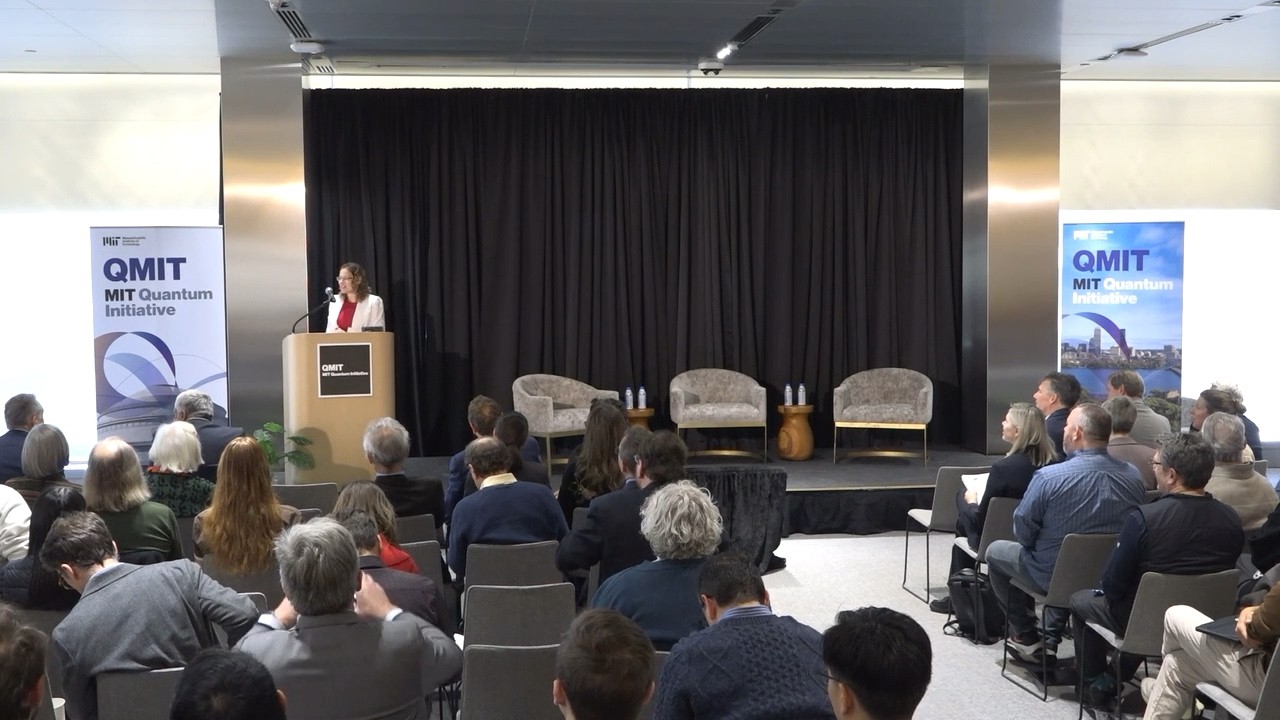
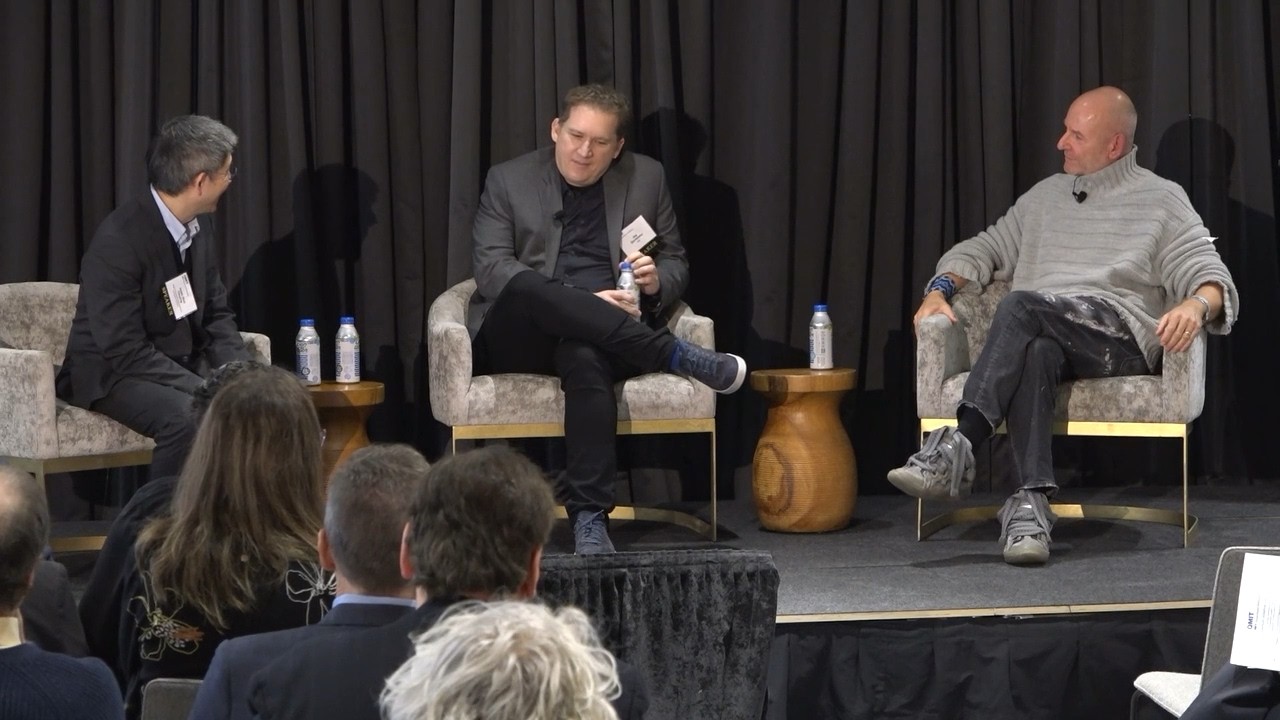
Welcome back from lunch, everyone. I hope that you had an amazing time catching up with all of the folks in this room, and that you had an opportunity to see our students and postdocs posters, which, I second Mark, will be the highlight of this conference. So to progress a step down from the student poster session, it is my pleasure to introduce this so-called fireside chat-- Where's the fire? --I know, it's very upsetting-- for early adopters. And so for our first conversation this afternoon, I'm here with somebody who understands very well what it means to support interdisciplinary innovation in a field of research that's about to transform the world. Professor Eric Lander, founding Director Emeritus of the Broad Institute of MIT and Harvard, geneticist, molecular biologist, and mathematician. Eric's played a leading role in all aspects of reading, understanding, and biomedical application of the Human Genome Project, and was the principal leader of the Human Genome Project. He founded one of the world's leading biomedical research institutions, the Broad Institute, which is an interesting template for thinking about interdisciplinary institutions as a global theme, the Broad Institute, which focused on genomic medicine. From 2009 to 2017, Eric served as the co-chair of the President's Council of Advisors on Science and Technology. And from 2021 to 2022, as the Presidential Science Advisor and Director of the Office of Science and Technology Policy. He has launched a lot of companies in biotechnology and fusion, of all areas, which is pretty cool. His honors include the MacArthur Fellowship, the Gairdner Foundation Award, the Dan David Prize, and the Breakthrough Prize in Life Sciences. Eric's a Professor of Systems Biology at the Harvard Med School, and a Professor of Biology here at MIT. Welcome, Eric. Thank you, Danna. And Eric knows almost nothing about quantum. It's possible. Wasn't the NQI in effect during that time? Well, yes. I said almost nothing, compared to, say, the 75th percentile in the room. It is a very impressive room-- Yeah, it's an impressive room. --this audience. But I can spell quantum. Nope, I'm not going to respond to that. Exactly. No political jokes. OK, if that's the rules, sure. OK, so let's begin talking more about quantum and early adopters. So, fundamentally, everything in the quantum space relies on early adopters. This is an area where the technology is just now starting to become ready for prime time. And it's a time of tremendous ideas and technological breakthroughs. In this conference so far, we've heard about ideas as disparate as quantum money and quantum computing for chemistry, and so this is a broad space. Can you share some of your thoughts about being, in a sense, a canonical early adopter? Well, so the first thing to say is quantum and the Human Genome Project, both are early adopters. They may not map perfectly onto each other. And the Human Genome Project was very much about a new technology becoming possible, DNA sequencing at scale. Back in the late 1970s, DNA sequencing was invented, and it was done standing behind plastic shields with radioactive reagents and running gels and putting X-ray films on it. It was horrendous, and I remember those days. And it began to begin to get automated, but we thought about it more for a piece of information we wanted to get-- the sequence of the human genome-- as an organizing goal. It was in parallel driving a technology, because back then people thought the human genome would cost $3 billion to get. If they were serious and did the math right
Segment 2 (05:00 - 10:00)
it would have been $30 billion, because they way underestimated what it cost at the time. But happily, it got driven down to the point where today it's about $300 for a genome. And the leading record is a complete genome sequence now in under four hours, so a lot can happen. But it wasn't organized around technology. It was organized around uses. How were we going to get information that people never thought they could have before and do important things with it? So I think the single most important lesson from our experience-- which, as I say, who knows for your experience, but I'm excited you're doing this-- is that there was this great dialogue between technology and use, application, discovery. The Genome Center, and then its successor the Broad, worked because there was an equal mix of people who wanted to be driving the technology forward and the people who wanted to be looking ahead and inventing new uses for it, which went back in a virtuous cycle and drove the technology pretty tightly. So I think that was what was exciting about it. Now, we at MIT did not create the automated sequencers. There were companies out there who did that. But we were vastly better and more sophisticated users of their sequencers than they were, because we knew what to do with it. We knew how to find the problems with it. They wanted to work with us, because we would beat up on their machine far better than their staff would beat up on their machine. We would find new uses for their machines. And I think we developed a great relationship with industry, because everybody knew-- and they still know and they still come-- because when they have a new technology, they bring it to us and ask, is this good for something? What is it good for? What would you do with it? And I remember when the second or third, or whatever generation of sequencing was being developed. And some folks from a little company in England called Solexa, that eventually was bought by the company you may know called Illumina, came to us and said, oh, we have this ability to do this and this in reading sequences. And we said, yeah, you have to read them from both ends. And they said, well, we can't read them from both ends. We said, no, you really have to read them from both ends. And I was walking around Cambridge, and I just kept repeating this. And two months later, they called back and they said, OK, yeah, you're right. We can now read from both ends. So there was this amazing conversation between people who understood the technology well enough to make reasonable demands of it, but understood how it could change the world well enough to tell the technology developers that they were not doing the right thing. I don't have that will exactly map on what you need to do, but you've got to build a community in which those voices are equally respected and represented. And so our case, we needed physicians, and engineers, and mathematicians, and computer scientists, and even some chemist, and physicists occasionally. There were some occasional astrophysicists who took refuge in the Human Genome Project and things like that. So anyway, that's random thoughts in response to your question. That's, just to follow up on that a little bit, the element of having people who knew what the technology could enable. That's really difficult. And it's difficult to get those. How did you do That How did you make sure the right people were in the room, and that their voices were heard? Well, the first thing to say is young people. It's young people. I'm going to randomly cite an example from 1989, when we were having this slightly pre-Genome Center conversation on the seventh floor of the Whitehead Institute early in the mornings. And Wally Gilbert, Nobel Laureate for a shared Nobel Prize for inventing DNA sequencing, came every day, as did a starting technician from my lab, Alex Weaver. And at some point during a conversation, Wally he got up. And I love Wally. He's a dear friend. And he bloviated about something or another. And Alex stood up and said, Wally, that's bullshit. And Wally thought about it, and he said, yeah, you're right, and sat down. And then I knew this was going to work, because the people who see what you can do with it do so because they have not been so trained as to have a narrow vision. The people who did molecular biology and human genetics
Segment 3 (10:00 - 15:00)
in the late '80s had too clear a vision of what they thought it could do and couldn't do. And so you had to get a generation of young people who did not know that, and just make sure that they did not somehow learn that, and instead thought very openly about it. And then you had to put at their disposal some resources and let them do crazy things, because that's how all progress happens. So it was a highly non-hierarchical place. We did have to be very accountable for turning out sequence, and this was well organized and all that. But even there, the people who were on the production floor turning out sequence rotated through the development group so that when they were not on the production floor they could spend the month asking, how could we make it better? So there are a lot of those things, because everybody had very limited views of where this could go. And when you have people who could say, oh, yes, we want to be able to sequence a genome in four hours, when at the time it was 15 years and $3 billion. How do you create a culture? And this is why a place like MIT has so much to contribute, even though Googles and IBMs and others are going to be building super big devices, and we're probably not going to compete at that. Because only at a place like this can that happen, and I think that's what we experienced. I agree. MIT is a special place. And I want to send out a special thank you to our Google and IBM folks who are building the things. Nothing? No, no. Oh, yeah, this is a partnership. That's right. You said they're building the things that we can't build, and that's why we have them in the room. We can't build them. We can come up with crazy ideas that will enrich them. It's a question of mutual respect in all of those directions. Again, you're getting me thinking about things I haven't thought of in years. At the very earliest part of the Human Genome Project, somebody from EG&G, Doc Edgerton's company, this defense contractor came to me and said, so I understand you have this grant for the Human Genome Project. We can manage it for you. And I said, what do you know about this? And he said, well, we don't, but we're very good at managing things. And I, as nicely as I could at that age, explained that I didn't think that was what we needed. We needed to find our way through the paths in the wilderness, and maybe that wasn't their forte. And it turned out we were right, and it was good. But it's having respectful partnerships that drive all this. There are so many companies that played a role. We've collaborated with IBM, with Google on these things-- and you are, as well. Yeah, it's an amazing space. I'm also going to follow up on another thing that you said, which is you have no idea how it's going to map on to a quantum problem. Yeah. But maybe I'll ask. Do you see a space for mapping some of these ideas onto a quantum problem, possibly leaning on some of your significant expertise in this space? Sure. Look, Quantum has largely been driven by Shor's algorithm. Peter's right there. Sorry? I said, Peter's right there. Oh, hi! Well, thank you very much. Peter unlocked tens of billions of dollars through showing that you could factor prime numbers. Imagine you made that statement 100 years ago. People would not understand it. But, of course, I know from inside the US government, outside the US government, that the ability to do computes you couldn't otherwise do, particularly ones that let you read everybody else's mail that's been accumulating for the last 25 years, is the reason why we have massive government investment. He thought this would be a really interesting algorithm to figure out how to put on it. I suspect it's not the last really interesting thing to put on it. What things really can reside on what quantum architectures? How do you balance between quantum architectures and conventional architectures? My guess this is not a single answer. Just in sequencing, there are actually a lot of ways to sequence and get genomic data. And depending on the questions you're asking, you will see needs that might or might not occur to Google, or IBM, or anybody else in the field. So, to me, the way it does map on
Segment 4 (15:00 - 20:00)
is the possibilities that will come from two different types of architectures talking to each other, two different kinds of algorithms. Now I'm going to go beyond my thing, but because there are different ways to instantiate quantum computing. There will be pluses and minuses around using those instantiations of things, and how much you need accuracy versus error correction, number of qubits versus perfect qubits, and things like that. You have a huge design space, and unlocking the minds about what I would do with all of that design space is going to be so interesting. The part that's a little different was we really didn't how to open up a sequencer and fix it, and change it, and give people direction as how to build it differently. And we were not shy about doing it. And I'm just ignorant as to how much you can do that with current quantum devices, but I'm not going to underestimate young people figuring that out. This is just an area of ignorance there. Related to that, let me ask, so we work with technology and science in everyday in different manifestations. You can think about different ways we do this. So how do you think about technological adoption at different stages of maturity? So the tool we call a thermometer can range from the thing I used to take my kid's temperature to raised to something Paola could use to measure temperature in-- I don't know. What are you going to measure temperature in? A spin system. I think nanokelvins. Oh, nanokelvins? Nanokelvins. Woo! And so if we're thinking about that range, how do you choose what the level of tool adoption is for different technologies? How do you match that and figure out this is ready for co-design or no? Yeah. So A, problem driven-- is there a good problem? B, how many orders of magnitude are you off from solving that problem? So we kind of had some rules that taking on very large projects to get new kinds of information. If you couldn't see your way to collecting 1% of the thing you wanted to do, it didn't make sense to do it. If it was really inaccurate, like after the human genome was sequenced, immediately the New York Times announced the human proteome was coming next. I have no idea where this came from, because the tools were not really available for it. And we all decided we should ignore that for about a decade or so, and we were right. But people get, especially now in this world. super hypy about all sorts of directions. And so having some ability to say there would be an incredibly good use for this, and we're within two to three orders of magnitude of the thing we really want to do, and therefore, there are interesting problems we can do within that, its taste. You need people with taste. I think around MIT and Harvard, what's been so wonderful is we've got a lot of people with excellent taste. There are many projects you could declare. Most projects you think of are a terrible idea-- they just are. Fair. You need to be able to kill most of them, because they sound good, and then when you really get down to it, they are not the intersection of practical and interesting. So there's a lot of taste. That's a really interesting answer. Do you have any thoughts on killing projects? Oh, you don't kill projects. You nurture good projects, and you let projects that deserve to die just to die on their own. So when people come to you with good ideas, you can say, mm-hmm, that's interesting. And you pose a couple of questions and send them off. Or what I love most-- still love about my job, because it's a very active job-- is somebody comes in with a good idea and I say, that is a really interesting idea. What would it take to pilot that? Or could you write something up on that? It's a question of encouragement. Because you never want to say, I know this is a terrible idea, and drive a stake through its heart, because you could be wrong. But on the other hand, when you see something good, you want to water it and nurture it, and you want to get people money quickly so that they can try something. And that sends great messages that this place is open for ideas. And whatever becomes of MIT Quantum
Segment 5 (20:00 - 25:00)
having some pot of unrestricted resources that you can spend and take bets on, this is something academia has a hard time with, usually, because all the grants come earmarked for this or that. And actually having-- we don't use words like slush fund, because people misunderstand it-- but unrestricted funds to place bets. Just as in venture capital are placing bets and you place bets on ideas and teams, and usually the union of ideas and teams. And in this initiative, you're going to find yourself placing bets. And I don't want to tell you about money I've wasted on things, but we've wasted money on things. Because you can't place bets without losing some bets-- but you win more. I swear, I did not script this as a request for more slush They're unrestricted funds. Yes. I have to say, I love that answer. Discretionary, unrestricted, yeah, but it is so important. If we did all the things that we put in the NIH grant without having money to really do the next things coming down the road and the next things-- and this is why MIT creating institutes around the place with some kinds of private support that comes from generous donors and industrial support and federal support-- no comments-- that combination is super powerful. Yeah, that actually makes me think of another question. In terms of the founding of the Broad, what's the tipping point that tells you that a Broad type initiative, as opposed to collective collaborations between departments, and a model more similar to others in academia? Right. So it's very common to build centers without walls. Yeah. And the problem is, when it rains, it gets wet if there are no walls, and the wind blows in. There are times you need anchors, and magnets, and things that pull people together. What the Human Genome Project taught us was not just having a lot of separate labs doing their thing, but for example, having what we named platforms. At the time, that was an unusual thing to call it. I think it's been widely adopted since. But having platforms that had industrial strength technology and serious grown up people there, because there are times you don't want a graduate student doing something. You want somebody who really knows how to do process and all that. So bringing people together like that. Same on computing. There are things where critical mass matters. And critical mass does not happen simply from having scattered things. And often, a common project, a common platform, brings people together. And it did for us, because we had all these human geneticists around town who wanted to map the genes for common diseases. But they all would have had to invent the same platform, and they couldn't possibly do that in their lab. But they came together, and together we were able to invent that, and the next one and the next one. And then that becomes a very, very nice cycle, because young people want to come here. For example, Brad Bernstein was a young professor in the Broad environment. He was a Harvard professor. And he was applying for the first epigenomic center grant, whatever that is. It's something to do with methyl groups on DNA. It doesn't matter. Methyls are confusing. Yeah, all very confusing. But anyway, he said, I'm not going to be able to apply for this because I'm a first year assistant professor, and all these 800 pounds gorillas are applying for this. And then he wrote the grant with the platform standing behind him and other things. And when it was done, he found out that he'd got the highest score and was getting the thing. And he came in sheepishly and he said, I guess I'm an 800 pound gorilla. And the idea that young faculty could be 800 pound gorillas because they had serious things that they were standing on, or were standing behind them, is something you can't easily organize in most academic institutions-- and yet, a place like MIT can. And so it's not just a superpower of ours, it's a responsibility of ours to be doing this. How would you incentivize that? There's been a continuous theme in your answers of let the young people do it because their ideas are better than yours, which I think is a fantastic answer. And our assistant professor panel earlier definitely made the case for this in an expert way. How do you figure out the balance between putting too much pressure on young faculty that
Segment 6 (25:00 - 29:00)
still have to do something successful to get tenure? They can fail for five years, but they can't fail for seven years. Yes, it's a very precise window there. It's a precise window. How do you balance putting them in these roles? Any suggestions? Young people are the source of incredible creativity and innovation. Old people still have jobs. And by the way, when I was doing the Human Genome Project, I qualified as a young person. But it's a question of how do you then mentor people to get things done? And the balance between, yes, they have to produce products while they're coming up for tenure. But sometimes-- again, I'm just going to cite real examples-- there were three young faculty all starting. One was an immunologist, one was a cancer biologist, one was a metabolism person. And there was this new technology called RNA inhibition, whatever that is. Anyway, you had to make a gazillion RNAis. They joined forces, and they did it. And they spent 40% of their time building this common resource. And with it, they were each able to write pathbreaking papers in their field, which they could not have done had they not come together and built a common resource. So it's not just encourage young people and let them go off and do their thing. I don't believe that that's enough. It's encourage young people to come up with bold ideas, and then help craft how that could possibly get done so that it's producing results in the short-term and the medium-term and the long-term. I will digress again a second on the early days of the Human Genome Project. The first proposal by Wally Gilbert, the person I talked about, was to build one big center where the entire human genome would get sequenced, with some radioactive sequencing and things sliding. It was a terrible idea, because it was-- ooh. Was that a signal? It might have been somebody just leaned on a thing. But it turned out Wally admits it was not a good idea, because the only thing you got at the end was you wait. You get the whole sequence, and you're done. And instead, a committee was organized and figured out how to chunk out the Human Genome Project so that there were deliverables-- deliverables after only a few years, and after some more years, and some other years. And every one of those, even though you didn't have a whole human genome sequence for another 12 or 13 years, were transformative things. You had a genetic map that you could use to map genetic diseases within a handful of years, and you had another thing, and another thing. There are physicists here? One or two. I'm going to get in trouble, because the Genome Project was started essentially the same year as the superconducting super collider. Ooh. I hear we don't have one of those. And the issue was that half a superconducting super collider neither superconducts nor super collides, and so there was nothing to show for it other than half a very big hole in Waxahachie, Texas. And so what was smart about the Genome Project was, there were deliverables coming out all along the way that people could point to and say, yeah, they're out of their mind, but boy, I use that thing. And so there's an art-- both in being an assistant professor coming up for tenure, or being a large national project-- of being able to show along the way. I don't love the expression quick wins. There should be important wins, and some of them should happen on different timescales, but you need a layered portfolio of things. I have so many questions. Well, this isn't our last time to talk. I want to ask about the superconducting super collider. But I think there isn't even time to get in a last question. Well, maybe not. I'm looking across at what you're doing here. I'm very excited you guys are doing this. And I'm not very far. I'm right over there. And so I hope this isn't our last conversation. We've accumulated stuff. Like I said, I don't know what's useful or what's not, and what's parallel or what's not. But I feel like you're at incredibly exciting moments, and it's just so important that MIT is doing this. And Danna, thank you so much for starting, not ending, this conversation. Thank you.
Другие видео автора — Massachusetts Institute of Technology (MIT)