Good morning, everyone. We have an incredible program today as we launch MIT's new Quantum Initiative, or QMIT. And I'm delighted to introduce a special guest to help us kick things off, Governor Maura Healey. An advocate for research and innovation across Massachusetts, Governor Healey is leading efforts in AI, climate technology, advanced manufacturing, and the life sciences. And through a range of efforts focused on research, development, and workforce training, she's strengthening our state's position as a global leader in quantum technology. She's also always an enthusiastic supporter of MIT, and it's a great pleasure to have her with us again on campus. So please join me in offering a warm welcome to Governor Maura Healey. Thank you. Well, thank you so much, President Kornbluth. It's always a treat for me to be on this campus. And so thank you for the opportunity to come by today and celebrate QMIT, a very, very exciting initiative, exciting endeavor. And I want you to it's one that we as a state want to find ways to partner on, to support, and that's what today is about for me, to make that clear to everybody in this room. To Dr. Donna Friedman, congratulations. Best wishes. It's exciting. And thank you to you and to all on the team who are making today possible. We are, once again, so proud that this world-leading university is not only in our state, but also bears the name of our state, the Massachusetts Institute of Technology. We love that. Goes back to our land grant days. And I do think it bears noting, just because I think that one thing you should know-- how many of you are from outside of Massachusetts? Oh, I love that. Great. Look, from the beginning, Massachusetts has been about both innovation-- we're the birthplace of this country, where it all started 250 years ago-- and we've been about knowledge and the use of knowledge to power each generation. And that has certainly happened on this campus decade after decade, and it's part of the ethos of this state. So I think the synergies between MIT and the state of Massachusetts are strong. We're making them even stronger through the partnerships that we've had in our administration and what we want to have going forward. But I am not confused. Science matters. Education matters. Knowledge matters. It makes our country stronger. It makes our world stronger. And really, it makes the condition of humanity all the better. So many thanks to all of you, whether you toil away in labs or classrooms, boardrooms, just know that I am grateful, as an American, that you guys are doing the work that you're doing and always, as governor or as American citizen, support those endeavors. When it comes to this particular topic, it's a great example, QMIT, and I'm not surprised because MIT scientists have led the way in so much over time and, in particular, have led the way when it comes to the development of quantum science and technology. Your impact is already unquestioned, but creating this hub-- and I see a lot of synergies. There are a lot of folks, as I understand it, across MIT, who are thinking about the different ways that this can be leveraged, working with partners across industry and elsewhere to work on these applications. And I think it's not only something that MIT is great at, it's also something that I think about when I think about President Kornbluth's leadership, because she's always been about partnerships and trying to bring as many people in. And I think strengthening networks and creating new vehicles for collaboration, both within and beyond MIT, is really, really powerful. And this is an instance of applying quantum to breakthrough technologies, whether they're in life sciences or defense. You name the industry. I understand, though-- I was a liberal arts kid from the other college down the street-- that quantum is everywhere. It's foundational. And so the work that you're going to do
Segment 2 (05:00 - 10:00)
is going to be transformative across the board. I'm also happy that QMIT is engaged in collaborations with other institutions, academic institutions in Massachusetts and across New England. These are the kinds of partnerships that my administration, as I say, has been about supporting and sharing on. And one of the people you should be really happy about who's leading-- for those of you who live in Massachusetts, OK, know your Economic Development Secretary is a technologist, is a founder, is an entrepreneur. His name is Eric Paley. Some of you may him. He's super. And he's picked up the ball and is running with this, and it's going to be really, really exciting and beneficial to all of us. So we're here to support. We're here to support QMIT's ability to intersect and create synergies across the board. Some of the ways that we think about-- Eric and I think about the things that we can do, and know that this is just the start of a conversation because you will have bigger and better ideas. But we have targeted investments in quantum via Mass Tech. We have a new AI hub that we've created in the state. We've focused on a new initiative in the defense sector industry. MIT is responsible for creating, spawning so much of the technology deployed in national security and defense. And we want to lean into that as a state, and so through my SHIELD initiative, we're doing just that. And of course, we're continuing through the DRIVE initiative to lean into and fund promising medical research at a time where there's been some uncertainty at the federal level. I know that QMIT is going to add rocket fuel to what Massachusetts innovation engines have been doing, and it's going to come at a really, really critical moment, a really critical moment where we want to see-- I'm a little bit of a homer, but I want to see Massachusetts lead and America lead. And what you all are doing today through this initiative is going to help us do just that. This is mission-driven innovation. It's critical to our economy. country. And I think here in Massachusetts, it's one of our differentiators. It's what gives us an edge in the global competition for talent, for investment. It drives startups and the growth of companies and our economy here. And I'm just so grateful. So I'm pumped about QMIT. Massachusetts is made for this. MIT is certainly made for this and made of this. It's who we are. And so congratulations to all of you. Thank you for your efforts, and know that you won't have a stronger partner anywhere in the country when it comes to these public-private partnerships, these collaborations. And again, many thanks to all of you on the front lines of discovery, of knowledge, of innovation, and of training the next generation of scientists, researchers, and entrepreneurs who will continue to change the world. Have a great day. Thank you, Governor Healey, for your leadership on behalf of Massachusetts. You're thankful for us? We're thankful to have a governor and a statehouse that recognize the power of innovation to improve lives for everyone in the Commonwealth and beyond. So thank you. I just want to say a little bit more as the governor leaves. But she listed a number of state-level initiatives, and they all overlap with what we're trying to create today. The AI Hub, a Life Sciences initiative, the DRIVE initiative that was specifically designed to fill some of the gaps that's been left by federal funding in the last year, the SHIELD defense initiative. She really does understand, and her team really do understand how to drive innovation within the Commonwealth and more broadly. So it's great to have her here today. We're launching MIT Quantum Initiative. Yeah. This is an ambitious, institute-wide effort to apply quantum breakthroughs to some of the world's most challenging problems. It's the newest of President Kornbluth's strategic initiatives. It takes its place alongside institute-wide priorities that collectively create a vision for the future, next five 10, 20 years. The initiatives anticipate major contributions from MIT and from all of you in fields
Segment 3 (10:00 - 15:00)
such as new manufacturing, health and life sciences, human insights, climate, generative AI, and now quantum. In quantum, the rapid pace of discovery and innovation has brought the entire field to an inflection point. We have powerful new sensors that can be integrated with new computational systems, and these are about to change what we can do in science and technology. In some ways, as a non-quantum person, someone who's lived my life in the classical world, I look at quantum computing and quantum engineering, and it seems like magic. But it's not magic. It's built on decades and decades of really creative, fundamental work to understand the nature of the world that we live in. And it's amazing to me that we now can conceive of a system of lasers that would hold an individual ion in place or an individual atom, or we can super cool something to millikelvin so we can control the tunneling of individual electron pairs, and not just do that for individual units, but we can do that for thousands of these, or hundreds of these now, to solve algorithms in ways that completely advance what's possible to do today. So it's just remarkable to me how far we've come and what the opportunities are as we look to the future. This initiative will work across all the schools at MIT and our college, and it will bring together quantum experts with domain experts, people who have problems to solve, so that we can apply those technologies to those problems. It will include work across the breadth of the presidential initiatives that I mentioned and, really, some of the most exciting things there are out there in the application space, things like life sciences and biomedical applications of quantum sensing and quantum computing. We will also work very closely with MIT Lincoln Laboratory. Lincoln Laboratory, since 1951, has advanced the nation's national security abilities. They have very unique strengths in quantum hardware development, systems engineering, and rapid prototyping that are already leading to fundamental changes in what we're able to do. To support all of this, we actually planned something that will be, I think, quite exciting, and that is a physical home for QMIT in the center of our campus. This will be a home to integrate academic, public, and corporate engagement with state-of-the-art, integrated quantum systems. We hope to have much more to share about that in the months ahead, but it will be a very exciting physical instantiation of our commitment to quantum. For now, it's enough to say that the launch of QMIT marks the start of something big for MIT. I want to invite Danna Freeman, faculty director of QMIT, to tell you more about her vision for this initiative and the speakers who will bring it to life today. Dana is the Frederick George Keyes Professor of Chemistry. She's a synthetic inorganic chemistry chemist. I was almost going to get organic and inorganic wrong, which I know is a sensitive point for her, and instead I flubbed the word "chemist. " Her research contributes to the development of materials for quantum information science. She's a recipient of the American Chemical Society award in pure chemistry and a MacArthur Foundation Genius Grant. She specializes in bottom-up design of molecular-based qubit systems, with such degree of control over the physical and electronic structure of the qubit as to generate long lifetimes, well-controlled qubit-qubit interactions, and pathways to control qubits with light. Her vision for the Quantum Initiative has a unifying and outward-looking perspective that will enrich quantum research and education at MIT and shape the future of technology. Please join me in welcoming Danna Friedman. Wow I'm-- I'm flummoxed. I don't think I've ever had such a kind introduction. First, thank you, everyone, for being here. I am so excited for this day and all of our amazing speakers.
Segment 4 (15:00 - 20:00)
I also want to thank Ian. It's been wonderful to work with you on this initiative, and I'm so excited about the years we have to build up QMIT. So I'll take this brief opportunity to talk a little bit about QMIT and a vision for it, and also to introduce some of today's events for you. I'll keep my remarks brief, because I think that I am certainly not the main event. Our exciting speakers and poster presenters are the main event of today. So I want to start by saying, MIT is just this absolutely wonderful place, and my hope for you at the end of today's launch event is that you leave in awe of our leadership in this quantum space and of what your colleagues and folks in allied industries are working on right now. Today's speakers will showcase our quantum innovation. Speakers from all over campus, from physics, engineering, math, even my home department of chemistry, and computer science will share their discoveries and perspectives. But I want to echo what Ian said. And if we limit the idea of quantum to the work that we've already developed and neglect the application of quantum, then we're missing part of the picture. Some of the most amazing innovations in quantum are not just the core of quantum, but the applications or discoveries that arise from the creation of quantum tools. In one of the sessions today, we'll hear about that. For example, our dean, Nergis, will present on, I think, gravitational waves, which one could argue is a key discovery of a quantum sensor. Thinking about how our quantum tools can help us understand the world around us is one of the things that QMIT will build out. So one of our key goals at QMIT is to engage the broader community at MIT, to create this connective tissue, to enable co-design in the quantum space. So quantum science and technology are in an era of rapid acceleration, and this is something that we can take advantage of with QMIT. see across quantum technologies. Quantum computers have emerged from potentially a curiosity to something demonstrating meaningful quantum advantage. That's something that hopefully will be covered extensively in the first session of today's event. We have amazing discoveries with quantum sensors, and some of those are outside of the traditional quantum space. For example, Paola's done lovely work integrating quantum sensors into biological and medical applications. And so our quantum technologies span an amazing space with proliferating applications. At MIT, it's our role to create and understand superlative visions of these technologies while integrating them in the broader community. One of the hard problems-- and MIT likes to work on the hard problem-- is connecting the development of these unparalleled advances with the right connections in science and industry. To build connections between quantum creators and quantum beneficiaries, we need to deliberately construct shared spaces, mechanisms for teaming and collaboration, and thoughtful opportunities for co-design. From a practical perspective, this will involve workshops, community building, seed funding, and figuring out what challenges we want to solve in the next 20 years. Through the MIT Quantum Initiative, we're elevating MIT's quantum excellence across fields, expanding the frontiers of our community, incentivizing collaborations across domains, including with industry and government, as hopefully is well illustrated by today's event. And we're creating, as Ian mentioned, a home on MIT's campus for the development of quantum systems with carefully considered co-design opportunities, developing an all-quantum ecosystem where we can connect between designers and users. I want to take a minute to touch on the history, which will also be covered in today's program. QMIT arose out of two separate initiatives, Quantum at MIT, led by Paola Cappellaro, with invaluable contributions
Segment 5 (20:00 - 25:00)
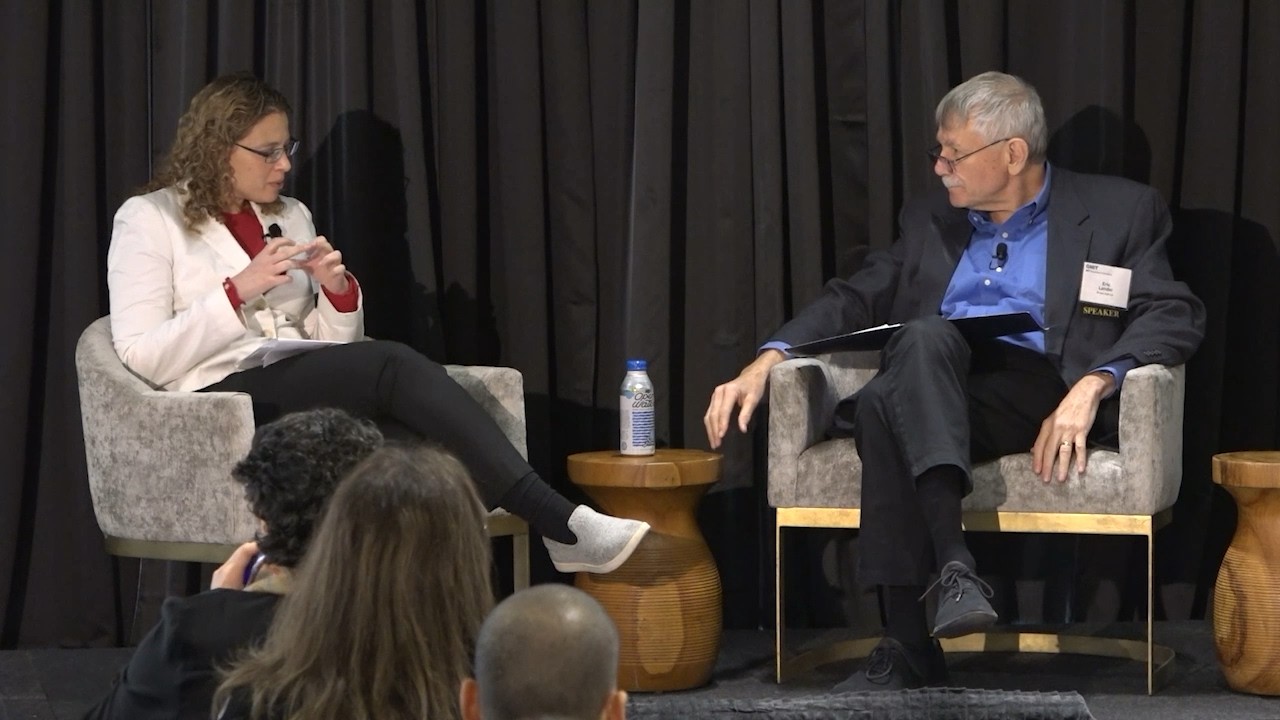
from Pablo and Will and-- I see Peter-- and would not have gotten off the ground without Peter Fisher's contributions, and also by the Pioneering Center for Quantum Engineering, led by Will Oliver, and possibly the first center for quantum engineering in the country. And-- QMIT would not be here without the leadership of all of the people that I mentioned and more. Paola and Will generously agreed to provide their reflections on the evolution of QMIT as part of our program today, and I'm excited to hear that. The QMIT leadership team also builds on its history. Our team is organized into pillars, and we have some amazing folks on our leadership team. We have, as mentioned, Paola and Will and Pablo and Vladan, who I just saw back there, I think. And from Lincoln Labs, we have Jonilyn Yoder, who's the Associate Leader of Quantum-Enabled Computation Group at MIT Lincoln Laboratory. Any effort in the quantum space at MIT could not exist without the contribution of Lincoln. Lincoln represents a huge part of MIT's footprint in the quantum space, and we're lucky to have close ties with Lincoln, which will hopefully be strengthened by a physical space on campus. Later this morning, we'll hear from Daniel Ripin, the head of the Advanced Technology Division at Lincoln, for some of his perspective as well. To briefly return to the program, possibly the most unusual part of this program is a fireside chat on early adopters. I believe that in many ways, quantum is ready for early adopters, and that's been demonstrated by the research of many of you in this room. Finding the right early adopters requires asking the right questions. Where are the questions that quantum advantage would be transformative in the spaces of all of us around us? This afternoon, I'll be speaking with Eric Lander about the boldness required to make a visionary bet on emerging technologies. In general, there is such an amazing body of research on what it means to be an early adopter and translate technology, and this is something that QMIT will build on. So many technologies have been adopted in our space, and that's something that we can learn from so we can successfully develop this and not reinvent the wheel every time and focus on the science and engineering. MIT Technology is already at the forefront of some leading commercial efforts in quantum as well, and this is another component of our program. The quantum computing companies QuEra and Atlantic Quantum are notable examples of this innovation. And we can say that those are both MIT products, and we'll be hearing from them this afternoon in industry panel, which will be moderated by Peter Fisher. Another really exciting part of today's program is we all are quite senior academics and probably a little unlikely to change our core trajectories. One of the most exciting things about being at a place like MIT is hearing from the next generation of scientists. And to that end, we'll have an assistant professor panel where assistant professors from across quantum fields will tell us their thoughts on the future and what is the next thing that's coming. Here we have some inspiring early career faculty, Harry Zhao, Anand Natarajan, and Soonwon Choi. And then, of course, we'll hear from established pioneers of the field, including Peter Shor, who probably needs no introduction but will get one, and Nobel laureates Wolfgang Ketterle and my colleague Moungi Bawendi. I'm really excited about today's event. This is such an amazing collection of speakers. I can't believe they all agreed to come. I think I would actually use my own discretionary money to pay to go to a conference with this speaker lineup. It's just my perspective. It's possible that the most impressive science that you'll hear today will be featured at lunchtime.
Segment 6 (25:00 - 26:00)
there'll be a poster session featuring the work of 20 students and postdocs on topics ranging from quantum computing-enhanced sensing to quantum simulation with ultracold quantum gases. Our students are at the forefront of every field, and the poster session will showcase the frontier of quantum. Many people have been involved in bringing QMIT to the point of launch, and I'd like to especially thank Vice President for Research Ian Waitz, Provost Anantha Chandrakasan, and Dean of Science Nergis Mavalvala for supporting this vision. I'd like-- oh, there. And above all-- I thought she was gone-- MIT President Sally Kornbluth for her leadership in creating these initiatives, which elevate the research priorities of MIT faculty and create structures to facilitate interdisciplinary science and engineering. President Kornbluth will share some of her thoughts and introduce our keynote panel to kick off the day. Thank you.
Другие видео автора — Massachusetts Institute of Technology (MIT)