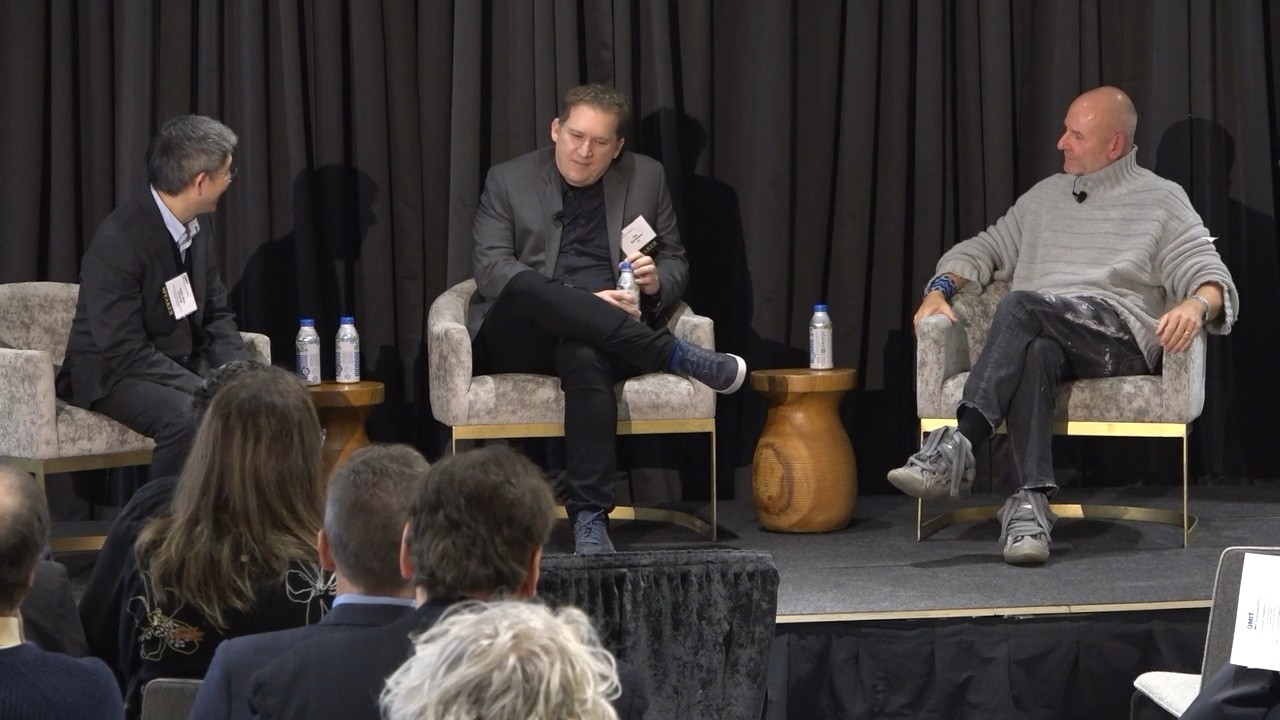
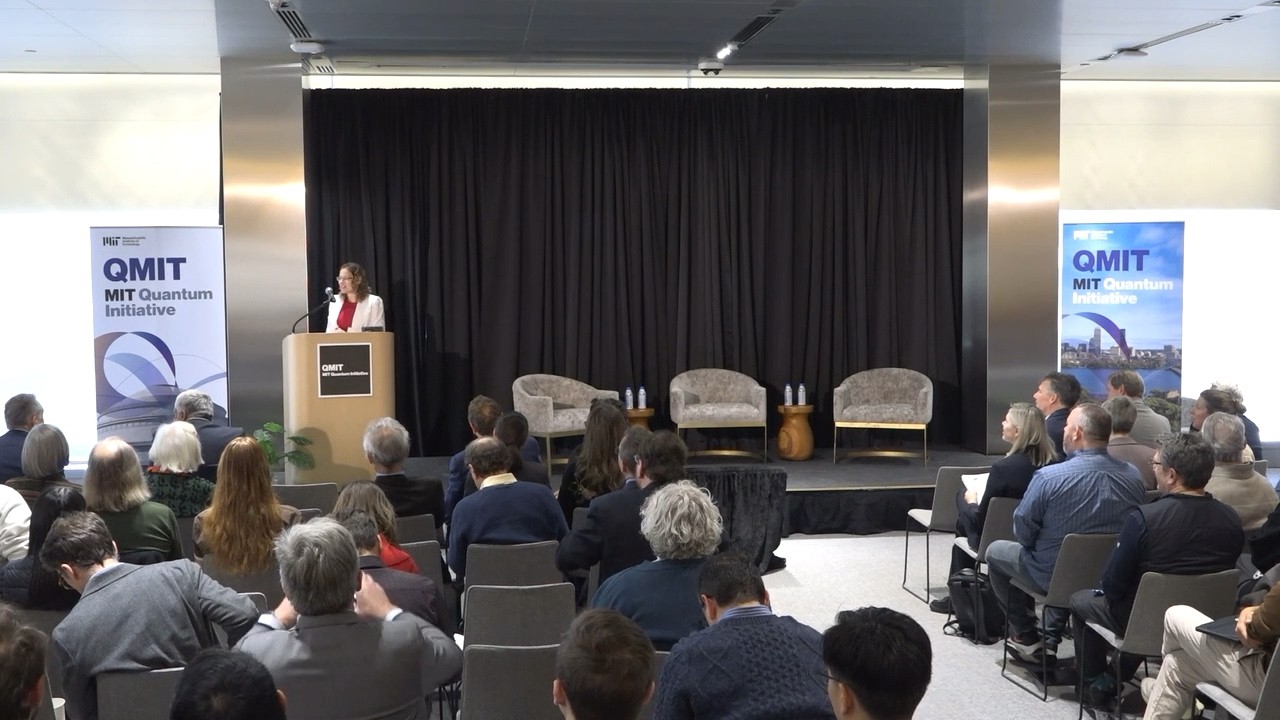
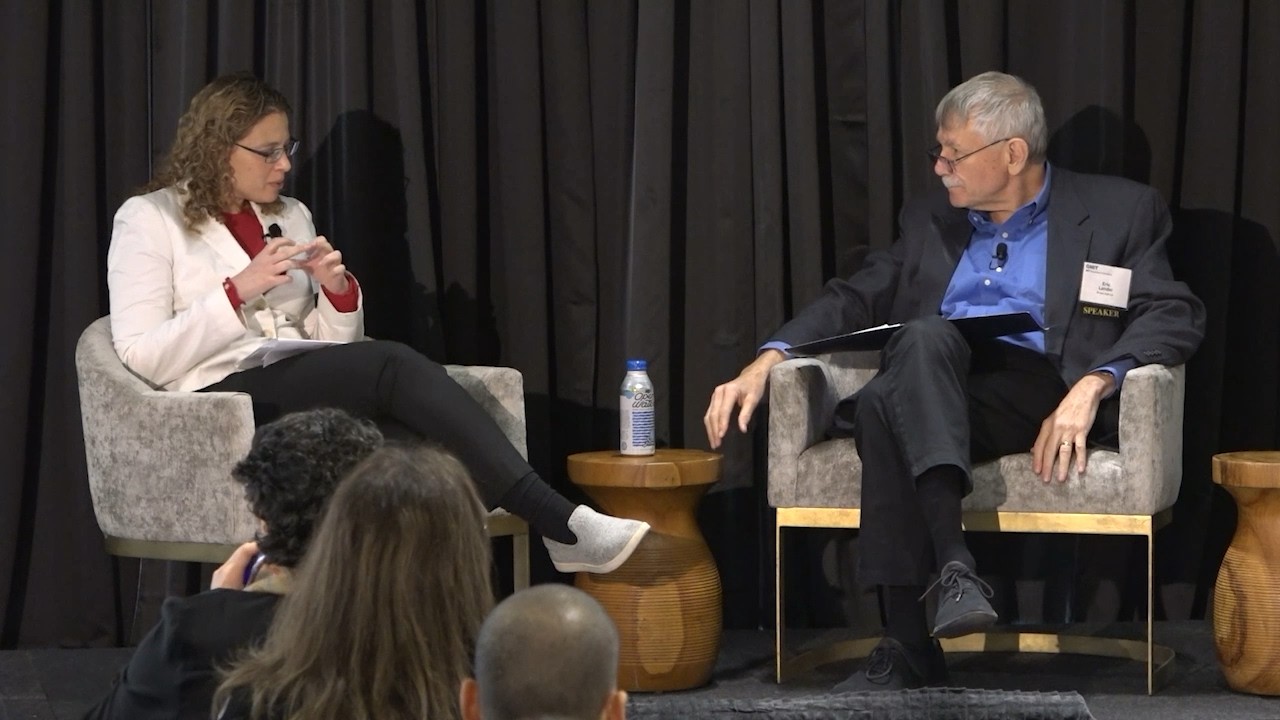
It's a pleasure to have you here for the question and answer today. Let me make sure-- can you hear my mic working? It's good? And we are joined as friends here, Jay and Hartmut, and I've known them for decades now. And I thought that I might begin by sharing with you some of that friendship and personality. I did not know until today that Jay actually grew up in what is known as the Bronx of Australia. And he started as a theorist and has come all the way from studying quantum foundations about why quantum actually works and describes the world. And we're seeing that even in Harmut's talk just now to where he is today in leading one of the most storied and important research laboratories in the nation, which invented hard disks and floppy disks and magnetic storage. We're seeing this experience from Hartmut, who has started with-- both of them have degrees in physics. Their PhDs are in physics. And yet Harmut has had this journey all the way from physics to neuroscience, vision, understanding AI, and then coming to quantum. Could the two of you share a little bit about this journey in the sense of what advice would you give to a student who would like to be successful today the same ways you have in an unusual route, in a different way, something that's inspirational? Do you want to start? My typical of what I'd like to answer to this question is that I like to go into areas long before they are popular and everybody streams in, because then there's so much competition it's hard to deal with. So I worked on what today you would call self-driving cars in the '90s or AI in the early 2000s. And then these areas are, I feel, more fun when they're sort of just beyond the edge of where current interest lies. And often, if you ask these very fundamental questions, it's easier to pick winners, where sooner or later, a self-driving car is going to happen. This is easier to predict sometimes than to predict what is the big thing in two years. Fun. So that is a key word for you. Yeah, so mine very similar. Oh, I'd say to students is I always chose-- well, first I dislike this idea of theorists versus experimentalists. I always chose, every time, what I understand, and what I don't understand. I jumped in. So early on, I started off shooting lasers into atoms and measuring physics cross-sections, and I realized I didn't understand the equations behind it. So I went to Howard Wiseman, who is a quantum optics theorist, and said, hey, I want to do theory and understand these equations. And he was gracious enough to give me a chance. And then I worked with him. And then I realized I didn't want to do quantum optics. I really wanted to build a quantum computer. And Steve Girvin at Yale gave me a chance. And so I said, all right, I'm going to learn about superconducting qubits and condensed matter and never doing any of this and having an optics background. And so my advice is don't worry how challenging it is. Just jump in and then find good mentors, speak to good mentors. And if people say that it doesn't make sense, don't worry about it. So find and choose the hardest problems to work on. But isn't quantum too popular these days, and AI may be even more popular, and now we have quantum and AI? So, well, quantum is definitely popular, but I still think there is good questions that can be answered. And if we are going to build a fault-tolerant quantum computer, we should acknowledge that one doesn't exist now. And if one doesn't exist now, there's still a lot of questions, even if it's popular, that need to be done to actually build that. And even after we've built it-- and I think we'll hear from [? Shor? ] at the end-- I think there's still a lot of-- there are great algorithms, but there are a lot more algorithms that need to be discovered. Yeah, when people ask, hey, isn't AI very hypey or isn't quantum AI even more hypey? I learned a new term from, an economist called Mohamed El-Erian. And he told me he would call this rational exuberance. Rational or irrational? No, rational exuberance.
Segment 2 (05:00 - 10:00)
Yeah, because it's like with railroad tracks or the early internet. These technologies are not hype in the sense that they just went poof. And huge investments were made, needed. And of course, some people will lose when investing because they come too late. But there's no question that AI-- probably all of us use it every day by now. So in that sense, it's not hypey. Yeah, some over investment at such moments happened, like happened with railroads. But I think that's a term I prefer over hype. Yeah, so rational exuberance is quantum today. We should be exuberant like Danna said at the beginning. Hooray for the field. But maybe there's another issue. If we really look at this in an honest today, quantum computers, as they exist today, are not economically useful because they're not competitive with what you could have done without the quantum computer otherwise. So I'm afraid your Google quantum computer, your IBM quantum computers are like the Sinclair ZX81 and the BBC Micro of our generation. And yet remember all of you who are students in the audience, who really we are speaking to right now, the future was so hard to see from those early times, from those computers. So to what extent is our early quantum computing of today kind of like early computing of history back when Bob Noyce went off to Intel and so forth? Are you the Noyce of our generation, or are they going to be the Noyces of our generation, those who are sitting here? What do you mean by noise? About Noyce, when was it founded? Oh, sorry. I didn't understand the question. Yeah, I think quantum is similar to where classical was. I would push back a little bit in that if you just think of getting an algorithm that is a return on investment for an enterprise, I agree with you. They're not there. But science is doing things on devices that we can't easily simulate is a great question for science. We can have a debate about what quantum advantage means. whether we do empirical tests or whether we are continue-- we have to wait to fault tolerance till we get it. But I think there's the area for students to explore and to investigate and to discover new numerical and heuristic algorithms is essential. And we earlier explained the quantum echos algorithm. So the algorithm is ready. And we have shown on small examples that you can actually learn as of today unknown properties of small molecules. In principle. In practice. Now for the end application, I should say this you could also still have done on a classical machine. So we need some more computational volume, meaning we need lower error rates before an NMR practitioner who doesn't care for quantum computing at all, but chooses a quantum computer because the best tool-- to lodge it in practice in this way will probably still two-ish years out, but not much more because we have as soon as your molecule has more than 50 spins, then it's very expensive for classical machines. We showed examples with 15 spins. So a little gap still, but you don't have to have the Milestone 6 machine to do this. And of course, will it really-- I'm not NMR expert myself. Hard to say whether this community will find it really useful enough to make it a go-to new protocol, but there is a chance now we will watch it. So maybe I'll add. So obviously, Google are doing great experiments. We've chosen a different way. So all the students out there, go check out the quantum advantage tracker. You can find it online. And what I would like to see done is to me, I think, for these early science experiments, I'd like to move it from slow iterations based on writing papers to very fast iterations where we can cycle between. We identified-- well, the community is identified at least three different methods towards quantum advantage. I like this peak circuit results idea--
Segment 3 (10:00 - 15:00)
peak circuit idea from Scott Aaronson. And in it, you essentially hide this signal. So early on-- this is a great example-- we were able to show on one of our quantum computers. We could find the peak faster than a tensor method. And then someone from AI came up with an AI algorithm, a black box, and showed that they could find it, like 100 times faster. So you saw, in real time, this iteration. Then Quantinuum has now put their-- BlueQubit has put a continuum result on where they can find the peak faster on a quantum computer. So the question is, will this AI do it? And then for similar ones to what Google have done, what Harmut's team has done, we did this observable estimation for let's call it similar circuits to estimating correlated dynamics. And we were able to find observables that flatirons tensor methods couldn't actually simulate, so they went and said they did-- the simulation could not simulate it. And then a student from Madison in Wisconsin came up with a quantum-- they basically did just one iteration, not all the dynamics, and removed a lot of the interference and showed they could. So you see you get this real-time things. My view is I think that is science. It is science. And so let it go. Even more fun than that, maybe it's gaming in a sense because it's back and forth with the community. Jay, I think you left out a piece of the story the audience would enjoy hearing about, just for fun, if I may, which was IBM put out a beautiful paper showing that they could answer using that quantum computers in very important fundamental physics questions about the Ising model. And then a student was able to replicate the same result on a Commodore 64 without the quantum computer. But IBM did not give up. IBM went back and kept on going and iterated. And today, we have an advantage board which is actually showing advantage IBM. I would say none of them show advantage. Let me say it a better way-- advantage quantum. Sure. And so maybe we're getting there. But then, OK, let me ask you the diciest question of all. And Hartmut, maybe you could lead on this one. It is often said that in order to get it to that point where we can really see that quantum advantage, really in a return on investment way, will require of the same kind of investments that made silicon successful. We're talking about trillions of dollars and not billions and not millions of dollars. How do we put in the wherewithal of investing the 10 years of trillions of dollars total that we will need to make this whole industry get over the hump? How do we get there? Yeah, I'm not sure I would buy into the premise that we need trillions of dollars. I mean, it is expensive, but I would still think it's orders of billions. Of course, one challenge we didn't quite answer your earlier question when you lead an effort like we both lead superconducting efforts. So we made, for very good reasons, a decision that building a useful quantum computer is best done with superconducting qubits. But in Silicon Valley there's a saying, "only the paranoid survive. " So we always look over our shoulders. What are the other computing modalities doing? And Misha was sitting here looking-- was sitting here a short while ago. And QuEra was mentioned earlier. So neutral atoms is another modality, and they have made marvelous progress. And so to add to our investment, we made an investment in QuEra because we wanted to have a first row seat to understand where this technology is going. And of course, this branching out does cost money, but I still don't think in the trillions. Fair enough, Jay? I think I tried to cover this a little bit in my talk. We should keep investing in smart students that look at codes, because the order of magnitude on the dollars is going to depend on whether or not we can build it by either reinventing the CMOS industry, or we can leverage the CMOS industry, or, in Misha Lukin's case, leverage all the great lasers and controls. I chose superconducting qubits because we can leverage microwave industry. We all use mobile phones. Radar is everywhere, and we can leverage CMOS. If we can come up with designs that fit within the structure of where we have, I don't think it's trillions. Maybe the first quantum computers will just tell us how to build future quantum computers, and then over the time, it could get into trillions. But I don't think we should be thinking that we will not have a fault-tolerant quantum computer by the end of the decade. That would be, as Hartman says in the billions rather than
Segment 4 (15:00 - 20:00)
trillions if we allow the creativity of working out how to do it within the infrastructure that already exists. Maybe both of you are really building on the idea that we need much smarter ways to get there, instead of the most straightforward ways to get there-- things that require more cleverness, new innovation. Maybe that's why you're sitting here today with us at MIT, maybe. But let me ask one last question about that because, in many ways, both of your system in engineering endeavors are very laser focused on getting the milestone chart, your pathways. What else could other folks do to help your missions move forward, other than completely new modalities and helping get the next cryo controllers, getting the next better qubits? Are there peripherals that you could imagine that you could connect and just make something go better? I remember my first like TRS 80 Cocoa computer, and I loved the little cassette tape thing that I could use to play my programs into the computer. But we don't have a quantum cassette tape, as retro as that might sound. What do you think? Sure. I tried to touch on this in my talk. I would say three things. Quantum information science to get the most out of whatever we have in the devices, be it error correction or coming up with new algorithms that can do things simpler. Think of quantum as a subroutine in classical compute-- really bring the HPC and quantum communities together. And the third is if we could-- it's one of the biggest things that I worry for building our biggest system. I showed you a picture of-- it had 10 cryogenic fridges connected together. If one of them fails, I have to cool them all down. So I could be sitting there forever, cooling this one, cooling that one, and never succeed. If we were to say, let's make a vacuum chamber at Millikelvin that we open and close, that's near impossible. But at 4K, space physics has shown this is possible. So can I make getting to your peripheral comment an ability to go from my qubits inside the Millikelvin up to something where I can break it, and things in? If that can be done, that actually offsets a lot of the risk in the demonstration. And then you could go-- you let your imagination go wild. If you can actually mix different computers or put quantum data directly into a quantum computer, you can maybe look at some of these algorithms where people have explored on quantum data. So I want the practical one first to allow me to engineer a bigger system. But if you get that physics right, you could imagine much more. Like, connecting your computer to Misha Lukin's computer, Vladan Vuletić's computer. Many different things like that. Exactly. OK, Harmut? Plus one to all the things that Jay mentioned because I think we all agree that quantum computing is a system engineering challenge and has many-- as a full stack with many, many components. And even well-funded organizations like Google, the trade-off space is just too large. We can't possibly try everything. Let's say today we still use aluminum as our metal, but there were great successes reported on tantalum. So you want to try those things. And I think that's an opportunity for universities lie. There are just so many aspects that need to be tried, explored with smart ideas, move the field forward and particularly also fully agree with Jay. Recently, we have seen quite a bit of movement in quantum error correction. So the surface code that ruled for many years is now being challenged by smarter codes. And of course, this will lead to more effective machines. Isn't that amazing how these theory ideas are coming into practice and engineering so fast? And basically, because of these industrial efforts that the two of you are leading. So in view of that, let me bring us to a close by inviting each of you to give one last sentence of admonition and advice to students who might be interested in joining you in this endeavor. What would you say to them in a single sentence? Go, quantum. Go AI. Completely drop this and go to neuroscience instead. I think I already said it, but I turn it into a sentence. Don't assume everything is done. Come in and challenge. And good ideas will always emerge. Harmut. One sentence-- I think you will have fun and probably
Segment 5 (20:00 - 20:00)
a good financial future if you go into quantum AI. Wow, you can't beat that. Let's give Harmut and Jay hand. Thank you very much.
Другие видео автора — Massachusetts Institute of Technology (MIT)