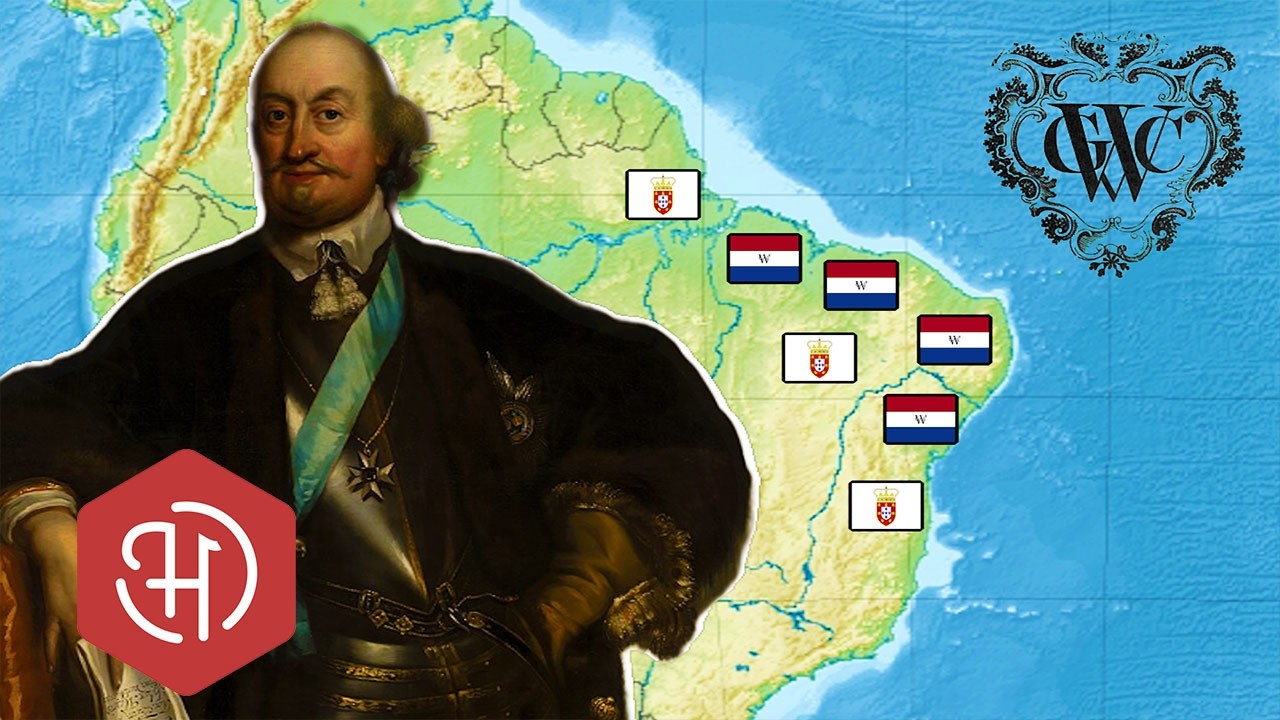
So if you would ask an average Dutch school pupil which countries the Netherlands colonized in the past, most likely they will say 'I don't know'. But for those who did make their homework they will probably say Suriname or Indonesia, but what if I told you that the Dutch colonized a big part of Brazil during the 17th century. And that was done under the leadership of Johan Maurits van Nassau-Siegen. But it lasted short. This here is a video on the rise and fall of Dutch Brazil. When we talk about Dutch colonies, most people don’t think beyond Indonesia, Suriname, the Caribbean, and perhaps South Africa. But for a short period, a large part of present-day Brazil was under Dutch rule. The man who played a key role in this was Johan Maurits of Nassau-Siegen. Whereas this man barely appears in Dutch schoolbooks, children in Brazil do learn about him. Johan Maurits, originally a German count, should not be confused with Maurits of Nassau (also called Maurits of Orange), who was the son of William of Orange, the leader of the Dutch Revolt. Johan Maurits came from a different branch of the same family, namely the German line Nassau-Siegen. The Dutch presence in Brazil began with the efforts of the Dutch West India Company (WIC). This trading company mainly wanted to profit from the lucrative sugar trade, which until then had been largely in Portuguese hands. Because the Dutch Republic was at war with Spain — and Portugal was then under Spanish rule — the Dutch also considered the Portuguese to be enemies and saw an opportunity to attack Portuguese colonies. Between 1630 and 1635, the Dutch eventually conquered a long strip of territory about 600 by 70 kilometers along the east coast of South America. The fight was not yet over, however, as the Portuguese managed to hold their ground in the southern part of the region. The area in Brazil conquered by the Dutch, also called New Holland, came into being in 1630 after an army of the WIC took large parts of Brazil from the Portuguese. That success was partly thanks to Piet Hein, who shortly before had captured the Spanish Silver Fleet. This loot suddenly gave the WIC a lot of money — enough to plan and carry out a major military attack on Brazil. These conquests instantly made the Dutch Republic an important colonial power, as until then most colonies had been relatively small trading posts in the East. In the West, the Dutch had mainly focused on privateering — attacking and looting enemy ships — rather than governing their own colonies. It’s worth noting that the Dutch had already captured territory from the Portuguese in Brazil before 1630, specifically in 1624. A Dutch fleet briefly took the city of Salvador (also called Bahia), but the Portuguese quickly recaptured it. The real breakthrough, therefore, came in 1630, when the WIC sent a large military expedition and took parts of the northeast coast of Brazil, including Olinda and Recife. From Recife, the Dutch expanded their power. They took over sugar plantations and tried to make the territory economically profitable. The conquered area was called New Holland. Later, Johan Maurits of Nassau-Siegen was sent as governor to administer and expand the colony. He resided in Recife and had a palace built there called Vrijburgh. This area was now called Mauritsstad and became the cultural center of the New World, with a botanical garden, a zoo, and a museum. Today, nothing remains of Johan Maurits’s palace. The site is now Praça da República, as you can see here. From Johan Maurits’s palace Vrijburgh, one could see for kilometers across the ocean. The new palace radiated wealth. One room was entirely furnished with ivory: the table, the chairs, and even the candlesticks were made of it. Around the palace lay a park with vineyards and fountains. At the foot of the palace was a neat city basking in the tropical sun. The streets were straight and intersected at right angles, as if drawn from a drafting table. There was a hospital and an orphanage. Mauritsstad seemed like a piece of modern Europe in America. To connect this new city with old Recife, a bridge was built over the river. That was no easy task. The current was so strong that the chief engineer said a stone bridge
Segment 2 (05:00 - 10:00)
would be impossible. The governor, who liked to design things himself, therefore proposed a wooden central section. The current Ponte Maurício de Nassau stands in roughly the same location as the 17th-century Dutch bridge and still bears Maurits’s name. In Brazil, he is known as Mauricio de Nassau. He remains a hero there. Schools, a bridge, and a university carry his name, and his bust stands by the governor’s house. But who was this man who became more famous in Brazil than in the Netherlands? And how did a colonial governor gain such a good reputation? Johan Maurits of Nassau-Siegen was born in 1604 at Dillenburg Castle, just like his granduncle William of Orange. He was one of 25 children of John VII of Nassau-Siegen. His parents could not provide all their children with the same opportunities. The eldest sons could still study and travel, but there was no money left for Johan Maurits. At sixteen, he therefore chose a military career. He went to the Dutch Republic and joined the States Army, which had fought Spain during the Eighty Years’ War, also known as the Dutch Revolt. At that time, there was a temporary ceasefire. During this period, Johan Maurits became an officer in the cavalry under his relative Frederick Henry. In 1621, the Twelve Years’ Truce with Spain ended, and the war resumed. Johan Maurits fought in various campaigns and sieges. He stood out for his courage and was quickly promoted to captain. In the winters, he stayed in The Hague, participating in court life. In 1632, he purchased land next to the Binnenhof to build a palace now known as the Mauritshuis. Money probably played a role when he agreed to a position in Brazil. The directors of the Dutch West India Company, the Heeren XIX, were looking for a governor for their new colony. They wanted someone of high standing. The Republic had only recently become active in Brazil. In 1630, the WIC had captured parts of the coast from Portugal. The main prize was sugar. The Dutch settled in Recife and called their territory New Holland. The Portuguese retreated and burned sugar mills. In 1636, Johan Maurits was appointed governor-general. He received a high salary and a share of the spoils. In October, he left for Brazil, accompanied by artists and scientists tasked with studying and documenting the land. In Brazil, he worked tirelessly. He achieved military victories over the Portuguese and expanded the territory. He also brought more order to the colony, tackling crime and corruption and establishing a legal system. He introduced standard measurements, as used in Amsterdam. Recife was fortified and expanded with a new city called Mauritsstad. To restore sugar production, he sold abandoned plantations. Portuguese owners could borrow money to buy them back. The Dutch still had little knowledge of sugar cultivation and little interest. Because few Dutch colonists came, the colony remained dependent on slavery. Johan Maurits sent a fleet to Fort Elmina in Africa, strengthening the Dutch slave trade. Yet it was primarily his policy of tolerance that earned him a good reputation. He could not completely defeat the Portuguese and therefore needed their support. He granted them equal rights. Portuguese residents were also allowed to participate in city governance. In 1640, he convened a meeting of Dutch and Portuguese representatives, later regarded as the first parliament on the American continent. He granted religious freedom: Catholics could practice their faith, and Jews were allowed to gather openly, building the first synagogue in (South) America in Recife. This synagogue still exists and is now a museum — which I visited in 2024. In addition, the scientists and artists left behind important work on tropical diseases, biome, and astronomy. Yet the Heeren XIX, the WIC board, recalled Johan Maurits in 1643. Peace had been concluded between Portugal and the Republic, and they wanted fewer troops in Brazil. They also found his expensive construction projects and his style of governance excessive. They were primarily interested in profit and military success. Johan Maurits, in turn, complained of insufficient support and unrealistic expectations. On May 11, 1644, he bade farewell to Brazil. Large crowds came to see him off. After his departure, things quickly declined. His successors could not maintain peace. Mauritsstad was later destroyed during the defense of Recife. In 1654, the Dutch lost Brazil for good. Johan Maurits was already back in The Hague. His palace, later known
Segment 3 (10:00 - 11:00)
as the Mauritshuis, was complete. He filled it with Brazilian objects, stuffed animals, and paintings. During festivities, he offered guests exotic drinks and hosted Brazilian performers. He remained active in the army until 1675 and became commander-in-chief. The following year, he withdrew from public life. He died in 1679 near Kleve and is buried in Germany. He never married and had no legitimate children. In Brazil, he remained known as one of the best colonial administrators ever. In Germany, he is remembered for his parks and construction projects. In the Netherlands, he is primarily remembered through the Mauritshuis, although many people associate the name with his distant cousin, Prince Maurits of Nassau — after whom he was named. In short, he is barely known in the Netherlands, which is why this video exists. Let me know what you think below. Buy me a coffee if you can. If you want to learn more about modern Brazilian history, here are two more videos for you.