Understand sentence structure in French! (B2 Level)

Understand sentence structure in French! (B2 Level)

Machine-readable: Markdown · JSON API · Site index

Поделиться Telegram VK Бот
Транскрипт Скачать .md
Анализ с AI

Оглавление (3 сегментов)

Segment 1 (00:00 - 05:00)

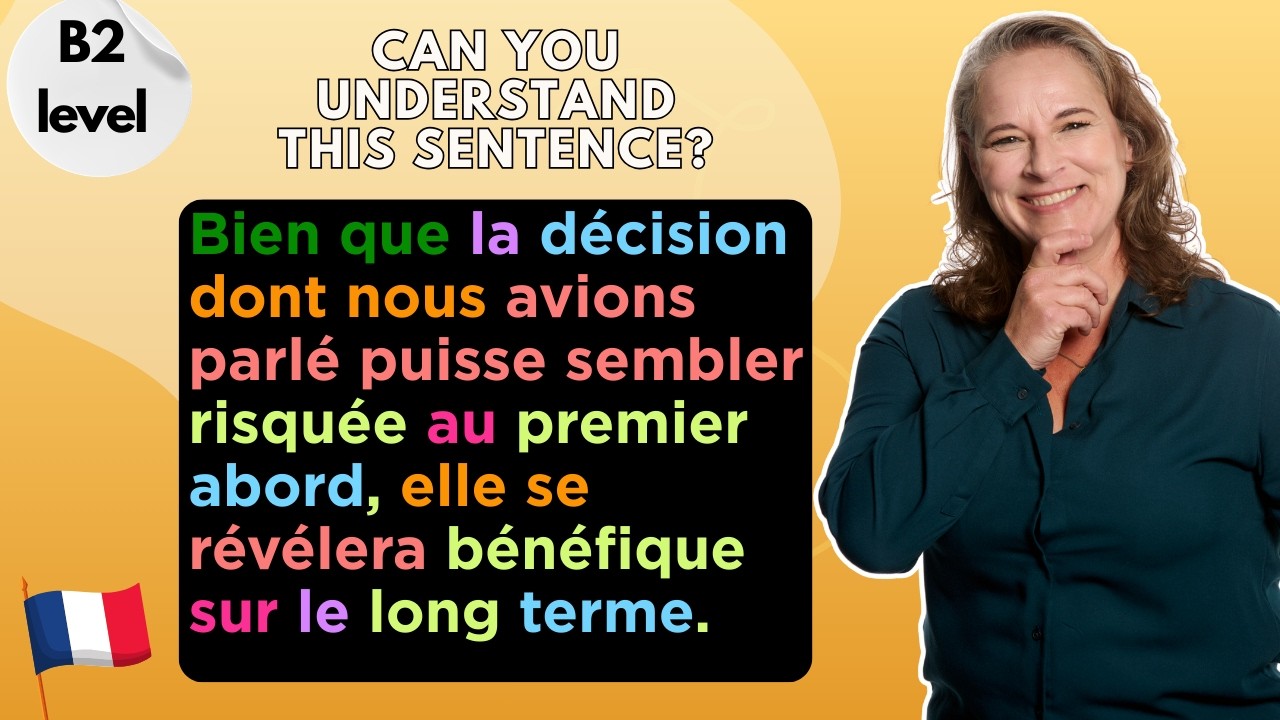
Here is a couple of sentences in French at B2 level. Can you understand these sentences? So this is the sentence. In today's video, we will take a sentence aart that one so that you able to make your own with confidence. So remember sentences are constricted with nouns, verbs, articles, pronouns, adverbs, conjunctions, etc. These sentences, especially the ones that B2 that we have chosen today, can be seen in a professional settings. Okay, it could be a document, conversation, more professional. This series is all about understanding sentence structure in French and identifying the role of each word. So let's start. Let's have a look at the full sentence again and then I will take the first part of the sentence. Okay, let's have a look at the first part of uh the this paragraph if you wish of the two sentences is known as a conjunction subordin conjunction of subordination. It means even though or although bianca is used to express a concession and is always followed by the subjunctive which makes this sentence a B2 level. Now if we have a look at decision and they go together because la is a feminine singular definite article. Why do they go together? because decision is also a feminine singular noun and the two go together. So, whatever article you're going to choose has to agree with the gender and the number of the noun you're using. Remember that L is masculine singular definite article and le is used for a plural definite noun. Okay, so in that case it's a plural definite article. Okay, let's have a look at. It means of which or from. This is known as a relative pronoun. It refers back to the noun decision in our sentence. Why are we using? Because it is used here with the verbi and parley is usually followed by d. So we talked about what as for new it's of course a subject pronoun. So first person plural remember. So any verbs which follow will have to be conjugated with the right endings. For the ending of any verbs will be o n s in the present tense. E I imperfect or conditional tense here we had spoken this is a perfect soicative this tense is formed with the auxila or it depends on the verb we're using now I have lots of lesson on what auxiliary to use for what verbs okay in that case we're using avoir it is used with avoir in the imperfect tense and followed by the past participle of the conjugated verb. So have a look at it again. Can you say that? So we had so a here is in the aer and we follow by a past participle just like we use a compos. Okay. Now let's have a look at p. P is the present subjective of puvo. I know right now it is here in the third person singular because the subject is la. So l third person singular and as mentioned before we need the subjunctive because of at the beginning of the sentence. Now remember the full sentence. Okay, that's hence why we have p because we started with. Okay, what is here in that case? It comes right after puvoir. Okay, in the subjive. So it may seem sly means to seem. Okay, prely may seem or literally it means may to

Segment 2 (05:00 - 10:00)

seem because in that case sly is in its infinitive form. So risque. Now risque is an adjective in its feminine singular form because it agrees with the word decision which is also feminine singular. Remember that all the adjectives in French agree with the gender and number of the noun they relate to. However, there are some colors that do not follow this pattern, but that's another lesson completely. Let's look at oira, which means at first sight. It is an adverbial phrase made of three elements. O, which is a contraction of the preposition a and the article. So, you don't say all, you say o. And the ordinal adjective okay in its masculine singular form because of the gender of abore. Okay. So abore is a masculine singular noun. So everything is going to relate. O masculine singular. Premier is going to be masculine singular and ab is masculine singular. Do you see the connection here of all the words? And a lot of the time in sentences, actually every time, be aware of your subject. Be aware of the noun you're using. Okay? Is your subject feminine plural? Then in that case, what's going to follow should all agree in feminine plural and so on. It's very important. So let's have a look at the full sentence now. is your subjective. So what does it mean? Although the decision we had talked about may seem risky at first glance. Okay, can you see that? Now remember this is of B2 at a high professional level. Now let's have a look at the second part of this sentence. Now are you ready for it? I mean out of the two sentences I think this one may be easier. Okay, but it comes together and we will translate it all at the end of this lesson. Now L is a subject pronoun which refers to la again that's what I said earlier on everything has to agree in gender a number okay s is a reflexive pronoun and goes with s to reveal itself so we say here rea is in the future for re or future simple now re means to reveal the way it is with e is in its infinitive form. However, in order to make it a future, we have to have the right ending for l the subject pronoun of it is a su. So, you keep the full verb as it is and you add an a. And of course, if you want to know how to conjugate these tenses in the future and so on, I have a very popular video on how to conjugate a verb in different tenses. So have a look at this. Elsa benefit. What about benefit? It is an adjective in its singular form. Note that the adjective ending in remain the same in the feminine and masculine. So that will be the same. benefic you don't necessarily see the gender of the noun it is attached to. Okay, if you see the word itself. However, if you know benefit, we know that benefit here is a feminine adjective. As for s, well, that's a preposition. It means on or in depending on the context. And of course L is a definite article masculine singular referring to the noun term l. And so we have l as well is a masculine singular adjective. Why is this? Because is masculine singular. So have a look at the full sentence. long term. It means it will prove beneficial in the long term. It of course refers to L refers to. Have a look at the full sentence. Now remember this is B2 level at a high

Segment 3 (10:00 - 11:00)

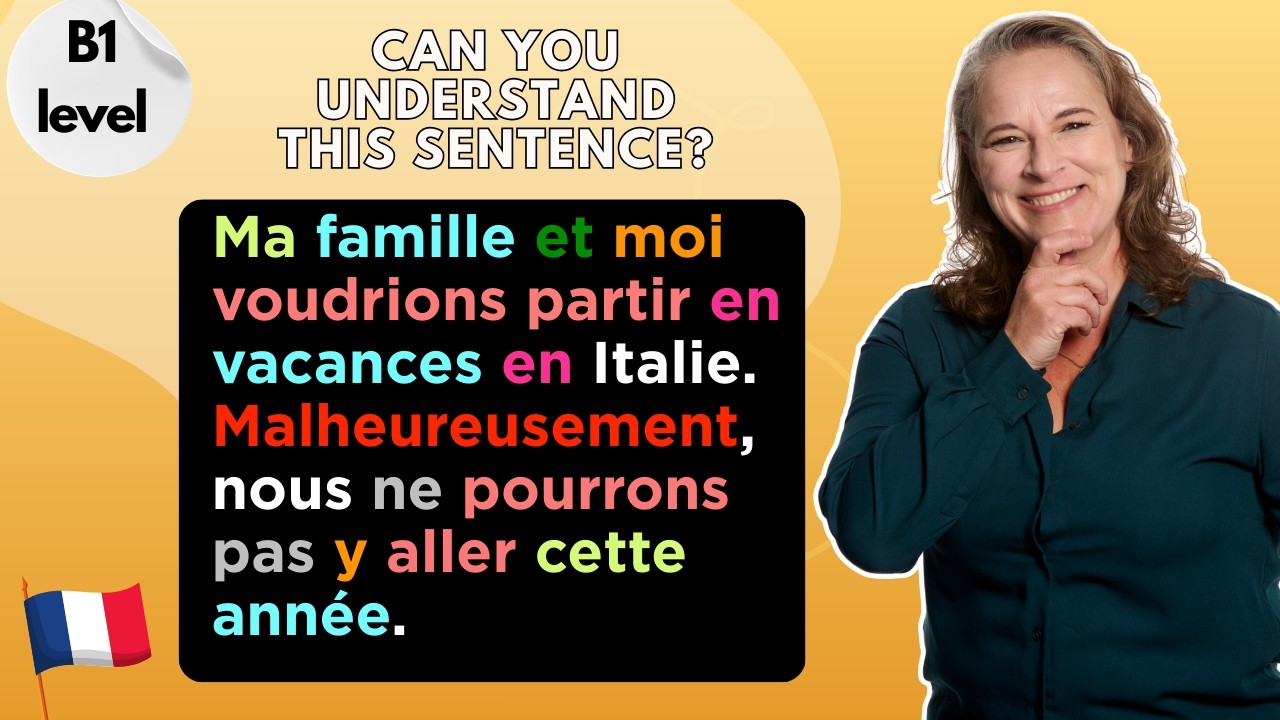
professional level. Uh this is something you would see in a letter uh at work or whatever. Okay? But it's useful for anybody to know about the placement of words and especially about the subjunctive. I cover the subjunctive in great length in my course learn French with elixa. com. If you do not know the course, have a look because it's followed by hundreds of thousands of people. Now, here's the sentence. So although the decision we had talked about may seem risky at first glance, it will prove beneficial in the long term. Now I remind you that this is of B2 level. Why is that? because there is a subjunctive there is a par there is an adverbial phrase here as well that makes it complex. Have you come across sentences like that in your workplace? If you are in the French workplace or even if you're studying French for a TE or whatever uh context or TCF, have you come across a complex sentence like that? If so, can you put that in the comments below? Why don't you have a look at this B1 level uh sentence where I do exactly the same except that this time it's not a B2 level, it's a B1 level sentence. That's it for me.

Другие видео автора — Learn French With Alexa

Ctrl+V

Экстракт Знаний в Telegram

Экстракты и дистилляты из лучших YouTube-каналов — сразу после публикации.

Подписаться

Дайджест Экстрактов

Лучшие методички за неделю — каждый понедельник