Understand sentence structure in French! (B1 Level)

Understand sentence structure in French! (B1 Level)

Machine-readable: Markdown · JSON API · Site index

Поделиться Telegram VK Бот
Транскрипт Скачать .md
Анализ с AI

Оглавление (2 сегментов)

Segment 1 (00:00 - 05:00)

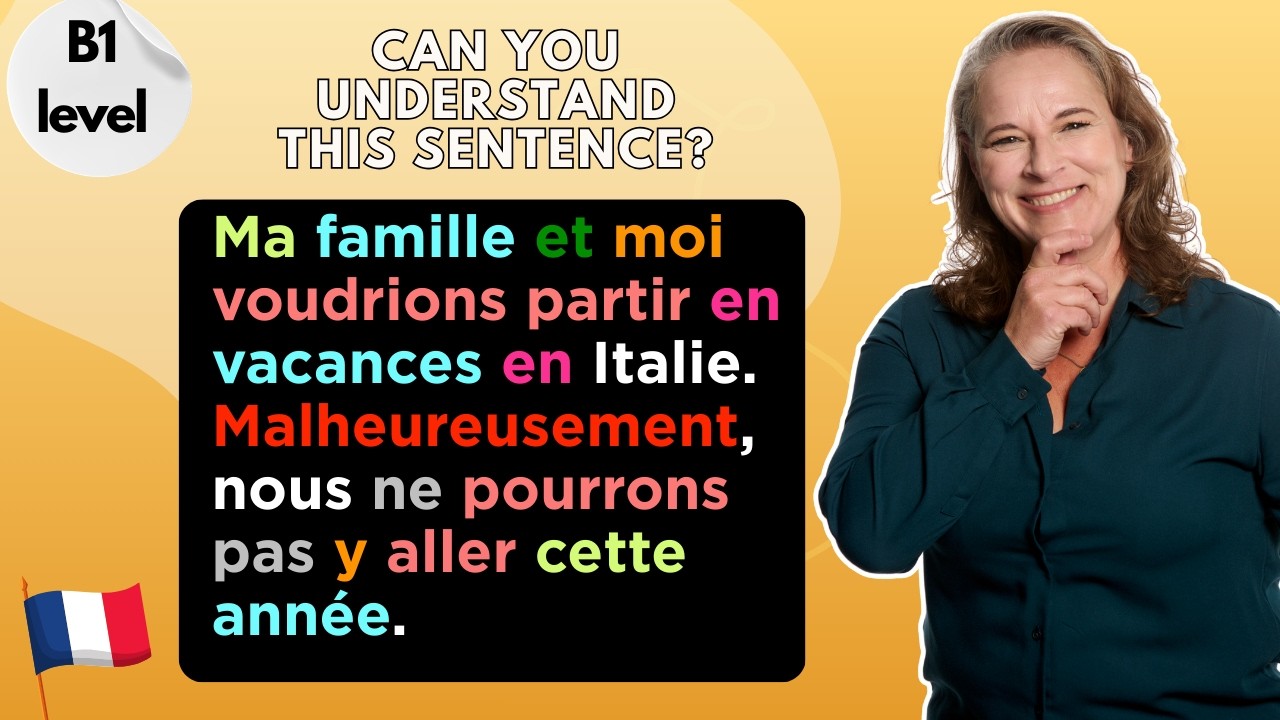
Here's a couple of sentences in French at B1 level. Can you understand these sentences? In today's video, we will take a sentence apart so that you are able to make your own with confidence. This series is all about understanding sentence structure in French and identifying the role of each word. So, let's start. Sentences are constricted with verbs, articles, pronouns, adverbs, conjunctions, etc. So, what I want to do is take this text apart. Let's have a look at the first sentence. Can you define each word grammatically? Let's start by the very beginning of this sentence. Ma means my. It's a possessive adjective. We use ma because the noun fi is feminine and singular. With a masculine singular noun, we would use ma, for example. And with a plural noun, we use m mea my cats. I in that sentence is a coordinating conjunction and mu ma is known as an infhatic or stressed pronoun. Infhatic pronouns are mwah l v l. Can you spot the verbs in this sentence? Well, we have vri, don't we? Which is the conditional of the verb which means to want. It has the ending because the subject is so mu is my family and I is we as a subject. So, we need to agree the ending of the verb with the subject it relates to. It means we would like. Of course, if you're not familiar with how to conjugate a verb in the conditional tense, I have done many videos following rules of how to conjugate in the conditional tense. Notice also that there is a second verb is to go or to leave in its infinitive form. So which means in other words it is not conjugated. It is to leave. We would like to leave or to go or yes that's pretty much what part means to go or leave. As for on, we can see it twice here. O can be a preposition followed by a place like on Italy in Italy or preposition followed by a noun like on vacance on holiday. But unfortunately for us, it can also be an adverbial pronouns used to replace nouns in sentences about quantity or place. For example, Have you bought apples? We Yes, I bought three of them. That's what means here. So, it's a versatile little word that. And if you want to learn more, please check my YouTube videos on this very topic. E versus. So, let's have a look at this sentence again. Italy means my family and I would like to go on holiday to Italy or in Italy. Now let's have a look at the second sentence. Now this one is slightly more uh complicated. Can you spot the verb and its tense? Can you spot the adverb in that sentence? Can you spot the nouns and the pronouns? Okay, let's have a look at this sentence and let's start with memo. Meorismo. So, this is known as an adverb of manner and it means unfortunately within this word have a look at the word you have the feminine of happy.

Segment 2 (05:00 - 09:00)

Can you see that word within that word and we have it we've added to make it an adverb. So happily and then to make it unhappily or unfortunately we added a prefix mal it becomes unhappily or unfortunately. Okay. So now let's have a look at the verbs. Mhm. Yes. P is one of them. Here it's in the future tense. It's the future tense of to be able to or can is the ending because of the subject pronoun new always new is awes. So we can we could you see sometimes it takes one little letter and that means completely something completely different. Again I cover how to conjugate conditional and future in great length in my course at learn French with Alexa the website. Now can you see the negation np is always placed before the verb and p after. So we will not be able to do what the second verb is ali and just like part it is in its infinitive form. Okay. So we will not be able to go. Now let's have a look at one letter which I think is the hardest in the whole sentence. E Ei, what is it? Well, just like E N, E is an adverbial pronoun. E can be used to replace a location in which case it means there in English or to replace an object, not people introduced by a for example. Are you into music? Yes, I'm into it. To learn more about E and O, you can check out my YouTube videos on these pronouns. Again, to recap, in our sentence, E replaces Italy. We won't be able to go there. So, technically means we will not be able to go. I know it makes no sense. Okay? But in this case e has to come before the infinitive ali. And to finish set ani can you see that set an do have you come across set c e tde e. Yeah. Well set ani is a feminine demonstrative. Okay. Adjective. It means this. So we've got a few s set depending on whether the words that follow is masculine or begins with a vowel or is feminine. So in our case an is a feminine word. So we use set an it's very important. It means this year. Have a look at the full sentence. Unfortunately we will not be able to go there this year. How are we doing so far? Are you able to spot the verbs now? these little coordinate or these little adverbs? Can you identify them all? Here's the full sentence. [clears throat] Can you see the verbs now? Can you see the pronouns? Can you see the adverbs? Can you see the nouns? This video is part of a series. Why don't you have a look at other uh videos based on understanding sentences in French at different level? And again, I cover all these extremely difficult grammatical subjects as part of the course, the complete French course at learnwithala. com. Please have a look. It's extremely popular. That's it for me. —

Другие видео автора — Learn French With Alexa

Ctrl+V

Экстракт Знаний в Telegram

Экстракты и дистилляты из лучших YouTube-каналов — сразу после публикации.

Подписаться

Дайджест Экстрактов

Лучшие методички за неделю — каждый понедельник