The Weird Physics of Adding Cream to Coffee

The Weird Physics of Adding Cream to Coffee

Machine-readable: Markdown · JSON API · Site index

Поделиться Telegram VK Бот
Транскрипт Скачать .md
Анализ с AI

Оглавление (2 сегментов)

Segment 1 (00:00 - 05:00)

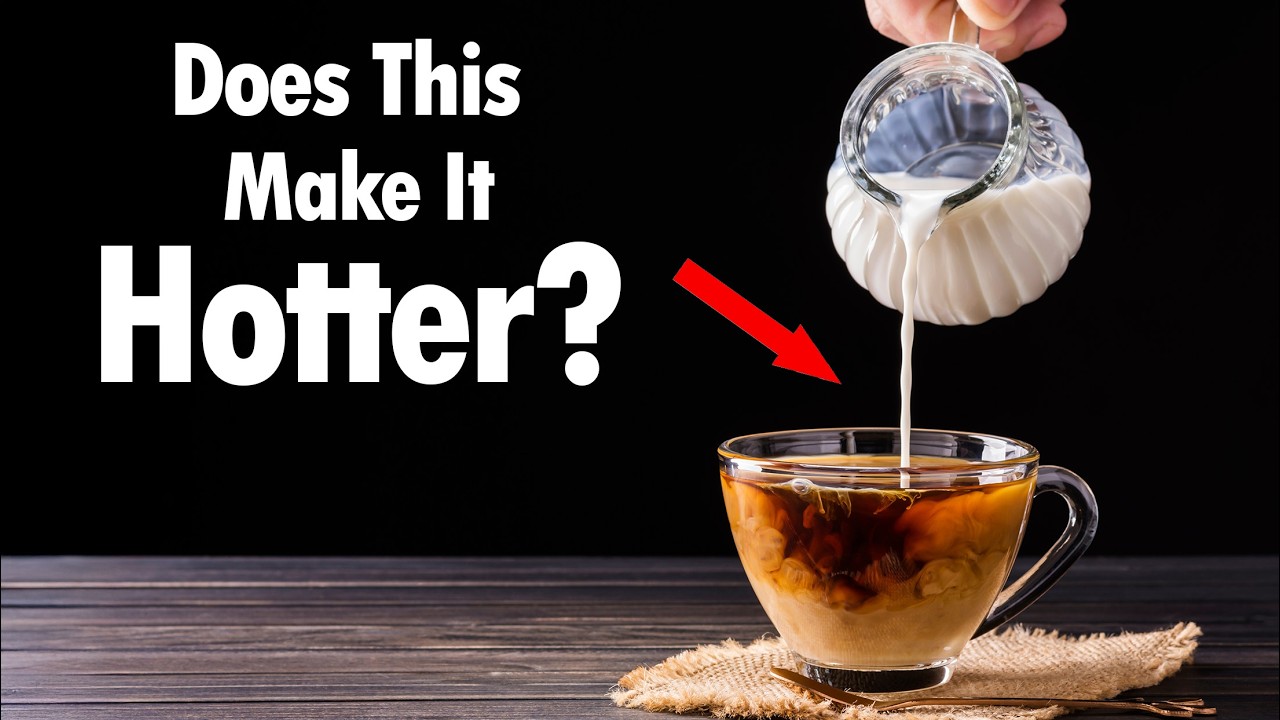
Okay, imagine you just brewed a hot drink like coffee or hot chocolate or tea and you're going to mix some creamer into it before you drink it. But then someone rings your doorbell. Now you really want your drink to be as hot as possible when you come back. So you have the option of pouring the cooler cream in it now and then answering the door or waiting until you come back from the door and then mixing the cream in. So the question is, do you think it will be the same temperature no matter what order you mix it or should you mix it first and then get the door or get the door first and then mix it right before you drink it? Well, let's go ahead and try it and see what happens. Okay, so I've got my two boiling temperature hot chocolates here and my two room temperature creams here. Then I have my two cups with two thermalouples in them. They're both at 72°. So, I'm just going to pour 150 ml of 197° Fahrenheit hot chocolate into both of the cups. Then, in the cup on the right, I'll pour 100 milllers of room temperature cream into it. But in the other one, we won't mix it yet. Now, let's start the timer for 10 minutes. And when the timer is up, we'll go back and mix the other cream in and see if there's a difference in temperature. Now, while we're waiting, if you like doing experiments like this, then I want to tell you about our sponsor for this video, Mel Science. One of the best ways to learn something is by doing it yourself, and their science kits bring that experience right into your home. Mel Science Kits are a subscription box delivered monthly. They have a lot of different options like chemistry kits, physics kits, and even kits designed just for kids. This is their lenses kit that has all kinds of cool experiments in it. Their boxes are my favorite science kits because they have so many unique projects and give you everything you need to do the experiment. They also make great gifts, especially because it's a subscription box, so it's the gift that keeps giving throughout the year. I use Mel Science Kits all the time at home, especially with my kids. So, if you want to check them out, click the link in my description and use the code James70 for 70% off your first month. Now, let's get back to our experiment. So, you can see the one on the left is currently hotter, but the gap is closing and we haven't mixed the cream in yet. Okay, it's been 10 minutes now. Let's mix this cream and see the temperature difference. Whoa, there's a huge difference. Stir them both up here. Look at that. 116 versus 131°. That's a 15° difference here. That's 8. 3° C difference. That's a huge That literally makes the one on the right taste hot and the other one on the left just really warm. So why would this happen? Why would there be such a big difference between when we mix them? So we started with the exact same temperature hot chocolate, cream, but we mixed them at different times and it ended up with a 15 degree Fahrenheit difference. Well, in order to understand what's happening here, we have to understand how heat transfer works. Newton's law of cooling says this. The rate of heat transfer over time is proportional to the difference between the hot thing and the room temperature times some constant. Now, this constant includes the effects of convection, radiation, conduction, and the shape and material of the cup, for example. And it doesn't really matter what it is in this case since we're using the same cup in both cases. Now, we aren't measuring heat directly. We're measuring temperature. So we can relate heat to temperature by factoring in something called the specific heat and the mass term. The specific heat is unique to the material in question. So now we have an equation that tells us how the temperature will change over time when we have a hot object in a cooler room. So I'm going to use this equation and graph what the temperature looks like for the cup in which we mix the hot chocolate and cream right at the beginning. You can see that we get this nonlinear decrease in temperature over time. But now let's look at what happens when we add just the hot chocolate and no cream. You can see that the temperature drop is much more extreme. The reason for this is that it has less mass. So the thermal mass term is smaller. But another strong reason is also the driving force is different as well. It starts out with a much more extreme difference between the room and the drink. So for both of those reasons, it's losing heat faster than the one where we already mixed the cream. But then after some point we add the room temperature cream to it. So the temperature drops to the weighted average of the two liquids. So it drops even more. In my graph here you can see that no matter where I choose to add the cream, the best time to add it to end up with the highest temperature is right at the beginning. Now this math makes sense and the graphs do too. But intuitively it still might not quite make sense to some of you. So let me try to explain it without equations. Picture that we have this 150 ml of hot drink. There's a

Segment 2 (05:00 - 07:00)

finite amount of heat in this liquid and it has to spread out somewhere. So, we have the choice. We can either let that heat go into the room or we can let the heat go into our cream. Well, obviously we want it to go into the cream since that's the thing we'll be drinking as well. So, when you mix them early, almost all the heat from the hot drink goes into the cream and then a little gets lost to the room over 10 minutes. But when you wait to mix, then most of the heat goes into the room over those 10 minutes, but then a little only goes into the cream when you finally mix them. So the difference is where you want the finite amount of heat to go in this short amount of time. So even though you're dealing with the same amount of heat from the start in both cases, in the mixing early case, you allowed more of it to stay in the cup versus losing it to the room. This same concept applies in reverse as well. If you heated up some soup from leftovers, for example, and you accidentally heated it too hot in the microwave, so you want to mix in some cold soup, you should wait and let the high driving force and lower mass transfer its heat to the room first and then add the colder soup a little later. You'll end up with a lower overall temperature if you wait a bit first. I love these examples because it shows you how important the driving force is in heat transfer. The larger the difference in temperature, the faster the heat transfer rate will be. That's why when you get something out of the oven, it will be extremely hot for only a very short period of time. But it can stay pretty warm sitting on your counter for a long time. As the temperature difference shrinks, the heat transfer rate continually slows down. And the cool thing about this idea of driving force dictating the rate of transfer is that it doesn't just apply to heat. It applies universally to any transport phenomenon. For example, if instead of heat you're transferring mass, the same thing applies. Instead of temperature, it's just concentration differences. And it even applies to momentum. In fact, my favorite and hardest graduate class used this book here called Transport Phenomena. Notice how the equations of change for momentum, mass, and energy all have the exact same form. The most amazing thing in physics is when we find these universal laws that apply across extremely different phenomena. And thanks for watching another episode of the Action Lab. I hope you learned something. If you haven't subscribed yet, consider hitting that subscribe button and we'll see you next time.

Другие видео автора — The Action Lab

Ctrl+V

Экстракт Знаний в Telegram

Экстракты и дистилляты из лучших YouTube-каналов — сразу после публикации.

Подписаться

Дайджест Экстрактов

Лучшие методички за неделю — каждый понедельник