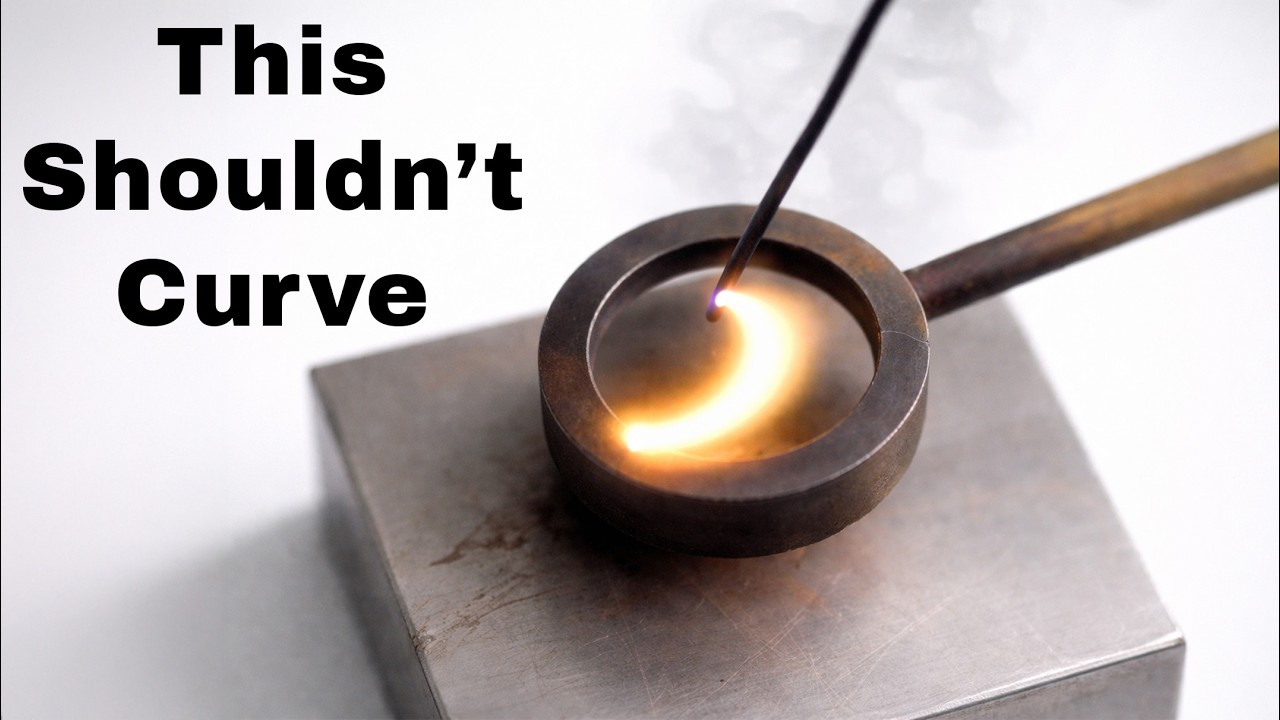
Hey everyone, I have a problem. Whenever I try to plug in a pickle, it sparks and lights up. The problem is the pickle preferentially lights up on one side and gets hotter on one side than the other. And sometimes, depending on the pickle, it even randomly switches. This is an AC circuit. Shouldn't both electrodes act the same? I see the same problem when I hook up my Jacob's ladder, which runs at high AC voltage. One of the electrodes heats up more than the other. If you don't think this is weird, you should. AC is supposed to be symmetric. There's no positive or negative electrode. It's constantly switching. It swings from high positive to low negative and back again repeatedly. So, whatever action one electrode is seeing, the other one should see it as well. In this video, I'm going to show you why whenever you have some AC plasma arc, you almost always have hidden DC currents inside of them. This [snorts] Jacob's ladder uses a ZVS driver to make an AC voltage at tens of thousands of volts, alternating times per second. So, this is very much an alternating voltage here. But let's run it for a bit and then measure the temperature of each electrode after it runs. Okay, I'll turn it off. Now, let's measure the temperature difference between them. So after we run it, you can see the top one, which is the left electrode, is at around 200° F, while the right one is at 110°. This asymmetry wouldn't make sense for a pure AC circuit. But then I remembered about welding. If you use a DC current, then the negative electrode or cathode will get about 70% of the heat and the positive piece will get about 30% of the heat. The reason is due to something called a Dubai sheath. In a plasma, we have two charge carriers, electrons and ions. Electrons have the same magnitude of charge as these ions, but they're about 50,000 times less massive. So, if I have a negatively charged electrode near a plasma, it blows the electrons away almost instantly. And what's left behind is a sheath full of positive ions. Now, these ions sit right next to the negatively charged cathode. And because the electrons are gone, the electric field there becomes enormous. Now, just a few microns away from the surface, those heavy ions suddenly accelerate and smash into the cathode, dumping a huge amount of energy into it. That's what causes this intense heating. But on the other side, at the positive electrode, the anode, there's no similar buildup. The ions don't get blown away like the electrons did on the other side. So, electrons are slowed down before they hit the surface due to these ions. And because electrons are so light, they don't transfer nearly as much energy as well. So in DC plasmas, the cathode heats up dramatically, while the anode barely heats up at all, even though the same current is flowing through both of them. But that's for a DC current. This Jacob's ladder should be AC. Could it be that there's some DC component to this? Well, I can easily check if there's some direct current going through these wires. Remember that when you have a moving charge passing through a magnetic field, the Lorent force causes that charge to curve. So if I set up my electrode so that I have a center electrode surrounded by a circular outer electrode and turn it on, you see a normal spark, exactly what we'd expect. But when I move a magnet underneath, watch this. It starts moving around in a circle. Also, if I flip which direction is facing up on the magnet, the rotation direction changes. If this were purely AC, the current would just alternate back and forth. So there would be no net charge movement. curvature. The plasma would just wiggle. But we clearly see circular motion here. So this means that there's a slight DC current in the ZVS circuit or there's something about the electrodes themselves that's turning some AC into DC. So let's check if it's the ZVS driver that has some DC component. The easiest way to do this is to switch which wire is connected to the ring. And sure enough, you can see that if I switch the wires, then the ring rotates the opposite direction. So that means that the current reversed. I looked this up and sure enough, ZVS drivers are known to have a slight DC component to them. So that answers why one electrode was heating more than the other in my Jacob's ladder. But what if I use a high voltage source that shouldn't have a DC bias? This is a neon sign transformer. It outputs about 6 kts at 40 kHz. There's no obvious positive or negative terminal here. So, let's try the magnet test again. It still moves in a circle. That's weird. This is supposed to be pure AC. Why do I still see a DC current causing it to move around in a circle? Well, maybe it's still coming from the electronics inside this transformer that's pushing a little bit of a DC bias. Well, when I switch the wires on
Segment 2 (05:00 - 08:00)
it, the direction switches again. So even electronic neon sign transformers have a small DC bias to them. This is because it first converts AC into DC with a rectifier and capacitor and then electronically switches that DC back into AC. And that switching is never perfectly balanced. So you get a slight more push in one direction than the other making a small DC current. But can we just try this with a pure AC wave without any induced DC bias from electronics? Well, I got yet another neon sign transformer, but this one is an old-fashioned iron core type. So, there's no way that there can be any electronics making there be a DC bias. Now, let's see if we still see some curvature near the magnet. Now, with this one, the pulsing is a lot faster. So, it's harder to form a constant plasma. So, it doesn't move in a circle. So, we can't look at the rotation. We have to look at the curvature of the sparks that are bending. If I freeze it on each spark, you can see that it bends with the arc pointing clockwise most the time. And this time, I know that there's no DC bias coming from the transformer itself because there are no electronics to cause it. And even when I switch the wires, it doesn't change the direction that the spark bends. This means that somehow there's still a DC current that gets pushed naturally due to the geometry of the electrodes themselves. To understand why, let's slow time way down and look at what's happening during this very fast voltage spike. So, this center wire is sharper, so it creates a stronger electric field, and it emits electrons way more easily than the ring. And then the voltage swings the other way, but the ring can't release as many electrons. That tiny different means that the center wire heats up slightly more each swing. And because it's hotter, it emits electrons even more easily on the next cycle. So that lets more current through which heats it up more which lets even more current through. This feedback keeps going and going until that has now been chosen as the cathode. Let me show you this graph to explain what I mean. The red line is the AC current that's constantly swinging back and forth. And the blue line is the average direct current. For true AC, the average is zero. But if one side of the AC wave lets through a little more current, then watch what happens to the average current. It becomes non zero. So there's a slight average DC current that happens now. So the plasma actually ends up acting like a tiny diode, letting a little more current flow in one direction than the other. So a DC bias forms naturally purely from geometry. In this case, there's a large difference between what these two electrodes look like. But no matter what, there will always be slight asymmetries between two electrodes. So now we're finally ready to understand my pickle lamp. A pickle is never perfectly symmetric. Neither are the electrodes. So once a plasma forms at some random spot inside the pickle, it just keeps forming there. That spot now becomes the cathode. It heats up and dominates the discharge and it makes a small DC bias happen in this AC circuit. After I let it choose one side to become the cathode, I can flip the pickle around and the same side of the pickle lights up. So the pickle is literally acting like a diode or a rectifier, forcing one side of the pickle to become more cathode like and the other to become more anodelike on average. It turns out it's actually very hard to build a high voltage AC system with a plasma that has no DC bias at all. So that's why you always get one-sided hot pickles and one-sided Jacob's ladders. And thanks for watching another episode of the Action Lab. I hope you learned something. If you haven't subscribed to my channel yet, remember to hit that subscribe button and we'll see you next time.