The Biggest CPP Mistake Canadians Make Retiring Before 60
13:39

The Biggest CPP Mistake Canadians Make Retiring Before 60

Parallel Wealth 16.04.2026 6 049 просмотров 221 лайков

Machine-readable: Markdown · JSON API · Site index

Поделиться Telegram VK Бот
Транскрипт Скачать .md
Анализ с AI
Описание видео
Learn more about our services at https://www.parallelwealth.com/planning PWL CPP calculator: https://research-tools.pwlcapital.com/research/cpp In this video, I'll go through the common CPP mistake Canadians make when retiring early, and the exact process you should go through to find out when you should start your CPP. If you have any questions about this video's topic or retirement planning in general, visit https://www.parallelwealth.com/ or use the links below to learn more about our services: ➡️Fee For Service Retirement Planning: https://www.parallelwealth.com/planning ➡️Retirement Income Program™: https://www.parallelwealth.com/investments ➡️Parallel Wealth Masterclass: https://www.parallelwealth.com/education More from Parallel Wealth: 🔗https://linktr.ee/parallelwealth The above affiliate links are provided for your convenience. If you click on a link and end up purchasing a product or service, this channel may receive compensation for the referral. We have personal vetted each product and service we provide links to. DISCLAIMER: This presentation is for informational purposes only and should not be considered financial, investment, tax, or estate planning advice. All investments carry risk, and past performance does not guarantee future results. Any forward-looking statements are based on assumptions and may not reflect actual outcomes. The content on this channel is for educational purposes only and does not provide specific investment or planning recommendations. Viewers should consult a qualified professional for retirement, tax, or estate planning guidance. Parallel Wealth and Adam Bornn are not responsible for any decisions made based on this content. TIMESTAMPS: 0:00 - Intro 0:24 - Common mindset 1:49 - Calculating CPP 4:17 - CPP at 60 6:07 - CPP at 65 7:22 - CPP at 70 7:59 - The common mistake 9:40 - The powers of CPP 10:57 - Introducing RRSP meltdown 11:30 - Comparison

Оглавление (10 сегментов)

Intro

Most Canadians should look to delay their CPP, the Canada Pension Plan, until age 70 or close to it. But what if you're retiring before age 60? How does it affect your CPP? And more importantly, when should you actually start it? In this video, I'm going to break down the biggest CPP mistakes Canadians make when retiring early and the exact process you should follow to figure out the best time to start collecting. And the content for this

Common mindset

video actually came from one of our viewers. So again, we appreciate all your comments, questions below. So, always if you have questions, comments, leave those below. We have a great community that will feed give you feedback, but we also will create videos off your stuff. So, this one came from Argus 16-N3M. I'd like to see more discussion about dropout years and how they affect CPP amounts. Went to university from 18 to 24, took a year out between jobs later, and retired at 59, for example. Does waiting till 65 to draw CPP make sense? or 60 or 62 or if you exceeded eight years then what? And this is a very common question. People, you know, have years or many years of no contribution. So you have these kind of eight years of dropout already and you're like, well, I don't want more of those and those are affecting me. So because I retired at 59, I have all these years I didn't contribute. I'm going to start my CPP at 60 or maybe I'll wait a couple more years. 62 like they said. So what I want to do is actually jump into a few different softwares. I want to go into the PWL CPP calculator, which is a fantastic calculator. I encourage you to use it. We'll link it below, but use that to figure out what is your CPP. And so, I'm going to go through that in this case scenario. So, a 59year-old has those 18 to 24 years, zero contribution, one in between, what does it look like, and then take those numbers and put it into our planning software, which is the key step to really figure out like when is the best time to take your Canada pension plan. So step one, we need to go

Calculating CPP

to the PW calculator. So that's where we are here. So I put in a birthday, April 1st, 1967. So recently turned 59 years old and is now retiring. May 1st coming up here 2026. Now what you need to do is put in your earnings. So you can see here future earnings is zero. He's retiring. And I need to go past income. So if I click on this, it opens up this little nifty chat. So it'll show the maximum amount in here to maximum YMP. So, but what you can do, you can actually put in your years every year and this you can get from Service Canada. So, you can go back onto Service Canada and get exactly what you made taxable income every year to put into here. Now, again, I've kept it simple here. From 18 to 24, which is 1985 for him to 1991, he had zero income. He said from 18 to 24, I went to university, don't have any income. Perfect. And then what I did is he worked for 10 years and I put one more year at zero. And it wouldn't matter where I put it in here. So I put zero in 2021 or 2001 10 years into his uh salary career and then again 2025 he stopped he's retiring now. I didn't put any payments in for 2026. I just kept it simple. So again this matched his question of kind of those six early years non-contributo and you can see that the dropout years here. So we have those early years of dropout that one year where he didn't work dropout year and then again he's got one more year here and then again there's going to be all these years where he doesn't pay into it and this assumes taking it later. Now, at the top based on this data, now we have this data in here. And again, if you have children, you can put your children in here, disability, there's a bunch of information you can change around here. This is information I needed for this scenario. But again, play around with the software. It's a fantastic tool. We have a couple videos actually breaking it down and you can check out those as well. So, if you look at the top, it will give based on the data, future growth of CPP, all the information in here, it shows CPP at 60, 65, and 70. So if he was to start CPP at 60, he would collect $932 a month. 65 it would increase by 46% to $1,357. Now again, it's not a flat equation because he's got more years here now of non-contributori amount. Absolutely. But again, we want to take these numbers and put it into financial planning software to make it work with everything else. CPP at 70, 1,974, 112% bump if you waste 70. So now I've taken these numbers and let's jump into the planning software. So here we have

CPP at 60

trusty Ross G Seller is where he was due 1967. Uh again, so birth date is all correct in here. Uh now again he's retired his no income. We have a small pension here. $20,000 a year of pension for him which again this doesn't matter. You know you got to put your own information in here. Just grab some information that we had in here already. 700,000 RSP some TFSA etc. Now what we want to focus on here is government benefits. The question is because I have these dropout years, should I take CPP earlier, middle, later, what does it look like? Now, the one caveat here is obviously if you have no pension, you have no savings, you might have to take CPP. And I always say people take CPP if you have no other income, like you have to take it to put food on the table. Absolutely. Or you have a diagnosed uh medical condition that will shorten your life. Then looking at taking CPP earlier definitely could make sense. But again, you want to run that through software and just shorten your life expectancy to see where is that magic number for you still. So we take that $932 a month, times it by 12, we get the 11184. Again, we're starting at age 60 and it's prorated in the first year because he's retiring partly into the year for his birth date. But we can see here, so CPP starts at 60 and starts collecting. So what we want to look at is, okay, we're collecting CPP. I'm not doing an RSP meltdown. I won't do it in any of them. It's going to add more benefit. I'll show you that at the very end. But we just want to look at if he took CPP at 60, how much what's the max spend after tax in his pocket that he would get? And we've mapped this all the way down to age 90 in this scenario. Again, we could do it to 95 or 85 or whatever you want. In this case, we did age 90. You can see this real income $63,18. So, if he took his CPP at 60, everything else he has gone on, melt everything down. So, he's got zero left at age 90. What is the maximum income he could draw on an annual basis after tax adjusted to inflation? $63,18.

CPP at 65

Now, if we take age 65, again, we just want to compare all three against each other. Age 65 is $1,357 per month. Divide or times that by 12, 16,284. When we put that into the plan, you'll see here, and again, I haven't done RSP meltdown, so very inefficient here. But what we want to look at is that CPP starting at 65. And then again, what is the real after tax income? $63,967. So I would look at that and say, well, yeah, it's $800 more per year after tax adjusted to inflation. It's more money in his pocket, but it's not substantially more. So is there a benefit to delay to 65 for him? Absolutely. He's getting more money in his pocket, but it's not a massive difference. So if he said, "Yeah, you know, I just want to take it at 60 versus 65. " It could make sense. But again, we need to look at 70 to see is there a bigger difference? and then compare 60 to 70 like that's going to be a massive difference. Again, one thing I'm not covering in here is kind of the RSP meltdown tax strategy in that time frame. That adds a massive benefit. The lane CPP a gives you more and I want to prove that in this video. But the another layered benefit in there is now you have 5 to 10 years depending when you retired to draw down your registered account, create tax efficiency. Like there's a massive benefit beside just delaying your CPP. So delaying till

CPP at 70

71,974* 12 23688. When we put that in to the planning, we're going to see here again we have many years of no CPP. You can see all those zeros there. See old age security we left at 65. We're not playing with that in this video. But you can see the after tax $64,792. So now we're 156 $1,700 more after tax adjusted to inflation every year. And I'll so show you what the total amount is like how much extra money. It's quite substantial, but you can see age 70 is giving him much more income than had he taken it to 60. And I think this

The common mistake

is where the error lies. Like I have a lot of zero contribution here and so I have to take it early. And we can see here firsthand that the reality is no, it actually makes sense. 65 is better than 60. 70 is better than 65 and better than 60. So even though there was those zero contribution years, he should still wait till 70 to take his kind of pension plan. And again, if I took time and layered in like the RSP meltdown, all the strategy, the benefit ads even more. But let's just look at the CPP, just simple high level what makes the most sense. Delaying CPP will make the most sense. And again, your situation might be different, but I would say 99 out of 100 times, this is how it will map out. So for a lot of you, you have these zero contribution years. You've talked to your neighbor, your co-orker, your friend, your family, and they're like, "Oh, no. I went to university, had a couple like I'm taking CPP at 60. I already I've hit my eight years of non-contributor years or 17% of the years. " I' I've hit that. I need to take my CPP. I don't want any zero years to count towards it. But the reality is there's still that benefit. And so, the process you need to go through isn't to just delay CPP till 70. The process you need to go through is with your financial planner to look at exactly what I just showed you here. build out a plan and have CPP at 60, at 65, and at 70. And again, just from a high level like I did here, the number is probably going to be bigger at 70. Now, if you have a good planner, they'll then take those 10 or 11 years in this case and actually start drawing down your RRSP and create tax strategy and create a lot more flexibility in your plan, which will give you more money, hopefully allow you to pay less tax, but create a better estate situation, and again, might give you more income throughout your retirement as well. For the majority of you watching this video

The powers of CPP

your CPP, your kind of pension plan, will be the greatest asset or income source in your retirement. It may not be the biggest, but it's the best. It's adjusted to inflation. It's, you know, not market related. There's so many benefits to the Canada pension plan. And by delaying it, you're getting that bigger number. Like we talk about annuities, like a annuities don't make sense. Well, the best annuity out there, and I saw a podcast with Dave Chilton and Ben Felix the other day on Dave Chilton's Wealthy Barber podcast. If you haven't checked that out, go check that out. fantastic podcast, but they were talking about annuities and Dave asked Ben, you know, are do annuities play a factor in retirement planning and they can and but Ben said, "Look, the best annuity you can buy is delaying your CPP and I 100% agree with him. Like it is the best income source later in retirement. " So, not only does it give you more, but now you have a great income source later on. And so many of you are getting it wrong. And that's why we create videos like this, just to educate you. You got to look at this stuff. I don't care when you take your CPP. I care that you know the difference between 60, 65, and 70. So for this viewer that left this comment, he now knows, hey, like yeah, all the other assets aren't the same as his obviously, but now I can have that mindset of maybe it does wait make sense to delay it and I should sit down with my financial planner to figure out those exact numbers. Now before we wrap up, I want

Introducing RRSP meltdown

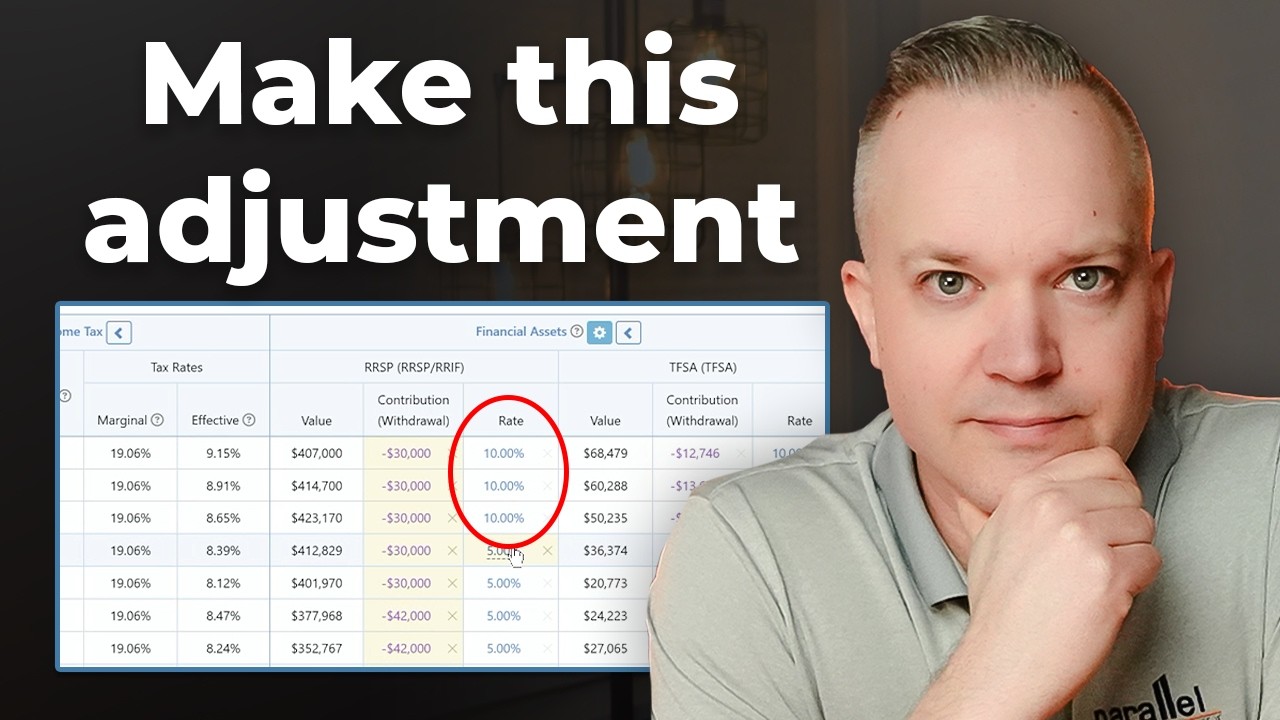
to do a comparison and I also want to show you like what this would look like now if we did an RRSP meltdown, like if we actually created some tax strategy around the whole plan. So you can see here CPP is still delayed till 70 and what I've done is I've actually done an RSP meltdown so that the account is emptied out by about age 8182 here wellunded TFSA spent all the money and you can see we've bumped it $65,204. So over $2,000 after tax adjusted to inflation in their pocket every year by a delaying CPP primarily but then b creating a bit of tax strategy behind

Comparison

it. Now when we compare all three again number one was age 60 number two is age 65 number three is age 70 with no tax planning lifetime expenses you're going from 3 million 38,000 to 3,19 so about $80,000 more of income and again this is nominal dollars personal taxes is a little bit higher here but if I add in number four and I'll do that here in a second you can actually see the tax bill goes down lifetime government benefits obviously we're collecting a whole lot more from the government in this case because we've delayed our Canada pension plan and again we've mapped it out here so that there's basically nothing left in the estate. If we pull it back to say age 86 as some of you always leave comments age 90 you'll never live there 86 which is life expectancy for a male here in Canada again you can see 2. 515 up to 2. 582 so about $70,000 more in his pocket throughout retirement. So again, I think a lot of us would love to have 70,000 more in our pocket. Now again, when I add in that fourth, which is delaying CPP till 70 and building out a bit of a plan around it, you can see personal taxes go from 541,000 the original plan, it bumped up to 602 with CPP, but then when we actually do tax planning and income planning, not only we giving you more money, right, 20,000 more, but you're paying much less tax. So, you know, double benefit there. So that's why it's super important not only to delete CPP, but you got to create strategy around that as well. So if you're someone that has years of zero payment into CPP, which is most Canadians, don't let it fall on you that because I have all these zero years, I need to take CPP early. Make sure you do this case study with your financial planner. Again, if you need help with that, this is what our team does. We build out retirement plans. That's all we do. Feel free to reach out to our office. You can learn all about what we do, how we do it, sample plans, all of that on our website, parallelwealth. com/planning. Again, we have a sample plan on there. There's a bunch of information. Check that out and there's a way to connect with us on there. And again, CPP timing, big factor. Another huge factor, and you saw it there, saving taxes, giving more money, is that RRSP meltdown. And if you want to learn how that works, how to do an RSP meltdown, you can check out this video

Другие видео автора — Parallel Wealth

Ctrl+V

Экстракт Знаний в Telegram

Экстракты и дистилляты из лучших YouTube-каналов — сразу после публикации.

Подписаться

Дайджест Экстрактов

Лучшие методички за неделю — каждый понедельник