Portfolio Performed Better Than Expected In Retirement? Adjust This Now
11:54

Portfolio Performed Better Than Expected In Retirement? Adjust This Now

Parallel Wealth 09.04.2026 5 932 просмотров 343 лайков

Machine-readable: Markdown · JSON API · Site index

Поделиться Telegram VK Бот
Транскрипт Скачать .md
Анализ с AI
Описание видео
Learn more about our services at https://www.parallelwealth.com/planning In this video, I'll go through how the recent good markets have turned into a bit of a tax problem for retirees, and how you can think about updating your plan and drawdown strategy to solve this. If you have any questions about this video's topic or retirement planning in general, visit https://www.parallelwealth.com/ or use the links below to learn more about our services: ➡️Fee For Service Retirement Planning: https://www.parallelwealth.com/planning ➡️Retirement Income Program™: https://www.parallelwealth.com/investments ➡️Parallel Wealth Masterclass: https://www.parallelwealth.com/education More from Parallel Wealth: 🔗https://linktr.ee/parallelwealth The above affiliate links are provided for your convenience. If you click on a link and end up purchasing a product or service, this channel may receive compensation for the referral. We have personal vetted each product and service we provide links to. DISCLAIMER: This presentation is for informational purposes only and should not be considered financial, investment, tax, or estate planning advice. All investments carry risk, and past performance does not guarantee future results. Any forward-looking statements are based on assumptions and may not reflect actual outcomes. The content on this channel is for educational purposes only and does not provide specific investment or planning recommendations. Viewers should consult a qualified professional for retirement, tax, or estate planning guidance. Parallel Wealth and Adam Bornn are not responsible for any decisions made based on this content. TIMESTAMPS: 0:00 - Intro 0:36 - Before we make any changes 2:50 - Base scenario 5:06 - What if they get a 10% return? 7:03 - Adjusting the RRSP meltdown 9:40 - Can they spend more?
Оглавление (6 сегментов)

Intro

Putting aside the shakiness in the markets we've seen early on in 2026, the last few years have been incredibly strong. And for many retirees, these strong markets have meant their retirement accounts haven't drawn down the way they originally planned. And in some cases, these accounts may be even higher today than when they retired. And while it's great to see those returns, if you continue with the same draw down plan, it can create a tax problem down the road. So, in this video, I want to walk you through what you should be doing if you've had higher returns than you planned for and how to adjust your withdrawal so you can get back on track.

Before we make any changes

Before we get into making any changes to your retirement plan, you have to understand, hopefully you know by now if you're retired or close to it, markets aren't level. They don't go straight up. down. They go all over like a roller coaster. And so while we're going to have good years and bad years in markets, don't make rash decisions. Just because you've had a really good year or maybe two years, it doesn't mean the whole plan should be blown up and changed and etc. It might just need small tweaks. Typically, you want to look for about a 10 to 50, maybe up to about a 20% change in your portfolio for a period of time, not a week or a month, but an extended period of time. So if you see a continual trend of yes this year I have more than I expected again I have more okay now we need to start making a change just like on the other side maybe we'll have a period of years where markets are really bad and I have less money than I expected and there's a small adjustment you need to make and again I'll jump into our software here shortly and show you exactly what you should be doing in these situations if your longerterm trajectory has been really good which for a lot of Canadians it has been. We've had a really good decade in the markets overall. And most of you have been averaging probably 7 8 10 12% rate of returns after your fees. If you haven't been, that's fine, too. But for a lot of you, you have. And maybe your retirement plan only shows a 5 or 6% rate of return. And this is what's bumped into a problem of we get this call a lot. Adam, I retired 5 years ago. I've been drawing down my accounts like my plan showed, but I have more money than the day I retired because my investments have done really well. Again, a great problem to have. So, how do you solve that problem? And again, I use the word problem here very lightly because it's a good problem. We have more money than we expected. But it is a bit of a tax problem. And before we jump into it, about 50% of you watching our videos still aren't subscribed, which blows my mind. If you're watching the videos, you enjoy our content, you want to watch more, make sure to subscribe to the channel and hit that notification bell, and then you get notification. We release two brand new videos every single week and our podcast every Saturday morning. So again, about 50% of you are not subscribed. Please subscribe to the channel. Join our community. We have a massive launch coming up this summer into the fall that you don't want to miss. So make sure to subscribe and let's jump into the software. So we're

Base scenario

back into the trusty Ross and Rachel Geller. And for those of you that have made comments, they are actually together on Friends. They are not brother sister. And we've had that comment before. So let's just clear that up. But into Ross and Rachel here. So we built out a plan. They're 60 years old in this situation. and we've built it out to age 95. Again, we did a video not too long ago showing there's over 50% chance one of them will live into their 90s. So, we want to build out till 95. And we've laded this income. You'll see in the go- go years, they have 80,000 after tax all the way till age 75. Then it drops down to 72,000. And then in the no-go phase, they have 66,000. Now, what I want to do is look at each one of them individually. And they have I've left them at the same amount of assets just to keep it simple from a sample perspective. uh for watching this. So, don't worry about CPP OAS. We've timed all that in here. What we want to look at is this RRSP meltdown. So, the original plan has them drawing down about $30,000 a year until age 65. Then, it ramps up to $42,000. There's some uh credits and that tax credits and whatnot. So, we want to bump that up a little bit and then back to $18,000 and the RRSP or the RIFF at that point is melted out or drawn out by age 83. So by age 83 there's no more um riff and their estate tax goes down to zero. So that's the current plan that we have in place. Now the question is well what happens if they get more than the 5% rate of return. You can see the rate of return here is at 5% both on the RRSP and TFSA. And you'll see the TFSA we're pulling some out. We're topping it up pulling out. So that's that lever account. And these numbers will change as the rate of return changes obviously. But again the main focus here is RRSP. That's a tax planning and this is where your plan maybe needs an update if it has done well in the markets or hasn't market. So based on the 5% rate of return again 30,42 then 18 um the same thing for Rachel. So I won't go back and forth between them consistently here but she has the exact same amount of assets in this case. So that's what they have. Now you can see at the end of their plan if we look at a combined view and go back to all types so both their TFSAs both their RIFF accounts at the end of the day when they're 95 they still have about $92,000 left. It's all in the TFSA at that point for so tax efficient but there is a little bit of money left. Now the question here is

What if they get a 10% return?

well what happens if they got 10% rate of return? So the next 3 years what happens if that rate of return is much higher than 5% and they have more in their accounts especially their RIFF account than they expected. We don't want to run into a tax issue down the road. So, let's take a look at what that number would come to in 3 years had they just lived out the plan of drawing down 30,000 a year, but their rate of return was much higher. So, here you can see that 10% rate of return for the next 3 years and then have left it back at 5%. So, nothing changes there. You can see we're still pulling money out of the TFSA, a little bit of a flex account going forward, all of that. The difference is here now look at the end of 2028. So after 3 years, this is the end ofear value, $423,000. If we go back to the 5% rate of return, you can see at this end of the same year, instead of $423, we have $363,000. So we've fallen into that range of investments have done really good and we need a plan update. So again, just as a reminder, we were at 30,000, 42, and then $18,000 with it depleted by age 83. Now, if Ross did absolutely nothing, he kept drawing the plan 30 40218. As we go down, you can see even at age 95, there's $63,000 left in the RIFF. Now, because they've done better, both Ross and Rachel, 10% on TFC and the RIFF account in the first three years, instead of that $93,000 left at age 95, they have a whopping $699,000. So, they have a lot more now just because that early rate of return. that made a massive difference for them. So, a couple things here. We we're going to look at how do they drop down more tax efficiently so they don't have an account value left in their RIFF later on. Like we want to transition that even if they're not using the money over to the TFSA. The second piece we want to take a look at is well, they have more money. Could they spend more? And what does that look like? So, here's the option of they're going to keep the

Adjusting the RRSP meltdown

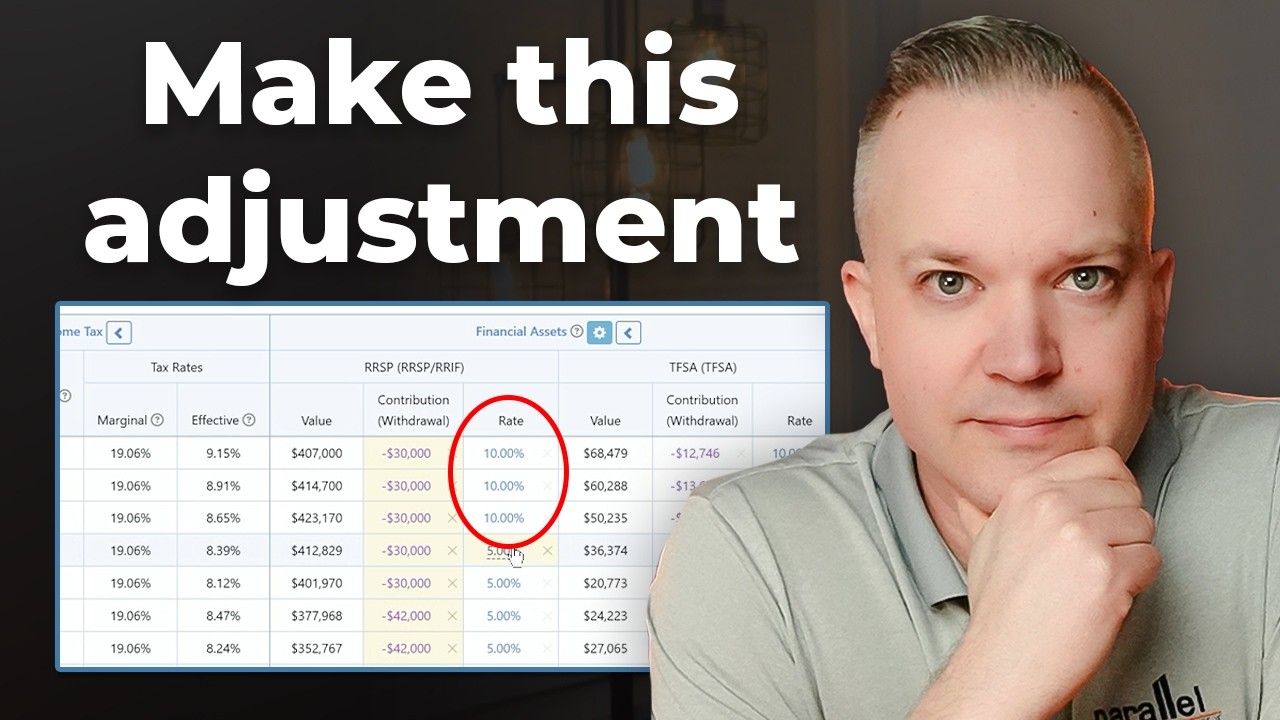
spending the same, but we want to draw down that RIFF account in a more efficient way. So, you can see the 30,000 stayed the same. And in fact, I didn't even bump it up. So the year that hey, we have more money. I've left it at 30,000 and 30,000 the year after. It's after that at age 65, I've bumped it up and only slightly from 42,000 to 45,000. Not a huge difference. And then again, when we hit age 70, we bump it from 18,000, which it was before, up to 24,000. So again, fairly big bump, $500. It's not a massive bump, though. And you can see we've depleted the account early at age 84. So it was 83 before we bumped it one more year again early in 2050. That account will be depleted out but much before life expectancy. So a big takeaway here. Yes, we've had great returns of account values worth a lot more but we're not making massive changes to the deumulation. And this is why when you have a plan, markets can do a bit of whatever and there might be adjustments, but the adjustments are small and small adjustments over time will make a big tax impact. And we see this when markets change like this or just in a plan in general. So you can see here there 42,000 went to 45. $3,000 a year. Like it's extra money, but it's not a lot. It's not a it's not like we went from 42 to $70,000 because they had all this extra. It's not that big of an impact. Now again, if they continue to get 10% year after year, we'd have to bump it up obviously. But 10% for 3 years, which a lot of you are running into, you've had a bigger return for, you know, a 3 to 5 to 7-year period. You have 501 $150,000 more. You're not going to double your withdrawals from your RIFF account. You're going to just bump it a little bit. Again, $18,000 to 24,000. It's a bump. And we're able to deplete the account in a taxefficient manner by age 84 still. So, great plan, small adjustment, got them back on track. Now, again, this is why if you get off track, meet with your planner, get that small adjustment just to make sure you get back on track. The reason I didn't change the 30,000 over the next few years, well, we've had some good markets. What if we have bad markets and it does level out at 5 or 6% rate of return? We haven't bumped up the withdrawal. Keeping that plan on track, and that's typically how you want to do it. keep it very similar or the same to what you were doing before for a couple years because markets do kind of figure themselves out. It doesn't always go up, down. So, if you've had some really good runs, you might have a bit of a pullback. This is where that cash wedge is so important. And again, I won't get into that. This is not a cash wedge video, but that's why having that cash wedge is so important. If you've had some good years, markets dip for two or three years, where's your income coming from? You need to know that. Now, let's take a look at because

Can they spend more?

they had more money because their investments have done better. Can they draw more out than they were previously? So, here's the situation here. For those three years, they were drawing $80,000 a year. That was the plan. That's what they live by. And then they realized, hey, we have more. Let's redo the plan. And they realized because they had the more assets that they could bump that go-go year up to 85,000 from 80 to 85. And they could actually do that from age 63 all the way down to age 75. They've left the slowgo years at 72 and the no-go at 66 and they have about 339,000. So there's more wiggle room within their plan. So if they wanted to maybe bump up the slowgo or the no-go years, they could do that or they have some flexibility or if they want to do a big trip, there's flexibility now in their plan. But again, they have 12 more years, $5,000 more a year in the go-go years when they can travel, do what they want to do. So a great solution. So, not only do they have more money now to spend in their go- go years, but they've stayed on track with that updated plan by just slightly bumping up their withdrawal rate in their RIFF account. And what that does is again, some of it is they're spending more money now. And in the years where well, we're maybe not spending as much. It just means they're pulling less out of their taxfree savings account or maybe even topping up or putting money into their taxfree savings account. Remember, the taxree savings account is that lever account. If I need a little bit more, I pull it from there. If I don't, I'll put it back in there. But the tax plan is for Ross and Rachel in their situation. That's the RIFF. They need to make sure they have a clear tax strategy around the RIFF plan. So, if you've had some good years in the market and you feel like your retirement plan is getting a little bit off track, like I'm 15 to 20% or more, more than the plan shows, it might be time to loop back with your planner. Get a plan update. A lot of you, if you have an ongoing dedicated planner, you should be getting a plan update every year or so anyway. Loop back with your planner. Get back on track. Remember, you want to make sure you keep that tax plan on track, that RRSP meltdown. You want to make sure your RIFF is drawn out or any registered accounts that are going to be taxable on death are melted out by life expectancy. And if you want to watch a deeper video on how an RSP meltdown works and the nuances of it and how you should be probably pulling it off yourself, we have a full video and you can watch that Yes.

Другие видео автора — Parallel Wealth

Ctrl+V

Экстракт Знаний в Telegram

Экстракты и дистилляты из лучших YouTube-каналов — сразу после публикации.

Подписаться

Дайджест Экстрактов

Лучшие методички за неделю — каждый понедельник