Delay OAS If You’re This Type Of Retiree
12:20

Delay OAS If You’re This Type Of Retiree

Parallel Wealth 13.04.2026 11 240 просмотров 450 лайков

Machine-readable: Markdown · JSON API · Site index

Поделиться Telegram VK Бот
Транскрипт Скачать .md
Анализ с AI
Описание видео
Learn more about our services at https://www.parallelwealth.com/planning In this video, I'll go through a case study and look at strategies you may want to consider if you’re going to be facing OAS clawback. If you have any questions about this video's topic or retirement planning in general, visit https://www.parallelwealth.com/ or use the links below to learn more about our services: ➡️Fee For Service Retirement Planning: https://www.parallelwealth.com/planning ➡️Retirement Income Program™: https://www.parallelwealth.com/investments ➡️Parallel Wealth Masterclass: https://www.parallelwealth.com/education More from Parallel Wealth: 🔗https://linktr.ee/parallelwealth The above affiliate links are provided for your convenience. If you click on a link and end up purchasing a product or service, this channel may receive compensation for the referral. We have personal vetted each product and service we provide links to. DISCLAIMER: This presentation is for informational purposes only and should not be considered financial, investment, tax, or estate planning advice. All investments carry risk, and past performance does not guarantee future results. Any forward-looking statements are based on assumptions and may not reflect actual outcomes. The content on this channel is for educational purposes only and does not provide specific investment or planning recommendations. Viewers should consult a qualified professional for retirement, tax, or estate planning guidance. Parallel Wealth and Adam Bornn are not responsible for any decisions made based on this content. TIMESTAMPS: 0:00 - Intro 0:21 - Clawback explained 3:23 - Base scenario 5:07 - Implementing an RRSP meltdown 6:44 - Delaying OAS 7:59 - Comparison 10:13 - Focus areas
Оглавление (7 сегментов)

Intro

I recently spoke with a retiree who had their entire old age security clawed back. But the frustrating part was with a bit of planning, it could have been entirely avoided. Now, to be clear, it's not always possible to eliminate clawback entirely. But in this video, I want to jump into our planning software and show you a few strategies that could help you reduce it so you can keep more of your old age security. Now, let's

Clawback explained

quickly talk about what is old age security clawback or what it's technically called is a pension recovery tax. And every time I call it the clawback, we get lots of comments. So, it's actually a pension recovery tax, meaning that they're recovering some of the money they're paying out to you. Now, there's a clawback or an amount that they'll start taking back once you hit a certain threshold. So, if we look at earnings year 2025, last year, and again, old age security, the amount will update every quarter, but it resets basically every July 1st. So, this July 1st, it will reset and it'll look at your 2025 income. Now, if your 2025 income was $93,454 or higher, then this is line 150 on your tax return, by the way, then you'll start to get clawed back and they will hold back 15% or 15 cents on every single dollar that you made above that threshold. Meaning that if you made $152,62, you would be fully clawed back, meaning you would collect no old age security at all. So again, there's this income threshold. Once you hit a certain income that you start losing part of your old age security once you hit the full amount 152, it's fully clawed back. So the pension recovery tax really falls on those people that are making about 93 $94,000 or more. You're going to start losing some of it. Now, how much? Again, it's 15 cents on every single dollar. So as you work through your financial plan with your planner, you have to figure out like if I'm over that threshold, which is a great problem to have. I always tell if you have old age security uh pension recovery tax, it's a great problem to have. You have a high income, but it's still an issue. And the question here that we need to answer is could you get it back and are you net positive in getting it back? And I just want to share a quick story with you before we jump into the software. And that is we've had clients that have OAS clawback. So we build out a plan and they're not getting all of their old age security. And so we'll create a strategy to get them all or maybe most of their old date security, at least less clawback. But the net result means they're actually getting less overall. Like the clawback's actually better. Like if we avoid the clawback, we're manipulating too much. We're paying too much taxes. We don't have the flexibility. There's other moving parts within the plan. And this is why it's really important to make sure everything in your plans are working together. Old age security is a piece of it. And for a lot of you, it's a nice little income source. Like it's $7, $800 a month for most of you. So again, you need to make sure you plan around it and figure out if you have clawback, can you avoid some or all of it going forward. And just before we jump into the software, we're up on five years, about 5 years ago, we had one of our videos on YouTube kind of hit the algorithm. And since then, a lot of you have been following, subscribing, but still about half of you that watch our videos are not subscribed to our channel. And we really want to take a push and say takes a second, cost you nothing. Subscribe to the channel. It really does help get our content out to more people. And most Canadians have no idea what they're doing in retirement. And so we want this content to reach people to help them out. And that's why we do it. So if you can hit subscribe, hit the notification bell. Let's jump into the software. So looking at the

Base scenario

software here, again, there's a lot of numbers here. What I want to focus on is the government benefit section and primarily the OAS and OAS clawback section. So we can see we have Ross Geller here, 65-year-old individual has a very nice income. So he's got lots of assets saved, nice income coming in, a bit of a pension as well. And so a really good scenario like you know Ross isn't struggling in retirement here but we can see he does have a bit of an old age security clawback um starting at age 65 and it actually goes all the way down until age 90. And so again very nice income 100,000 after tax in the go-go years in the slowgo and then 65 in the no-go years. Being an individual obviously you can't income split so less benefit there obviously as well as an individual. And that's why I did this as an individual because a lot of you asked we need more singles planning. We're actually doing a full deep dive into a singles plan here very shortly, so stay tuned for that. But as a single, you have less opportunity to income split in that. So more singles fall into old age security clawback than couples or married people. So that's just the reality of it. So how do we plan around this? So what I want to look at here is just a couple things. I want to keep this as simple as possible. We can see and I'll do a comparison at the end. In this case, Ross would collect 8,26. He does not collect 702. So, if he collected everything, he'd be at $8,98 total for old age security. But again, there's a small amount and again about less than 10%. It's not that bad, but again, if we can get more, we want to get more. So, what I want to look at is a clawback and at the end of the day, what he has left. So, he spent all his money. Um, the RSP's, you know, drawn out by about age 90 in this scenario and there's about $24,000 left in his TFSA. So, again, that's how this all mapped out. taking his old age security at 65 and not doing a proper meltdown. So, the

Implementing an RRSP meltdown

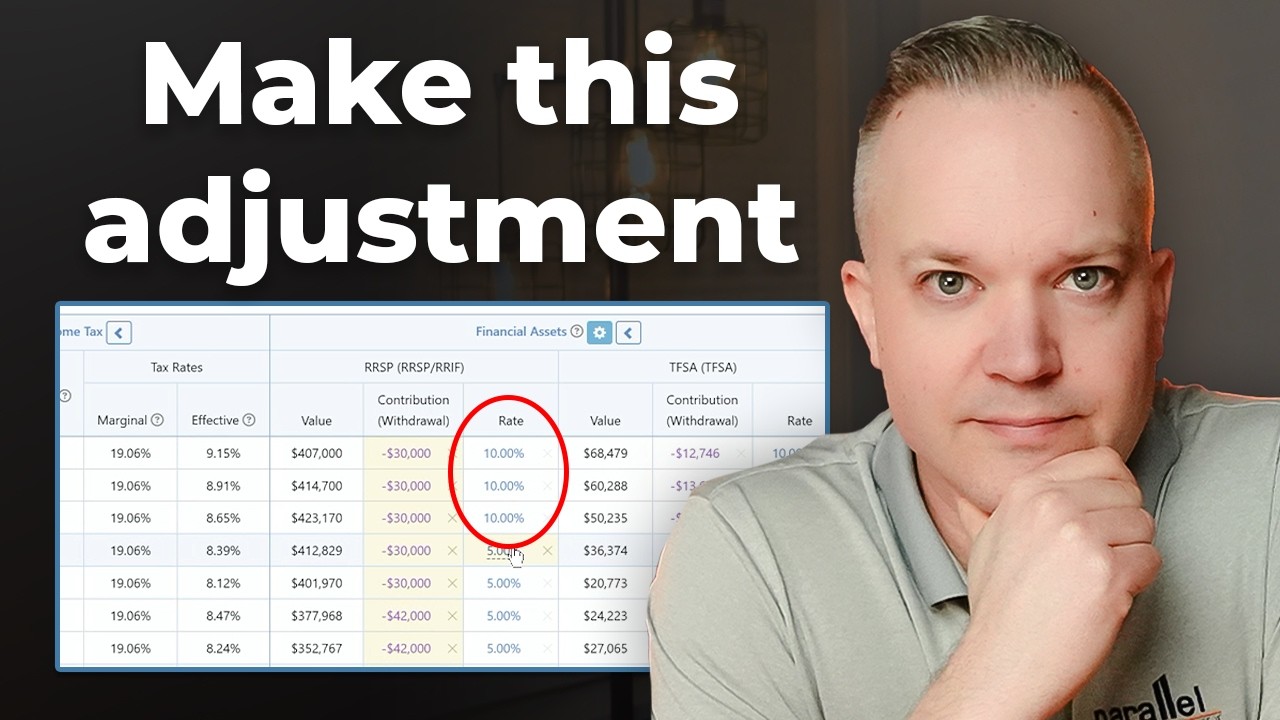
first thing we looked at is well, let's look at the tax planning first. Like, we want to draw down that RRSP or the RIFF a little bit faster or at least more tax efficient. And so, we did that. And what it did is it retained his TFSA a lot better. There's more flexibility in this plan. But as great as that is, if we scroll down to the bottom, we don't have much more in the TFSA, 25,000 versus 24,000. And if you look at his old age security claw back later on the numbers are a lot lower but early on he's actually clawed back a lot more. So again this is why when we build a plan as a team we do a lot of this in the background for our clients and we just start playing with this. So this would be like you know an early step in building a plan internally for our team. We say okay we mapped this. Okay we got an OAS problem. How do we maybe solve that? we start playing around with it, playing with the numbers, maybe taking RIFF withdrawals a little bit different. But one solution is what if we delayed old age security? And oftent times in our videos, we talk about take your old age security at 65, delay your CPP. There's a bigger financial benefit to do that. But in this case, Ross is probably going to be best to delay old age security. And I'll show you the numbers and then compare them here in a second. But this is a case in point. We get asked a lot like, Adam, when should I delay my old a security? Well, if you have clawback, you want to at least look at delaying it and see if there is a benefit because not only do you get more, but you might be able to then use those years to manipulate your income, keep it steady, but then also avoid some of that clawback or the pension recovery tax down the road. So, you can actually layer in a lot of natural benefits by delaying old age security for some of you. And you'll see Rost will fall into that category here. So, here what

Delaying OAS

we've done and again, let's just focus on the old age security for now. We've delayed it till age 70. So we have five more years of zero income. Now we can see at age 70 we take it. There's still pension recovery tax. There's still climbing back some of that old age security. But in those 5 years, you can see the RSP. We had 60,000. We've now upped it to 75,000 to keep again that effective tax rate and overall tax structure very level. But kept the income right after tax income 180 65. That's all the same. So by delaying old age security, we haven't avoided the clawback. But let's see if we have more money at the end of the day. And we can also look at the whole tax situation, estate and all of that. So if we scroll down on the TFSA again, we had 24,000 then 25,000. In this case, we have $119,000. This allows Ross to maybe take more while he's alive. It leaves more to his estate at death. It's a much better situation. So same amount of income after tax and more left in his TFSA. And again, you can see his TFSA in this case is very well funded. Like at age 73, he has $107,000 in his TFSA still. So, it's a very wellunded, you know, doesn't really dip much below. 70,000 is the lowest it gets here. So, very wellunded TFSA. When we go back to the original

Comparison

plan, his TFSA is emptied out by 73. So, that's $100,000. So, again, if he needed, you know, had an emergency or needed extra money, from 73 onwards, he's taking everything out of the riff. Very tax inefficient. So again, there's all these other things that come into play as well. So by delaying old age security, he's actually created a better estate. He's taken the same amount of after tax income. He still has a bit of clawback, but again, his estate's better, his income is the same, and he's created a lot more flexibility within his account. So here's a direct comparison. Not only have we created efficiency around the OAS, we've also, and this is really important, we've created that flexibility in his plan that he really needed. So when we look at everything, you can see option one was what he came in with. Option three is what he went out with. He saved $13,000 in tax. So a nominal amount of tax. That wasn't the focus here. Obviously, we always want a lower tax bill, but he's collecting the same amount of after tax income, right? Lifetime expenses. That's how much he'll collect in his lifetime. 3. 647. So it's the same in each. Now, lifetime government benefits. You'll see he's delayed old age security and has less OAS clawback, 23,000 less. meaning that his total government benefits he's collecting $117,000 more from the government. So again for a lot of you out there it's like well I want to pay less tax get more from the government. Look in this situation he paid a lot less tax and he got a lot more money from the government in the form of old age security less clawback and by delaying he got more. So huge benefit there. And then if we scroll down and look at his estate after tax. So he's collected the same amount of after tax while he's alive. During that period, he's collected more from the government and government benefits, and he's paid less tax to the government overall. And when he passes away at 95, he has about $95,000 after tax more in his pocket to his estate. Again, that's in nominal dollars. In real dollars, $45,000. So again, that's to age 95. What if we scroll back to more life expectancy? Well, you can see it's still a huge benefit. $20,000 less of clawback, $60,000 more in government benefits, $46,000 more in his estate. So, pick a year, it's going to be better. Now, if we scale it way back, it may look a little bit different, but this is life expectancy or even beyond. And so, when you look at old age security within your

Focus areas

plan, if there's a clawback, a pension recovery tax, meaning you're not collecting all your old age security, you really need to have your financial planner sit down and work through the numbers. Like, this doesn't mean you're going to get rid of it. In this example with Ross, we get rid of it. We have a lot of clients that we get rid of it altogether and their net benefit and it's fantastic. That's not going to be everyone. Everyone's going to be a little bit different. But in this case, we added the flexibility. To me, when I look at this plan and I, you know, walk away with Ross and I say, "Look, you've got more government benefits. You pay less tax. Your state's better. " But really, the big win here is your plan is more flexible. Your TFSA is funded throughout your retirement. If you have an emergency, which you probably will, there's money there to grab tax-free. It's a much more efficient, flexible plan that you can actually walk through retirement with. And that's important. Like, as you walk through retirement, you want a great plan, but you want a plan that's going to walk alongside you, right? Like that's how we came up or I came up with the name parallel to begin with. Like idea is parallel. Walking in parallel with our clients going forward. And you want your retirement plan to do the same thing. As you walk through retirement, you want your plan to walk alongside you. And so if you have an emergency at age 75 and you don't have any money outside your RRSP, your plan is not walking alongside you. In fact, it's punching you in the face with the tax bill. And so you need to make sure that plan is walking alongside you. So yes, there's so many moving parts in a plan, but they can come together. And again, this is one example of thousands that we've looked at. So again, when we're looking at old age security, look at is there a benefit to delay it? That's usually a really good way to do it. Or change the way your income's coming in. You got always got to look at the income sources, the tax rate, the effective and the marginal tax rate, more the effective. There's many things that you need to move and all these things. You change one thing, it'll change the other. And so, you need to find a financial planner or work with your financial planner to really work through the numbers to figure out what is the best way forward for you. Now, as you saw in Ross' plan, one of the big pieces is that RRSP meltdown, like creating tax strategy that actually created a lot of the TFSA structure within the plan. So, if you want to see a full plan buildout on how we do an RSP meltdown, check out this video

Другие видео автора — Parallel Wealth

Ctrl+V

Экстракт Знаний в Telegram

Экстракты и дистилляты из лучших YouTube-каналов — сразу после публикации.

Подписаться

Дайджест Экстрактов

Лучшие методички за неделю — каждый понедельник