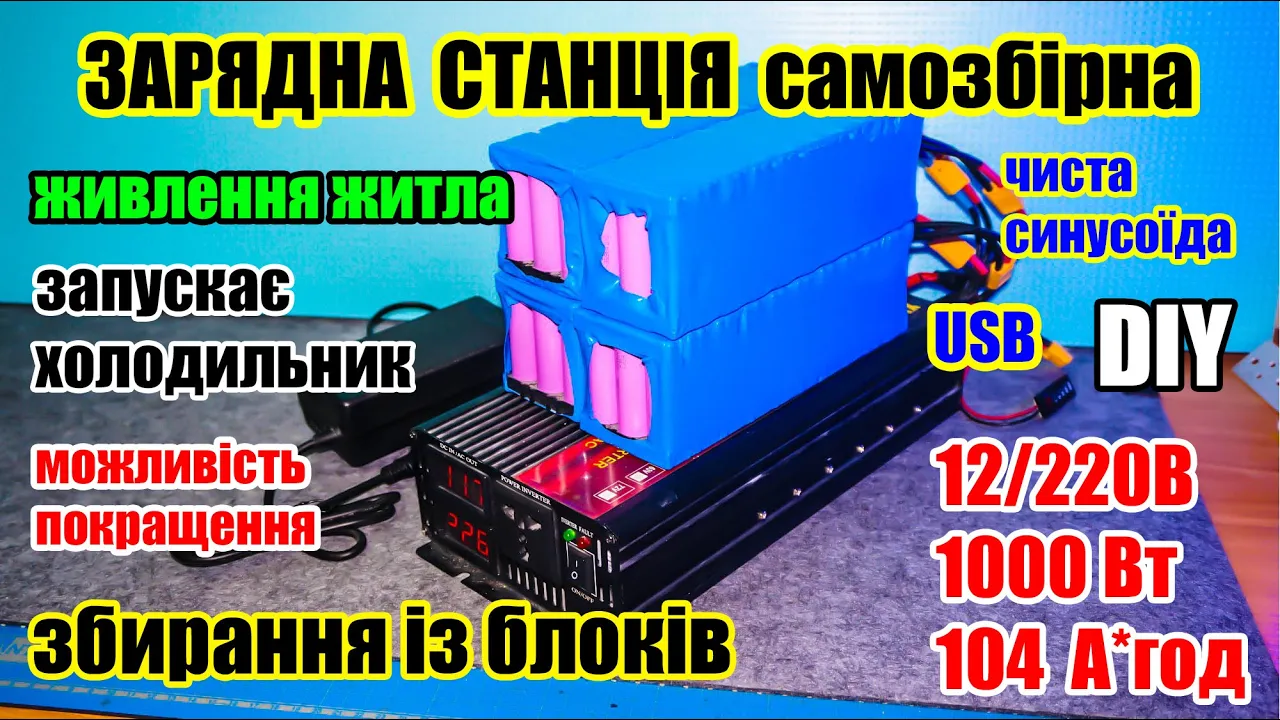
🔋⚡Simple homemade CHARGING STATION "for $100", 400W (1000W) + 400Wh battery. From blocks.
21:36

🔋⚡Simple homemade CHARGING STATION "for $100", 400W (1000W) + 400Wh battery. From blocks.

▶️ Radio-Lab UA 03.02.2026 8 996 просмотров 454 лайков

Machine-readable: Markdown · JSON API · Site index

Поделиться Telegram VK Бот
Транскрипт Скачать .md
Анализ с AI
Описание видео
⏩ Greetings! In this video I tried to show how you can assemble a simple and inexpensive charging station with a capacity of 400W and a battery of 36A*h (400W*h) with a pure sine wave at the output, from which a REFRIGERATOR, boiler, pump and other electrical equipment can work, you can also power a home from such a charging station. (Pure sine wave inverter). Such a station cost me about "$100". 🍺 Special thanks to those who support the channel with donations and thanks to the channel sponsors. 💲For monetary gratitude💲 👉 https://send.monobank.ua/jar/6dKFDUky7i ⏩ Links: ⚡👉 https://fas.st/KeOxe - popular budget inverters TATALIKEN ⚡👉 https://fas.st/W9dZIn - high-quality inverters HOULI ⚡👉 https://fas.st/2vyZmQ - high-quality inverters HOULI (more powerful) ✅ https://fas.st/GDu7XQ - charger 12.6V 20A ✅ https://fas.st/rQfOq - charger 12.6V 10A ⏩ Spare parts: ✅ https://fas.st/v5jyA - White BMS 3S 100A with balancer ✅ https://fas.st/zQ3T3o - capacitor active balancer 3S ✅ https://fas.st/lhSRu1 - plastic holders for Li-ion 18650 ✅ https://fas.st/Jnu7B - 18650 insulating rings ✅ https://fas.st/2cuymT - 0.15x8mm nickel-plated tape ✅ https://fas.st/CbFh_ - USB phone charging module ✅ https://fas.st/Bko58 - 4-port USB phone charging module ✅ https://fas.st/SqOjMv - battery charge level indicator (Li-ion 3S) ✅ https://fas.st/422PV - XT90 power connectors ✅ https://fas.st/7xZFUa - silicone wires (12AWG, 16AWG) ✅ https://fas.st/GwvFUo - heat shrink for battery assemblies ✅ https://fas.st/tfDJu - tips, select according to the diameter of the inverter terminals (I bought them at an electrical goods store) ⏩ Measuring devices: ✅ https://fas.st/a-wYGp - Smart Multimeter GVDA GD128 ✅ https://fas.st/hkKKO - Current clamps GVDA GD166B ✅ https://fas.st/0Icuw9 - Oscilloscope DSO152 FNIRSI 🎬👉 Instagram -   / radiolabpro   📲👉 Telegram channel - https://t.me/RadioLabPRO #18650 #inverter #refrigerator #Ukraine #chargingstation 👍 Thank you for your time! ⏰ Timing: 00:00​​​​ - Introduction 00:43 - assembling a 3S12P Li-ion 18650 battery 06:44 - measurements and checking the assembled battery 08:24 - CC-CV charger 08:37 - 1000W inverter (2200W) 09:04 - assembling an adapter with a charge level indicator 10:00 - assembling a charging station 11:04 - assembled charging station 11:37 - connecting various loads to the charging station 17:50 - charging the assembled charging station 18:57 - operating time under a 100W load 20:00 - safety rules 20:23 - cost 20:44 - conclusions and recommendations
Оглавление (14 сегментов)

​​​​ - Introduction

Welcome to the channel Behind the Microphone Volodymyr. In this video, I will show you a budget-friendly and do-it-yourself charging station that can start and power a refrigerator. Well, it will also be possible to power various other household appliances. I bought the inverter and charger ready-made for the project, but the battery will need to be assembled from 18650 lithium cells. 18650 lithium batteries were chosen because they can deliver the necessary currents with a relatively small capacity and size. And the basis of the future budget

assembling a 3S12P Li-ion 18650 battery

charging station will be a three-section lithium-ion battery with a nominal voltage of 11. 1 V and a maximum voltage of 12. 6 V, which is easy to assemble. Here are the main parts and modules needed to assemble the battery. I have 36 individual batteries. For this video I used Terra 30E cameras. Batteries may be different. The main thing is to dial their number to the required voltage and current. And this will be a three-section battery with 12 batteries in each section. I welded the batteries into a battery like this using holders and insulating rings, where three separate sections of 12 batteries are connected in series. The pluses of one section are connected in series with the minuses of another section. And everything is clearly visible in the video. My tape is nickel-plated, 0. 15 mm thick, welded in a mesh and in two layers to increase the cross-section and better transmit higher currents. Before welding, the batteries must all have the same voltage so that they can be welded in parallel into one section without any problems. And the easiest way is to simply fully charge each individual battery and only then weld the battery. Parallel connection of batteries allows you to increase the total capacity and operating currents, while series connection increases the battery voltage. The battery is welded and voltage measurements are made on individual sections. But overall, everything is fine. For lithium batteries, it is imperative to add a protection system. To protect the assembled battery, I will use a white 100 A BMS protection board for a three-section lithium-ion battery. And an active balancer will be added. This is how the BMS protection board will be installed near the main negative terminal of the battery. To prevent the BMS board from heating the batteries during operation, it will be mounted on several layers of double-sided adhesive tape. And so a thermal insulation air gap will be needed. Next, you can solder the BMS protection board to the assembled battery. Here is the connection diagram. And you need to start with the main power negative contact. I used a wire on Aug 16 to connect. Three wires soldered in different places are needed to increase the total cross-section, which will reduce heating. And then you need to gradually connect the BMS to the board. Other sections of the assembled battery, ranging from lower voltage to maximum. It is very important not to confuse anything here. So I soldered everything and everything is fine. Next, you need to solder the main power positive and negative wires to the XT90 MAMA connectors. That's how I did it. Similarly, as with a power minus. The main power wires will be 12 AUG. There are power positive wires. Now you need to solder two negative power wires to the BMS protection board. And to the wires, observing the polarity, I soldered the XT90 MA power connectors. The connector soldered on the BMS board closer to the middle is the power discharge connector with the maximum discharge current for this BMS board. And the connector on the contact closer to the edge is used to charge the battery or to discharge it, but with reduced power. According to voltage measurements at the connectors, everything is normal. The BMS protection board has started up and is working normally. And I will also install an active balancer for a three-section battery on the assembled battery. This is a capacitor active balancer. In accordance with the diagram, I soldered wires to the assembled battery to connect the active balancer. The black wire is connected to the main power negative and then the wires are connected in order to the higher voltage sections. You must first solder the wires according to the voltages, and then you can connect the active balancer. Here is the active balancer connected and already working. It consumes little energy and balances battery sections regardless of the battery charge level. Next, for safety reasons, I will cover the sides with exposed power conductive parts with electrical cardboard so as not to accidentally short anything out. This is the result I have right now. Now I'll try to charge and discharge this assembled battery a little and see if all the voltages on the sections are the same. After assembling, everything is fine according to the voltages on the sections

measurements and checking the assembled battery

. All voltages are almost the same. The BMS protection board has started and is working. There is voltage on its power contacts. I slightly discharged and charged the assembled battery. And also everything is fine with the voltages. The voltages of all sections are almost the same. The battery will always be balanced, even if it is not fully charged. This is important if the battery will be loaded with significant currents. I made marks on the connectors where the power connector is and where the charging connector is. Next, for reliability and a better look, I will cover the battery with heat shrink film. And here is the final result of the work. After assembly, I got this three-section lithium-ion battery with a nominal voltage of 11. 1 V, a maximum voltage of 12. 6 V, a capacity of approximately 36 A hours or approximately 400 Wh. Considering the 18650 batteries used and that there are 12 of them in parallel in each section, it is advisable not to discharge them with currents exceeding 40 A for a long time, up to 100 A for a short time, and the charging current should not exceed 18 A. These are the main modules of the future budget charging station. And these separate modules need to be combined into one device. To charge the assembled battery, I bought

CC-CV charger

this charger for a three-section lithium-ion battery with a voltage of 12. 6 V and a charging current of up to 20 A. The assembled battery will be powered by

1000W inverter (2200W)

this budget inverter and a TV with a supply voltage of 12 V. This inverter has a nominal power of approximately 1000 W and a peak power of around 2,000 W for a short time. And here's what's inside it. Two pulse power transformers of approximately 500 watts each are visible. This is for an example. The inverter may be different, similar. To connect individual blocks into one whole

assembling an adapter with a charge level indicator

you need to make an adapter. And so I bought all the parts for it. 12AWG wire and thin wire, copper tips, XT90 T connector and charge level indicator for a three-section lithium- ion battery. Everything must be assembled, observing the polarity on the connector and indicator. Here I soldered everything into one whole. And this is what the assembled adapter looks like. Next, observing the polarity, the assembled adapter must be connected to the power contacts of the inverter. It is very important to clamp the copper tips well, because if there is poor contact, there may be severe heating, melting, and damage. To prevent anything from coming loose, I used thread lock. Now I will place the three main units of the charging station in a way that makes it

assembling a charging station

convenient to connect everything and keeps everything compact. I added a thermal insulator between the battery and the inverter so that the running inverter does not heat the batteries additionally. I pulled everything together with cable ties and everything is holding. Well, all that's left is to connect the connectors and arrange the wires nicely. The battery power connector connects to the inverter, and the charging connector to the charger. It will be more or less normal somehow not to cut anything off. I glued the battery level indicator here on top. And after all the work done, I got this

assembled charging station

budget and small self-assembled charging station. The main characteristics are capacity of approximately 400 W/hour, nominal power up to 400 W, peak power of approximately 1000 W. The output of the inverter is 220 V and the voltage waveform is a pure sine wave. All the basic protections are also here. Next, I will show how the assembled charging station works and what it can do

connecting various loads to the charging station

. The battery is charged and to turn on the assembled charging station, you simply need to turn on the inverter. In general, an inverter operating without load consumes approximately 1 to approximately 11 watts per hour. Here I connect a 100 W incandescent lamp and it glows normally. This inverter also has a main start when turned on. Here you can see that this incandescent lamp consumes 100 watts per hour. But first of all, I was interested in whether such a small charging station could start a refrigerator, which is often very necessary in the absence of electricity. My refrigerator has a regular compressor. The inverter's no-load current is approximately 1 ampere. Here I connected the refrigerator to the assembled charging station. And it started and works normally. The starting power was more than 800 watts, and then the normal operating power was 126 watts. The starting current from the battery for the refrigerator was almost 90 A, and then the current decreased to the working 12 A. In my case, the starting current of the refrigerator can still be reduced by using the soft start of the inverter. You must first connect the refrigerator to the inverter and then turn on the inverter. And so the starting current can be much lower, but even at full current this inverter starts the refrigerator normally. The assembled small lithium-ion battery can provide the necessary current to start the refrigerator. And that's very good. As for heating when working on the refrigerator, everything is normal and the heating of the parts of the assembled charging station is minimal. heating system pump. Also, everything works normally and pumps coolant. The phone charges normally from the inverter using a standard charger. Or you can charge your phone using USB charging modules and power them directly from the battery so that the inverter does not waste energy on its work. I will also show the heavy duty operation of the assembled charging station. Here's a heater like this. I connected everything and the heater is working and consumes approximately 360 watts per hour. The current consumption from the battery is approximately 36. And with such a load, there is a slight voltage drop on the assembled battery. The assembled charging station can handle this amount of power normally, but the BMS protection board and batteries are already heating up. That much power is a bit heavy in an assembled battery For an assembled battery, a load of more than 36 A is not desirable to avoid local overheating and overloading of the batteries. But even so, it's a good result at this size. If necessary, you can also use this assembly to heal your home and everything will work normally. But the battery capacity is small and this whole thing won't work for long. Or you can assemble another identical battery and connect it in parallel to the first one. And this will increase both operating currents and capacitance. As a failsafe, such a build can be used as a compromise and when really needed, but not on a permanent basis. And in this case, if the load consumes more than the charger can charge, the battery will gradually discharge. The battery is discharged and to charge the assembled charging station, you simply need to

charging the assembled charging station

plug its charger into an electrical outlet and the charger will start charging the assembled battery. The charging current is 18 A and will gradually decrease. This is what the thermal imager shows. There is a slight heating of the batteries. The charging current of 18 A for the number of batteries used, connected in parallel, should not be exceeded. Less is possible, but no more. The battery charged in about three hours, which is normal. The voltage is fine and the assembled battery is fully charged. In terms of operating time, the toaster

operating time under a 100W load

incandescent lamp worked for 3 hours and 10 minutes. Taking into account the inverter's idle time of 11 W per hour and heating losses, the declared 400 Wh from the battery were almost completely used, because the load of 100 W is small and there was no strong voltage drop on the assembled battery. Here is an example graph. And the greater the load on the battery, the less energy can be extracted from it. Therefore, there is no need to overload batteries unnecessarily, and a small underdischarge will greatly increase the life and number of cycles of lithium-ion batteries. If necessary, you can assemble another similar battery and connect the batteries in parallel as one larger battery. This will increase operating currents and capacity. Well, the advantage of such an assembly is that it is very easy to maintain at the module level.

safety rules

As for safety, you just need to follow the basic rules for operating lithium batteries. It is especially important not to overload batteries, overcharge, overheat, or expose them to direct sunlight. Well, and other basic operating requirements. In terms of price, such a self-assembled charging

cost

station cost me about 100. I bought the battery for 40 UAH each, the inverter for 100 UAH, the charger for 100 UAH, and the rest for all the other parts. I had some of the small details. Well, I put everything together myself. Here is a simple, budget-friendly and properly

conclusions and recommendations

functioning charging station that I showed you how to assemble yourself. In this video, a refrigerator and other equipment can be powered by such a charging station, which is sometimes very necessary. If necessary, such a self-assembled charging station is easy to repeat and assemble, and it works normally. This is a very good option, especially when you have a very limited budget or don't want to buy a ready-made charging station. I hope this video is useful. That's all for now. Links will be in the description under this video. I ask you to like, comment, and subscribe. Thank you for watching. See you in the next videos.

Другие видео автора — ▶️ Radio-Lab UA

Ctrl+V

Экстракт Знаний в Telegram

Экстракты и дистилляты из лучших YouTube-каналов — сразу после публикации.

Подписаться

Дайджест Экстрактов

Лучшие методички за неделю — каждый понедельник