Cal Newport takes a critical look at recent AI News.
More from Cal
Download Cal’s FREE guide to cultivating a deeper life: calnewport.com/ideas
Learn more about Cal’s books: calnewport.com/books
Listen to Cal’s podcast: thedeeplife.com/listen
Chapters
(0:00) Is the AI doom fever breaking?
(4:30) Have the AI CEOs changed their tune?
(7:23) Why did they change?
(11:21) Why did they ever think this was a good idea?
(24:46) Conclusion
Resources Mentioned:
https://www.youtube.com/watch?v=DFnoQkYUqgU
https://www.youtube.com/watch?v=NWxHOrn8-rs
https://x.com/sama/status/2050229058425045178
https://fortune.com/2026/05/02/jensen-huang-nvdia-ceo-god-complex-ai-apocalypse-warnings-shortages-critical-jobs/
https://www.youtube.com/watch?v=2Kpb8eu1pEY
https://www.nytimes.com/2026/05/03/opinion/ai-jobs-unemployment-silicon-valley.html
https://nickbostrom.com/existential/risks.pdf
Credits:
Podcast Production: Jesse Miller
Newsletter/Research: Nate Mechler
Theme Music: Jay Kerstens
Оглавление (5 сегментов)
Is the AI doom fever breaking?
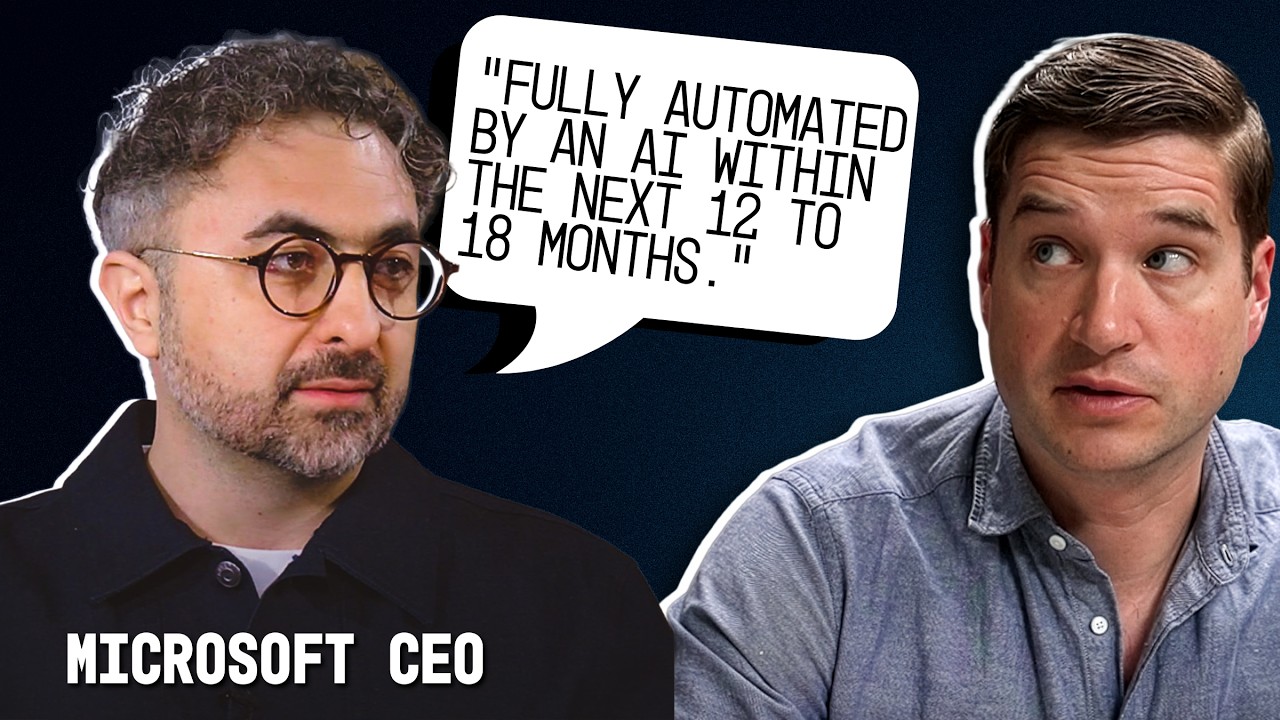
The way that CEOs of major AI companies have been talking about their products in recent years really has been bonkers. They seem to be going out of their way to terrify their potential customers. I mean, last week I played a clip of Microsoft CEO Mustafa Sulleman claiming that their AI systems would be capable of fully automating basically every knowledge work task within a year. That's not a very nice thing to tell to your customers. All your jobs are going to go away by the way. We're working on it. Hold for applause. I guess now he's far from alone in making these type of disturbing claims. Here is Open AI CEO Sam Alman talking last summer about what the world is going to be like after AI takes over everything. People really need agency. Like they really need to feel like they have a voice in governing the future and deciding where things go. And I think if you just like say, okay, AI is going to do everything and then everybody gets like a, you know, dividend from that, it's not going to feel good. And I don't think it actually would be good for people. So I think we need to find a way where we're not just like if we're in this world where we're not just distributing money or wealth like actually I don't just want like a check every month. What I would want is like a ownership share in whatever the AI creates so that I feel like I'm participating in this thing that's going to compound and get more valuable over time. — All right. So, to summarize what Altman just said there, — uh, sure AI will quote unquote do everything, but don't worry, we're going to find way for you humans to still participate in the world. And now, not to be outdone, here's Anthropic CEO Dario Amade also ringing his hands about the damage that his own company's products will soon do. But exactly those same kind of skills, things like summarizing a document, brainstorming, putting together a financial report, makes me worry a lot that entry-level jobs in areas like finance, consulting, um, tech, uh, many, many other areas like that, entry-level white collar work. I worry that those things are going to be first augmented, but before long replaced by AI systems and that we we may indeed. Uh it's hard to predict the future, but we may indeed have a serious employment crisis. — Think about how crazy this is, right? We have CEOs stating in effect that they're afraid of all the different ways that their products are going to destroy the economy and make everyone's lives much worse. We've kind of become used to this in the context of AI, but if we heard it in any other industry, it would really catch our attention. I mean, can you imagine the CEO of Fizer going on the air and talking about a new drug and saying, "Hey, we're excited for the potential of this new pill to reduce plaque psoriasis by 50%. " At the same time, however, I'm worried because once widely used, it will likely transform a large fraction of the population into zombies. That's basically what we're getting from the AI CEOs. And I think it's just lunacy. But here's the thing. Recently, I'm talking about like the last few weeks, I have noticed a bit of a shift in this rhetoric, there have now been multiple statements from major AI leaders that hint that they might be retreating from the strategy of trying to make everyone as anxious as possible about their own products. Now, if true, this immediately inspires some questions. What specifically are these AI leaders saying in more recent weeks? Why are they changing their minds about how they talk? And why did they ever think it was a good idea in the first place to try to terrify people about the products that they were also trying to sell them? Well, it's Thursday, which means it's time for another AI reality episode. AI reality check episode rather of this show, which means this is a perfect opportunity for us to explore some of these answers, which is exactly what we're going to do. So stay tuned. As always, I'm Cal Newport and this is Deep Questions, the show for people seeking depth in a distracted world. right. So, let's proceed by looking at those three questions that I just raised. Question number one, is it true
Have the AI CEOs changed their tune?
that the AICOs are starting to change the way they talk about their products potential impacts? Well, I want to give you some recent examples that give me hope. I want to start with a tweet from Sam Alman from late last week. So, this is sort of breaking news, right? He said, and I quote, "We want to build tools to augment and elevate people, not entities to replace them. I think a lot of people are going to be busier and hopefully more fulfilled than ever. " And jobs doomerism is likely long-term wrong. And just as a quick aside, it's all lowercase letters, Jesse. We've talked about this before. Why do these tech people write in lowercase letters? Have a little bit of respect, but okay, we'll let that slide. This is a far cry from the altman that we heard just last summer talking about how we'd have to find ways for people to participate in the world after AI took over literally every job. So this is definitely a change of tune from Altman. We're getting even stronger push back on job dumerism from the CEO of the largest of the AI relevant companies which is Nvidia. And Jensen Wong has been on a welcomed rampage recently, really pushing back on this rhetoric about AI replacing jobs. I want to read you some quotes here from a remarkable article that was published in Fortune uh just on Saturday, so just less than a week ago. All right, here's from the Fortune article. Nvidia CEO Jensen Wong has been pushing back against the popular narrative that AI will wipe out huge swaths of the workforce, but he also placed some blame on overly confident CEOs who assume they know everything. Although it's important to advocate for guard rails on AI. He added that scaring people into believing that the technology will pose an existential threat to humanity, destroy democracy, or eliminate 50% of entry-level jobs is quote ridiculous. End quote. In reality, he estimated that AI has created more than half a million jobs in the last few years. That's because when companies incorporate AI, they grow faster and hire more people. And data from hiring site Indeed shows that demand for software engineers is actually increasing. So good for you, Huang for really taking a stance. I love that sort of barely concealed dig at anthropic CEO Daria Amade who's the exactly the figure who's been saying that thing about 50% of entry-level jobs. And Hang is like nope, not going to happen. It's still early, but I have been picking up more and more of these signals that I think a memo has been successfully delivered to the AI CEOs. Hey guys, stop trying to terrify everyone about the product you hope they will pay for. All right, this brings us to our second question.
Why did they change?
Why did they change their minds? Why did the rhetoric shift? Well, now we're going to get a little bit more speculative. I have a couple uh different things I want to suggest here. One, I think the fact that multiple of these companies are preparing for an IPO andor considering an IPO, and I'm looking really particularly here at Anthropic and Open AI made a difference. Now, here's why. If you're anthropic or you're open AI and you're thinking about a IPO, you have to start hanging out with people from the East Coast who wear suits. And they're not in the Silicon Valley bubble. this world where everyone tries to oneup each other with who can be more apocalyptic about AI. They come from a different, more sober-minded, more careful world in terms of the ways they think and talk about things. And I really think this happened. I think a lot of these companies are basically hearing from Wall Street types who are saying, "What the hell are you doing? You're trying to convince people to get excited about your company and yet you're also telling them to be terrified about your company and all the damage you're going to cause. No, stop it. So, I think there was some East Coast influence which is trying is starting to pervade some of these otherwise very West Coast companies. It reminds me of that scene in the film festival episode of The Simpsons where Mr. Burns discovers that everyone in the crowd, with the exception of Hans Mullman, is actually booing him. — This Are they booing me? — No, they're saying boos. — Are you saying boos? — I was saying boos. — All right. But it's not just a collision with the world of finance that uh I think helped make this point. I think the AI CEOs are also picking up something that's being measured in recent public opinion surveys, which is the public is turning on these companies. A Quinnipic survey from March revealed that a healthy majority of Americans now thinks that AI will do more harm than good. And this is a sharp increase from a year earlier in which those numbers were reversed. Now, of course, this is going to happen. It shouldn't be surprising. How much can you tell people we are going to destroy your lives and everything you love before they finally say I don't think I like you and that's exactly what I think we're starting to see. So I think the AI CEOs are reacting to that as well. And finally I think the third factor that's leading to a change in rhetoric is that more and more reporters are uh beginning to develop some skepticism around some of the more breathless claims being made by the AI CEOs. And just last week, Ezra Klein, writing the New York Times, wrote a column with a title that warmed my heart. His column was called, "Why the AI job apocalypse probably won't happen. " If you read the article, Klein goes on to say, "Economists I found are quite skeptical that mass joblessness is on the horizon. " Right? So we no longer have this sort of phenomenon in the reporter space where they say well these CEOs they know more about this technology than anyone else. So we have to believe what they say. That grace period has ended. They've been too bombastic. Not enough of their claims have come true. They've changed their minds too much. So now they have skepticism from there as well. So I think these factors are all coming together. The impending IPO forcing them to behave like normal responsible citizens of the world turning public opinion against them. You can't just scare the public constantly and expect that people are still going to like you and your products. And finally, increasing journalism skepticism. That pressure has led the AI CEOs to back off their more apocalyptic discussions of what's going to happen to the job market because of AI. Well, this brings us to the most complicated question, our third and final question. Why did they ever think
Why did they ever think this was a good idea?
it was a good idea? Like, why were they actually talking that way, trying to scare people about their own products? Well, there's a common explanation for this that I've mentioned myself on this show before. The common explanation is, oh, it helps attract investment. Yeah, it might be scary that your company's going to automate all jobs, but that does make your company very valuable. If you're an investor, if there's only going to be one company left in the world that does everything, that's where I want to put my money. So that's the common explanation for why the AI CEOs have been uh so apocalyptic in the way they've been talking about AI impacts. And I think that's partly true. And I think this certainly happened. I saw a bunch of good coverage in the last week or so about the mass evaluation bumps that Anthropic got for, for example, presenting Mythos as if it had made a major leap and it was going to destabilize all cyber security. That was very scary. They hit a trillion dollar valuation for the first time. So it made uh made a big difference. All right. So I think that's partially what's going on. But there's a deeper reason that I want to explore here. And this came out of I uh just finished teaching a doctoral seminar on super intelligence at Georgetown. We read a lot of papers from a lot of different fields. and it's really giving me a deeper appreciation of the cultural context from which these AI CEOs emerge. I want to tell you a story here. This is my alternative explanation for why these AI CEOs were trying to terrify their customers. All right, so here's the story. You got to go all the way back to the first decade of the 21st century. This was a point in which a loose movement especially among engineers especially based on the west coast emerged that was known in part as rationalism. Uh it came out of some online discussion boards such as less wrong and slate codeex which now has a different name and it became quite popular in particular among engineers in the San Francisco area. At the core of the rationalist movement was this idea that humans have cognitive biases in the way they think and if you could be super rational you could overcome your cognitive biases and in doing so actually be more effective in the world. So it's a very sort of engineering way of thinking. I'm very used to this as someone who you know I'm an MI train MIT trained computer scientist. I'm around engineers. I am an engineer. I know this way of thinking. Um it it's foreign to other people but in engineering circles it makes sense like I'm going to be super logical on like data from Star Trek the next generation and by doing so I'll get over all these weaknesses that we have in our minds and then I can be more effective at my job or in helping the world or politically or whatever it is right so that's rationalism and it became a sort of well- definfined movement in the early 21st century okay so how do we connect this to AI today well rationalism had many sort of subgroups within it. For example, one of the best known subgroups coming out of rationalism was the so-called effective altruist who try to be hyperrational about where to invest money, time or effort charitably to get the biggest return. Right? So, this was this idea if we're super rational, we can be better at charity, we won't be just like emotionally manipulated uh or biased in what we're doing. And right so that became like a really big movement. famously Sam Bakeman Freed was very interested in effective altruism. Uh so that's like a well-known sub community within rationalism. Well, there was another well-known sub community that rose out of this uh rationalism that was called the existential risk or x-risk for short, the es x risk community. And here was their idea. we need to be super rational about studying existential risk to humanities. And the core mathematical rational tool they were applying was expected value. And here was their core idea, which is a completely sound idea. There's, you know, mathematically this makes sense. They said, here's the cognitive bias that we're worried about. If a negative event is really rare, humans discount it. I don't have to worry about that because it's very rare. But they said, "No, no, no. got to do an expected calculation uh expected value calculation where you weigh cost and benefits against their probabilities as something that is very rare but that has a super negative cost if it does happen can be just as relevant as something that is not so rare and has a much lesser cost. So let me be more concrete about it. They would say an asteroid hitting the earth is very rare. It's very unlikely to happen, but the cost of it happening would be incredibly high because it would kill all of humanity. And so the expected cost there is something we should care about. And if we compare that to like a hurricane, like a hurricane hitting me is not nearly as rare as an asteroid hitting me. And the cost though would also be not nearly as bad as an asteroid. And if we multiply those together, that might actually be a similar expected cost as the asteroid. So we shouldn't let rareness by itself determine what we care about. It needs to be rareness multiplied by the potential cost. That's what the es x ex risk community was focusing on. It's a rationalist way of thinking about things. They ended up with three major categories of existential risk that they began to argue that we should even though super rare care about. It was asteroid hits. It was deadly pandemics. And here comes the connection is super intelligent AI. So now we have by the 2010s the x-risk sub community of the rationalist that these are people like uh Nick Bstrom out at Oxford or Leazar Yukowski uh who's kind of doing his own thing. They were writing these papers. I we read a bunch of them in my seminar where they would just like do these ontologies of risks and asteroids and pandemics and super intelligent, you know, super intelligent AI and talk about like how these could unfold and why we should care about them now even though none of these things are like about to happen or we have any reason to fear that they're about to happen. And so that was the Xrisk community. It was them for example who organized that kind of infamous conference in Puerto Rico in 2017 to talk about existential risks that coming out of that you got uh Elon Musk, Stephven Hawkings, Bill Gates, you know, where you got all these quotes from these famous scientists saying, "Oh, we should worry about AI. It was coming out of this conference in 2017 and it was an X-risk conference like this is one of the far future abstract concerns that should be on our mind because who knows it could happen one day and we have to worry about these. So the the original sort of existential risk AI safety concerns came out of this subculture of the rationalist based on those online forums and largely in San Francisco. All right. Then what happened in this story is chat GPT. Now this is where I'm kind of throwing my own this is like my own original take here just trying to understand this world. You get chat GPT which is super impressive and it's very anthropomorphizable right because you're dealing with language and we project minds on the other side of a conversation when we're getting fluent language because that's our mind connects the fluent generation of language with another mind. It was impossible not to encounter these early large language model demos without being like, "Wow, AI is now advancing faster than we thought it was. Something is accelerating. There's changes of foot. " And for the Xrisk community within the rationalist, this presented a completely lifealtering, terrifying, exhilarating possibility. What if we were right about this risk? And not only were we right, but it's happening, right? It would be like if you had been warning about aliens and abductions for years and years, and then the Independence Day mother ship comes onto Earth. You'd be like, "This is terrifying. " But you would also be like the people dancing on top of the building in New York in that scene before they got, you know, destroyed by the lasers. They were excited that they were there. I'm kind of stretching this a little bit, but I think this was completely mindmeldding, life-changing for the ex-risk rationalist because they had spent years making list upon list and sublist among sublifts. I mean, just go read a Yukowski paper like a mirror paper from 10 years ago. It it's 19 levels of list with sublist with sublists with sublifts about da the CDI does this or that. like they obsess. They've been obsessing over super intelligence and all the ways it might unfold and I assume they're wearing when no one's looking at home they're wearing Matrix trench coats and pretending like they're Neo and you know I don't want to I'm just guessing all this type of stuff is going on right they've been obsessing about this and suddenly there's this thought what if it's real think about it this would make them the heroes it would make them John Connor Neo make them we are the ones who pointed out and are going to help save you from worldwide destruction I think that thought was so intoxicating that it sort of overcame the sort of rationalist guard rails like yeah but is this technology going to do that or not and it just became allconsuming. It gave meaning and structure to their lives. Super intelligence coming. We warned you. We're the heroes. We're going to be the ones to lead you to do it. Where's my matrix trench code? I think that's what happened. And in Silicon Valley, in San Francisco more broadly, post chat GPT, there was this huge X-risk culture just became boom, ubiquitous and accepted. You go 2023, you're walking around San Francisco talking to people. Everyone is just straight up apocalyptic, massive disruption. Everything is going to change. It became like the central meaning, the central engine of meaning and understanding the world and making life interesting. And it was a structure for life in that part of the country because we had laid the foundation with the rationalist community and then this technology came and it was just too intoxifying of a possibility that maybe they were right that had to be the case and it really took over that city. All right. Now here's what you got to understand. A lot of these big tech companies, these AI companies, they came out of that. Open AI was an ex-risk nonprofit. Elon Musk funded largely funded Open AI for to be an AI safety firm because they were sitting here doing these abstract thought experiments about super intelligence. They had money to burn and like let's put together this organization to just study AI so that we can figure out how to do it safely. Right? That was an X risk hobby project. That's why you have Sam Alman who, as we learned from the New Yorker reporting from my colleague Ronan Faroh and Andrew Martin's article in the New Yorker a couple weeks ago, why he's not really that great of an executive. That's why the board tried to fire him because this wasn't meant to be a trillion dollar company. It was meant to be uh, you know, this a nonprofit that was like a hobby for ex-riskers, right? What about Anthropic? It came out of Open AI. Anthropic is OpenAI employees who felt like OpenAI was insufficiently rational. They weren't being ex- risky enough and so they left to start their own company. What about Grock? Elon Musk was like deeply in this world, right? So these companies came out of that world. this monoculture, this eccentric, strange almost cultish sort of x-risk super intelligence monoculture that was really ruling out there in Silicon Valley, these companies all came out of that. So what I think was happening with Altman and Amade etc. I don't think they were playing 4D chess. thinking about how to move the markets or attract investment. I think they just kept talking the way that every single person they knew was talking. And finally, as their companies got big enough and their platforms the amount of people involved got big enough, finally someone had to say, "Hey guys, we're not, you know, in the Mission District anymore. " I don't think you can talk this way when you're a company that's taken on $60 billion in investment trying to do a $500 billion IPO. I just don't think they realize that most people didn't think and talk that way. For a while, they were just ex-risiskers that became the king of the ex-riskers. It was exciting. They're like, "Yeah, look all these guy. These all the people I hung out with and now I'm the king of it. I'm, you know, at the leading edge of this. " They were talking to their people. And then they looked around and realized over here was the rest of the world who were terrified out of their skin by what they were saying. It's like when you uh you you go to a new high school and you realize like, you know, the group of friends I was hanging out with middle school, I used to think they were awesome, but like they're a little strange and I kind of like sports and girls and like maybe I got to, you know, I'm going to have to kind of chill out a little bit about, you know, whatever it is I'm doing. So, I don't know if that's completely true, but I'm increasingly convinced this is a
Conclusion
cultural thing. It's just the way that community talked. And I'm so used to this. This is what engineers are like. And it's off-putting to other people. This rationalism stuff is offputting. I mean, like my wife after a while was like, "Don't take me to the MIT Christmas parties because you guys are all so weird. That's just the way we are. " But I don't think it plays well for the rest of the country. So, this is my theory. I'm putting it out here for you to take or leave. But there is a lot of what's going on with the terrifying this baffling strategy of trying to terrify your own customers. I just think part of it was just cultural. That's the way people in San Francisco came out of these rationalist communities. That's just the way everyone they knew talked and they didn't know any better and now they're learning and I think we're all the better for it. So, we'll see. Who knows? But I'll just say I it all these things. It's I am welcoming the end of the like faux terror. I'm welcoming the new wave of skepticism among journalists. Um I'm welcoming the East Coast people that are coming over and like will you guys stop talking like you're Sarah Connor from Terminator 2. All of this is good for all of our mental health. Maybe it's bad news for the AI reality check because I'll have less reality check. I don't think that's really going to be a problem, but who knows? But there we go. That's what's going on. I think it's good news. My explanation might be right, it might not be, but at the very least, it's entertaining to follow. All right, that's all the time we have for this week's AI reality check. I'll be back on Monday with an advice episode of the show, so definitely check that out. And until then, remember, take AI seriously, but not everything that you hear about it.