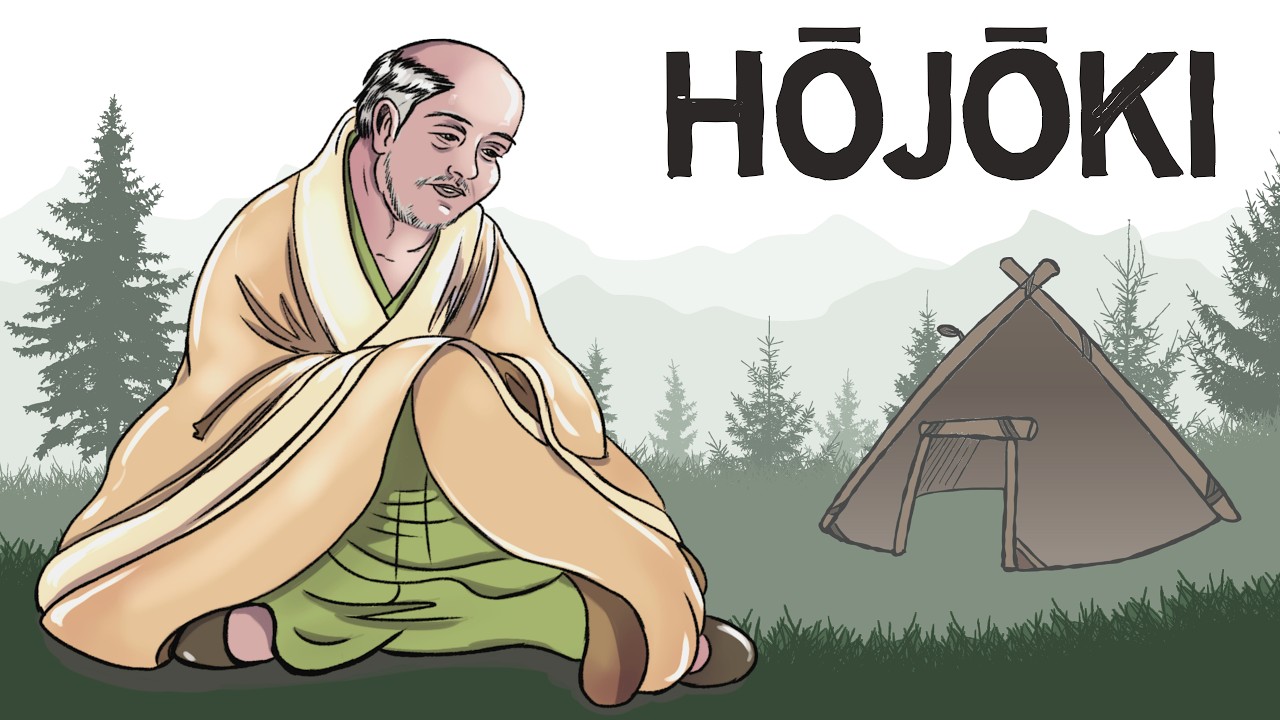
Living as a recluse, Kamo no Chōmei wrote his famous essay Hōjōki, reflecting on a world in decay, and what it teaches us about how to live.
Support the channel:
✔️ Patreon: https://www.patreon.com/einzelgangster
✔️ PayPal: https://www.paypal.me/einzelgangerco
Books: (affiliate links):
📖 Taoism for Inner Peace: https://amzn.to/4bN9lVB
📖 The Urge: Fall of a Stoic: https://amzn.to/3Yc77Kw
📖 Stoicism for Inner Strength: https://amzn.to/3rZU0xL
📖 Stoicism for Inner Peace: https://amzn.to/3e6myLX
📖 Loose: On Letting Stuff Go: https://amzn.to/3QVfrqM
📖 Unoffendable: https://amzn.to/35e23a5
Merchandise:
🛍️ Shop: https://einzelganger-shop.fourthwall.com
00:00 Introduction
01:41 A world collapsing
04:44 A game you cannot win
08:49 A troubling realization
12:33 Overshooting the goal
#hojoki #buddhism #solitude
Оглавление (5 сегментов)
Introduction
The world seems to move faster every year. And lately, it feels less stable… as if everything we rely on could shift or disappear at any moment. Each morning brings new headlines of crisis and collapse, keeping us on edge, worried about what the future might bring. Over 800 years ago, a Japanese poet watched his world fall apart. Natural disasters, societal chaos, and a life that turned out to be nothing as he had hoped. Like us, he was forced to face a difficult truth: that safety and stability are fragile, and perhaps never truly existed. But unlike most people, he decided he had enough. From his perspective, there was nothing lasting to be gained in the world. He saw everything was subject to change, loss, and decay. And so, he turned away from it all and built a small hut, where he spent his days in simplicity. Living as a recluse, Kamo no Chōmei wrote his famous essay Hōjōki, reflecting on a world in decay, and what it might teach us about how to live. This video explores the wisdom of Kamo no Chōmei’s Hōjōki. My name is Stefan. If you enjoy my work, you can subscribe to my newsletter on Substack. You can also support me on Patreon, and my books are available on Amazon. Thank you, and I hope you’ll enjoy this video.
A world collapsing
Kamo no Chōmei grew up in Kyoto, studying poetry and music from an early age. Born into a well-connected Shinto family, he had high expectations of life. But the world around him was already starting to fall apart. As a child, he witnessed the city consumed by fire, along with famines, earthquakes, and violent storms. In the years that followed, the turmoil only got worse, as the capital was suddenly relocated, causing widespread chaos, and rival military houses fought for power. The introduction to a recent translation of Hōjōki, written by Matthew Stavros, explains how environmental disasters and social instability led many to believe the world had “entered an age of karmic degeneracy. ” This came from a Buddhist belief in a final stage, a period of decline in which true practice and enlightenment are nearly impossible. Meanwhile, Chōmei prepared himself to follow in his father’s footsteps, a high position within an important Shinto sanctuary. But when his father fell ill, withdrew from his position, and passed away not long after, his future became uncertain. Even though ready to take his father’s place, Chōmei was passed over, and the position was given to his cousin. This key moment in Chōmei’s life confronted him with the fact that life doesn’t always work out as one expects or hopes. And that his life was not an exception. The trend of misfortune didn’t stop, though. In his thirties, while living in his grandmother’s house, he was forced out. Why exactly he lived there (and why he had to leave) remains unclear, but likely related to his social status. So he left and built a small house near the Kamo River. Rather than mingling with others in the city, he spent his days in solitude, writing poetry. He began to retreat from the world. And the life he once belonged to, one of high status and wealth, defined by rank, prestige, and honor, faded. Chōmei wasn’t attached to society by marriage or fatherhood. He was free to leave the world behind, and so he did, as he felt it had nothing to give him. By the time Chōmei was nearing sixty, his gradual withdrawal reached its final stage: he built a small hut and retreated into solitude. Chōmei finally had the space to reflect on everything that had happened: the misfortunes he had witnessed and experienced, the suffering they caused, and why he had walked away from society, and what he learned in his hut, where he made solitude his home. He put these thoughts into a short work now known as Hōjōki, which translates to ‘An Account of My Hut’.
A game you cannot win
The flow of the river never ceases, And the water never stays the same. Bubbles float on the surface of pools, Bursting, re-forming, never lingering. They’re like the people in this world and their dwellings. Looking back on the many adversities and disappointments he had faced, Chōmei came to see how fragile the world actually is. And so, the reality of impermanence became the central theme of his reflections. When reflecting on his experiences, one thing stood out to Chōmei: circumstances are always changing; nothing remains the same. The prologue of his poem suggests that while buildings may appear eternal, most are neither very old nor destined to last. And the same goes for people. It may feel like those around us are everlasting, but in reality, people come and go, and before you know it, most of whom you knew, let’s say, thirty years ago have already passed away. The destructive reality of change becomes apparent in Hōjōki when Chōmei begins to reflect on the adversities he experienced, including great fires and earthquakes, full of death, pain, and despair. Misfortune is all around us. It is inevitable and spares no one, rich or poor, young or old. No one is immune. His reflections resemble the Eight Worldly Winds in Buddhism, which describe how we are constantly swept along by changing conditions, both pleasant and unpleasant. Sometimes you gain, sometimes you lose. One day you are celebrated, the next cast aside. In one moment, you are praised, in another, blamed. Today brings pleasure, tomorrow pain. After witnessing so much misfortune and destruction, and realizing how transient everything is, Chōmei came to see human efforts as pointless. He saw it as especially futile to invest wealth and energy in building houses in a place as unstable as the capital. Yet, he observed that people kept engaging in all kinds of vain pursuits, be it success, status, belonging, or reputation, which is hardly surprising, because these are precisely the things society praises, back then and today. Chōmei then concluded that participating in society means that one deals with these attachments in one way or another. And it doesn’t matter if you’re rich or poor, powerful or weak; every position comes with its own problems and forms of suffering. As Chōmei wrote: Wealth brings great anxiety, while with poverty come fierce resentments. Dependence on others puts you in their power, while care for others will snare you in the worldly attachments of affection. Follow the social rules, and they hem you in; fail to do so, and you are thought as good as crazy To Chōmei, the problem was obvious: the society he had been part of for so many years was a source of suffering for everyone entangled in it. Regardless of where you stand, you’ll always end up cheated. And so, he wondered: Where in this world should one live and how? Where can one find rest, And peace in their heart? We already know his answer. What better response to a losing game than not to play? What better solution to a toxic environment that only brings suffering than to leave it? But as Chōmei became a recluse, hoping to finally find the peace he was longing for, he arrived at a troubling realization.
A troubling realization
Chōmei learned an important lesson from his experiences: the danger of clinging to what cannot last, and resisting what cannot be changed. He came to see that external circumstances are unreliable, constantly shifting beyond our control. Suffering, he realized, arises not from misfortune itself, but from our attachment to this “world of dust,” as he called it. We have hopes and expectations. We hold on to things we want to keep, and try to avoid circumstances we don’t like. We desire things to unfold as we wish, inevitably leading to disappointment, which Chōmei experienced firsthand. Now, what’s the logical solution for the pain of attachment? Detachment. By living in a tiny dwelling in the hills of Southeast Kyoto, just enough for one man to sleep and sit, he sought to disconnect himself from the sufferings of the regular people. And the idea made sense. Because if you don’t have much, you also don’t have much to lose. You won’t be stressing about wealth, possessions, or social status, because you don’t have those to begin with. Moreover, if all you have is a small hut, there is little to maintain or protect; you live simply, in peace and quiet, without the stresses of conventional life: chasing status and material possessions, having a family, and all the effort necessary to maintain these things, and the fear of losing them. Chōmei enjoyed his small hut. He relished owning a little. Observing nature and seeing the seasons come and pass became his delight. He felt free… and even pitied those in the city for missing out on what he so deeply enjoyed. But in the light of the Buddhist teachings he followed, something began to bother him. Chōmei realized he had become attached to his hut and the pleasure it gave him. As Chōmei understood from the teachings, if you want to relinquish the suffering of impermanence, letting go of your attachments is the key. After all, if you don’t hold on to anything, nor harbor aversion to things, then the changes of the world will not affect you. But Chōmei’s ways gave rise to a new problem. Even though he successfully detached from a myriad of worldly things by renouncing them and embracing the hermit’s life, he now held on to his aloneness, his hut, and the simple life he was living. He had jumped from the frying pan into the flames. He scolded himself for describing the useless pleasures he found in solitude, saying: In the quiet dawn, I ponder this and question my own heart: you fled the world to live among forest and mountain in order to discipline the mind and practice the Buddhist Way. But though you have all the trappings of a holy man, your heart is corrupt. Chōmei asked himself if his past karma had led him astray. Or if his critical mind drove him mad? He concluded he wouldn’t get any answers to these questions, and so he meditated and prayed, and then remained silent, which is how Hōjōki ends. The story of Chōmei and his hut doesn’t end on a
Overshooting the goal
positive note. Chōmei’s grave disappointments with life led him to seek solutions, which ultimately ended in more disappointment. But he also arrived at a profound realization, almost a cautionary tale: in trying to free ourselves from worldly attachments, we may become attached to the very means we use to escape them. I can only imagine that people who, like Chōmei, seek out solitude as a means to disentangle from the world, such as hermits and monastics, run the risk of clinging to their seclusion. Similarly, minimalists who make an effort to detach from useless stuff risk becoming attached to the very idea of minimalism. And when this happens, aren’t they overshooting the goal? Whether we’re minimalists or hermits, if we’re attached to our ways of life, be it a decluttered living space or a hut in the woods with minimal human interaction, we’re still watering the seeds of suffering. For as the worldly winds shift, we may find ourselves in cluttered environments again, or lose the solitude we depend on. And as we’re attached to what we lost, we suffer. Personally, I can relate to Chōmei, as I also began to seclude myself around ten years ago, after many disappointments and setbacks in life. Bitter and hurt because of all that happened, I retreated to my apartment, spending most of my time in solitude for many years. After all, the fewer people you let into your life, the less likely you are to be hurt by them. Many good things happened during those years, though… My financial situation improved, I drank less and less, I reflected a lot on life, I immersed myself in philosophy, and I started this channel. I finally found some peace after a life of chaos. I fell in love with my apartment, like Chōmei with his hut. Solitude can be addictive, the silence, being in your own company. And from my own experience, I need more of it than before, and without my ‘alone time’ I tend to become irritable. So, it seems that solitude has become a condition for my happiness; I desire it, I seek it wherever I go, at home or while traveling. Now, is there something wrong with that? Perhaps. It suggests I may struggle when solitude is no longer available. And when the dependency on it becomes too great, a proverbial hut turns into a prison rather than a path to freedom. Thank you for watching.