How Women Should Hydrate in Training: Sweat Rate, Sodium, Menstrual Cycle, and Perimenopause
12:02

How Women Should Hydrate in Training: Sweat Rate, Sodium, Menstrual Cycle, and Perimenopause

Dr. Stacy Sims Official 09.05.2026 7 309 просмотров 313 лайков

Machine-readable: Markdown · JSON API · Site index

Поделиться Telegram VK Бот
Транскрипт Скачать .md
Анализ с AI
Описание видео
Are you drinking tons of water but still feeling bloated, crampy, or thirsty? This clip explores why common hydration advice fails women, and what actually improves fluid absorption. I breakdown the two big hydration myths: the “8 to 10 glasses a day” rule and the idea that most sports drinks are designed for hydration rather than carbs. Watch the full podcast here: https://youtu.be/Ho7VH6xIrCk 📩 Join my newsletter for updates, tips, and free resources 👉 https://www.drstacysims.com/generic_optin Want to go deeper? Start here: Menopause 2.0 Your complete science-based guide to training through midlife and beyond 👉 https://www.drstacysims.com/menopause?utm_source=may26wk1s&utm_medium=social&utm_campaign=youtube Microlearning Courses Focused courses on supplements, hormones, and training - each under 3 hours 👉 https://www.drstacysims.com/microlearning?utm_source=may26wk1s&utm_medium=social&utm_campaign=youtube Next Gen: Training Active Girls For coaches, parents & teachers helping girls thrive through puberty and sport 👉 https://www.drstacysims.com/nextgen?utm_source=may26wk1s&utm_medium=social&utm_campaign=youtube Not sure where to start. Start here: 👉 https://www.drstacysims.com/product_guide?utm_source=may26wk1s&utm_medium=social&utm_campaign=youtube ▶️ Watch Next: Continue learning with these related videos: The Truth About Women’s Training & Nutrition | Dr. Stacy Sims on Andrew Huberman Podcast https://youtu.be/CYew_LtZt4I?si=DV3vpzKX7qcVuyWs Is Mainstream Exercise Advice Sexist? Here’s the Truth! | Dr. Stacy Sims on Diary of a CEO https://youtu.be/-4I0U9ApVEw?si=u1CsDLVaAG_SzMOi Why Women Need a Different Approach to Nutrition & Training | Dr Stacy Sims on The Proof https://youtu.be/4c7udsxd3c8?si=wG8wZTmE4s36xA9G 👩‍🔬 About Me: I’m Dr. Stacy Sims, exercise physiologist, nutrition scientist, and author of ROAR and Next Level. My mission is simple: stop training women like small men. I help you understand and work with your physiology - for better performance, health, and longevity. Follow me for daily tips: Instagram: @drstacysims Facebook: @drstacysims LinkedIn: Dr. Stacy Sims 🔔 Subscribe for new videos on women's health, training, and recovery 👍 Like, share, and drop a comment - I love hearing your questions #DrStacySims #WomenAreNotSmallMen #WomensHealth #FemaleAthletes #ExerciseScience #Hormones #StrengthTraining #MenopauseFitness

Оглавление (3 сегментов)

Segment 1 (00:00 - 05:00)

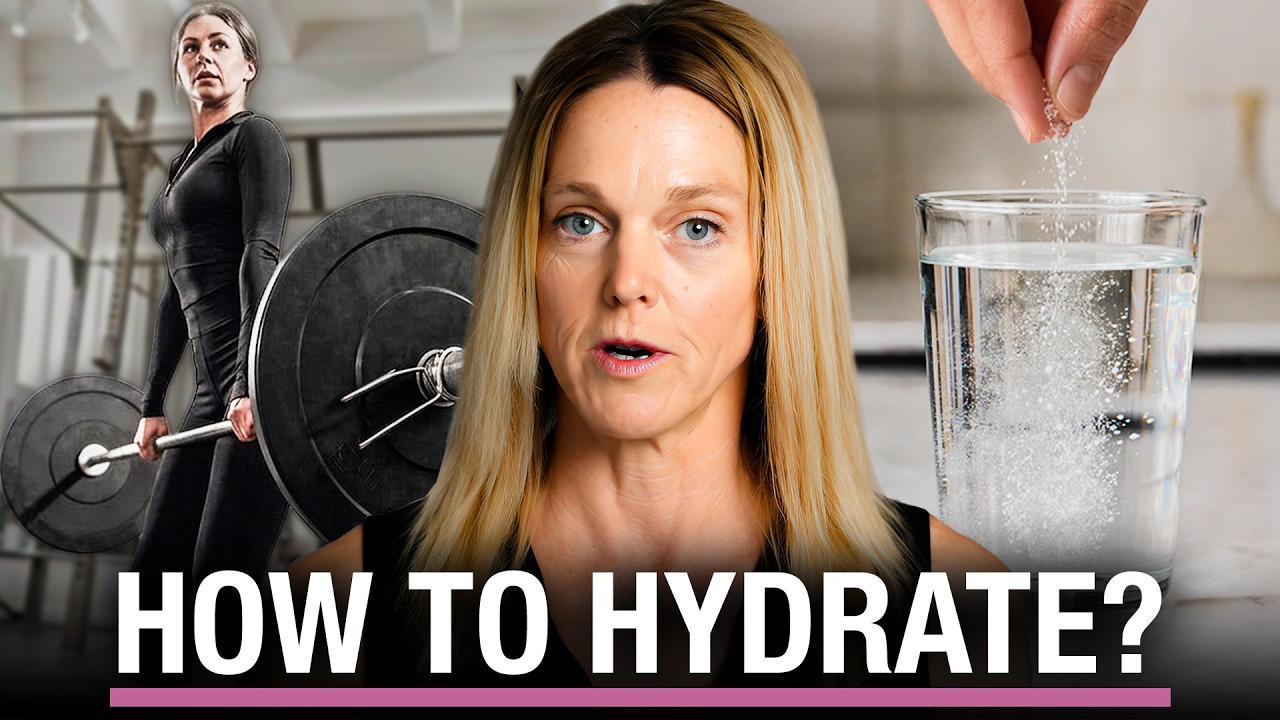
You know, on that we talk hydration is a almost a is become almost dogmatic yet women are still bloating, they're still tanking, they're still feeling, you know, cramping. What has science gotten wrong when it comes to women and hydration? You realize that my PhD was on hydration. — Especially when you do this is like really GETS US EXCITED. — I HAD TO GO THERE. I had to get you know, I had to hit your money spot, right? Yeah, so when we look at hydration just in general like we look at sports hydration and hydration. There are two myths that I need to bring up to clarify for everyone. First, when we talk about the 8 to 10 glasses of water a day, just like 10,000 steps is based on a marketing, right? So that's there's no real science behind it. And the other is this whole like electrolyte replacement sodium replacement idea, especially when we're talking about sports drinks. We have to think back to how it originated, right? So we think about um in Florida, right? When we're talking about that the origins of Gatorade where we have the assistant football coach and his flatmate or roommate who is a renal physiologist. And the renal physiologist is like, "Hey, you know what? If you were just to add a little bit of sugar and salt to that water, it's going to help your players. " And that's the origins of it all. It's like looking at physiology. And it's become this big thing because once that started taking off and then was bought by a corporation who then used an artificial sweetener to make it taste better. And then the FDA is like, "That's no longer allowed. " and took it off. Then they doubled the amount of carbohydrate to make it have the same pallet, then did research on it to show that it was a really good as a carbohydrate replacement and might help with hydration. But the conversation got reversed cuz you look at the earlier data coming through and it shows that like a 1 to 3% solution is optimal for plasma volume expansion which means hydration. But Gatorade sits and all those sports drinks sit between 5 and 8% which is all about carbohydrate replacement. It's not about hydration. So again, it's marketing was stronger than science. So then when we look specifically at sex differences, there is a difference. We see that women who do a long endurance race will finish with normal blood sodium or lower. And when we look at men, they'll finish with normal blood sodium or higher because we look at sweat rate differences, we look at fluid accumulation how fluid shifts during exercise and there are sex differences in that. So it was just 2 weeks ago that I saw that Gatorade has now implemented a you know, like a sex difference research project to see how women should hydrate differently. It's like I've been saying this for 20 years and now we're finally having people go, "Oh, wait. There's palletization differences, there fluid shift differences, there's differences in sweat rate, there's differences across the lifespan too because when we hit peri and post menopause, our thirst sensation isn't as strong. But our hydration needs are a little bit higher cuz our bodies are more stressed. So it's been very interesting to watch the evolution of the whole hydration space. All right, so doc since this is your lane, what are some of your strategies for the athlete woman to stay hydrated specially in different weather patterns and the office worker to stay hydrated in different stress patterns? So across the board, you just need a little bit of sugar and a little bit of salt in your water. So for the office worker that's hanging out, just adding maybe 1/16 of a teaspoon into 16 to 20 oz of water. So it's around 200 mg of sodium, but that's going to help actually pull the water in. And I say that because when we look at where fluid absorption happens in the small intestines, the small intestine is very sensitive because it takes a certain amount of pressure and certain amount of glucose and sodium to actually make everything work to pull fluid in. So if you're just drinking plain water, then the body has to pull salt and glucose in to make it work to be pulled out. But if you're ingesting it with a little bit of sodium, it's already there, can be pulled in. So it's a faster way and you aren't changing your pressure within the small intestine so it actually works. When we start exercising, we have blood flow that gets diverted away from the gut cuz it goes to the muscles and we need a little bit more help. So this is when we're looking at, "Okay, so if I'm doing a relatively shorter easy session, maybe I'll add a little bit of maple syrup to that. Maybe a teaspoon of maple syrup with that sodium cuz maple syrup has both glucose and fructose. So we know that that's cuz

Segment 2 (05:00 - 10:00)

it has the sucrose in it so it breaks down. So it actually activates all of the transport mechanisms. And that's all you need. We talk about potassium, that's more post exercise for rehydration or long endurance exercise when you start to have lots of fluid shifts. But you don't need all the other stuff. With sodium, there's no such thing as sodium replacement. So all the sweat sodium test, that's just a patch of what's happening under that exact patch, but that doesn't represent how much sodium your body needs. We can lose up to 50% of our sodium stores and be fine. So as long as you have a little bit of sodium in that fluid to help with fluid absorption, you're fine. So I'm already I'm right wait, I'm already thinking about so before I work out, I just need a stack of pancakes and some maple syrup and I'm good, huh? Yeah, there you go. And some water. — Water on the side, but I got the carbs and the maple syrup to drive the water that I'm going to eat with my stack of pancakes. So I'm good, right? — Or you could have coffee cuz coffee works too. — have coffee with my pancakes and maple syrup and a little bit of water and I'm hydrated? Yeah, there you go. I'm good. Try that. Try that and do a long run, buddy. — I'll be flying the second half cuz the first half is going to be digesting, the second flying. I'll be flying, Spence. — Wait, you know what? Look patient one of my interns told me about the Krispy Kreme run that's done in Florida. Do you know about this? No, I don't know that. — it's a you have to eat 12 Krispy Kreme glazed donuts and go for a 1-mile or 5-mile run or something like that. Yeah, and there's even a strategy on how to do it and that is that you the smart people that have to eat the 12 donuts, they compress them into their little flat pancake and they eat them and then go for it. There are more people vomiting on the side of the — side of the road. So you and your pancakes might not work that well. So I'll be happy for happy for the first three steps. — Like are you having one of the light fluffy protein pancakes or are you having the dense I hop pancakes? — going to Kodiak ones. Yeah. — Okay. You try to make it gluten-free, but — Stacy, let me ask you about electrolytes. That's a big comment you know, you talk about salt and sodium and so on and um the maple syrup idea, I think that's great, but you hear a lot about electrolytes. Yeah. — Yep. Is that good enough what you just suggested? And yeah, and then you know, when you start to eat real food, you replace the electrolytes. — Yeah. True. Cuz most people aren't going out on a daily basis and doing a half Ironman, full Ironman or you know, any kind of like ultra long endurance race. So if you're up to 5 hours, that's all you need. But when you start getting 5 hours plus, then we start looking at your food choices to help with magnesium and potassium and that kind of stuff. But it's not about gaffing your bottle with all this stuff like limit and all these other precision hydration, yes, I'll call them out because they're just banking on this whole like marketing idea of you have to replace all this sodium because if you don't, you're going to die. It's like, "No, that's not how the body works. You're going to have be a sweaty a salty sweater if you use that stuff, but that doesn't mean that you need more salt. It means that you're sweating out the extra stuff your body doesn't need. Yeah, and on the opposite end of the spectrum is that you know, back to your 8 8-oz glasses of water is that was something that we heard many years ago that was the rule of thumb. And now people walk around with the gallon jug that they have to knock off in a day. It's yeah, so one of my good friends who actually was my PhD supervisor he was like, "People are killing the thirst stimulus. As soon as you put water in your tongue, you kill the thirst stimulus so your body actually never really gets hydrated. " And when you walk around and you're drinking all these gallons of water, you end up peeing it out. So you end up being more dehydrated than hydrated. You're flushing and everyone's like, "Oh, I'm drinking all this water and my urine's really clear. I'm really hydrated, but yet I'm still thirsty. " It's like cuz your body's just flushing it out. It's too much. There's no way for your body to absorb that much water. What are you flushing out? You're just really just peeing out what you're taking in. You know, it that is this is the perfect time to mention that over hydration can actually hurt you. We had a one of my patients was a major league baseball pitcher for the New York Mets and he was told because they come down to South Florida, hydrate, hydrate. He was on the mound, he's pitching his last the last inning and he started feeling numbness and tingling down the arm. Long story short, he end they win the game, he walks into the dugout and passes out.

Segment 3 (10:00 - 12:00)

— Yep. And they're asking him, "What happened? What happened? Did you hydrate? " Yeah, I mean, I knocked off, you know, gallons of water. Like, no, he over-hydrated, ended up having to go in the hospital because of it. That's how I came up with my PhD topic cuz I was racing Kona. And at the turnaround, I like got really bloated and dizzy. I'm like, "What is going on? " And then I ate a Gastrolyte, which is one of those electrolyte tablets that you have when you have GI distress and diarrhea and stuff. Like, I had a few. And I had one, and then I had to pee like a racehorse. And it's because I wasn't having enough sodium. I was just drinking a lot of the water cuz I was so thirsty and so like hyponatremia is a risk for women, especially when you're in the high hormone phase of your menstrual cycle, which I was. And then I got back and I was like, "Whoa, what was that? " And then I started investigating, "Oh, look, there are sex differences and phase differences in sodium. " So, that kind of perpetuated the whole hydration issue. — So, are you saying that most women or people should never drink just plain water? They should always put a little salt in there? If they're just drinking, but if they're eating food with it because food has all, you know, has sodium and stuff, then it's fine. — Okay. Interesting. And the point that I think is really good to deliver again is that uh how we're reducing our um I don't want to say instinctive behavior, but our our thirst reflex by, you know, guzzling water because there's a rule of thumb, whereas should you know, you pay attention to what your body is telling you versus what you, you know, And so, you're exercising, and then the biochemical part doesn't work. You can't necessarily rely on thirst when you're exercising because there is a change in palatization as well as blood flow. So, it changes thirst sensation.

Другие видео автора — Dr. Stacy Sims Official

Ctrl+V

Экстракт Знаний в Telegram

Экстракты и дистилляты из лучших YouTube-каналов — сразу после публикации.

Подписаться

Дайджест Экстрактов

Лучшие методички за неделю — каждый понедельник