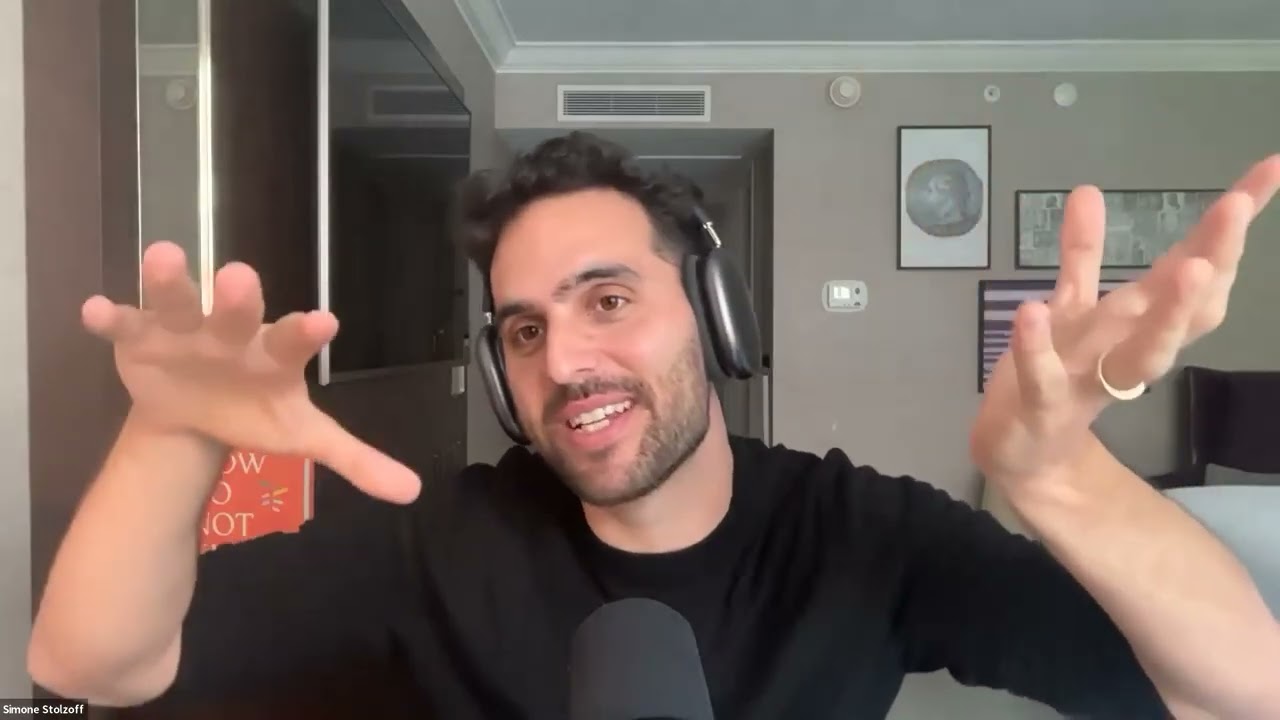
This is a Culture First Community event with author and speaker, Simone Stolzoff.
This was hosted on Wednesday, May 13th by Culture First Community Manager, Jessie Jacob, and Culture First Chapter Leads, Austin Drabik and Casey Boyles.
We’re living and working in an era of constant change.
Economic uncertainty.
Political unrest.
Rapid advances in AI.
Endless pressure to have answers and to have them fast.
And yet, many leaders are quietly asking the same question:
How do we lead when we don’t actually know what comes next?
In this special Culture First community conversation, we’re joined by author, journalist and TED speaker Simone Stolzoff, whose new book How to Not Know explores why our discomfort with uncertainty may be holding us back and how learning to sit with the unknown can make us wiser, more grounded leaders.
This is not a tactical workshop.
You don’t need to read the book in advance.
You don’t need all the answers.
This is a space to:
Rethink your relationship with uncertainty
Explore why “not knowing” is a leadership skill
Feel more grounded about the future of work—and your role in shaping it
To learn more about the Culture First Community and to join the conversation, visit community.culturefirst.com.
Оглавление (12 сегментов)
Segment 1 (00:00 - 05:00)
Someone said in the chat, a group of people around the world united in the shared belief that a better world of work is possible. We're all here because we care about culture and the world and so happy you could join us from all over. And so we always start our culture first events with our uh five core principles. They're really important to us. The first one we have is foster belonging and acceptance. Um we're all here. We're showing up. We're humans. Um, and so we just want everyone to feel safe in this space and be able to participate. The second one, be willing to reflect and grow, is one of my absolute favorites. We're all learning and hopefully we'll get to take away some important information today that can help us be better. Have courage. Have the courage to be vulnerable. We this um we want to make sure everyone is comfortable, but this is an opportunity with people who are hopefully think like you and are excited and want to make things better. So just be 10% more vulnerable today. Put learning into action. Simony is hopefully going to share some of some great takeaways and tidbits about how to deal with uncertainty. And then the last one is super important. We are here to connect as humans and so you're going to make lots of great friends. Maybe you'll even find someone to marry in here. But this is about connection inside and um business out. So save it for the DMs after. So we're here today because Simone has a really exciting new book out there and you don't have to have read the book. Hopefully uh the first 50 people that signed up, the book is on the way to them. if you've got it already like me or it could be on the way to you, but it'll be with you soon. Um, you don't have to read the book, you um can read it later. We're just going to have a great conversation and we don't know all the answers. We hopefully will find some more and our hope is that you walk away with some ideas about uncertainty that you can actually use to help make things feel a little bit better. So before we jump in to um chat, oh I forgot to introduce myself. Hi everyone. I'm Casey. I lead the Denver chapter. Good to see so many similar fa familiar faces around here. Uh Austin will introduce himself in a bit and he is going to um start with some questions with Simone and then we'll open it up to audience questions. So if you have any you can drop them in the chat and we'll get to them. But before we get started, I've got a question for you. So, I moved to Denver six months ago and I'm adjusting to the weather. It was we had 8 in of snow last week, but today is 89°. Um, and so weather is on my mind a lot lately. And so, the question to drop in the chat is, what's the weather forecast for how uncertainty feels in your world right now? Uh for me uh maybe a little bit stormy, things a little chaotic. I have a big event coming up next week which tomorrow is actually going to be at and so I'm all over the place, but I would love to hear how you're all feeling. Oh, lots of foggy and storminess. Okay. All right. Well, hopefully we can um find some way to deal with this soon. All right. I'm going to stop sharing and I'm going to hand it over to Austin and Simone to um have a little conversation. — Thanks, Casey. So, I'm Austin. I am a co-lead of the Columbus, Ohio Culture First Chapter. So, thank you all for joining us and thank you, Simone. to I feel like a good spot to kick things off and get things started is everyone has a relationship with this topic and idea of uncertainty and really feeling the weight of you know I don't know what to do here or a lot of decision fatigue and analysis paralysis but not everyone dives so deep that they write a book about it so curious to learn a little bit about your story in how you got here and uh invested the time and energy to give us a book for it. — Yeah, thanks for the question and thank you all for being here. I feel like I'm among my people. I worked in sort of people first organizations in the past and you do some of these book events and you're like, who are these people? Do they actually care about this topic? And the fact that you guys are all taking time out of your day to be here just like means a lot. The book actually just came out yesterday, so this is like all fresh. this is like the red carpet first peak. Um there's like a professional
Segment 2 (05:00 - 10:00)
answer which is like the world is incredibly uncertain right now and I wanted to write a book to help people deal with uncertainty. But there's actually a personal answer too that I'll share with you guys that isn't in the book. Um and in many ways the my interest in this is born out of this experience that I had when I was about 28 years old. I was writing for the Atlantic. So, I was a magazine writer living in New York and I got a job offer from this design and innovation firm called IDO. And on one hand, it's like, you know, woe is me, the agony of deciding between two attractive job offers, you know, like world's smallest violin. And on the other hand, it threw me for this existential loop. I was insufferable. I could not make up my mind for the life of me which job I wanted to take. And I talked about it with my parents and my friends and my Uber driver and my yoga teacher. And I just would flip-flop depending on the side of the bed I woke up on. And I think there were two sort of central insights that came out of that period of tumult in my life. The first was that I had enshed myself with my work. My job and my identity had become almost one and the same. And the second was that I was looking for certainty about a question where there was no certainty to be found. I thought that if I just sort of banged my head against the wall at the right angle, I would know exactly which job to take. And the world doesn't work like that, especially with anything that hasn't happened yet. You can't have full certainty about it. And so this insight about work and identity becoming so inshed became the topic of my first book, The Good Enough Job. And this question about looking for certainty where there is no certainty to be found became the topic of my second book. And so the cliche among authors is that you write the book that you need to read. And so in many ways this has been a multi-year investigation trying to provide myself with an existential bomb. — Yeah, thank you for that. I've seen in the book that identity still plays a big role in how we navigate uncertainty especially when it comes to us being comfortable. Uh my next question I want to preface with something from the book which is you mentioned the psychology professor Philip Tedllock looked at two decades of predictions from government officials, journalists, academics, super forecasters and then concluded that the average expert was roughly as accurate as a dartthrowing chimpanzee which I thought was a kind of funny anecdote to put in of hey we have all these experts out there and they're saying here's what's going to happen. They're not really accurate. We all think we know what's going to happen on something. And so to me, it's that kind of fundamental note of uncertainty. And I'm curious if you could tell us a little bit more about how do you see this being an unprecedented moment of uncertainty today that we're in, especially with internet, social media, smartphones, and then maybe contrasting with what maybe isn't so different that we feel like is unique. — Yeah, I love that question. I think there's two things going on. One is that the world is becoming more uncertain. And so there's this researcher named Nicholas Bloom. He's an economist out of Stanford and he's been tracking global uncertainty since the early 80s. And he's found that the five highest measurements have all occurred in the last 5 years. So you think about the pandemic and these wars overseas and shifting tariff policies and AI and the things that you're probably dealing with both in the realm of your professional life and personal life. So this global uncertainty has gotten higher. But the thing that is less often talked about is that our tolerance for uncertainty is in decline. So there's another researcher named Nicholas Carlton whose work I love who has found that there's been a strong correlation between the rise of smartphones and the rise of our intolerance for uncertainty. And I think a few things are going on. One is these computers that we carry around in our pockets, they bring all of the world's uncertainties to the four. So now we can track a crisis that's happening on the other side of the world in real time. We can track the real-time location of our children. And as you and I probably both know, access to more information doesn't necessarily make us any wiser. That often just fuels our anxiety. And then the second thing that smartphones do is that they create the expectation that answers should be readily available. So like personally whereas 10 years ago I might have been okay not knowing the name of a given actor now I feel this almost involuntary need to reach into my pocket. So the world is more uncertain. Our tolerance for uncertainty is in decline. I think that is why so many people feel unmed and anxious in this current moment.
Segment 3 (10:00 - 15:00)
The something that this reminds me of is this idea of you know there's a it seems that there's a cost to our addiction for certainty whether that addiction is through you know the technology or the algorithms or some just more innate pieces of our body that is kind of pushing for that addiction to certainty reminds me of uh there's a book from Jonathan hate the anxious generation and talks a lot about creating a culture of safety for kids and making playgrounds more safe uh in a way like more certainty of oh my kid's going to be safe and with that it creates different problems. I'm curious what does you know what is that cost of being addicted to certainty and creating more loops of certainty in our life. — There are a few costs. One is paralysis. So, one of my favorite definitions of uncertainty is a sense of doubt that stops you from making progress. I think we all probably feel some of this in our own lives and our businesses too. You know, it's hard to invest in the future when you feel like the future is precarious or the future is uncertain. And so the sense of paralysis and stopping people from taking action or making choices is a huge thing that prevents us from getting to where we want to go. It wastes a lot of time. I think another maybe more subtle cost is the way in which our desire for certainty incentivizes us to take the safe way out as opposed to the optimal way forward. So you can think about this biologically. If your ancestor was in the jungle and they heard a rustling in the bushes, if they didn't know the source of that noise, that uncertainty could have been lethal. And so our brains are wired to see uncertainty as a threat. Anytime uncertainty pops up, we want to get out of that situation as quickly as possible. The problem is that we have a lot of false positives. We treat these uncertainties in our life as if they were life or death when they aren't always. And so the most creative people, the people who are making scientific breakthroughs, breaking down boundaries between strangers, the people who are creating genre busting pieces of art, are the people who are willing to get to the point where they don't know what's next. and persist. Resist the shouting of our brains, the fight, flight, or freeze response that wants us to avoid uncertainty and are able to see uncertainty for its other purpose, which is the birthplace of possibility. If you want to learn or grow or create something that is truly original, you have to be willing to tolerate the uncertainty and the ambiguity of the messy middle before you get there. So when it comes to there's some good value in the pieces of things that we don't know but it could be difficult for us to recognize and realize and admit to ourselves when we don't know especially in the workplace where oftent times it's we have to portray confidence or feel that confidence. Could you tell us uh you know it sounds like there's three certainty traps to keep us from hey I don't know this thing admitting that thing we don't know could you tell us what those are — yeah of course so you know every non-fiction book needs the framework and this is my framework um I originally called them the three horsemen of delusion which I thought sounded smart and my editor said that's a little bit too uh high flutin for my taste and so we changed it to the three certainty traps and what they As far as comfort, which is that voice in your head that says, you know, stay where it's safe. Hubris, which is that voice that says you know best. And control, can plan the future. You can control everything. And they each have their downsides. So comfort by definition keeps us in bubbles that feel comfortable and they prevent the sort of learning and growth that comes from when we are able to step outside of our comfort zone. Hubris, that feeling that you know best keeps us from the humility of admitting what we don't know. And especially in a business context and a leadership context, this is increasingly important. The best leaders aren't necessarily know-it-alls.
Segment 4 (15:00 - 20:00)
They are people who are conscious of what they know, don't know, and are able to be clear about the bets or the experiments are running to find out more. And then with control, I think the flip side is acceptance. You know, we can't control the future. Like definitionally, anything that hasn't happened yet is uncertain. But it is sometimes this white knuckle gripping to one particular path that keeps us from opening our mind to new possibilities. And so there's lots of canonical examples in the business world like these companies that had very rigid strategic plans and weren't able to recognize when conditions were changing around them. But I think this is maybe more pernitious in our personal lives when we have an assumption that we know exactly how the relationship is going to turn out or we know exactly who someone is based on who they voted for in the last election or we know exactly how an interaction with a stranger is going to go. It has a narrowing effect. It closes our mind. And part of my goal with the book is to help people develop more uncertainty tolerance to help them open their mind to reality as it emerges as opposed to making assumptions about what will come. Yeah. Hm. I'm curious the on the uh you know the same note of keeping an open mind while also balance planning and sticking to a path for a period of time. How do you balance knowing when to give yourself more of the hey, you know, have some exploration room, challenge what's going on versus, hey, we need to give this plan some more time. We haven't let it run out far enough, long enough before we even know, like we haven't given it a chance. How do you navigate those two kind of dichotoies? — I love this question. Yeah, it's true. You know, there's a tension there. And to be clear, I don't want to advocate for sort of total entropy like full uncertainty. The research shows actually that when we are certain about some aspects of our life, it makes it easier to hold uncertainty in others. So one of the first pieces of sort of practical advice I often give people either in a business context or in personal context is to find your anchors. Find the things that will remain steady amid all the changing winds around you. So maybe in an organization this is a commitment to your values or your commitment to serve a particular customer or your team's commitment to have a personal sort of personal purpose statement or as an individual maybe it's your commitment to a spouse or to a place but when we know what we are certain about it makes it easier to hold uncertainty in others in terms of sort of the tension between the two there's this concept I really like from Aristotle and he calls it the golden mean and what he says is that you don't need to know the exact definition of a virtue. So you don't need to know exactly what say courage means but if you can know the bounds of the extreme tendencies you can try to find what is what he calls the mean between two extremes. So say one extreme is complacency where you're sort of stagnant and stuck in your ways and the other extreme is chaos where you're seeking so much novelty that you can't sort of find any ritual or routine or balance. You don't necessarily need to know what is the optimal point at which you want to be but you need to know sort of whether you're too far in one direction or the other and whether you could use sort of nudging yourself a little bit further. So just one more example. There's this concept in theoretical computer science called the explore exploit trade-off. So imagine you work for Netflix or Netflix is a good example or Spotify maybe it's a little bit easier and your job is to pick the next song that's recommended for a given user. You can choose to do one of two things. You can exploit what you know, which is to say pick a song that is very similar to other songs that this user likes, or you can explore what you know, which is to say pick a song that's sort of outside of your map of their preferences. And there are trade-offs for each. when you exploit, when you continue to go back to the well and choose something that you know, whether it's like returning to the same restaurant or doing the same routine or sort of staying stuck in your ways, you're more likely to find something that you like because it's sort of in line with what you've done in the past. The cost is that you might sort of
Segment 5 (20:00 - 25:00)
overplay the song to the point where you get sick of it. you aren't necessarily conscious of what is outside of your field of view. When you explore, the benefit is that you might discover something that you love. You might keep things interesting by choosing a song that you didn't know that the user liked and then surprising them and delighting them in the way that maybe old Pandora used to recommend songs as opposed to the current version of Discover Weekly. And the benefit is that you can discover something about your taste or the user's taste. If you go to a new restaurant, you might find a new restaurant that you love. If you order something different than what you normally order, you might find a dish that you order even more. But the cost there is that you might go too far a field. You might recommend something that's sort of outside of the bounds of their taste and risk turning a user off. So, it's not about like full exploration or full exploitation. It also depends maybe on where you are in life. If you're older and you're more calcified in your ways, maybe you do more exploiting. Or if you're younger in your 20s and you're figuring out who you are, maybe you do more exploring. But I think for all of us, we need some element of both. And it's incumbent on us to figure out sort of what we need in this season of our life. — Yeah. It's kind of like a teeter totter of — figuring out where we're at in the journey. — Exactly. Uh you talk a lot about uncertainty tolerance and obviously that fluctuating and kind of nowadays our uncertainty tolerance being lowered. I'm curious, could you tell us more about what uncertainty tolerance is exactly and how can it be something we lean into and hone as a leadership skill? — Yeah. So, I define it basically as being able to endure what you don't or can't know and not reaching for the false certainty that often gets pedled by others or even ourselves. You turn on the news these days and there's someone predicting exactly what's going to happen in the election and exactly when the market is going to crash. And we do this to ourselves. We assume that we know exactly how a relationship will go or an interaction will go or you know what your job will look like in five years. And if you are able to develop uncertainty tolerance, the research shows that individuals tend to be more creative because they're able to endure the sort of ambiguity that comes from creating new things. Communities tend to be more collaborative because they're more open to new perspectives as opposed to sort of fixed in what they know. And organizations tend to be more adaptive and resilient because they're able to endure the sort of ups and downs of market cycles and are able to take the types of risks that lead to breakthroughs. Our natural tendency is to avoid uncertainty as I mentioned earlier. But to build uncertainty tolerance, it's a skill. It's not sort of a fixed trait like your eye color or your height. It's something that you can cultivate and work on over time. — Yeah. I'm curious from a from getting to write the book, you got to explore and talk to a bunch of people's create a bunch of stories for us to learn from. What's one of your favorite or maybe surprising stories that you took away from this book? — I mean, there's a lot that I love. Um, I'm a narrative journalist and so what I'm looking for is good stories first and foremost. Um, I open the book with a story about a couple who's been together for 17 years, married for 10, and they're out having a drink at a bar in Manhattan. They're talking about their relationship and they decide to do something that others thought was insane. It's called the year of living dangerously where they left that bar and they decided to go their separate ways for an entire year and then come back to the bar to decide whether they wanted to stay together 12 months later. And it's this fascinating story like I, you know, met the couple and talked to them and I thought it was like, you know, stranger than fiction. But it's also this super interesting case study of what it looks like to turn toward your uncertainty. And when I do sort of an informal poll of asking like, do you think they broke up or stayed together? It's about 50/50. You know, half of the people are like, oh, it's the pina colada song. They like went off and then they found each other again. and the other half is like, "Oh, there's no way they stayed together if they like spent their energy outside of the relationship for a year. " Um, and so I won't spoil the ending, but you'll have to read the book. That's one I like. Um, there's a chapter about climate change where I spent a few weeks in this country in the Pacific called Tuvalu, where the average height of the country is 9 ft above sea level. So, a very sort of short country. And estimates are that with the rising tides, half of its land mass will be
Segment 6 (25:00 - 30:00)
underwater by 2050. And so it's this real sort of existential lens on uncertainty, like what do you do if the forecast and the projections are that your home is no longer going to be inhabitable? Um, and then a more sort of like business example, I profiled this team within the Federal Reserve, you know, like the central bank that sets interest rates and tries to reduce unemployment. um that was created after the '08 financial crisis and they were called the department of doubt and their job was basically to be professional devil's advocates to poke holes in central bankers main arguments and try to expose some of the cognitive biases that leaders have and I think especially for this community it would be particularly interesting because it's all about how do you encourage divergent thinking within an organization how do you get people with diverse viewpoints to not just sort of take the consensus view or the way they've always done some things and to think a little bit outside and — this is just what I made. — Thank you, Meg. This is also what I made in this chapter about the bank. And so I think there's like some tensions there where it's like on one hand introducing dissent or introducing room for doubt can slow down decision-m processes within organizations and on the other hand it can make decision-m better. So how do you think about this tension between sort of efficiency versus accuracy? Um, I'll take a brief pause to invite the we we'll keep going, but in the meantime, if you have questions in the audience, please fill the chat up with whatever's on your mind, questions, curiosities, uh, to ask Simone and about the book. Uh, so as we continue, we'll get to those questions. So, feel free to ask whatever comes to mind. you touched on something I'm curious to tap into a little bit more which is the personal element like each of us has a personal a very deeply personal experience when it comes to uncertainty and our personal lives and you mentioned something that I've been reading a lot about hearing a lot about something that's a little bit of a I don't know if it's newer but it feels newer it seems newer is more of like this exist existential uncertainty and I think some of it comes from like more baseline needs are kind of being met. So then it allows us to be more in our head and think about okay I don't have to think about food and water and shelter. And so now I'm thinking about more existential things like climate and so you just mentioned uh there's a kind of story in part in the book around this entire uh place that is projected to be underwater. So they are like they're projected to not be around anymore in like 25 yearsish now. But that's an uncertainty especially I think from Gen Z and under is what I'm seeing is a heavy kind of existential uncertainty whether it's climate or other things of you know are we going to be around uh how what are some practable practical tips for helping manage more of that existential uncertainty in our personal lives. — Yeah. So, let's take it at both extremes. Let's look at sort of like personal decision-m and then existential uncertainty. I think one of the benefits of being a journalist is I don't have to have all the answers myself. I can just go out and talk to very smart people. So, when it comes to like the first part of your question about sort of personal decision-m, how do you deal with uncertainty? I'll give three heristics. One comes from a philosopher, the second comes from an ethicist, and the third comes from a professional poker player. So, let's start with the philosopher. I talked to this philosopher named Ruth Chang whose work is all about how do you make decisions under uncertainty and one thing she says is what makes a hard decision hard is not that one option is clearly better than the other option and you're just too stupid to figure it out. What makes a hard decision hard is that one option is better for some reasons, another other reasons and neither option is better overall. And sure her advice is when faced with a hard decision, make the decision and then use that energy that you would have spent agonizing over which decision to make to convince yourself that you made the right decision, which is to say retroactively tell a story about the reasons why you picked one thing over another. So, say you're deciding between having yogurt and a donut for breakfast. And the yogurt is healthier and the doughnut is more delicious. And does the choice matter? Maybe not as much as you think.
Segment 7 (30:00 - 35:00)
So, choose one. I choose a donut. And then the reason I chose a donut is because today I I'm worth it and I deserve it and I want to start with something sweet and put the day on a good note or whatever. So, the sort of narrative power that we have to spin the story around why we make decisions. Nice donut emoji. Let's talk about the ethsist. So I talked to this ethicist named Ira Bredzowl who fascinating guy. He is both a rabbi and a ethicist in the hospital. So helping people make decisions about their health. One of the biggest sources of anxiety is not knowing about a health outcome. Uh in one study they found that for breast cancer patients the period waiting between getting a biopsy and getting a diagnosis was the hardest part of the entire journey. Harder than chemo or surgery. was the not knowing and having to deal with that ambiguity. So, Ira works on a college campus. He does a lot of advising of students and when students come to him with their problems, he always asks them the same three questions. The first question is, what do you want? And the idea with this question is to try to get a little bit out of your head and into a more embodied experience of what your gut is telling you. The second question is, do you want to want that? which sounds a little heady, but the idea here is to get into what is often called your second order thinking, your sort of higher level self. So, do I want a cigarette? Sure. Do I want to want a cigarette? Maybe not. And then the third question is, what does this choice say about the person that you are? And this is really the money maker in my mind. I love this question because it ties our decisions to our values and our identity. And so you can think about what is sort of an aspirational version of yourself and who do you want to be through this decision. You can't control the outcomes of your decisions, but hopefully you can make a decision that's in alignment with your values so that you can stand by the choice even if you don't get the outcome that you desired. And the third is this woman named Annie Duke who you might be familiar with some of her work. She wrote this great book called Thinking and Bets. and she has a lot of like quick tricks about whether you can go quickly or go slowly with a decision. And one of them that I like is called the only option test. And so what she says is imagine you are deciding between going on a vacation to Paris or a vacation to Rome. And it feels like this really high stakes decision. It's expensive. You might not get very many vacations like this in your year or in your life. And so you make procon lists and you talk to everyone you know and you try and, you know, weigh all of these different options. But the thing that she uses to sort of cut through the noise is says, "Imagine that someone had a gun to your head and said, "Your only option is to go to Rome. Would you be happy? " Okay. And then someone else or maybe the same person has another gun to their head and they say, "Your only option is to go to Paris. " And if the answer is yes to both of those questions, then the decision maybe matters less than you think. It's sort of going back to that Ruth Chang idea of what makes a hard choice is that there are trade-offs. You know, you still might worry about getting swindled by a Italian cab driver or getting food poisoning from some undercooked esargo or whatever, but the decision in the period of time that you're making the decision might matter less than you think and so you can make that decision relatively quickly. So, those are three tools that you might apply to sort of personal decision-m when it comes to some of these more existential things. Um, I like this idea of finding your anchors. You know, what are the things that will remain constant? I also really think that faith is a practical skill. We often think about faith in sort of a religious context, but in order to be a human in this world, you have to be willing to put your heart on something, to make bets without knowing exactly how they will turn out. So, as I mentioned, I used to work at this firm IDO, and we used to have this metaphor that we'd use all the time about this sort of innovation process. And we'd say that being an innovator is sort of like being on a lake that is shrouded in heavy fog where you can't see very far in front of you and you can't know exactly where you'll end up, but you have two jobs. And the first job is to have faith that you'll eventually reach land. This is true because you're on a lake. And the second is to keep rowing. And I think the keep rowing part is the most important. Action can absorb our anxiety. So whether it's something like climate change or fear of your own mortality, the more we can ground ourselves in sort of the next right action, continue to take steps, that is how the clarity begins to emerge
Segment 8 (35:00 - 40:00)
when it comes to climate change. It also happens to be the thing that can make a difference on something like the climate crisis. And so, you know, you guys are all people leaders or people that care about building culture. I think this is one of the most important lessons that we can take into a business context is that rather than spending all of our time planning, rather than just thought experimenting our way into figuring out what to do, we have to build to learn. We have to be willing to prototype to try things out. And one of the benefits of this sort of new age of AI that we're in is the cost of making something tangible has never been lower. Like I think about this with like Jesse and this amazing community that you guys are all co-creating together. No one is going to come to you with a silver platter and say you know please build this book club in your office or please you know organize this affinity group. But by taking the first step, by sending out the Slack message or the email, by hosting the table, you get a seat. And so that's something that's really stuck with me is when I'm feeling anxious, how can I think about getting a sense of autonomy, grabbing a little bit of agency or control back from the universe? Yeah, the donut analogy uh makes a lot of sense and kind of ties to what you earlier you were talking about in that you have to have those pieces that ground you and otherwise it's hard to even optimize for where do you go from there. kind of like uh Sylvia Pla talks about this in her fig tree analogy of just sitting there and watching these fig beautiful figs grow on the tree and then eventually they all just wither away and then you kind of starve cuz you didn't decide to choose any one fig because you were like oh which one am I going to choose? They all look so good and then they all go away because you did nothing at all. And when you eat the doughut, it's like, okay, you know, I really like that. Or, oh, maybe I feel tired. And now you can think through, okay, maybe I won't eat donuts. Or maybe you're eating the brand cereal every day and you're like, this is so boring. I need to do something different. But now you have that trigger that tells you it's or that stimulus that says, hey, actually, here's what you should do. that pushes you in a direction that stimulus doesn't happen though if you don't make any decision at all. Um — yeah, I love that. Yeah, if you guys aren't familiar with this passage from the bell jar that he's describing, it's so beautiful. Like the writing is just so evocative. It's basically like this character sitting underneath a fig tree and she looks up the fig tree and each fig sort of represents a potential life that she could lead. And there's one where she marries this man, another where she marries that man, and one where she lives in this place, another that place. and she's spending her time sort of agonizing over which fig to pick. And in the meantime, the figs are getting ripe and then overripe and then falling off the tree and then there's no more figs to pick. And it just such a beautiful image and I think it couldn't be more relevant to this moment in time. You know, we as humans need to be able to make choices in spite of not knowing. There's this great quote from this psychologist named Rolo May who says, "Commitment is healthiest not in the absence of doubt but in spite of doubt. " And I love that because we can't necessarily know how our choices will work out, but we have to be willing to make choices anyway. I'll take a break from me talking or asking questions rather for a second and highlight. Christie said, "This has me thinking about choice. " And a TED talk that resonated. We often think that more equals more choices equals freedom and means greater happiness, but in actuality, an abundance of choices in a store or dating brings greater discontentment. Simone, what are your thoughts about our desire for more choice and happiness? — I think you hit the nail on the head, Christie. I mean, so many of our problems in this current world that we're living in are problems of abundance, not problems of scarcity. And abundance have their whole host of other sort of negative externalities and side effects. So the canonical study for this was by this researcher named Barry Schwarz who studied people buying jam in a grocery store. And what he found is when there were many different options for types of jam to buy, people were so overwhelmed by the choice that they didn't end up buying jam at all. But when there were fewer options, it was more easy to make a decision. And the implications of studies like this are all around us. We think that optimizing for optionality gives us more room for
Segment 9 (40:00 - 45:00)
creativity and for freedom when in actuality we need constraints in order to focus our attention. Um I'll give a personal example. Maybe this is TMI but when I was in my early 20s I was doing a lot of dating. I wanted to sort of figure out what I cared about. And so I was optimizing for novelty and I never wanted to sort of be tied down in a relationship because I wanted to be able to like experience the novelty of getting to know lots of different people. And then I had this realization where just sort of a surface level of investment in many different things is not novel at a certain point. There are diminishing returns. And what was actually the source of discovery or growth or novelty for me in that phase was commitment. I had never been in a relationship over a few months. And I think this is true for our professional lives. for, you know, college kids deciding where they want to go to school or maybe that's not the best analogy because there's it's getting harder and harder to get into schools. In an age of abundant choice, we need to be able to put up the constraints. We need to erect ways to limit our mind's ability to go a million different places so that we can actually move forward and make progress. — Yeah, I think about that a lot. even obviously there's so many examples of where that's happening but also with AI is it's all of a sudden you have this tool that w that will continue to get better but even as it stands today you have this tool where now almost anything is possible for you to do — and it's kind of up to your imagination but in a way that's kind of scary because now it takes some of those constraints paints off and it's like, "Oh, well, now I'm overwhelmed because anything is possible. So, — what should I do? " Because you're no longer bound by some of these physical things that were bounding you before that pushed you into going one direction because you're like, "Oh, well, that's not going to work or that's going to cost too much money or, you know, I don't have $50,000 to hire a software developer. " Now, now it kind of reduces some of those barriers to entry and kind of floods the mind with optionality. — Totally. Yeah. I haven't been paying close attention to the chat, but I just saw that point from Brenda and I think like you're spot on. Like there are so many creative ways to procrastinate and there's also outsource doing the actual thinking. One of the things that I'm most worried about with AI is the decrease in cognitive time under tension. So the way that we grow our brains are similar to muscles which is putting them under tension. And once we entered a world where there was sort of caloric abundance where food was readily available, we had and our lifestyle became more comfortable and sedentary, we had to create spaces like gyms to be able to use our bodies and put them under tension and so we could build our physical strength. And now mentally there are so many potential shortcuts. Like even for me, I'm a writer and I feel I love writing. I've been I was a poetry major for God's sakes. Like I've been doing this for my entire life and yet I feel this sort of like urge to just like let Claude finish the paragraph or like outsource the memo. And I'm not sort of a lit. I don't think that we shouldn't do this at all. But I think it's very important to understand one of the costs of outsourcing our thinking to some of these tools is the lack of development. the sort of way in which we're cutting ourselves short. I saw it put well recently, which is, you know, using AI to solve hard problems can be like taking a helicopter to the end of a hike. Like you might get there faster, but you miss out on all the reasons that the hike was worth doing in the first place. So, this isn't to say that like we shouldn't use AI at all, but we're going to have to cultivate other ways to foster cognitive time under attention. I don't know whether there's actually going to be like brain gyms. I feel like there's been like half a dozen apps that have been like touting this sort of mental workout thing for a while. But I think in our own work, in our own lives, we have to be conscious of how thinking using our brains, working hard on problems is a source of purpose and meaning for all of us. Sorry, that was a little bit of like a soapbox diet tribe that's appeared a little bit, but it's something I've been thinking about a lot recently. Um, and I think it's something that I'm trying to keep in mind at least for myself.
Segment 10 (45:00 - 50:00)
— Thank you for sharing those internal monologue thoughts. the uh when Chat GPT first released or not like first released but kind of after playing it when it was first coming around. Something for me the reflection of was it felt very similar to the world of Harry Potter where they literally are magic and have magic and can do spells, but they have to go through school to learn how to use that magic. And even still, not all of the wizards can perform all of the spells that some of the other ones can. And some are still going to be better at doing, you know, one thing than another person. And then it requires like the most advanced type of magic for them to do it without a wand. And so if you try to turn a water bottle into a cat and you don't know what you're doing, it's going to turn into like a mouse or something. or a water bottle with a tail, which is really weird because you don't actually know what you want it to be. And it seems AI is a very similar thing of or even just generally what we're talking about is you have to have something to ground yourself in. of knowing where you're going, knowing what your compass is really. And it still requires putting the reps in because the magic doesn't just happen in itself. I love that. A you should write the book. That was really beautiful. — I wonder, you know, we don't have too much time left. Do people who have questions want to just raise their hand and we can take them off mute and they can just ask the questions themselves? I'd love to hear some other voices if people have questions to ask. — Amanda, you have a question if you wanted to speak it. — Sure. Hi. Um, my question was, if I'm ready to pick the fig, I see the one that I want, but my team wants to just sit there and watch the figs get overripe, how do you sort of — motivate whether it's, you know, managing up or across? — I have a good framework for you. Well, you can tell me whether it's good or not, but there's something that I like to think about, which is often when we are making decisions as a group, you know, collective decision-m, we tend to put out sort of like two options. one is sort of yes and the other is no and I think there's a gray area in between that is really helpful in these sorts of situations which is safe enough to try and so rather than thinking about these two extremes like we should do this or we shouldn't do this how can you think about the sort of minimum viable version of the thing that you want to try and frame it as an experiment that is worth doing and frame it as something that you can collect data upon and then have a way that you can check in whether you want to proceed. And I think what framing decisions like that does is it lowers the barrier to get people on board. Whereas, you know, we all work with certain naysayers that just have like status quo bias and they want to keep everything the same or the whole pokers that like find a problem in every sort of new program or solution. By framing it as an experiment, maybe something that's like time bound and measurable, you can get more consensus than waiting for everyone to be 100% in. Is that helpful at all? — Yeah. No, that tracks. I found sometimes if I just say, "Oh, we'll just pilot it like the anxiety levels. " So — those five levers, you know, even if it's not actually a pilot. Um, so yeah. No, that's helpful. Thank you. Simona, are you going to be narrating the audio book for How to Not? — Already recorded it. It is actually It's out as of yesterday. It's very so fun because like writing is such a solitary act where I'm just like behind my little glowing screen and I don't know if you can tell, but I'm like this total extrovert who just loves talking to people, loves to be around people and now people can actually read the book and I can like talk to them about the book as opposed to being at like Walden's Pond with my quill or whatever. Um, so yeah, I did read the audio book. If you are sick of my voice, don't download it. But if you want to hear more, I can whisper your ear for about five hours. — I don't see any more questions. So, if you have one, come off a mute now or you're going to forever have that question, unless maybe it'll be answered in the book for you. Uh, — question. Oh, yeah. Go ahead. — Simony had the beautiful insight of him leaning towards being an extrovert. And I have so many precious people that I'm running into that have so much to say on argue on the neurode divergent scale um and can go to the extreme extroversion or the extreme introversion um and when you're bringing them out in the onetoone conversations you would not know that they have stage fright. So this beautiful uncertainty how to be with it
Segment 11 (50:00 - 55:00)
how to build in community how to make it safe. There's so many beautiful uh pearls of wisdom that you have. I'm looking forward to reading the book. But as a global citizen, I want to learn from you because I'm at that early stage of what does that look like and feel like to walk in the world um in this place of uncertainty? How do we hold that calm, if you will, within all the crazy chaos, finding our anchors? But what advice would you have for the beautiful um complexity of our different communication and learning styles and being styles? Yeah, thanks for the question. The f the first place my mind went is that uncertainty tolerance is built through exposure. But exposure can mean many different things to many different people. It doesn't necessarily mean, you know, quitting your job and backpacking around Southeast Asia. If you find yourself in sort of a prison of your own preferences or like trapped in a comfort bubble, exposure might be small. It might mean taking a different route to work than the one that you normally take or striking up a conversation with a stranger at a coffee shop. But the research shows that when we expose ourselves to uncertainty in small safe environments, it rewires our brain to be more comfortable with uncertainty in other environments as well. Another thing that I might recommend is doing some retroactive thinking about your past and thinking about moments that you have been exposed to uncertainty before. maybe after a layoff or a breakup or just a period where you were really uncertain about who you were or what you wanted and then build your conviction through the evidence of your past life. There's this idea called the end of history illusion which is we can look backwards at our life and see all of the ways in which we've changed and grown and our identity and our preferences have evolved. And yet when we think about our life moving forward, we often think that we're fixed. We think sort of the person we are today is the person that we'll be forever. And recognizing this bias, I think, is incredibly liberating. And knowing that, you know, maybe you don't have to know exactly what your career looks like in five or 10 years or what your life will be like because the person that will have to deal with that situation will be born into existence then. And so you can sort of trust in your future self's ability to handle some of your future problems. So those are some of the things that come to mind for me. — Thank you. Beautiful. — And it gets us to that time where I want to invite Casey back in to help us wrap this up. And — Austin, you have the most beautiful voice. Do you have a podcast already or should you create one? — We're we're working on it. I wanted to talk to see how slow I could go before we get the slides up. — Beautiful voice and a good friend. Then I get the slides up. Um okay. So, thank you so much. I'd love for people to drop in the chat what's one thing you're taking away today. Um, so many beautiful reflections and I like cannot wait to finish the book. And then Simony, how if people haven't got the book already, what's the best way? — Uh, oh, I'm glad you asked. Um, I just put a link in the chat. — I just found out today that I have this like discount code that will get you 50% 15% off. 50 15. Um, and I love this website, too. It's called bookshop. org if you're not already familiar with them. And it's like an alternative to Amazon where they support local book sellers in your neighborhood. So you can still like buy it online. It gets delivered to your house, but rather than it coming from like big book core, it comes from like the little bookshop around the corner. So um you can use that link if you want. And then if you want to stay in touch with me, um I'll drop two things in the chat. One is I have a little thing that I call the article book club. substack. com. Um, and that is just like a way that I send out like good writing that other people have written and I've run it for like 10 years and I really like it. Um, or I will also drop my personal email address if you want to follow up and chat or bring me to your company to speak, which is how I make money in addition to selling books even though no one reads anymore. Okay, enough from me. Thank you so much to Jesse and Austin and Casey for hosting me today. It has been such a pleasure. The book just came out yesterday, so you guys are like this the first group that is, you know, getting to hear some of these ideas and get familiar with some of these topics. And so, thank you for your time and your
Segment 12 (55:00 - 55:00)
attention and being here. It really means a lot. — Thank you. And I can confirm you should definitely bring him to your company to speak. The great voice, great presentation. So, second plug from me. — Cool. Okay. — Thank you all. Enjoy the rest of your afternoons. Nice to meet you. — Thank you. Happy Wednesday. — Cheers.