Land your first 5 "silent" $500/mo clients HERE (plus a free 30 day trial) and I've included all these emails and campaigns: https://www.gohighlevel.com/mike-killen?fp_ref=sell-your-service75&fp_sid=86maths
📄 Get the whiteboard here: https://go.sellyourservice.co.uk/whiteboard?source=86maths
Disclaimer: Some of the links in this description are affiliate links. That means if you choose to buy through them, I may receive a commission. It helps support my business and allows me to keep creating free content for you.
Оглавление (9 сегментов)
Segment 1 (00:00 - 05:00)
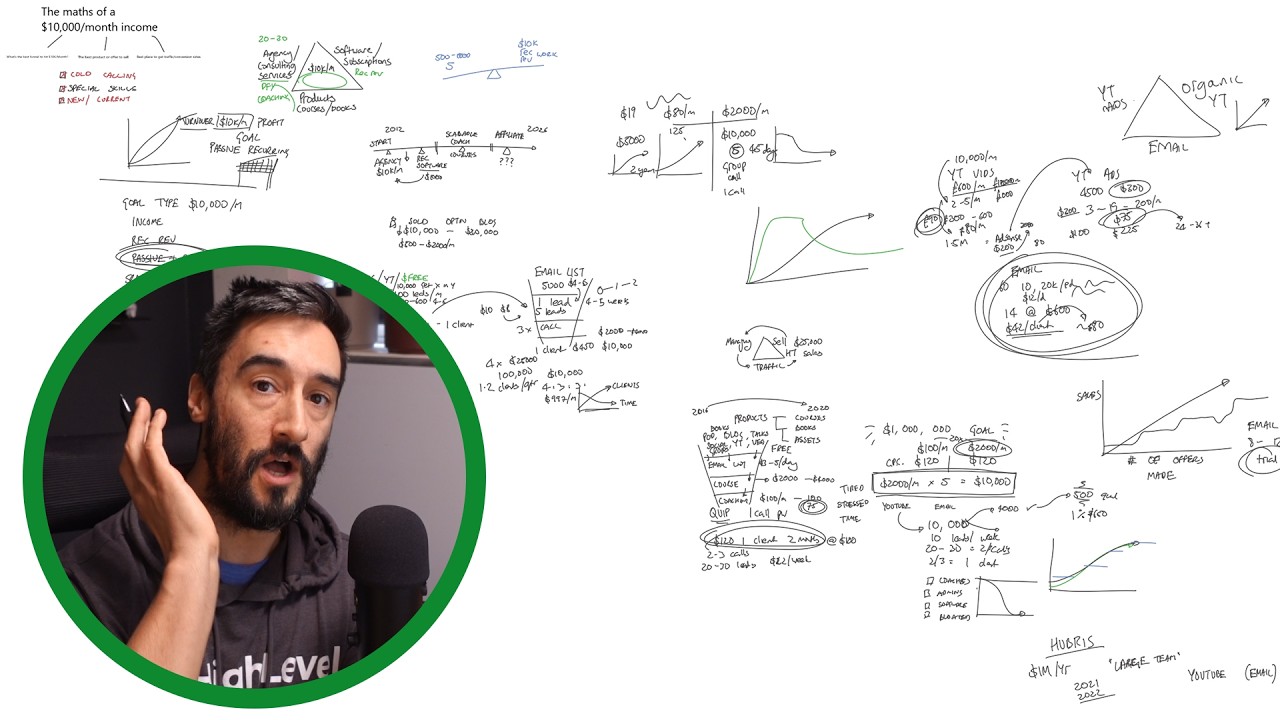
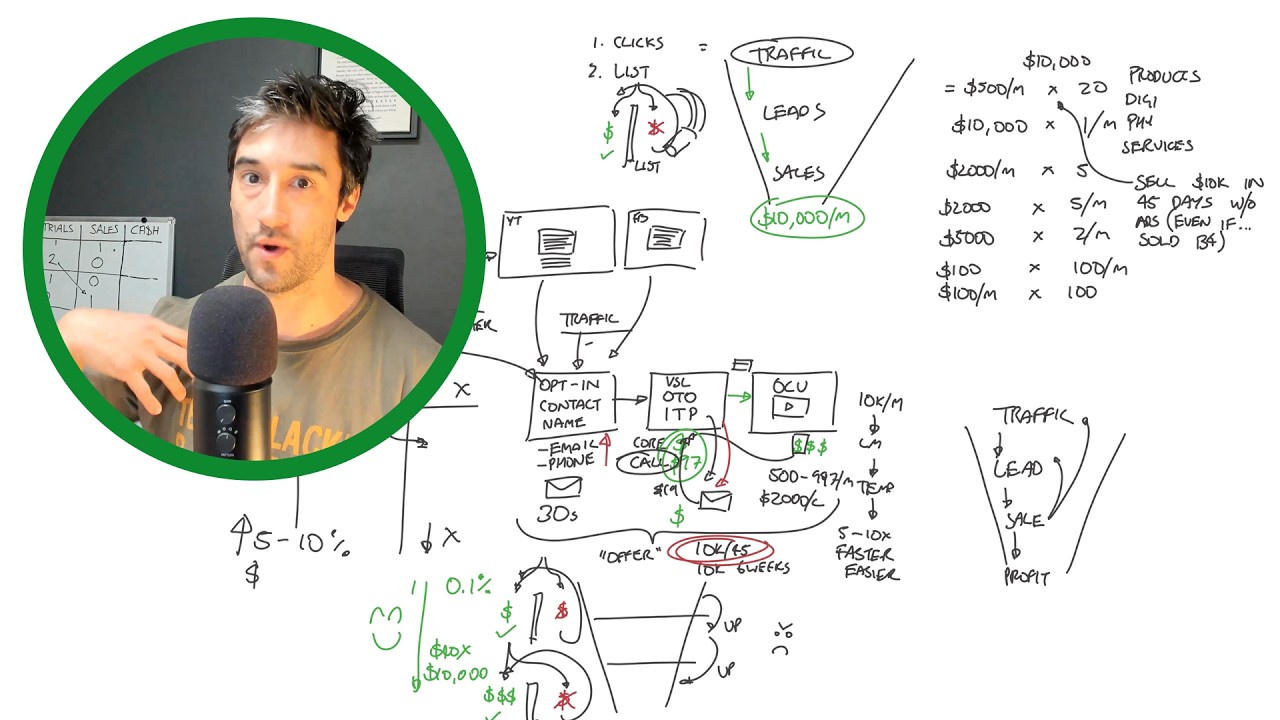
I want to talk about the maths of earning $10,000 a month for your business. We're going to talk about what the best funnel is that I found to in order to hit 10K a month. We're also going to look at the best product or service to sell because they've both got sort of pros and cons depending on where you go, and the best place to get traffic and conversion rates. Now, I'm lucky. I've done this four or five times now, so I've got a really good blend of selling certain products with certain traffic systems and certain sales systems. So, I've got a pretty good idea of how much it costs in order to start generating and hitting that $10,000 a month income. Now, we are not going to be doing any cold calling whatsoever, so don't worry about that. There will be some emails, ads, there will be some free organic YouTube videos or blogging um or any kind of organic social, but there'll be something in here for you no matter where you are, which kind of reminds me there will also be no sort of special skills required. I don't have any particular talents. I'm not a brilliant copywriter. salesperson. I'm not particularly talented marketer or anything like that, but I do have a habit of just kind of sticking with something and seeing how it grinds out. And also, it doesn't matter whether you're new or current, whether you're brand new to this sort of online marketing online business game or if you've been running a service-based business or a coaching-based business for a while, I'm going to talk about all the different ways that you can start to hit $10,000 a month income. Now, the place where I want to start, the actual most important point, is what I would consider the goal. So, if you imagine this is like a finishing line with a little checkered flag, the goal might sound obvious. It might sound, "Well, it's a 10K a month income. " And actually, it's not. What I need you to think about to start with, and a lot of people get this wrong, is how do you want to earn that $10,000 a month? My current goal is basically a $10,000 a month completely passive, and it's going to be I hate that term, but I'll promise you this is how I'm going to be hitting it, passive recurring income. In my opinion, hitting 10K a month is actually relatively easy. I'm going to show you a few ways involving consulting, services, no matter your skill level, coaching, selling products all the way through. But if you are currently earning this kind of money, you're realizing that it's actually the workload that goes up. Actually, it looks a bit more like this, doesn't it? It's exponential. And so, the goal really for me now is to set up a system where my team and my company and all the products and services that we offer generate $10,000 a month profit. That's really important because the difference between what we would call turnover or income or sales or cash collected is very, very different 10K a month profit. If you're starting out and you're like, "Look, I'm starting this new business. I really like working with clients. I want to do coaching or consulting or building funnels or doing some kind of delivering some kind of service to someone. " That might be completely different. You might say, "I want to hit 10K a month turnover so that we can start investing in staff and expanding our products and services. " So, I want you to first be aware, what is the goal and what type of $10,000 a month matters to you? Because if it's just income, that's going to be a very, very different method to a recurring revenue. You might be in the business now where you're thinking, "Actually, we make, you know, 250, 300,000 a month already, but what we really need is recurring revenue. " You might be thinking just starting out, or you might be in my position where you're like, "Actually, I just want to see if I can build something that's completely passive and recurring revenue. " Because it's one thing for us to sell, like I sell books on Amazon, right? I've got my books. That's passive revenue now. I don't have to do anything. Amazon promotes it, but it's not recurring revenue. The kind of holy grail is this passive recurring revenue that comes in. Now, it is a lot of work. I wouldn't call it completely passive. The actually the term that I use is what we call it scalable, but what it does mean is that January, when I'm filming this, I don't have to make this video. The question is why, and the truth is when I don't make these types of videos, I become very maudlin when I'm not helping people. So, while having the income is great, actually that meaningful sense of contribution matters more, but the goal is to get it to a point where if I work 1 hour or 100 hours, it almost doesn't matter because I know my income's taken care of. But we're going to get onto that. So, there are, in my humble opinion, three basic ways for you to be able to make money online if you want to hit 10K a month like this. We have things like services. This is where you do the work for the client, done for you. I've put consulting here because you have to turn up, you do the calls, you have conversations with people. I've done this. We've hit anywhere between 20 and 30,000 a month with this, but I'll talk to you how about I hit that how I hit that first 10,000 a month. Then we have things like software and subscriptions. This is the recurring revenue that I was talking about. There were different ways to hit this
Segment 2 (05:00 - 10:00)
and again, some are more profitable than others. All of these have got pros and cons, right? Every single one of these is a balancing act and a seesaw. You might say, "Yeah, it's one thing for me to be able to hit 10K a month and to have that like recurring revenue. " But what you might not know is that it actually can take you anywhere between, you know, 500 to 1,000 customers in order to be able to get there. Whereas some of these, it's only going to take you five clients. It's just going to require you to do a little bit more work. So, we'll talk about all of those differences between the two. So, we've got agency services where you sell the product to the client or the service to the client, you do it for them, software and subscriptions, and then you've got products, which is things like courses or books. I don't hate these. I still like them and I still sell them. They just require a lot of upfront investment, but again, we'll talk about those numbers and like how I hit them and what we did to hit them. I'm going to put, if you're interested in coaching, somewhere here. Coaching is kind of a blend between the two, but you can also have a recurring revenue component hopefully to your coaching. So, coaching does kind of sit in the middle here. Maybe it's even in the center. That's not to say it's the right thing to do. I don't know if you remember during COVID, like everyone became a coach. I wouldn't worry too much about whether everyone is a coach or everyone is selling SaaS or software or subscriptions or everyone's now a YouTuber or podcaster. That's kind of irrelevant. You need to figure out what's right for you and for your business, and we're going to go through those numbers with you. So, what I'm actually going to do, kind of I figured the logical thing was to start with my journey of where I started back in 20 — [snorts] 2012, Jesus, — and where we are today in 2026, like what I'm making my money with now. We will start with the kind of basic agency services that I sold. There's still a lot of value in this. I don't think they're sold in the exact same way, but I will show you how I hit 10K a month and why I was able to scale that quite quickly. I'll then talk about moving into the kind of recurring revenue side where we sold software, essentially. Then I'm going to talk about into the more scalable passive side where we sold coaching and courses. Courses, there we go. And there was a little bit of software, and then I'll talk about like what we're doing today and how we basically make 10K a month profit, recurring revenue without having to necessarily increase our working load. So, when we started out, it was just me, and what I was doing was basically selling agency services. I'll talk about that in another video, but very basically, I sold opt-in forms on blog posts. We had a specific market, niche that we went after, and I just said to people, "Hey, if you've got a lot of blog traffic, I can convert them and turn them into leads for you. I'm just going to install opt-in posts. " And we sold our services for anywhere from 10,000 to 20,000 dollars, but that was a one-off service. What we eventually realized is actually if we, and I this might go against everything that kind of you're if we lowered the initial kind of buying price, so to speak, and then we added anywhere from 500 to $2,000 a month service and maintenance on the back end, we could hit that 10K a month pretty easily and consistently. I've actually got my numbers here in terms of how we did this. The way that we got traffic, and I remember when I did it, I remember people asking me, like, "This is incredible. How have you managed to get this many leads and traffic and things? " And I was like, "I just followed what everyone else was kind of telling me to do. " And at the time, this is 2012, remember, right? Like a trillion years ago. And at the time, blogging was really big, and I also started dabbling in YouTube, which goes to show you how bad I am at YouTube because I think if you look, this channel itself has been going since 2016. There's guys who have started after me who have just blown past me in terms of viewers and subscribers. So, you can see that I'm an example of someone who is distinctly below average in skills and capability, and yet I have a six-figure scalable passive income. But back in the day, 2012, we started with blogging. And what we would do is we would try to get leads from those blogs. We try to get those leads onto calls, and then we get those calls to become clients. Now, I want to talk to you about the numbers. These are the best numbers that I could come up with at the time. Ryan Dice talks about this how tracking metrics can actually become more confusing than it is, but I've gone back over my numbers. I've kept spreadsheets basically from day dot on what I used to call the traffic report, like how many people are viewing the blog and YouTube videos, how many people coming leads, et cetera. And I tried to work out roughly what those costs are. Now, in terms of cost, this is free. I mean, I think the website cost like $4 a month or something to host cuz I had a proper site, but creating blogging content, creating YouTube content was free. Little pro tip, all I did, and I have said this for a trillion years, I just said my blog was a 10,000 word blog post about how to get X in Y time. And I
Segment 3 (10:00 - 15:00)
think at the time it was something like how to get a thousand leads for free from your blog without paying for ads or something like that. And that was all I did. That was literally all I did. I just wrote a really long blog post on that and it generated in fact it still generates traffic today on how to do that. It was on our old agency website. Roughly speaking, I'm just trying to have a look through here. We ended up growing to So we would get roughly I'm going to call them leads but they were essentially opt-ins roughly a hundred leads a month which is not a huge amount. You know, that's what three to five a day. It's not a huge amount. And I knew that every hundred leads roughly would give us one call. So a hundred people would opt-in and what I would do is I would reach out to every single one of those people and say, "Hey, I saw you downloaded our lead magnet on like how to drive traffic from your site. What type of blog do you run? " 80% of them wouldn't get back to me. 15% would get back to me and wouldn't be suitable. 5% would say, "Yeah, I'm interested. " And then eventually one of those would become a call. I'd say, "Hey, why don't we jump on a call? " I think even back then I was probably using Skype and eventually we moved to Zoom pretty quickly. And then I knew that it roughly took four to six calls to land a client. Now what I mean by one client four to six calls is it meant four I just need to four to six different people. So if you kind of work your way back up that would be anywhere between 400 to 600 leads and remember we're only getting a hundred a month so it'd be about four to six months per client, right? Now eventually that became quicker and quicker because we worked really hard on referrals and I'll show you kind of the second way that I found to get a lot more calls quickly. Now the advantage is that this was all free. It just cost a lot of time. I remember at the time I went nuts and I would write a blog post pretty much I would write sort of like three to four a week same with YouTube when we moved over to that and I was just constantly hammering one point and the idea is I kind of wasn't concerned about quality. I didn't want to be a YouTuber or a blogger. I just thought when we have that out there if I just keep writing about all the problems that my audience has by definition the volume will end up bringing me clients. And sure enough this is how we landed our first sort of like four customers. Now they paid us as I mentioned anywhere between 10 and 20,000 or 25,000 for products and services. I'll talk about recurring revenue in a bit. So you can see here that it essentially took us around 600 to a thousand opt-ins to get a call or enough calls that would end up converting into a client and one of those would pay us 10 grand. It was free. It just took a long time and I had to work crazy hard. But if you've got time and you're willing to put in the work and the effort this is an extremely good way of generating sales and leads. Now what worked on kind of like an afterburner for this when you kind of add that NOS is what I was basically building was an email list. And at the time I think we ended up with about 5,000 email addresses. All right, so not a huge number but remember it started at zero and then it was one two and then so on and so forth. We were getting roughly I think I said about a hundred a month ish. It went up and down, you know, like Christmas it just dropped off summer dropped off. But we ended up with about 5,000. And what I would do is roughly three or four times a week no two or three times a week probably as I've probably shown you guys before is I would ask people to get on calls. And if I look at the numbers here I knew that we would get roughly one good lead a week. Now for an email address what I mean by lead is essentially an inquiry. So that's someone replying back to me. If I had a big bulk email list a bit like I do with you guys on the email list I would say, "Hey, we're working with another group of bloggers who want to turn their kind of current traffic into leads. If that's you let us know. " Roughly one person a week would come back to us and say, "Yeah, that sounds interesting. I I'd be interested in working that. " Now what we knew is it took roughly five leads in order to turn into a call. And again what that means is five different leads. Only 20% of the people be qualified enough for a call. So that meant that was itself taking anywhere from four to five weeks or you know, a month in order to get enough leads to book a call. So it's not a huge amount of calls. This is in conjunction with this and we're having referrals. I did do cold calling as well. Don't really want to talk about this because that was selling a different service but that was just relentless and the numbers are actually roughly similar to this to be honest. So that would generate a call and I also know that it took roughly three calls to get one client. At the time it cost us anywhere from like four to six dollars a day to send that type of the cost of sending email have actually gone down for us it would cost about that. We worked out that one client roughly cost us about $450 to land via our email list. By going through these numbers it meant that if
Segment 4 (15:00 - 20:00)
we were able to get a client it probably cost us about $450 in email fees. But again we were going to charge them like 10,000 plus. And if you've done any of my training before you know that what I try to do is I try to charge people anywhere from like 2,000 to 100 2,000 to 4,000 up front before I even do any work with them. So this was always profitable. The name of the game is profit. I know there's a lot of businesses out there who are like, "If you can spend $10 acquiring a client and the client only pays you $8 and as long as you're making money on the back end it's fine. " What I find is that for services that didn't work for us. I needed them to be profitable pretty much up front. In terms of the maths of how it works out we only needed four clients at 25,000 for us to hit a hundred thousand, right? I know it sounds obvious but this just means that if I landed the maths works out 1. 2 clients which is kind of dumb every quarter we would have a $10,000 a month income. Now the difference is that none of this was massively profitable. We had a team to pay building sites building funnels building campaigns people is expensive and it takes up my time and energy. But what it also meant is that I wasn't able to work on the lead generation stuff. So what we ended up doing is charging people $10,000. What we would do is a 433. So 4,000 3,000 and then afterwards we would charge them usually 997 a month and that would be to maintain and continue working alongside them. That would be support it would be all their hosting it would be installing and updating the plugins and there would be a little bit of like content stuff in there as well if they sent it over to us. The difference is that this still for us wasn't massively profitable and what I found is I was answering lots and lots of support tickets. The amount of time that I had would go down the more clients I added. Eventually we sold this business we sold this agency because it had a system and a methodology and a list and a bunch of clients who were paying us the media company that bought us. I think they got a pretty good deal. It's actually still going now and some of those clients are still with that company that bought us. It wasn't for me though. I found that my time basically plummeted and I just didn't get any time for myself. What I ended up transitioning into because I had this experience I could do three core things, right? First of all I could sell extensively what was known as websites back in the day for $25,000. Okay, I was really good at what we call high ticket sales. I was also very good at managing a team which I didn't think I would be. Anyone who's ever worked with me in a corporate atmosphere knows that like I didn't particularly I wasn't easy to manage and I wasn't a great manager but I was quite good when I had to work with another company or earn my own money or run my own company. I was quite good at managing people. And what I was also good at was generating traffic. So I think I had the skill sets to say to people, "Well, why don't I show you other web designers funnel designers marketers how to sell $25,000 funnels? " And that's basically what we did for a big chunk of time from 2016 up until about 2020-ish we had a big coaching company that sold courses and products. Yeah, so this is the recurring software part I was telling you about. This is sort of that transition point where we lowered our price of entry point and we would charge them about a thousand a month for the software. Bearing in mind back then like you had to build your own software. There wasn't like plug-in SAS stuff like high level that you could just sort of white label and push off to other people. You had to build it yourself, right? So this is that transition now where I kind of sold the business and then we moved into what I would call scalable coaching and course based businesses. So this is uh where we're now looking at things like uh products. So this is courses books. We had a few things what I would call assets. So it'd be like plug and play websites like templates and stuff. A business that I really admire is or the business types people who create like 3D assets and then sell them for to animators and stuff. That's kind of what I was talking about the digital products and assets. The basic funnel was again traffic at the top. This is when I went like nuts. We had a really big team. It was a lot of revenue as in high turnover but actually you'll see at the end not massively profitable because I was just putting so much time and energy into acquisition. So we had a podcast we had a blog and my team who are still with me now from these days will know just how much content we created. We had social media we had YouTube. I was doing webinars. I was doing talks. I had the books as well of course and the audiobooks I'll include in that And there's probably some other stuff in there that I'm forgetting. And social is like five or six different platforms. And a lot of it was, what would you call it, like spreading across different platforms
Segment 5 (20:00 - 25:00)
but it was all basically the same. Regardless, all of that, what I was trying to do is just build our email list. I wish I had some of the data on like what this stuff is up here. I will say there was a time when I won an award for being in the top most 100 influential social media accounts on the internet. Remember, this is 2015, 2016, so very, very early on. And I'll guarantee you it's just because of the sheer amount of content that I produced. None of it was particularly groundbreaking. I wouldn't even be able to tell you what some of the titles were anymore. My book still sell very, very well, but all of it was designed to get people back to the email list. Once they're on the email list, I would sell them a course, and then once they had bought a course, I would sell them coaching. Now, at the time, the model I had was I just wanted 100 people, I sorry, $100 a month and 100 people, and that would give me a $10,000 a month income. So, bit behind the scenes, a little bit kind of vulnerable. If you were with me in that point where we were I was only charging this low small amount, but it was like a really core group of us. If you guys remember, we were on Quip, yeah? This was probably one of the happiest moments in running my business. I loved it. I loved talking with you guys and hanging out with you. The sales process is really fun, the coaching process, and I just I did a call a week. There was something really kind of scrappy about us. Now, I actually don't think we hit 100 people a month. I think the most we got was 75, but the core sales kind of bumped that up. We would sell anywhere between like $2,000 to $4,000 worth of courses a month. I wasn't doing any ads. This is all organic, so this is essentially free up top. Our email list was probably costing us maybe $3 to $5 a day, maybe, in the amount of emails that I would send out. And we would do a lot of webinars that obviously had costs as well, and that was kind of all gone down. But, if I take a look here at some of our kind of calls, the problem was is that managing 75 people was actually very stressful. Like I said, this was when communities and group coaching and stuff, it wasn't a thing. It wasn't systematized yet. It wasn't productized yet. And I was making it up as I went along. I had loads of kind of worksheets and stuff that I worked on, and we just had this messaging board powered, like I said, by something called Quip, which I don't even know it exists anymore. But, these are the heady days that I remember back to when I thinking, "God, that was fun. " I just I really miss those days. Maybe I could go back to it, I don't know, but regardless, had a call a week, but the only downside is it required an enormous amount of community engagement, both on the front end, on the webinar, and the Oh, we had groups as well, didn't we? We had the Facebook group, jeez. The reason that I dropped this is I lost sight of what mattered to me. This wasn't a huge amount of work, to be honest. It was one call a week, it was fun. People paid us the 100 bucks a month. I didn't give anything else. Like, I just kind of did what I wanted, and we kind of hung out. What happened is I was seduced by the $1 million kind of goal, right? This idea that I could suddenly hit a million bucks, and everything would be amazing and happy, and you know, I'd be happier. That was it. I was tired. I was probably pretty stressed. Although I look back with rose-colored spectacles, I remember just how much time and energy the community You think you've got 75 paying members, they've all got problems. And by the way, if you're a member of that group, like I said, those were the happiest times in the business. I don't resent that, but I'm sure you guys know, it's a lot. You deal with a lot of stuff, and you also take that on. And so, I was seduced by this kind of million-dollar goal, and I was like, "We could hit that. " And so, I decided to start charging $2,000 a month for my coaching. It would still be group coaching, and the maths works out that just five clients at $2,000 a month equals your 10K a month revenue. Now, within a year, we were pretty close to this. I think in our first year we did like 350,000 or something a year. So, this here, without question, is the fastest I have ever hit $10,000 a month. Now, admittedly, I had an asset, I had a big email list, and I was producing a lot of content. But, there is a slight caveat to that. Maybe you guys won't remember this, maybe you guys weren't around. I know most of you are new. I deleted almost all of my social media and only kept YouTube and email. I don't know if you remember that. The numbers that I've got here, if I look at our coaching, is back when it was like 100 people, roughly, it cost us $120 to land one client. They were paying 100 bucks a month, so it took two months for them to be profitable. It took us roughly two to three calls, so two to three different people had to qualify to get a call to be a client, and it took us roughly 20 to 30 lead leads to get
Segment 6 (25:00 - 30:00)
those two to three calls. And that was spending $42 a week on email. And at the time, we had around 8,000 to addresses. So, for $42 a week, roughly speaking, it worked out to be $120 for one client. Okay, that was for a That was at the $100 a month level. What do you think, roughly speaking, for the $2,000 a month, what do you think our cost per client was? Write down in the comments. Give me a guess. The old one at $100 a month was $120 per client. For $2,000 a month, what do you think my cost per client was? Write in the comments, cuz I'm going to tell you now. It was $120. Isn't that insane? The numbers didn't change even though I 20X'd the price, the numbers for the amount of calls it took us, the amount of sales kind of the sales engine and stuff behind us, which meant this was incredibly profitable for us. Hypothetically, even if someone only stayed a month, which we did have people only stay a month and they quit, which is fine, you know, my coaching style isn't for everyone, but it meant that they were always profitable. What's insane is that the conversion rates are the same. We started with roughly 10,000 email addresses. From that, we would maybe get Just trying to look at the things here. It would we would get maybe 10 leads a week from that, and it would take us roughly 20 to 30 leads. That's people putting their hand up, if you've seen my hand-raise campaigns. 20 to 30 to get two to three calls, and those two to three calls would equal one client. The problem, though, is that we had — [sighs] — coaches, admins, software, and I had a very bloated team at the time. A really bloated team. And so, while technically, yes, 2K a month was like the most profitable in terms of customer acquisition, I was spending so much money on keeping the business going that it ended up kind of not being worth it for me. This was also the most stressed I'd ever been in my entire life. The reason for that is because we were working with some amazing clients, and it's not the clients that were stressful. What ended up happening is that And by the way, this is the fastest way I've ever hit 10K a month. Within I think it was within 45 days or something we hit 10K a month. It was lightning quick. But, we deleted all of our social media, we just focused on email and YouTube. So, YouTube would feed, you know, the email list. I don't think you need to have 10,000 email addresses to hit 5K a month at 10K a month. In fact, I know you don't, because in fact, when we started segmenting it out, what we found is it was roughly 4,000 people were worth talking to, and of that 4,000 people, maybe only 500 were actually qualified in the first place. So, while I was emailing 10,000 people a day, it was only 500 who would end up doing anything about it, and we ended up landing our first five clients from that 500. So, what's that? Yeah, roughly 1% conversion, which makes sense. And I think in total, that cost us, if I do the math, something like $650 or $600 or something to land those first clients. The problem is I put enormous amount of pressure on myself. As the results I got from my clients went up, my expectations on where I had to meet them also went up. You see my testimonials page, and it's stuff like, "We got people this result, and then we got them this result. " And in the end, I just couldn't hack it. I was spending an enormous amount of time and energy, and again, what you'll notice, the moral of this story — is hubris. Hubris. I was seduced by the $1 million a year goal, right? And I was also seduced by the idea that real companies had a large, can't even spell, team. And we did. We had like 10 people working for me at the time, 12 maybe. I was unbelievably stressed. I was not happy. I felt all I was doing was building other people's businesses, and we did some cool stuff. We did some amazing stuff, but what I found is that spending a lot of money that I had left over in order to counteract the fact that I was so stressed didn't really mean much to me, right? [snorts] And so, I remember the In fact, I remember the actual kind of the whole date incredibly clearly. In 2021, I got cancer. In 2022, everything changed. Then I was like, "W- This is different. " And in 2022, I decided we're changing this. I said to my wife, "I don't think I can do this anymore. I'm not happy with the work, the business, the team. I think some people are taking advantage of me. " And so, what we did is we shut it all down, and I said, "We are going to move to a strictly YouTube with email in the middle affiliate model. " And so, if we look at the timeline up here, we shut this down. Maybe got some of you guys remember. If you do, let me know. And I moved specifically to an affiliate model. Now, I think affiliate marketing has a bit of a Well, it's got two
Segment 7 (30:00 - 35:00)
reputations. First of all, it's super dodgy, blah blah. Fine, whatever. It also has a reputation like, "Oh my god, I'd love that. Just kind of passive recurring income coming in. " Let's look at the two differences, right? If we start with 2,000 a month, I know that the average price per month or the average cost per month my clients pay now is about $80, roughly per month. That can be as low as $19. In fact, it can actually be lower than that, but that's the lowest that I can kind of offer it to my clients at. In order to hit $10,000 a month, I only needed five clients. And this was profitable. What was really interesting about that business when I had that is We were actually most profitable only when we had five clients, which was bananas to me because as I acquired more clients, I needed more support. So, our profitability actually went down, and we made less money the more clients we got. And I And to be fair, full disclaimer, I'm an affiliate for HighLevel. So, any links you click, you might end up buying something of theirs or whatever, and I'll get paid for it. This does go up, but now you're looking at What even is that? I need to get 125 clients in order to hit $10,000 a month recurring revenue. Now, what's interesting about this is our numbers are actually slightly less than that, but we hit those numbers because your average client, what would you call it, value kind of fluctuates as it goes as the months go on. But I knew if I just keep five people happy, I could easily make And this was with a group call, remember? They all had to join the same call. Group call. You could easily just do one call a week individually with them if you wanted. It's all about building that model. The lesson that I've learned, and I'm sorry that it's taken 40 minutes for me to tell you the lesson, is the goal of how you make money is more important than how everyone else makes money. Long story short, I went into the affiliate model, and I'm going to share some of my affiliate numbers with you guys if you want to do it. Is A friend of mine had sold his business, and I was like, "I don't really know what to do. We're making really good money, but I've never been more stressed. We make We have a high turnover. I don't think we're as profitable as we could be. In fact, I know we're not as profitable as we could be. My tax bill is always super high, but I never seem to have any time, and I don't enjoy it anymore. " And I explained to him the affiliate model, and he was like, "Well, do you have enough cash to see you through the time it would take to help you hit even 5,000 a month to be able to sort of just pay for everything, and then everything after that is basically pure profit? " I was like, "Yeah, we've got the cash reserves for that. " The difference was, like I said, this took about 45 days in order for us to hit I think our first 5,000 took almost 2 years, all right? Now, again, you guys can probably do that faster. You're smarter than me. You work harder than me. You're more disciplined inspired than me. I don't have that many skills, but it took me 2 years roughly to hit those kind of numbers. But this friend of mine's And I was like, "Yeah, but I won't have a big team. I won't have like really high turnover numbers. I might not even hit a million dollars. " And he pointed to an office We were [snorts] We were at a co-working space, and he went, "I want you to look at that office over there. " And to me it was like, "This is like a big marketing company. Rows and rows of desks of people, nice shiny office. Everyone's got like new laptops and stuff. " He was like, "That company there maybe makes a couple of million a year, but they barely break even. They have an enormous amount of people to pay for, staff to train, turnover. Working with clients, as you know, isn't very profitable. You need to have a good profit margin on it. If you were to able to turn around and say to that boss and business owner there, 'Would you like 10K a month without having to do anything for it except create the occasional YouTube video and write the odd email,' he'd be like, 'Yes, I'd love that. ' Looking at the vanity of the size of the team and how much turnover they have is irrelevant. Profitability is all that matters, and I just don't think people talk about that enough. I make technically less money than I do now, but I keep more of it than ever. We are more profitable than ever. There's only two, three of us in the business now. None of us are working crazy hard, and yet we've built a system where it just pays us to do a little bit regular and often, rather than having to go out and find those clients. I think the kind of What would you say? The trade-off is that the affiliate income model now that I have took a lot longer to get to, but is now, I think, way less stressful. But it took me a long time to hit those numbers. Having a higher price point selling software, you can hit those numbers quicker, but I think you are going to have to do more work in the long run. I actually don't have a problem or I don't have trouble selling software or selling I sell software now, selling consulting. The difference is I need to think about, "Well, is this what I want to do? Is this the type of business that I want to run? " If we go into like kind of Let me talk about the statistics a little bit. There's three main ways that I acquire customers for my affiliate stuff. There's what you guys are watching right now, which is the organic YouTube stuff. That is, as always, um free, essentially. We've got organic YouTube
Segment 8 (35:00 - 40:00)
which, believe me, is its own stress. I've just traded stresses because I get very obsessed with seeing number go up that I worry about views. In actual fact, roughly speaking, the views are irrelevant and subscribers are irrelevant as long as the leads come through. We have I do a few YouTube ads, and I've been experimenting with ads. I'm going to share some of those numbers with you as well. And mainly, the main way we get customers with is with email. YouTube ads, over the Christmas-ish period, we paid for 4,500 clicks. This cost us about $300, and we got three clients out of it, three paying customers who on average pay 19 to $200 a month. That's like the cut that I actually take. I happen to know the average in the middle for these guys is $75. So, it took each one of them It cost us $300. Each client makes us about $75 a month, which is what, 225? So, it took a couple of months for them to be profitable, but I happen to know that once our clients are with us, they tend to be with us for 24, 36 months plus. We've had some clients who've been with us for 4 years, 5 years now. So, very profitable, but requires us to spend, you know, a fair chunk of change in order to get them. I personally, and I'm going to tell you kind of the little organic hack that I do, we do organic YouTube vids. Technically speaking, it's free. However, I pay an editor roughly 600 a month. It's actually more than that, but coming up with the cost of clients and cost of acquisition is always difficult because numbers fluctuate and change. If you include the price of software, bonuses, delivery bonuses, training, and all of that, it's probably closer to 1,200 a month, I would thought, roughly speaking, if you combined everything. If I take a look here, we generate two to five new customers a month, which means it's anywhere from two 300 to 600 or, sorry, 90. Here we go. It's anywhere from like around 90 to 600 bucks per acquisition. And again, I happen to know that these guys, roughly speaking, we have someone paying 19, someone paying all the way up to, you know, $200 or whatever a month. The average being 80. It can take a few months for these guys to be profitable. Here's the important point. So far, we've done 1. 5 million views in organic traffic. That does generate us a tiny little amount of um AdSense. That money that we make, anywhere, roughly speaking, is 200 bucks a month-ish, roughly, we pour that into our YouTube ads. We just take the money that we make from AdSense, we pour this into YouTube ads. I know that 300 is different from 200, but they kind of even out because there's some months where I don't advertise at all, really push advertising. And this number can go anywhere up to 2,000 and drop down to 80 uh another month, depending on number of views and like the seasonality. On average, we get two to five clients a month. Our views are super low. They're only about 10,000 on average a month, and we managed to get two to five new clients per month paying us roughly $80 or 80 Yeah, $80 per month. But if you take in cost of like the cost of paying like a team and staff and things, it's maybe not as high as It's probably closer to 1,000. It's not 1,200. Probably not It's probably 1,000. So, you can start to see some of these numbers get a little bit messy, but they do end up making sense if you can put time and energy into it. But where we make the most of our sales is with our email. In the last 60 days, we have sent, on average, 10 to 20,000 emails per day. That costs us around 12 quid a day to send that. In those 60 days, it we made we generated 14 new clients from email. It cost us $600, roughly, cuz this number goes up and down, and down. It cost us $600 over those 60 days at a cost of $42 per client, which, as you can see, is significantly cheaper than 90 and significantly cheaper than whatever I said this was, $100 per client. Email is $42 per client. Within 1 month, most of the time, the average being $80 per month per client, within 1 month they're profitable. Email is without question the most profitable place for us to generate affiliate sales and software sales and recurring revenue sales. Now, I wish I could say that our affiliate income growth looked like this or even like this. It did not. It looked more like this, right? It goes up, it goes down, it flatlines, it plateaus, you try new things, it's seasonal, new offers come along. I've learned this. The number one thing that I need to do if I want to increase more sales, the number one thing that I have to do is increase the number of offers made. On average, again with our email list, and this is an email list only because I can't get this data from YouTube or even from YouTube ads, on average, someone on our email list, like you, needs to see our emails about high-level, just a
Segment 9 (40:00 - 41:00)
high-level specific email, and know that there is an offer there anywhere from eight to 12 times before they even sign up to become a trial, right? So, if you do the maths going backwards, it's kind of insane. Anyway, that is how we're now making 10K a month. I'm happy to say that it's pretty passive and pretty recurring. I like it because I just look at my bank balance every month and it goes boop and it goes up a little bit. I work way less. I've taken all of January off. I've picked up new hobbies. I've started painting uh miniatures again — with the spare time that I've got. And yet, all I have to do is create the occasional video like this. And what's also cool is that these videos don't have to get tens or even hundreds of thousands of views. A few hundred views can result in a couple of sign-ups. Those couple of sign-ups will pay us as long as they're using the software. There's loads of other stuff I could go into. I'm not going to teach you guys necessarily how to do affiliate marketing, but I just wanted to go over the maths of how we run a 10K a month business that is profitable, 10K a month profit. In the meantime, guys, thank you so much for hanging out with me. Massively appreciate it. If you want to see the funnels specifically that I'm using, I'm going to talk about them in this video here where I actually walk through the exact offer and the sales process and the emails and the video sales letters and all of the ads and stuff that I use in this exact video here. That is literally the same funnel I've used across all of these campaigns. Other than that, I'll see you in another video. Uh have courage, commit, and take action. Bye, guys.