Support on Patreon: https://www.patreon.com/statedclearly
Learn More:
Paper on flagella evolution: https://pubmed.ncbi.nlm.nih.gov/32149348/
Paper on diffusion inside a cell (see Video S2 in the supporting information): https://journals.plos.org/ploscompbiol/article?id=10.1371/journal.pcbi.1000694#s5
Viewer Question:
What is the difference between co-option and recruitment? Where is the line and what is the purpose of having two specific categories for something that seems similar.
Viewer Comment:
I've just thought of something: The term "Irreducibly complex" doesn't necessarily mean "irreversibly complex"
Viewer Comment:
Think what it means for that dog breed Lundehund to evolve ear control. It means lundehunds that couldn’t close their ears died off. Or, the breeders selectively chose ear closing dogs to breed. Either way, fascinating
Viewer Comment:
…citing the Taylor study is a classic software versus hardware bait-and-switch. That experiment showed a regulatory rewire—a software tweak that turned on a pre-existing, 40-protein factory already sitting in the DNA. It did absolutely nothing to explain the structural origination of the hardware itself.
Peter:
So... double the horn-gene, double the horns?
Philipe:
I’d like to ask whether the “observed abilities of evolution” categories (optimization, co-option, duplication, recruitment) presented in your videos are something you developed for didactic purposes, or if there is any literature you could recommend that explores this framework in a similar way. I’d love to read more about it.
Alex:
In the mega-plate evolution experiment, did they run it multiple times? In any instance of the experiment, did bacteria fail to evolve full antibiotic resistance?
Shai:
A question related to the falsifiability of evolutionary theory: Is there any structure you could look at and say definitively that evolution could not make it?
Оглавление (7 сегментов)
Segment 1 (00:00 - 05:00)
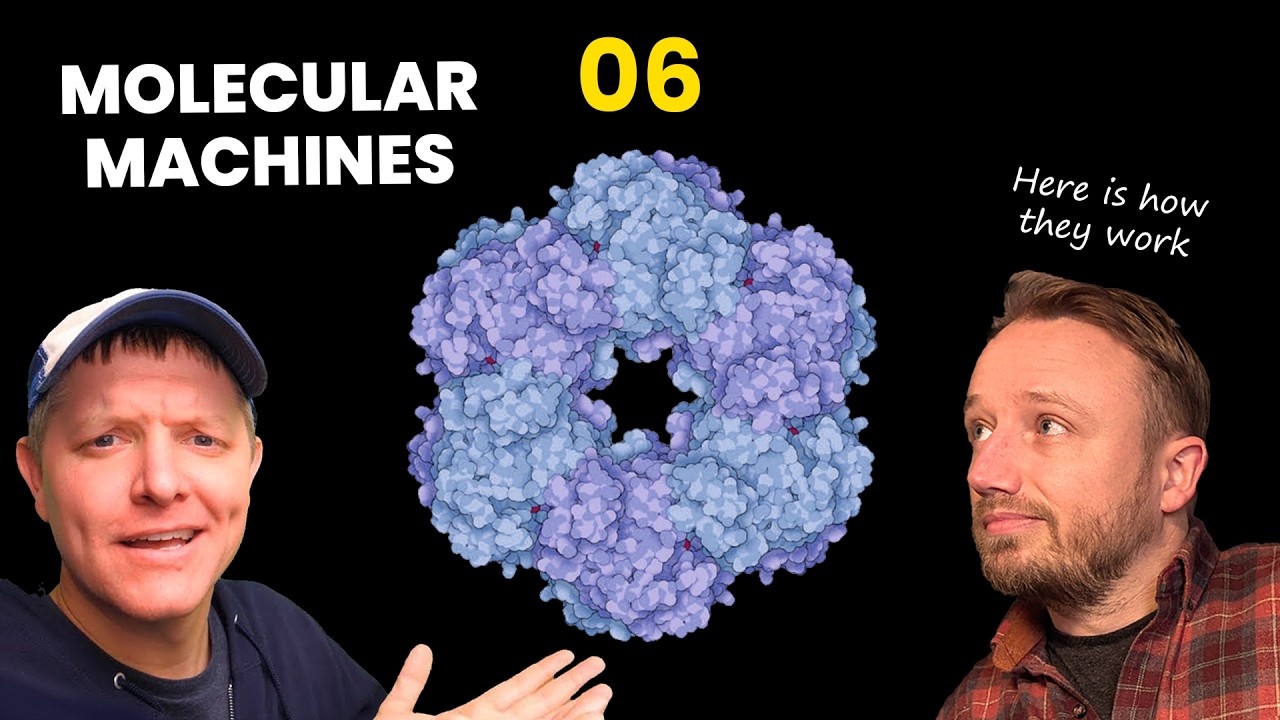
Ladies and gentlemen, John Perry here. Today is another Q& A. I'm going to answer some questions that you guys have been asking. Video six will be next Thursday hopefully. Video six is all about proteins. How proteins fold and how protein complexes form. So, a protein complex is a structure made of multiple proteins that stick to each other. The bacterial fugellum is a protein complex. This video has a lot of moving parts to it. I've been building things in my basement. I'm very excited about that video. But, as you might imagine, it's taking a little bit longer than I would hope. But that's okay because that gives us time today to answer more questions from the audience. And I have gotten a lot of questions from the audience. I've got a couple from Patreon that I'll be reading. But actually, a lot of these are just questions and comments on YouTube or questions that were sent to me via email. There's a lot of really good ones here. I'm saving the best for last. The best. Well, the best is it the best question? I found it the most interesting to think about. A friend of mine asked me about the falsification of evolution. Could evolution be falsified by the discovery of a structure that is too complex to have evolved? Darwin thought the answer was yes. He challenged people to find one. According to the US government, this question is worth $16. 5 million. That's how much money they spent on the Felix program, which is a US intelligence program aimed at trying to figure out if a virus is natural or engineered. That is a super important question to be able to answer now that genetic engineering is a thing. But starting off with question number one, this was a comment on my most recent video. I just thought of something. The term irreducibly complex doesn't necessarily mean irreversibly complex. Obviously, that's not a question, but I love that comment so much that I had to include it here. I like that so much that I I'll probably include that in my list of sayings, little catchphrases to remember from this video series. I have been told that the catchiest catchphrase so far from this series is there's more than one way to web a duck. But I do think I'm going to have to add this one to the list. By the way, if I'm not showing your name in this video and you wanted me to, I apologize. I'm referring to this as just a viewer comment instead of by the person's name because I didn't have time to contact them and get their actual name. If your comment is in this video and you want your name highlighted, let me know. I'll put it in the uh video description. The next comment was about the London's ability to fold its ear. Looks like this right here. This really cool ability that these Lhuns have. They can pinch their ear closed. There were a couple of people who were saying, "Hey, my dog can do that. that it can fold its ear back. Is that the same? That is not the same. All dogs can fold their ears back and that sort of closes their ear. This breed can really cinch it closed. It can pinch it closed. And it's this is such a unique trait that it's mentioned in all of the uh papers for dog breed standards. This is specified in there as a unique breed characteristic. It's not something that normal dogs can do. Some of the documentation on this breed claims that they have a new muscle. I don't that's not been confirmed. No one's ever like dissected it and confirmed that that's the case. Most likely what's happening here is that there's just been a slight rearrangement of the muscle and cartilage. But this was a really interesting comment. Think what it means for the dog breed Lund to evolve ear control. It means London that couldn't close their ears died off or the breeders selectively chose earclosing dogs to breed. Either way, fascinating. I like that comment. Those are two very interesting options. I can't tell from the comment if she is assuming that the breeders knew and intended to create a dog with a closable ear. But another option, possibly more likely, is that simply by selecting for dogs that were really good at hunting in these tiny little caves, they ended up unknowingly selecting for the ability to close its ears. There is a population of people in Norway that have been living off of puffin meat for like over a thousand years. They don't do it any longer. Puffins are now protected. But in the past, people were doing this. And if your society basically lives on puffin meat, you're going to be very picky about which dogs you let breed. You're only going to let your best dogs mate. And them mate with other people's best dogs. The idea here is that being able to pinch your ear closed helps you hunt better. You're not getting stuff in your ear. You're not getting distracted by getting stuff in your ear when you're inside of a cave. You're making more kills. There is also the possibility that there was a lot of dogs dying from ear infections. There is a fourth possibility, and that is that this trait that everyone thinks is an adaptation for hunting in caves, it might have actually just evolved through genetic drift. it might not
Segment 2 (05:00 - 10:00)
actually affect their hunting much at all. It is a unique ability in this breed, but no one's ever actually done uh careful scientific studies to see if being able to pinch your ear closed really does help you hunt puffins. Like I said, hunting puffins is now illegal in Norway. So, we wouldn't even be able to do that experiment if we wanted to. All four of those options are possible. Maybe dogs that couldn't do this were dying from ear infections or getting ear infections. Maybe dog readers understood that they wanted a dog that could close its ears and so they were trying to get that this ability bred into the dog. That's pretty unlikely. Third, they accidentally selected for this simply by selecting for the best hunters. Or fourth, this just evolved through genetic drift. Here's a viewer question that was really good. What is the difference between co-option and recruitment? Where is the line? And what is the purpose of having two specific categories for something that seems so similar? Excellent question. You've probably noticed that most category systems we have in biology are a little bit blurry on the edges. For every rule you find, you can always find some weird exception to that rule. One of the reasons for this is that evolution is a thing and evolution is a blurry process. Things evolve gradually and so there's a bunch of weird edge cases for any norm that you could come up with. any rule I drew a little graphic to help make this more clear. First of all, recruitment is a special type of co-option. So, it's a subcategory of co-option. It's also worth noting that co-option is often called exaptation in the scientific literature. I'll talk more about that later and why I use co-option instead of exception. But up top, we have just generic co-option. Here we have a trait. I'm representing that as a blue circle that evolves to perform a new function and I'm showing that here with a color change. Now it's kind of this pinkish color. You can also have just a regular co-op option where you go from a trait having one function to moonlighting and kind of performing two functions. A really good case of this is a bat's wing. A bat's arm evolved to be a wing, but it is still used as an arm. They have a really nice thumb with a really good claw on it, and they still use that to climb. So, a bat's wing moonlights still as an arm. It still kind of keeps its original function, but it's now doing something very unique, very new. It's now being used for flight. And the entire arm, the entire forlim was co-opted for flight. So, that's why we just consider that to be standard co-option. Recruitment is different. That's where you have two traits, two structures that fuse to form a new system. One of the cleanest examples of that at the animal level, at the like anatomical level, is the evolution of snake fangs. So you have the fusion, the joining together of the venom duct with the tooth. Those two things come together to form the fang. Another type of recruitment is where you have a system that already exists and an outside structure, an outside trait is recruited into that system or it's uh drafted into that system. And so that changes the system overall. One anatomical example that I gave of that in the video was the recruitment of a lip muscle into the nose of a moose. And then there's another form of recruitment, internal recruitment, where you start with a system and parts within that system rearrange how they interact with each other and it causes the system to change. And the anatomical example that I gave of that was the London, the Lunhound. The ear muscles already exist, the cartilage already exists. They're rearranging internally slightly and that causes the dog to be able to pinch its ear closed. Hopefully this clarifies the difference. And why is this difference important? This difference is important especially when we're talking about protein complexes because recruitment is a very common form of evolutionary change in a protein complex. I should note again talking about the fuzziness of categories in biology that you could think of a bat as a system, an entire bat as a system. And if that's the case, you could think of the co-option of the arm into a wing. You could phrase that in terms of recruitment. So there are ways, depending on how you zoom in and zoom out of a structure or a system that you're looking at, there are ways in which these two terms can be swapped out for each other. This is a really common jargon problem in biology. Think about it. you're we talk about the digestive system and circulatory respiratory system, right? When we're talking about the different systems that our bodies have. Well, actually all of those three things you could say are just one
Segment 3 (10:00 - 15:00)
system, right? Because what is blood circulating? It's circulating oxygen, uh CO2, and food. that it gets from the digestive system, oxygen from the lungs, and then it brings CO2 from the body to the lungs to be excreted. So, we have this problem everywhere in biology. Categories are useful inventions. Next question. Actually, this is a comment. Citing the Taylor study is a classic software versus hardware bait and switch. This person was upset with me. They took issue with several things in the video, which you can see here. In particular, they were upset with the last example that I gave in last week's video where I talk about Tiffany Taylor's research group. During a real-time evolutionary experiment, they witnessed the recruitment of a nitrogen regulatory protein into the fleella regulatory system. This viewer is upset with me for using that experiment. They don't think it counts. They say, "Cighting the Taylor study as a classic software versus hardware bait and switch. That experiment showed a regulatory rewire, a software tweak that turned on a pre-existing 40 protein factory already sitting in the DNA. It did absolutely nothing to explain the structural origination of the hardware itself. They want me to show the evolution of a structural protein in the bacterial fugellum, not a regulatory protein. In the mind of this viewer, there is a hard distinction between software and hardware. In biology, it's really common for us to talk about genotype versus phenotype. And that's kind of the software versus the hardware. You've got your genome and then you have the traits that your genome ends up producing. Right? This distinction is extremely useful. It helps us apply things like information theory and all sorts of different math and different concepts that we developed in computer science. We can now apply that directly to the cell. We can genome. the hardware software distinction. It's far more than just an analogy. It's actually useful to think of DNA as an information molecule. However, when it comes to the naked physics of things, DNA is just a physical molecule in the physical world. The ability of a protein to stick to a specific stretch of DNA, that's really no different than the ability of a protein to stick to a specific part of a different protein. Here we are looking at a simulation of the inside of a cell. This is a really cool paper. This is showing you the cytoplasm of a bacterial cell. So, remember we looked at David Goodell's painting of a cell and we saw how crowded the cell is. There's tons of different particles in there. Well, this is an actual simulation of how things move around inside of a cell. This is dramatically slowed down. If we were to watch this in real time, it'd be going so fast that we couldn't see it. Thermal vibrations when we get down this small are insane. Every 3 seconds of this simulation represents one 1 millionth of a second in real life. A microscond. So these vibrations that you're seeing here, they happen incredibly fast. These are just thermal vibrations. Molecules bounce off each other. This clip is 6 seconds long. I'm playing it on loop for you. So it represents the amount of movement that happens in two micros secondsonds. to 1 millionth of a second. What we can't see here are the water molecules. They are hidden. Same with any small molecule like sugars and so on. What we're seeing are proteins and we're seeing we're not seeing DNA in this simulation. This is a part of the cell that doesn't have DNA, but you are seeing RNA. You see the big glob that has kind of a green and yellow thing curled around it. The stuff curled around it, that is RNA. What you can see when you're looking at a cell this close up is that DNA is just another physical thing inside the cell. The hardware software distinction melts away. It disappears when you zoom in at this level. The genotype just is a phenotype. DNA is just another physical thing being physically interacted with inside of a physical cell. There's no magic here. And by the way, the same is actually true of computers. There's nothing magic happening inside of a computer. When you are editing software, you're actually causing hardware to be manipulated. You really are flipping transistors and so on inside of a actual machine. A computer is just a machine, right? There's no magic inside the cell. of a computer. It's physical. Information always has a physical substrate. So, if I were to turn this comment into a question, should we be concerned about a hardware versus software distinction when we're thinking about the evolution of proteins and protein DNA binding or protein binding? No. It's all the same. Changes in a protein structure will make it more or less attracted to
Segment 4 (15:00 - 20:00)
specific surfaces. That surface can be a surface on a DNA molecule. protein molecule. It works the same way. We're talking about three-dimensional shapes and we're talking about charges, positive, negative, and neutral. the strengths of those charges. I don't want to be too dismissive of the differences here, though, because one thing that is often different in a regulatory protein than in a structural protein is that regulatory proteins often have more than one state. They'll bind to some sort of a molecule. That binding will change their shape and open up a new binding site. That site will bind to something else. And that's one way that you get regulation to change over time. But it's very important to understand here. We're still just talking about the shape of a protein. Form determines function. A protein's form is determined by a protein's amino acid sequence. And amino acid sequence is determined by nucleotide sequence in the gene that codes for that protein. If you mutate the gene, you change the protein. The evolution of regulation works like the evolution of everything else. the normal process of mutation, duplication, all the things we've been talking about in this series so far. They can shape regulatory systems in exactly the same way as they shape protein complexes and so on. There is nothing magical happening here. Amazing. Yeah. Fascinating. Yes. Not magic. It is evolution by natural selection. And finally, this is a question that comes from Patreon. This question came after kind of a long conversation, so I should probably give you some backup, some background data on this. Peter was watching the video on duplication. And in that video, I talk about gene duplication and I talk about trait duplication. them together. Trait duplication in biology is called serial homology. That's the classic term for trait duplication. Gene duplication is a common term in genetics for when a gene is duplicated. It's fairly rare to read about those two concepts together like in one chapter of a textbook for example because physically the causes for them are very different and then also just historically we knew about trait duplications we knew about serial homology long before Darwin even people had been writing about this and studying this and then we learned about gene duplication I don't know it became something well written about probably in the 70s so for these reasons the two concepts are not often spoken about together the way that I've been talking about them together. The reason that I lump them together is because whether a trait is duplicated or a gene is duplicated, the end result is the same for evolution. Evolution can quote play with each duplicate and pull them down different trajectories as evolutionary history continues to unfold. When a gene is duplicated, you've got two copies of the same thing at the beginning, but mutations in one of them can cause it to change its function or change its specialty. And the same thing happens when a trait is duplicated. But anyway, Peter's concern had nothing to do with anything I just said. Peter's concern was that he said, "The way that I worded things in that video, a viewer could go away thinking that I'm saying that a gene duplication causes a trait duplication. " So Peter asks, "Are you saying that if you double the horn gene, you double the horns? " No, I'm not saying that. Trait duplications, serial homologies, evolve in lots of different ways. A gene duplication could cause a duplication in a trait, but any type of mutation can cause a duplication in a trait. It just depends on the organism's genome and how that specific organism develops and so on. And there's a bunch of research on this in the field called EVO Divo, evolutionary development. That's where you can learn physically what types of mutations cause horns to be duplicated or split. In most cases, it's not a gene duplication that causes this. It's other types of mutation. Filipe wrote in and said, "I'd like to ask whether the observed abilities of evolution categories, I have those on a slide that I keep showing over and over in this series. Those categories are optimization, co-option, duplication, and recruitment. I'd like to ask whether the observed abilities of evolution in your videos are something you developed for didactic purposes or if there is any literature you could recommend that explores this framework in a similar way. I'd love to read more about it. These concepts are not my original concepts. The category name observed abilities of evolution. I did come up with the name for that slide. If you look in the scientific literature, sometimes these different things are called mechanisms of evolution. The reason I didn't go with mechanisms of evolution for this slide is that term in most textbooks when we talk about the mechanisms of evolution, we've kind of settled on four, sometimes five that get name dropped in every textbook article on the mechanisms of evolution. mutation, natural selection, uh
Segment 5 (20:00 - 25:00)
genetic drift, gene flow, and then sometimes they'll talk about uh what is it? Non-random mating is a fifth that they'll sometimes add. It's very rare for a textbook to talk about uh like co-option and duplication and stuff. Or if they do talk about them, they'll just be a chapter about duplication or a chapter about co-option adaptation. That's why I felt like I should come up with some sort of a new category title for these things. And it's also worth pointing out if you're trying to look this stuff up in the literature, optimization, what I'm calling optimization here, is sometimes called an adaptive walk. And it's sometimes referred to as maximization in the scientific literature. Sometimes it's called optimization, but a lot of times it's called adaptive walk or it's called maximization. And then if you want to look up things on co-option, definitely also use the keyword adaptation in your search. Also look up moonlighting pre-addaptation. And if you want to look up what Darwin was saying about it, you got to use the keyword conversion. He called these things conversions, trait conversions. Co-option is just it's a thing that's just been named and renamed and discovered and rediscovered by different people. They thought they were discovering it for the first time, so they gave it a name. And then for duplication, if you want to look up trait duplications, you want to look up serial homology. That's the term that's most commonly used in the scientific literature for trait duplication. But in genetics, just look up gene duplication. That's the term that that's used in genetics. Let me also plug this paper. This is the main paper that I have based this series on. And it talks about co-option. It calls co-option adaptation. It talks about adaptive walks. what I'm calling optimization and it talks about duplication and it talks about recruitment. The next question comes from Alex. In the mega plate evolution experiment, did they run it multiple times? If so, in any instance of the experiment, in any version of the experiment, did bacteria fail to evolve full antibiotic resistance? The answer to the first question is yes, they did run it multiple times. And if you go and look at the original paper down in the supplementary data, the supplementary information, they've got links to a bunch of videos, time-lapse videos of a bunch of different experiments that they did, instances of this experiment being run. Then to your second question, did the bacteria ever fail to evolve resistance? Yes. Look at this. Here's a figure from their paper. And the panel on the left here, we're looking at a failure here. They went they jumped from 0 to 3,000. And I apologize. I don't remember what 3,000 means in this context, but basically it was a huge jump. They went from no antibiotics at all to a bunch of antibiotics in that uh section of the plate. And it was too big of a jump for the bacteria to do it. So what they said is that, you know, bacteria needs a gradient in order to evolve antibiotic resistance. You can see a little bit of bacteria getting in there to the high concentration area, but they said that that's because of just plain old diffusion. The final question is from Shai. Shai asks, "Here's a question related to the falsifiability of evolutionary theory. Is there any structure you could look at and say definitively that evolution could not make it? " Yes, but only if you also knew a little bit about that structure's history. So, let me give you an example. If someone were born tomorrow, if a baby were born tomorrow with perfectly formed arms, perfectly functional arms, functional legs, and a perfectly functional pair of bird wings, that I could tell you definitively that evolution did not build that. In contrast, if an alien came to Earth from outer space and I knew nothing about its history, the species history and it had arms and legs and functional wings, I would not be able to tell you that was impossible to evolve. The reason for this is that evolution is incredibly competent. The things that evolution has built, they're far more complex, far more sophisticated than anything a human has ever built. However, the process of evolution has some serious constraints. The reason I could say with confidence that a human baby born with bird wings did not get those bird wings through the process of evolution is because complex functional traits can only evolve gradually. They require many rounds of mutation and selection and mutation and selection. And I know that humans don't already have anything like bird wings. The alien, on the other hand, I don't know. It is obviously possible for wings to evolve. And so before I could tell you if that alien evolved those wings or if those wings were somehow engineered, I'd have to know more about the species in general and its close relatives. What this means is that in order to use the theory of evolution to detect engineering, you have to know something about the history of the species or the structure that you're looking at. And this is why we can't just use the naked theory of evolution to tell if a virus has been engineered
Segment 6 (25:00 - 30:00)
or tampered with versus whether or not it just evolved naturally. Most viruses and microbes have not been studied. They're not even documented. We know nothing about them. So, government programs like Felix, instead of just leaning on the theory of evolution, what they did is they built an AI that learned all the different genetic engineering techniques that humans have ever invented and published. And when there is a new outbreak with a new disease, they look at the genome of that pathogen. and they look for the hallmarks of known genetic engineering techniques, scars that we know are left behind when lab work is done. But you have kind of embedded in here a second question. How could evolution be falsified? If I saw a baby born with wings, that would falsify the idea that baby is just the normal product of evolution, but it actually wouldn't falsify the theory of evolution in general. It would still be true that a sea goblin's spiderlike legs are actually modified rays from its pectoral fins. It would still be true that a bee's stinger is clearly a modified ovapositor. It would still be true that a bat's wings are clearly modified mammal arms. It would still be true that bacteria have been directly observed developing increased immunity to antibiotics through the process of mutation and natural selection followed by further rounds of mutation and selection. It would still be true that marine gobies, they rest on the seafloor by standing on their pelvic fins. It would still be true that they fight vigorously over territory. It would still be true that as populations expand, unlucky individuals are pushed further and further into worse and worse territory. It would still be true that some populations have even been pushed near the land. It would still be true that mudskippers are obviously gobies. Gobies with mutations allowing them to survive long stretches of time out of the water. A single anomaly like a human baby born with bird wings would not erase all of these observations. It would just tell us that whatever happened to that baby was not normal evolution. If you read the philosophy of science, Carl Pauper was big on saying that a scientific theory must be falsifiable. It seems like he expects that you should be able to have one anomaly in discovering that one anomaly will topple an entire theory. His student loatos criticized that idea. He pointed out that if you look at things like germ theory, for example, Lockat used examples in physics, but I'm going to use germ theory here. Germ theory is the idea that diseases are caused by germs, microorganisms that reproduce inside your body. Well, we now know that there's lots of things that can cause diseases. You can have pron diseases which that's caused by a misfolded protein that has a cascade effect in human tissue. Pons are not germs. We also have things like cancer which is not I mean some cancers are triggered by germs but cancer itself is not germs. It's your own cells rebelling and growing out of control. What loatos points out is that when you have a theory as big as germ theory, these anomalies don't debunk the entire theory. All they do is say, "Oh, look, that's an example of not germ theory. Some diseases are caused by other things. " So, if that is the case with germ theory and with evolution, how is anyone ever supposed to falsify germ theory or falsify evolution? How do you falsify a theory that's been so successful and is so big and is being used to explain so many different things and has been so incredibly progressive, all the research programs built on it just they just keep working? How do you falsify a theory like that? Well, according to Loat, you come up with an even better theory and then you base research programs on that new theory. And if those new research programs are more progressive, they are leading to more discoveries, more advances than the old theory, eventually everyone will abandon the old theory and go to the new theory. Evolution is falsifiable for individual cases. If we have enough historical information about a trait, we can say whether or not normal evolution could have produced it. This is because the abilities and the limitations of evolution are very clear. Biologist Lin Margus actually did this. She was looking at mitochondria, piecing together their evolutionary history. She realized that normal gradualism could not explain the presence of mitochondria in ukareotic cells and she produced a new theory evolution not by gradualism but evolution through endo symbiosis. It's now well accepted that endo symbiosis and not gradualism is how mitochondria ended up in ukarotic cells. But again, she didn't replace the theory of evolution by gradualism everywhere. She just pointed out that at the origin of ukarotes there is a weird exception. But how could you go about falsifying the entire theory of evolution? How do you make it so the entire scientific community throws the thing out? Well, all you have to do is come up with a better theory. That theory needs to explain most or preferably all of the
Segment 7 (30:00 - 30:00)
facts that evolution currently explains. And then you need to demonstrate that this alternative theory leads to more new discoveries than evolution does. Research programs based on your new theory should be more progressive than research programs based on evolution. That's it.