Lie theory, part 11 | Daniel Tubbenhauer
Machine-readable: Markdown · JSON API · Site index
Описание видео
🎓 Lie Theory | Daniel Tubbenhauer
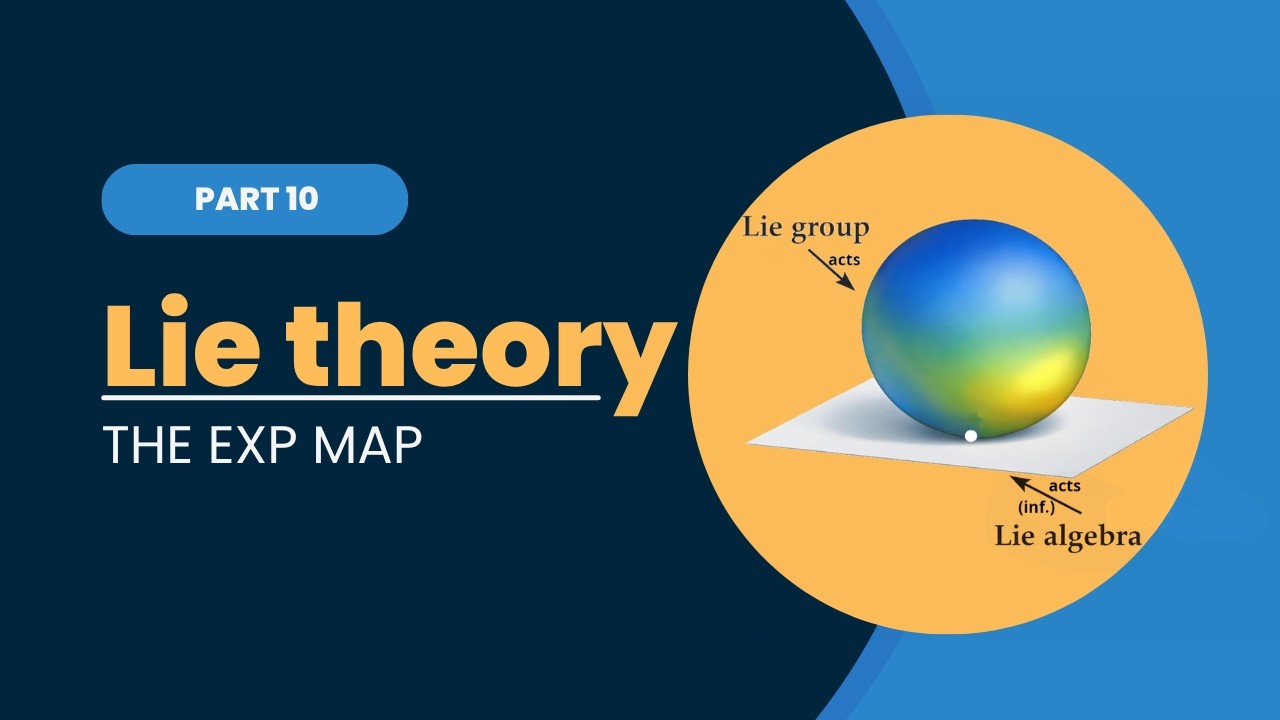
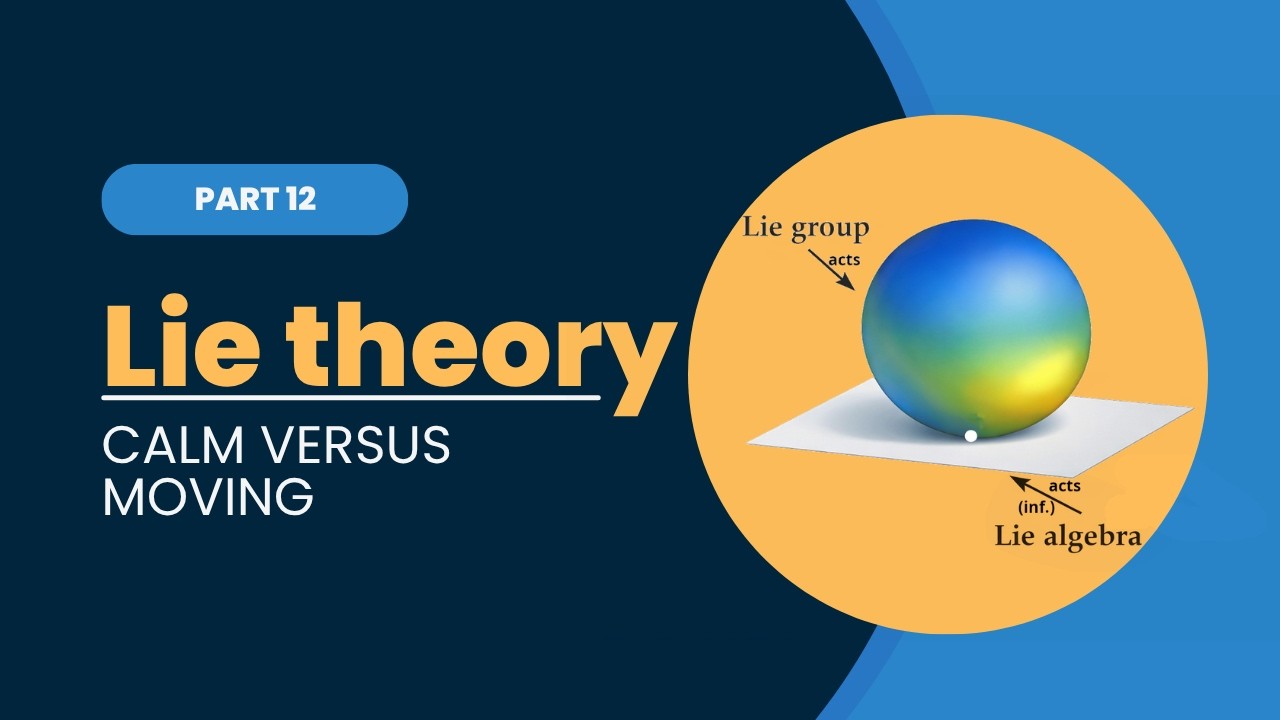
What is a Lie group? What is a Lie algebra? And why does “continuous symmetry” come with such a precise algebraic shadow? In this series, we build Lie theory from the ground up: starting with concrete matrix groups and gradually developing the core dictionary between geometry (groups, manifolds, flows) and algebra (brackets, exponentials, and representations).
The goal is conceptual clarity with hands-on examples. We’ll compute with classical matrix groups like SO(n), SU(n), and SL(n), learn how Lie algebras capture local structure, and then lean hard into representation theory: because once symmetry acts on vector spaces, it becomes something you can actually organize, compare, and (sometimes) classify.
💡 Keywords: Lie groups, Lie algebras, exponential map, adjoint action, commutators, representation theory, characters, highest weights, applications
💬 Comments welcome! Corrections and suggestions are very welcome (email is best).
Contents will roughly orbit around:
1. Matrix Lie groups: examples, first properties, and why they matter
2. Lie algebras: tangent spaces, brackets, and “infinitesimal symmetry”
3. The exponential map and one-parameter subgroups
4. Structure via the adjoint action (and what it reveals)
5. Representations: basic language, examples, decompositions
6. Characters / weights / highest-weight ideas (as far as we want to go)
7. Applications and “why care?”: symmetry in geometry, physics-flavored examples, and other places Lie theory shows up
About me.
Hi, I’m Daniel Tubbenhauer (but feel free to call me Dani, they/them). I’m a mathematician working around algebra, topology, and representation theory, with a soft spot for conceptual explanations and concrete computations.
🌐 Website: http://www.dtubbenhauer.com
📁 TeX and slides: https://github.com/dtubbenhauer/My-TeX-files
🧵 #lietheory #liegroups #liealgebras #representationtheory #mathematics