Abstract.
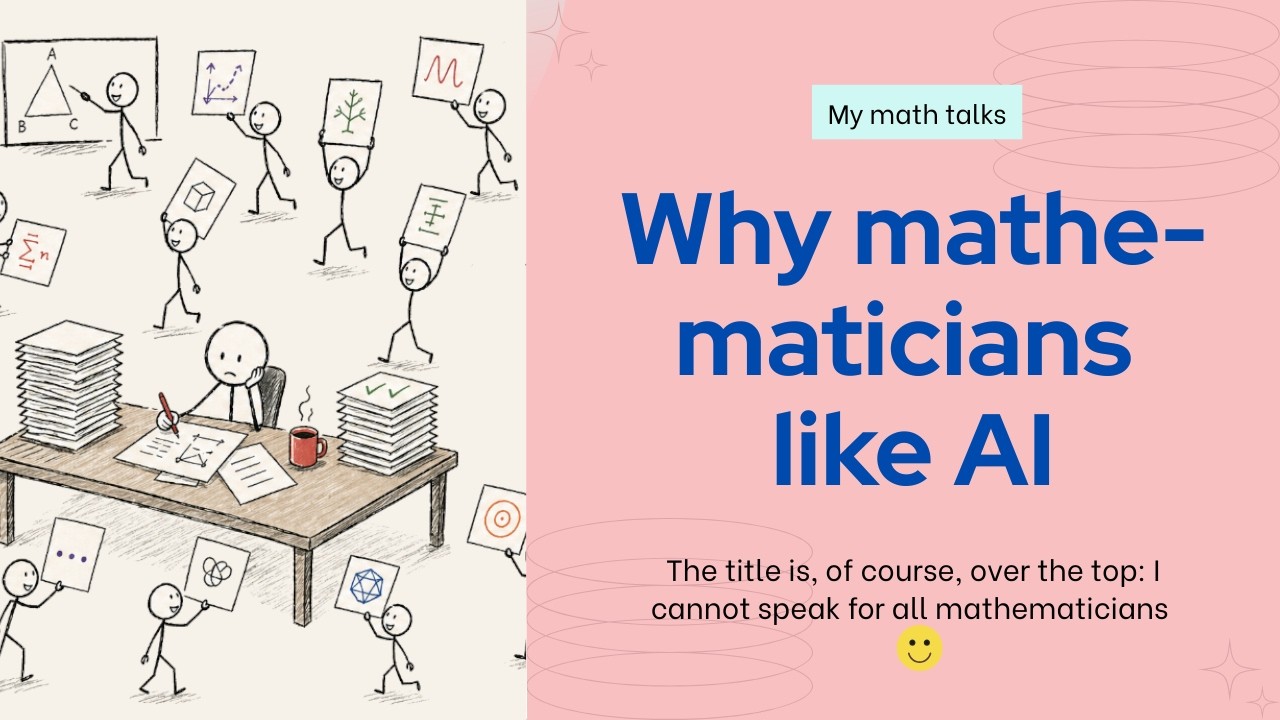
The title is, of course, over the top: I cannot speak for all mathematicians. This talk will be a friendly yet biased tour through recent uses of AI in pure mathematics. The guiding idea is simple: many mathematical worlds have exact rules, enormous search spaces, and checkable outputs. In that setting, unreliable guesses can still be extremely useful.
TeX files for the presentation.
https://github.com/dtubbenhauer/My-TeX-files
Slides.
http://www.dtubbenhauer.com/talks.html
#knottheory
#machinelearning
#ai
Оглавление (14 сегментов)
Segment 1 (00:00 - 05:00)
Okay, welcome everyone to this, um, recording of a talk that I'm going to give, uh, hopefully around August 2026. Right now, when I'm recording this, it's April 2026. April and August, not a big difference, of course. Uh, but the field is moving very fast. I'm very confident that what I'm going to say is still accurate in August, but it's clearly not accurate at one point, in my life or in life in general, and eventually, of course, everything ages very badly. Okay, um, so let's jump right into it. So, my title is, uh, very much over the top. Um, I know quite a few mathematicians by nature, right? Um, and most people, or almost everyone I know, agrees that AI will play a huge role in mathematics in the future, but of course, I can't speak for all mathematicians. It's more my biased perspective on things, and we will see this picture here, uh, in a second again, because this is literally how I think about AI in mathematics in 2026. And if I'm really honest, it's a constant trend, which started about 5 [snorts] years ago, roughly. It was around before, so AI in mathematics is nothing really new, but it really started off, uh, like roughly 5 years ago, so in 2021, if you want. And the slogan I really subscribe to, um, is like this, a thousand things to check beats nothing to try, yeah? Um, of course, so, uh, if you're hiring, for example, you will complain that you get, whatever, a thousand applications, and ah, it's so much work to sort through them, but it's of course better than, uh, to get zero applications, yeah? And that's essentially why AI is so fantastic for mathematics, because essentially, it gives you a thousand options, and 99% are [ __ ] but 1% is good, which is still better than, um, having no options at all, right? Okay, so this is really more like an overview talk. So, it's based on work of too many people, way too many, way too many people. So, not really my work, right? Just general. And since this is an overview talk, I somehow decided not to cite anyone, which is I don't know, I don't know. We'll see, we'll see. So, it's really huge community. Everyone stands on the shoulders of giants. And there's a big trend in mathematics that we have fewer and fewer single author hero type stories and more big collaboration type stories, which is probably just kind of the natural development of any type of field essentially. Cool. A long disclaimer, let me repeat. My title is a lie. I'm really just going to tell you about why I like AI in mathematics. And it's like very different from how you usually see the discussions about AI general public type, if you want. Because in mathematics we have a specific goal and it actually works really well. There's almost no downside in using it. There's always some downside using everything, but we'll see, we'll see, we'll see. So, why the excitement is part one. So, essentially I'm going to do the following. Why the excitement and then I give you a case study. And I'm very biased. The case study would be about knots because knots. Essentially, that's what it is. And yeah, so here's another picture, which is actually also a really good picture. Essentially the same flavor, right? You just get a lot of options. Most of the options are just absolute [ __ ] But some of them are good and you are able to check which ones are good. And it's just a cool tool. I will zoom in into that into that. I already zoomed in into the I will zoom into the story a little bit further down the line. Um essentially on the surface it looks like mathematics and AI should be like enemies of one another, yeah? Because mathematics like mathematicians like exact statements, right? That's that's I think essentially the definition of mathematics. And AI is really a tool to get you give you like plausible attempts, yeah? So, um in particular the large language models, they are really good in piecing things together and give you things that sound plausible. It doesn't need to be right, right? It's like a probabilistic machine. But it sounds plausible. And this kind of looks like a tension between the two, right? Mathematics wants kind of the opposite. But actually and this is essentially I think you could turn off the video at this point if you want. This is essentially the message. Possible attempts are actually really useful if you have an a cheap way to just check which ones are [ __ ] and which ones are good, yeah? Then you just create like in my picture up here
Segment 2 (05:00 - 10:00)
a million plausible attempts and you just sort out the good ones and you are very happy, yeah? And that's just so successful uh in mathematics that's essentially why AI uh is to be loved by mathematicians, by more and more mathematicians. It's It's still an upcoming trend, yeah? So. That's what it is. The key effect which goes back to my little picture here is the following. Essentially and I've heard this many people saying in many different forms, so it's not just me, yeah? AI is like a hundred unreliable but productive cores. Some people say oh I actually wrote a thousand. Anyway. But many unreliable but productive cores, right? They they're like this, yeah? They generate a lot of funny ideas. Some of them have absolutely nothing to do with your problem. Some of them are pretty good and it's it's you just need to sort them some sense, yeah. Some people say they're like a bunch of and to the Aztec students or whatever. Essentially it's this idea that if you want to build the pyramids and you are an Egyptian god king then you just throw 100,000 people at the problem and eventually you have pyramids. It's kind of the same idea. Nowadays I'm very sad life is very sad. I'm not an Egyptian god king. It's too bad. So I can't just throw 100,000 people at my problem. And somehow I is playing that job pretty well. So the analogy is a bit shaky obviously but kind of that's what I would you like to have you in mind. And what makes this so good in mathematics it's kind of roughly how we use AI in everyday life as well, right? But what makes this so good in mathematics is most of the time you can just see what comes out look through the results and you can kind of check which ones are good and which ones are bad. So kind of it doesn't matter so much if it is often wrong, right? One of the big problems is still of AI is that it hallucinates a lot. So you get a lot of kind of very questionable results but it doesn't matter if you can just cheaply check whether they're correct or wrong, right? So that's kind of the effect the key effect at least in my very biased opinion. Why this works so well. Yeah, so here my little picture with the little AI very friendly AI very into elastic running around and creating ideas. I will give you so this the beginning of this talk is a lot of blah blah. Give you some more explicit examples as we go along. But essentially that's what it is, yeah. So historically speaking I think there is this myth that mathematics people think of well most people think of mathematicians as just calculating with large numbers. Some people have a bit more of an idea and the next step on this ladder is that mathematics is about theorem proof next theorem. In particular, if you look at math education, that's how it sometimes looks like, right? Theorem proof next theorem. That's not true. The reality is there is what a surprise there's life beyond theorems. Yeah, there's life beyond theorems and there's life beyond proofs. And life is interesting. That our life is interesting in its own right, right? So, um it's really more like examples, pictures, computations, simplifications and a lot of false ideas. Oh my goodness. And sometimes you're just completely unproductive. You're just sitting around and staring at your screen and doing some brain rot instead of mathematics. — [snorts] — That's how reality is. It's not theorem proof next theorem. That's very sad or whatever. It is just what it is. And I think this comes from historically at one point roughly around Gauss's time. So, Gauss is one of the big names who's really good at that. Mathematics went from a more explanatory style to a more polished style. So, essentially you don't publish your failed attempts anymore or your how you get there or even examples. You just publish the polished statement and it became kind of a big trend. It's going a little bit backwards nowadays. Nowadays, if you open a book nowadays and you compare it to a book 100 years ago and they're still both about algebra. So, they essentially no change in the topic. You would see way more examples, illustrations or whatever nowadays. But traditionally, at least going back to Gauss roughly, mathematics was really good at being very dry. Yeah, so that's I think why a lot of people have this impression that mathematicians is are very dry. In reality, we really like examples and computations and conjectures, pictures, computation simplifications and a lot of [ __ ] that one produces some from time to time. I produce a lot of [ __ ] Uh, so here's a famous example of that.
Segment 3 (10:00 - 15:00)
One of the first computer generated conjectures, the Birch and Swinnerton-Dyer conjecture. If you don't know what it is, it won't appear anymore in this talk. Very famous mass conjecture. Essentially, uh, the blue points were guessed with a machine not guessed, computed with a machine and the guess is essentially, um, that it should be the growth rate should be this line here. Essentially, right? So, computer generated examples and then there's a conjecture and eventually the statement itself of this Birch and Swinnerton-Dyer conjecture looks very abstract. Uh, that's usually what mathematics does, but in reality it's really just, uh, they are a bunch of points and they fit into a line. That's essentially what it is and it's a really good example that's how mathematics works. Behind behind the scenes. Yeah. And yeah, as I said, it's kind of changing. You see more and more people actually revealing their cards. But of course there's still, um, a huge bias and if you want in the system and yeah, [snorts] mathematicians don't really tell you in their papers how they came to the result which is very sad. But anyway, there is life beyond. This was me rambling by the way. Um, there's life beyond theorems. And this is essentially where AI comes into. So, most mathematicians at this point don't think of AI like, oh, please ChatGPT prove my theorem, but really more like, ah, can you generate examples, counter examples, maybe give me an idea, something like that, right? So, the behind the scenes type of excitement which, uh, mathematicians are very excited about. Uh yeah, I already said that this but I I thought this picture was fun. This bridge will be closed for 1 day uh between October the 17th and 28th. So, this sentence is not wrong but it is a bit uh questionable uh because it kind of could be independent in two ways. So, uh clearly between October 17 and 28 is not 1 day, but anyway. Um just as just to distract you from the actual topic. So, before anything becomes a theorem right there examples, we already had that. And there a lot of dead ends. And kind of AI will help you with a process of getting there. Which most people are very excited about. We'll see. I mean, uh I give you very explicit examples in a second. And essentially what happens is the following. A lot of problems Oh, this is fun. Oh, this is such a fun picture. Apparently, this bacteria I will not try to pronounce the name, but the blue one. Um doubles itself every 20 minutes. And you're just like, what the hell? So, you start with one, then you have two, then you have four, then you have eight. And in very few minutes, you have a lot of them. Oh, bacteria are fun. Um so, in nature itself and in mathematics in general, you very often have way too many. I mean, it's grows way too fast. And you get way too many options. The number of choices just explodes. There's a name for it. It's called combinatorial explosion. So, very often you get um whatever. You you check it by hand for three steps. Then for four steps, there's already so many options and you probably don't do it by hand anymore, so you find a student to do it. For five steps, uh you can't even find students anymore, so you need a computer. And for six steps, the computer can't even do it anymore because there are way too many things. And standard examples are be easy to understand like knots, graphs, groups, all of these grow like oh god they grow so fast. Right? So the rules are exact. Of course, you could in principle write down n equals 6 or n equals 7, but the number of choices is just too big, yeah? And essentially this is where the opening comes in where AI is so helpful. Um it kind of is very patient with large-scale things. Um and this is kind of a really important point that I want to drive home, so I'll take some time to explain it. If the most problems I have there there's of course a finite number not of course, but there is a finite number of options, but the number is so large that I just can't list all of them and run through all of them. And also the things I'm looking for are so rare that I can't just grab a random thing and just study the random thing. It's just not going to happen. This is where AI comes into the game. It makes kind of smart guesses if you want. So it avoids the problem of this ocean of options. Yeah? And in some sense this is how it's supposed to be because if you could solve the problems that AI is solving nowadays using just a brute force I list everything or I do it randomly approach, someone would have done it already, right? So these type of questions are already kind of solved. The whole point of AI is more like there is this ocean of options
Segment 4 (15:00 - 20:00)
uh but there are still some really tiny patterns which you can detect and AI will kind of pick out these patterns. It still does a million of mistakes, but it that's fine for because it can just do a million operations per second or something. It doesn't matter if it does a million of its mistakes, but it still finds the correct thing. And this is what makes it so valuable. And this is kind of a standard thing and that's why I have these pictures. The explosion of choices is kind of a standard thing uh in mathematics and the world itself. So, I'm still surprised that this bacteria actually doubles itself every 20 minutes. Uh very, very efficient. Uh asexual reproduction, very efficient thing. Uh we should all do that, actually. Um but, that's just me. Right? So, that's what I'm trying to say. There's structured chaos as in this picture. So, I struggled a long time to find a good picture of structured chaos. Um I thought this was It's kind of a bit chaotic here, this uh little settlement from upstairs, but there's also some pattern. Right? So, this is kind of where AI is really good. If there is plenty of choices, or way too much to list them, to do it by hand, or do it randomly, or anything like that, but there's still a little bit of a pattern. Right? If it's just white noise, there's nothing you can do. But, if there's a little bit of a pattern, kind of AI might pick it up and actually give you some reasonable, right? Example. That's the whole point, right? And then, it does a thousand attempts, and that's why I have my subtitle. Yeah, I actually don't need to scroll all the way up. Um oh, no. Now it broke. Uh so, the file, by the way, is very large. So, if it breaks from time to time, that's just what it is. I have it down here as well. Look at that. Oh, it even goes back to the Oh, I didn't knew that. Excellent. So, um the subtitle is a thousand things to check. So, it generates a thousand things. Most of them are a little bit weird, but some of them are good because it picked out some very tiny patterns. Yeah? And then, you can just check those. And if you would just I said it again, if you just would generate a thousand random examples, you wouldn't find anything because what you're looking for is still too rare. And this is exactly where AI is so good. Yeah? And again, we can easily then usually check afterwards um why this works so well. So, this is literally what it is. One more reason and then why I so beloved in mathematics, and then I give you some examples, and then we go into some real examples, and my blah blah is over. So, here's my some really good illustration from Quanta Magazine of the Fourier transform. Essentially, you have this function up here. And you decompose it into its elementary frequencies, and then the sum of all of these is that thing up there. The Fourier transform gives you a way to go from here to here and back, essentially. And the Fourier transform is one of the most important tools in mathematics ever discovered, and it's like used everywhere. Like, Fourier transform everywhere. Of course, I could have just made a much easier example, like the derivative, but I wanted to tell you a bit more of a fancy example, Fourier transform. What I'm going to tell you now is that another reason why I so beloved, because good tools are actually really hard to find, and this is kind of again a general pattern of life, if you want. Essentially, we are still driving the same cars as 100 years ago, they were just refined. So, we are still kind of using the same tools. Good tools are hard to find, and they are just reused mercilessly, yeah? And good tools, there are not many good tools in mathematics, yeah? If you It takes a while to understand, and when you first grow up as a student, all the fields look so different from one another, but they're all doing the same in some sense. That's the whole point, yeah? I It's a new tool. We hadn't had anything like that before, or not in the form we have it. It changes the search, and a new tool, people will use it mercilessly, right? Imagine you have 1,000 people to throw at a problem, yeah? Something new. Um in as I said, in uh principle, I could also just be an Egyptian god king and throw a 100,000 people at my problem. Turns out that it's not happening, so I rather stay with AI. I tell you about the Egyptian god king and the ideas people have how to actually do that in a moment, but for now AI is just cheaper to perform than throwing 100,000 people at a problem. All right, new tool. New tools are very rare. Please remember new tools. All right, new tools. Um Ooh, I wanted to tell you about the tools on this screenshot uh but I actually have no idea. I've no idea. I don't know a single Maybe I know some of them. More of them looks like a drill or something. Uh anyway, so new tools very hard to find, right? And AI is a new tool. So at least in my circle it's a new tool.
Segment 5 (20:00 - 25:00)
So the excitement comes from new nails. You can now Sorry, you have a nail and now you have a hammer. So that's where the excitement comes from essentially, yeah. Is there a hammer on this picture? I can't see a hammer. It's very sad. It's very sad. I haven't picked a good example. Let me give you an example. I haven't picked a good tool example. Let me give you an example of how that works. So very famous Um why does it work? Same thing again. Very famous is Alpha Evolve. It's pretty cool idea. Essentially it's an LMM that plays evolution on Python code. Uh pretty good. So it plays evolution not in the biological sense, but now you can mate a program with itself a thousand times, yeah. Uh asexual reproduction. We all would like to do that. So you mate a program with itself a thousand times or you can mate a thousand programs together or whatever. Anything is possible, but you play the evolution game on Python code and evolution is very strong. So you kind of get very polished Python code in the end whatever your problem is. And they use that to solve um these type of problems that you can't solve by throwing a thousand people at it. So, here for example, essentially this is from Oh, no, file is too big. This is from the Alpha Evolve paper. Uh the hexagon problem. How many hexagons essentially can you fit into a bigger hexagon? And you want to minimize something, and they were able to go down from 4 to 3. 942, something like that, right? So, using some slightly strange configurations. So, that's kind of a It's kind of a standard configuration human found and a slightly strange configuration that AI found. Similar problems. You can solve similar problems with uh AI essentially. Show you some more examples in a second, but this is roughly the state. So, almost everything you see in AI mathematics is some variation of this idea to throw a thousand people at the problem and find something someone just randomly found essentially. That's just what sort of randomly, right? There's a bit of human intuition involved if you want, and that's exactly what AI does. So, because I just contradicted myself if I would have said randomly because before I wanted to make the point that it's not quite random because random wouldn't give you enough give you the correct results. And that's exactly true, right? So, this is pretty good example. Before we go into more details, let me just wrap up with a few more examples. I just put them on screen, and they all are on the same flavor. I call them on the rural mansions. We do the one in the screenshot in a second. So, you can read it here, but let me just show you the one that got me into AI. This is this fabulous paper by now like five years old from Adam, Construction Combinatorics via Neural Networks. Pretty simplistic neural networks, but it's pretty cool idea. So, several constructions, and it's kind of the same strategy and you get real ex- So, in this case, you get real statements out of it and I show you one example. So, Adam explains a little bit — [snorts] — what's going on. I'm looking for a specific type of picture. This is very nice. So, there's a certain type of problem, a conjecture, whatever, Adam wants to disprove. Um Where's conjecture? It's probably that conjecture. That conjecture. Blah blah blah, whatever, some number blah. Um And you can disprove it by training a neural network. I hope I clicked on the right conjecture for that one. But anyway, [clears throat] you train a neural network, you give it a reward. Um let's say if whatever kind of number gets close to Right, you want the conjecture to be false. So, you want this to be smaller. So, you give a reward the closer to you get to a smaller. And what Adam then did is, well, train a neural network, it guesses some graphs, it's really bad in the beginning, and it'll It kind of learns and learns to get better and better. And eventually, as you can see here, so this is like the evolution, it kind of converges to something that I can understand, and then I could just go, all right, it will output these guys, and then I will just go and prove or generalize it, add more leaves here, and disprove the conjecture, which is kind of a nice idea, right? So, it's kind of converging to something. And then you can just take it and uh disprove the conjecture. Yeah, did that thing. Um similarly here, there's an evolution on these things for another conjecture. And eventually, I thought you had a Eventually, you can just guess the example. So, this one gets close, and maybe I give it an evolution again, and you will see, ah, maybe the counterexample should have a long string here and a little bouquet here, and you can then guess it, and you can you construct the counterexample. Yeah. This was the starting point for me. Mhm, again, this could have been
Segment 6 (25:00 - 30:00)
something that you could have solved by just throwing a thousand people on it. But, in this case, you can actually solve it. Um let's go back to Adam's paper by uh by a machine. In this case, a reinforcement learning machine. And it's kind of a nice thing, yes, again, you it each stage, you can easily reject the wrong things, right? You have that graph, you just compute the corresponding numbers. Where's my conjecture again? I hope it's the right conjecture I'm pointing at. Um you just check the conjecture again. There's some numbers involved. You check whether this graph satisfies the conjecture or not, and you can reject it and just keep on going. And it will generate a thousand things, and eventually something interesting pops up, and then you are very happy. Yeah, nobody was able to do it before. So, it's kind of a new tool um coming up here in mathematics. There are many other things. I'll list some of them. Some of them One of them that I get very excited about nowadays is the gamification idea, right? To which is a modern version of I'm an Egyptian god king, and I throw a hundred thousand people at my problem. Um because uh you just have Essentially, the idea is the following. You have a question, you formulate it as a game, and hope you hope that you can somehow let a lot of people play it, right? Gamers are very persistent. kind of collect the data, the high scores, or whatever you want. They create, and hopefully that they solve your problem. Which is um pretty cool idea. So, let me show you this thing, which I think is pretty cool. Um so, it's here. It's called unknot. So, if you are the creator, very unlikely that you watch this video, but please contact me. I'm very interested in gamification of math problems. And essentially, what I have in mind is the following. So, here's this unknot game, which is a fun game, so you could pull your knot here. Um and you could flop crossings. You'll see a flop crossing flop in a second. You can flop crossings over. Plop. And then you can unknot it and happy. You're very happy. You just found the unknot. Yeah, there you go. You found the unknot, so you kind of cleared the stage. Right? So, then you can just Okay, fine, fine. And you needed one swap. Cool. And why is this so cool? And you can do other things. Why is this so cool? Well, let's say you were interested in this unknotting process. Yeah, you get 100,000 people to play this game. They kind of swap crossings on complicated knots. And you immediately have a way to just verify whether Well, it's immediate, right? You can just verify what they whether what they did was actually correct or wrong. Uh it's very easy. And you then have 100,000 examples. And maybe among those 100,000 examples, you find something that you were looking for because actually you would just phrase your problem as a game. Yeah? It's very, very interesting idea. Um which I hope will get more and more popular as we go along. Right now, I don't know anyone who's really doing it. A lot of people talk about it. But I don't know anyone who's really doing it because obviously in practice this is more difficult than just uh using some easy Python code to uh use a neural network to do something. But it's kind of this idea that human intuition in 2026 is still better than neural networks. So, if the advantage of a neural network is that it can do a million things per second, uh maybe you just need a million players and they actually get you better results. So, I would be really interested in doing that. If you have uh some computer programming skills, uh so game programming skills, let me know. It would be fun to do. But this is my modern version of the Egyptian god king who throws 100,000 people at the pyramid problem. And yeah, so that was a lot of waffle. Hope it was reasonable. Let me summarize. Uh AI is so important in mathematics because it generates a lot of examples that you can easily verify, so you don't even run into the problem of hallucination or something. And it's a new tool that you can use, and people get very excited about new tools. And yeah, it's like having a thousand people thrown at your problem, which is always very useful. Okay, let's continue. And I just realized um I should make this clear — [snorts] — that of course the strategy of throwing people at a problem or maybe more general 2026, [snorts] uh throwing AI at a problem is not gendered, but I don't know any gender-neutral name for god king. Is it a language gap or is it a problem on my end? Let me know if you have any ideas in that direction. Cool. Let's go to knots. So I'm going to explain AI problems how AI can solve knot problems. So I just need to tell you a little bit about
Segment 7 (30:00 - 35:00)
what knots are, and it's fabulous. So the the end result is so fabulous. It's absolutely bizarre what's going on. But let's do knots first. So knot, excellent. So a knot is that thing here, right? So it's essentially a rope. I have my little figure-eight knot here. Can you see the figure-eight knot? Maybe, maybe not. Uh I build it out of I have no idea what that is. It's kind of a little ribbon type thing. It's a [snorts] very nice knot. Uh so what you usually do is you take like a ribbon or a string uh or a rope like in the left-hand picture, and you glue the ends together like here. Uh and you get a knot. Here's my little knot. Ah, to be a figure-eight knot. Ah, beautiful. This little knot thing has two sides. Very nice. So, a knot is well, literally that's it. So, that's literally a knot. So, it's an everyday knot, but you glue ends together because otherwise you would be able to um undo it. At least mathematically, not necessarily in practice. So, a lot of real world knots, applications of real world knot theory, are actually not these type of knots. They're just knots where such that the string is so thin that you can't easily undo it. So, here of course, if this would not be glued together or here in my little thing here, if this wouldn't be glued together, I could easily undo that. Um but if you imagine the string is like really really thin, uh then getting rid of a little knot is actually pretty difficult. So, that's how it usually works in practice, but for mathematical reasons, we like to think about knot length to be just a closed string. Yeah, you just glue the ends together. Yeah, I want to make this very clear. Just glue the ends together here. Um I'm just really stupid. I just have a little bit of tape to glue it together. And literally the knot is just I have a little video which is a bit better than playing around with uh the thing here. You can just move it as much as you want and you can already see uh the thing that will happen is kind of the shadow that you see from here is like the projection, if you want, and you can change that. Uh and it will look very different. Oh my goodness, now I have ruined my figure eight knot. Ah, what's going on here? I have no idea what's going on. Oh my goodness, it's so difficult. Oh, here you go. Um anyway, and the subtle question that mathematicians like to do is they want to identify the knot essentially, yeah. So, you look at one of these pictures and you say, "Oh, this is a trefoil. " Something like this, yeah? That's what mathematicians usually like to do, okay? And there are plenty of interesting questions in knot theory. And the reason why people like knot theory so much is because you can build it. So, it's a very nice knot it's not super difficult abstract, but there is still a lot of interesting mathematics, which is kind of a nice sweet spot. And knot theory is what people like a lot. Yeah, and I like it a lot. I mean, uh come on. I I I I I spent so something like 20 minutes. I'm very inefficient. It was probably 20 minutes really to build this thing. You could probably build this in 1 minute, but I'm just super inefficient here. Uh anyway, this is kind of a knot. Um I'll have a nicer video in a second, but roughly that's a knot. Here's another knot I built. Um this is a trefoil. And the basic game is well, uh the string may kind of wiggle wildly, and uh what you see actually might change a lot. So, here the slides are very big, right? So, here uh this is also a trefoil, just a really shitty kind of I just took this thing and then just shittily wiggled it around, and you get some pictures that look like that, yeah? So, while wiggling actually gives you very very bad pictures sometimes. And kind of the whole point of the game is to identify the knot from a bad picture, yeah? And this is just very difficult in general, and it's still very a lot of fun, very playful. So, as I said, people like that a lot. Yeah, so I'll give you a few more details as we go along, but right now uh we are in uh waffle mode, which is fine. Everyone likes waffle mode. And the way this works is maybe now is a good time for the video that um instead of thinking about the three-dimensional object here, you think about a two-dimensional thing you can draw and a shadow. Do I have a nice shadow picture? I do picture or something like this, yeah? So, instead of thinking about the three-dimensional object, you just think about the two-dimensional shadow of it, which people usually call a diagram of the knot. Um and as you can see, a certain knot can have many, many shadows, depending essentially where your light source is, how the string looks like
Segment 8 (35:00 - 40:00)
and so on, and so on. And turns out that on shadows, you have three moves, and knots represent the same shadow if and only if they're sorry, a shadow represents the same knot, exactly the other way around, if and only if uh there's three of these easy moves. They're usually called Reidemeister one, two, and three, and you'll see in a second why they're called Reidemeister when I'm going to play the movie, right? So, in the shadow, the only additional information you remember is over and under, so get these um over and under type pictures of knots. Um so, essentially, what I want is a knot diagram, and you'll see something like this. Let's see. Uh do we have some nice image for knot theory? A knot diagram, something like that, right? So, ooh, a little bit of a shadow of a three-dimensional object. Do we have some other nice knot diagrams? These are nice knot diagrams, right? So, you remember the over and under type crossing. Let's have a look at the knot theory here. Do they have nice pictures? Yeah, that one is a bit easier to see, right? So, this is a shadow of a trefoil, and literally only remember the over and under crossing type information. Okay? And then there are only three moves, these moves, and we'll see them nicely in action in this video. Uh not my video, I stole it somewhere, but I forgot where I stole it from. Anyway, so here I noticed this type of string, you know, whatever. Does something. Blah blah blop. And yeah, you can deform things. As you can see, you can do these. And uh the nice thing about the video in a second that it will tell you uh each and every single move step-by-step, right? This was just a still the same knot. It was just a topological operation on the knot. And now we can have a look at um the moves themselves in each step. So here I write a move step two, which just pulls these things apart. This is a writhe a move step one, which just gets rid of a kink. And now we see a writhe a move step three, which is a little bit more complicated, but essentially I need three arms to do it. But anyway, essentially you have a crossing somewhere and something in front, say, and you can just move it around. And the magic of the theorem is the writhe a move is that every knot every uh sorry, every The knots and knot diagrams are related exactly by the writhe a move in the sense that two diagrams represent the same knot. Here's a writhe a move step three move if and only if uh there is some finite sequence of these moves connecting the various projections. That looks like a writhe a move step two move. And you undo it. Beautiful. And you look at uh but it's really nice to It's like this local cookie-cutter type thing, right? Every move is just local. And you can also apply the move the other way around if you want, right? So in this case you added a few crossings. And this is literally uh why knot theory is so interesting cuz you have those three moves. It It's a three-dimensional thing here called writhe a move step three. Uh theorem for 1927. That's why they are called the writhe a move step three moves. Uh let me just close the video now. Right? So this is kind of why it's so interesting. It's a pretty complicated problem, but you can draw it on a piece of paper and you have like a combination of three moves, but the problem is there's like this tremendous search space of the three moves that you can do. So, it looks very innocent, but um very often in life you have an innocent looking problem that kind of gets complexity by just applying random things somewhere. Okay. So, the same knot has very many many different drawings. And some of them are just tremendously bad. Just uh so bad. So, here um right. So, a photograph of a knot can be really bad. So, this is from some biology paper. I think this is a knotted protein. And usually under electron microscopes you see some of those bad pictures. So, you want to kind of have a method to identify the knot from a bad picture. Yeah? And you have no control whether the bad picture is bad or good essentially. So, some photographs are just very unhelpful in this case, right? This kind of the point. And here's one example which I really like. So, this is an unknotted string. Yeah? This thing here And this is just a very bad projection of an unknotted string, right? Literally so bad. I mean, if I just give you this picture, I would think most people would say this is this is a knot than a real knot. But you can see here this beautiful sequence of moves that undoes it. And kind of very notable also for later is that there's not a single simplification move on this diagram to get you here. You have to make the diagram more complicated by adding crossings, by doing a Reidemeister two move the wrong way around, and then you can simplify
Segment 9 (40:00 - 45:00)
it. Yeah? This is a local minima in a certain way. You can't get out anymore. You need to by being flat. You need to get out by adding crossings. And it just happens all the time. This is just a small example for the unknot of a really bad choice of diagram for that unknot. And essentially all problems you ever face in knot theory is some way related to the existence of extremely bad drawings of the knot and extremely bad photographs of the knot. Yeah, so unknot is just that thing. And yeah, a simple knot can have very very very complicated diagrams and the sequence of moves is anything but obvious. Yeah? And sometimes you have to do something counterintuitive like to add crossings to actually undo the knot. Which is a bit it's a bit of a strange thing to do, right? And this is why this is so interesting. Visually appealing and still combinatorially exciting. It's kind of very good. And counterintuitive, which is why I like to use AI on it. It's counterintuitive and somehow AI um AI is really good at these. But in the end it's really just a puzzle with receipts because you just have uh you can just verify every move locally, right? You have writhe master two, three here. Um actually two of them. You have it here and you have it here. And yeah, if a machine can do it, you can just verify it. So this is a really good problem. Anything in knot theory is usually a really good problem. I not anything maybe, but a lot of knot theory questions are usually really good problems for AI. Yeah? And I can easily check that nothing illegal happens so that the point we had before uh if the AI hallucinates, who cares? You can just verify it. It's easy. And so it gives you plenty of — [snorts] — um different options. So for example, what people usually do is you have those fingerprints associated to it. A knot invariant. Think of it like a black box. You feed in two diagrams, you get out a number, And if the numbers are different, you're very, very happy because then you could tell that the the the knots are different. It's literally a fingerprint thing, yeah? Literally a fingerprint thing. But it can happen that two knots have the same fingerprints. So, people are always using for uh searching for more and more fingerprint type objects. So, essentially everything in knot theory we know is in some way or form um related to fingerprints, to knot invariants. But there's a kind of life beyond knot invariants, which is at this point uh very difficult to access usually. And this is where I could be really, really helpful and it usually is very helpful, right? And people really like to do this just to just to say that to hear um an electron microscope picture of a knot that not the DNA, and then people draw it out very nicely and try to identify the knot using something like a fingerprint, if you know what a Jones polynomial is. They would compute something like um the Jones polynomial. But again, this is cheap evidence you can just compute uh usually to check whether the machine has not messed up. So, in general, the point I'm going to make here is interesting problem and usually it's cheap to verify whether the machine has not messed up, which is perfect for AI. And three, it's a bit counterintuitive. We see more counterintuitive things as we go along. So, very, very bizarre things are going to happen in knot world. And another point why this is so great that you can just I mean, this is something I would just zoom in, just take it for granted. So, essentially there's a way to turn a knot diagram into a sequence of numbers. So, perfect for a machine. And there's everything just what I just told you boils down to operation on sequences of numbers. Perfect for a machine. Essentially, how it works is uh you label the edges 1 2 the segments of the knot 1 2 3 4 5 6, right? And then around each crossing you see here 1 5 2 4 next crossing whatever you see a 3 1 4 6 and so on. And so you can encode all diagrams just in very computer accessible language and every funny move on diagrams is just some manipulation of numbers. So it's even easy to put most problems into a machine. And after diagrams can be encoded as finite combinatorial data. Um same problem as before the number of possible moves just is silly it's just tremendous you don't do that. And this is exactly where I can be helpful, right? Easy to encode counterintuitive easy to double-check
Segment 10 (45:00 - 50:00)
and plenty of moves. You say I on it. That's essentially um the story why not uh why not theory is uh so well studied and I'll show you two as you can see here two case studies in the second. Uh but something like oh I'll show you this is so good. So here is an example, right? Uh we already said that let me just read it out again. Exact rules huge search space huge search space uh checkable output plenty of room for bad intuition perfect for AI. And here's what I mean by plenty of room for bad intuition. So uh in this very strange illustration five complicated illustration of a knot you can see this little part here which sticks out. And you can just pull it in, right? in as you can see here. Just pull this part in. But turns out if you flip this crossing yeah you flip it over from that to that um you think this just gets stuck, right? You can't pull it out anymore. It it looks like this before and after flipping it looks like that, so you can't pull it out anymore. So, it looks like locally it's just completely stupid. You've done a stupid move. You made it more complicated. You wanted to make it more easy. But, it turns out that then there will be a simplification somehow coming from the side and it's actually easy. The knot, if you flip this crossing around, is actually easier in some sense than the knot that you see here, which is so bizarre and counterintuitive. Ah, very beautiful. And we come back to that later. But, uh for now, let me just repeat here exactly what exactly as before, right? Whatever I'm trying to say. Exactly what you should say space, checkable output, and plenty plenty of room for absolutely bizarre operations. Okay, time for applications. Um applications are examples. And if you're following this channel, you will notice that I've talked about this uh several times before. Uh the reason is very easy. I don't have many ideas. I actually have like epsilon many ideas and I'm not even sure whether epsilon is zero or the usual uh tiny bit bigger than zero. So, I produce more videos than I have ideas, so it will be the same old [ __ ] in some sense. If you haven't seen it, um welcome. So, let's do it. It's actually fun. It's actually a fun application. Of obviously nothing huge, yeah? So, uh most ideas are just epsilon. That's just what it is. They're not just epsilon many ideas. Also, most ideas are epsilons, yeah? Progress is very slow. But, it's fun. I had a lot of fun. It's And it's kind of half-baked finished. I will uh comment on that as we get there. So, in particular, if you want to join in, um let's do it. I would be very happy if someone wants to join in. Okay. So, standard problem. We have that discussed knots, um standard problem is something the unknot, yeah? Uh can you untie a knot diagram, find the minimal number of crossings you need, things along those forms. And yeah, we have we already talked about this. So, um drawings are just combinatorial data. So, essentially, you can essentially, you just [clears throat] can feed it in a machine and ask them questions. And the problem a diagrams of that form here. Oop. Uh boop boop boop boop. And that's why I let's zoom in into the text a little bit. Uh so, I stole that from a really beautiful paper. Um unknotting something. Oh my goodness. Can I find that paper? Let's try to find that paper. Uh unknot knotting unknotting. Oh my goodness, what a hard word. Uh neural networks, maybe? Let's see. Uh Yes, this paper here. Really beautiful Ooh. What the heck? Really beautiful paper. Um So, ooh, I found it. Excellent. And they give a lot of examples of those diagrams of unknots that are just hard. And I explain the word hard in a second. At 50 42 crossing hard unknot diagram. So, 42 crossings. So, this is the unknot. It certainly doesn't look like an unknot. Oh my goodness. Yeah? So, as I said, very counterintuitive knot theory, usually. So, this is an unknot. Um Yeah. Uh And hard So, they call an unknot hard, and I will follow that. And not just they. This I think this was terminology was around before. But they call an unknot hard. And not just they, as I said. Anyway, uh an unknot is called hard if they you need to make it more difficult before you can uh simplify it. So, there's no obvious Reidemeister one or two simplification here. Uh so, it's hard. Yes. And they call it very hard if Snappy is one of those programs that can do not. And as you can see if it wasn't able to simplify it by just using that. So essentially it's
Segment 11 (50:00 - 55:00)
a very deep local minima of the problem. Yeah, and there are infinitely many of those guys and they're just this this very nasty. So you might wonder whether our machine can help with this because essentially the problem is the same as before. There's a huge set of moves you would need to try, right? It's your deck of cards you need to make them more complicated than it's simplified. But the set of moves is just too large. So here Oh god, so many moves. You can't do them all by hand and it's super counterintuitive. I mean what would you do here? I have actually no idea what to do. Maybe play around with this thing. I I have no clue. Um and machine might be able to do that by just creating plenty of examples and then eventually find the subtle pattern and try to do it. Yeah. So the action is essentially try one move, uh see whether it simplifies, try again. I will be more precise in a second, but you can set this up on a machine. Yeah? Can you untie those very hard uh unknot diagrams? Seems to be a reasonable question. Um and the reinforcement learning translation, so here just as a reminder are our three Reidemeister moves. Yeah, the ones that simplify a diagram and the one that just that I will call a shuffle. So here the diagram has three and whatever it has 100 crossings and afterwards it has 100 crossings, but it somehow shuffled the crossings in. And again I think of this is like the uh deck of cards where these moves remove cards or add cards. You can read it the other way around, right? So you can read it from trivial to non-trivial. And this is a shuffle move. And that's what I want. So reinforcement learning translation, so I I used a reinforcement learning approach here. If you don't know what reinforcement learning is, uh we'll do that in a second. So, essentially a state is a diagram and an action is one of those legal moves. And really we want an add or remove card move or a shuffle, right? So, you build that up in a certain way. And the whole point of reinforcement learning is that you give rewards if you do something smart, right? And then eventually you just Essentially that is how people learn in school. You give rewards if you've done something good and you get penalties for done something bad and you can do that with a machine as well, yeah? And yeah, so that's just literally what it is. It essentially starts with some random it guesses a random move. It doesn't get a reward or it gets a reward and just redo this whole process a million times and then it kind of has to learn some patterns according to the rewards. And a reward in this process should be some progress towards simplicity, right? So, if you successfully remove crossing from a diagram, that should give you a reward, yeah? So, that's literally what it's supposed to be, but you have to be a bit careful because of the local minima. So, just giving rewards when you remove crossings will be will not get you there, right? That's kind of the whole point. Hopefully that's reasonably clear. So, I don't expect you to know a lot about reinforcement learning. It's essentially just you give you have certain actions and you give certain rewards, like a computer game. What the heck was that? That was interesting. Okay, so and the point is the trap is this thing, right? The trap is the best route may first take make a diagram worse. So, you can't just give it a reward for removing crossings. And that's why essentially you need to train it in a way and you can do that if you give a reward for a successfully add shuffle remove, right? So, you go a little bit up in your little picture. Let me see what I can actually what I'm doing. What am I doing? I want to click here. You [snorts] can go a little bit up in your picture if you do something like that, right? I think of it like a mid local minimum, whatever, something like that. And then down here it goes further down. And I'm stuck here. And I can't just remove things. So I do an add shuffle. I think of it as shuffle move is we've got Okay, if I wouldn't shuffle I would just add remove which is [snorts] a bit boring. So I do add shuffle remove. So that's my move. Add shuffle remove move. The Oh my [snorts] goodness. And I will learn when to apply that. If you just play the game and you can literally set it up it's not so difficult. And I did that, right? So you can do it. It works. And this actually works. So the move may look stupid. Oh, I actually have a picture. But it's literally that picture, right? The move may look stupid but it's actually very smart because you're somewhat stuck in this local minima. And this is very counter intuitive, right? Humans like monotone simplifications. Not — they're not like that. You're stuck in this I have this picture here. You're
Segment 12 (55:00 - 60:00)
stuck in this local minima type situation. So the machine gets paid to be patient. And the machine is really good at that. And turns out it kind of picks out these kind of smart local minima move at least on the test set. Which is not necessarily generalizable to really really large but are not diagrams but around in this regime of like 40 crossing which is already pretty impressive, right? So 40 crossings is something you rarely see in knot theory. Most people stop around 10 crossings. Some people stop around 20 crossings. But 40 crossings is actually pretty impressive. So, yeah, I can do that and it's kind of you can uh program a reinforcement type unknotted, which is something humans can't really do. Which is literally what you want, right? And you get You literally, right? You just want to do that and it will find a way to go to the unknotted and it's not uh hallucinating because you can just verify. You get the diagram. You get the diagrammatic moves and you can just check, oh, but that actually works. And this is literally why AI is so good for the problems of this form, right? That's literally what it is. Um so, essentially, nasty diagram and you can check every move. If it does something like that, oh, you just reject that, right? Uh and otherwise, you just have nasty diagram, you do whoop some moves. This one looks good and then you just accept as a set of moves. Right? It's literally the main problem the LMs, whatever I have in real life, not in math life, if you want, — [snorts] — is that you can't necessarily easy verify what it's doing and yet super easy. If it's doing something stupid, you just reject it, right? Uh and so, the certificate is mathematical, you're very happy, works very well. And I'll tell you in a second how well it actually works. It's It's pretty good. So, yeah, um we ran it and it does So, those guys here in this beautiful paper, they have uh a set of hard unknotted diagrams and a set of very it can undo 100% of them, which is a kind of a pretty impressive thing. And in each run, roughly, it undoes 95% of them. So, sometimes it still gets stuck, but you just need to run it again um and it will get unstuck. So, with one run, roughly 95% probability, but even better, the set of 5% that is not undone is essentially random, so you just do it a few times and everything is undone. Yeah? So, it's really good. So, the unknotted, which is pretty simplistic idea of if I'm honest here, just this idea or maybe the bad move idea, right? So, you that idea is super successful. I was very shocked. So, this I think this is a cool application of AI because it literally just does something that humans somehow can't do. I think this is pretty cool. I call this thing the unknotter. Uh The machine learning is pretty good. It's pretty good. I mean, and again it's not super great. You can easily improve it. Um and I was just shocked how easy you get such a nice result in the end. It can undo very hard things. It finds very very counterintuitive moves. So, obviously, then you are just like, "Huh, can I use it somewhere else? " So, I picked up um another problem. And the same type of problem. There is this beautiful, absolutely beautiful, breakthrough. Uh let me see where I can find that. Unknotting number not additive. Uh from last year. A really absolutely fantastic breakthrough. So, the unknotting number is not additive, and that was a huge the conjecture was very old, and everyone thought the unknotting number was or everyone believed Well, maybe I shouldn't say that. Most people probably believe that this unknotting number was an equality, um but it's not. And the problem is this unknotting problem. Uh I tell you in a second again what that it modern means. Or I tell you in a second what that means. It's again very counterintuitive. So, you are just like, "Huh, counterintuitive moves. Oh, that sounds like an and then you get certifications. That sounds like a good AI problem. " Yeah, so I was just like, "Ah, maybe I can do that. " Um and this is a cool example of that. So, this are the This is a flop thing. We come back to that in a second. Um so the whole unknotting is you flop certain crossings and you can literally see. So this is what the reinforcement learner in the end found. So here you can literally see you have this little bridge up here that goes all the way over. So you can just pull it away, right? So you think you just pull it away and then all is easier. But for this unknotting problem, the smart move was actually to flop this crossing over. So that this piece actually gets stuck. That was the smart move. And this is again why this is so difficult because who would do that?
Segment 13 (60:00 - 65:00)
I've no idea, right? So this thing goes all the way over and you have to swap this crossing. Um, and before you we wonder why do we even have that part up here? You don't use it. Correct. So there's a bit of randomness involved. It does a bit of It's sometimes over the top, right? You don't need that part. You only need this part essentially. And but you still need to flop uh the crossing over. So you have a bit of randomness, but that's just how AI works. So don't worry about too much randomness. AI does randomness. But anyway, so I think this is so cool. Um, I will go into more details momentarily, but this is so counterintuitive, right? So you just have this situation where you can just pull away a string uh very easy and you do make it this so you can't pull away anymore and the knot is easier. Oh my goodness, it's so good. Um, anyway, uh so let me explain what this is. So crossing flop, crossing flip, crossing flop, crossing change, I have no idea. There's so many names. Is literally you have this game where you Here's your knot and you're allowed to flop a crossing, right? So here the red line goes over and under and then you can undo your knot in this case. So and the game is to find the minimal number of flops until your knot is undone. And that is called the unknotting number. Yeah? So here this is unknotting number one because it's uh knotted to begin with. You flop it over and then it's undone. So, unknotting number is one. And the whole point is again like unknotting numbers are So, this knot is easier, right? So, unknotting numbers are kind of very tricky and very counterintuitive to uh compute, you know? So, that's literally what it is. And the question is how as I said how many times suffice. So, the unknotting number is the minimum over the crossing flips you need. Sounds reasonably easy if you just think, "Okay, here have a three-crossing knot, so I just test all possible possibilities to flop a crossing, and then I'm happy. " Uh the problem is this whole thing is diagram depending. Uh so, you can't just check a minimal diagram. You need to check all possible diagrams, which makes this extremely nasty. And this is essentially why um our little problem here was so difficult because um the way they construct a counterexample is not on a minimal diagram. It's on a more complex diagram. Yeah, so that's essentially what it is. So, it's diagram dependent. So, you have would have to check essentially infinitely many options naively. Very difficult thing. So, on one diagram, sure, you just flip whatever crossings you want, and there's a finite number of them, and you're very happy. Uh on Well, you have to check infinitely many crossings. So, that's why this problem is still unsolved for certain 10-crossing knots. So, for certain 10-crossing knots, we still don't know the unknotting number. Um and again, if it would just be look at the 10-crossing diagram and run through all options, so that's easy. There are like two to the 10 or something options. That's not so many. You can just check them uh with a computer, but the problem is you need to run over all diagrams, and then you don't know what to do. So, it looks like a perfect situation for an AI because there are counterintuitive moves that you sometimes have to do, and you want to guess how they work. So, the idea is if you have a knot here, and you want to knot this unknotting number, uh you can't just naively flip crossings and see what comes out. But rather, you add crossings, let the right you run a reinforcement learning guy again, and it kind of decides where to add crossings, um and then you decide where to flop crossings. So, this is an example of what I call an inflation of a smaller diagram. So, it's inflated, right? We had it There's this move that's completely useless. Inflated over, but it's actually here. So, that's why you need to inflate your diagrams. Right? So, you learn to how to inflate your diagrams, flop a crossing, uh and then try to see find it on the list. Because there's a list of knots with an unknotting number. So, the idea is the following. I take my knot uh K, and I want to know its unknotting number. Unknotting number of K is whatever, I don't know. Okay. I inflate it to K prime, which is still the same. I flop a crossing, I get L, and I find L on the list. U of L is whatever, uh M. What? Then I can conclude that U of K is smaller or equal to M plus 1. Right? So, I find bounds for maybe this is smaller or equal, whatever. I found bounds for my unknotting number. I make it more difficult, I flop over a crossing, I try to find it on the list, and I of course I flop one crossing here, so I need to add one. And this strategy, which is literally uh — [sighs] — if you want an auto automated version of what they do, that's my interpretation. An automated version of they do is so successful, unbelievable. Yeah. And reinforcement learning kind of essentially comes in to guess the good
Segment 14 (65:00 - 68:00)
diagram, diagram to flop a crossing. That's what you do. The rest is more algorithmic. Yeah. So, um reduction is the unknotted, because you kind of need to you blow it up to a crossing range where you don't have a list. So, you need to reduce it to your list range. You need to use the kind of the unknotter. I haven't said that the unknotter cannot just it's not just a verification for finding the unknot, but also it tries to find minimal crossing diagrams of a knot itself. So, the reduction step here is actually the unknotter from before. Hopefully, that makes some sense. And the problem why this is so hard is uh as I already said, the same knot has infinitely many drawings, you would need to check all of them, right? And usually the flops you need to do like this guy is so bizarre it's so bizarre, right? So, you have this funny move here and you flop it over here and the thing gets easier. So bizarre. Um yeah, so the moves are very bizarre that you need to do and that's just perfect perfect for Here's another difficult diagram. Um I had I didn't really know what to put on this slide, so I just put another difficult diagram on it. Right? So, the unknotter the sorry, the agent the new agent which uses the unknotter is not proving the unknotting diagram directly, it's kind of making good guesses, getting an upper bound, and hopefully you this you also have lower bound and then you could get the unknotter the unknotting number. And it works really well. It works amazingly well, right? It's kind of the same um type of process and we found plenty of new new uh knots unknot for for 11 crossing knot already, where it was only known that it was somewhere unknotting number was either two or three and if you didn't find the verification for two, you're done. Unknotting number is two. There are plenty of improvements and we have even plenty of more. So, it's pretty good, actually. So, yeah. So, what I'm still planning to do um can we fit this on the page? is I really want to complete the outcome. I haven't that yet. I'm just too slow. I really want to complete the automated this activity problem, right? So right now my little un-noter here, this thing here uh this thing here runs only on prime knots and it kind of gives new well, new bounds for prime knots. Which is kind of good. People weren't able to do that and because of the moves are so bizarre that you want to do. But of course I would just want to automate automate this and then just find unexpected un-knotting numbers. And kind of this very interesting thing the way they do this is so in the original one they have well, let's just click on it. Blah blah blah. Let's zoom in. It's really beautiful paper. You should read it. Okay, so this is a conjecture. Conjecture is wrong. And the counterexample they find is 71. So a seven crossing knot, you do it with itself, you have a 14 crossing knot. That thing is supposed to have un-knotting number six, but they found a witness of un-knotting number five. And what brought me into this is that this witness that I hope that I had on one slide at one point. I think I did it. This one. The witness where you have this fun crossing flop, right? So flop. So this is 71 #71 is on a god knows how many crossing diagram. It was 56 or something, right? So completely inflated and you have a fun swap. That's why this problem is so difficult. So I hope to just set it up um with this thing which works really well on prime knots as at the moment and it eventually will hopefully also work very well on connected sums. Anyway, I hope you enjoyed this video and I will talk to you next time.