🎓 What is…quantum topology? | Daniel Tubbenhauer
What is quantum topology? Why do mathematicians care about knots, categories, and strange new "quantum" ways of looking at space? And what does any of this have to do with algebra, logic, or physics?
In this new series, we explore quantum topology; a field that builds bridges between topology, algebra, number theory, logic, and quantum physics. Our central players will be quantum invariants of knots and links: mathematical quantities that not only distinguish between topological objects, but also encode deep algebraic and categorical structures.
The series is based on my lecture notes “Quantum Topology Without Topology”, where the goal is to understand these invariants from a categorical and diagrammatic point of view. We'll introduce categories, monoidal categories, braidings, duals, and fusion/modular structures; all through graphical calculus, with minimal assumptions about topology or algebra.
🔗 Lecture notes (PDF): https://www.dtubbenhauer.com/qinvariants.pdf
💡 Keywords: quantum invariants, categorical algebra, diagrammatic methods, representation theory
💬 Comments welcome! Corrections and suggestions can be sent via email and are very welcome!
Contents of the series will loosely follow:
1. What is a category? Why think categorically?
2. Monoidal categories and graphical calculus
3. Duality, braiding, and pivotal structure
4. Fusion and modular categories
5. Quantum invariants: diagrammatic and web approaches
6. Examples and applications: from knots to physics
About me.
Hi, I’m Daniel Tubbenhauer (but feel free to call me Dani, they/them). I’m a mathematician working at the interface of algebra, topology, and category theory. My work often involves diagrammatic and categorical approaches to representation theory, quantum invariants, and low-dimensional topology. I’m passionate about visual and conceptual ways of understanding abstract mathematics, and I enjoy sharing that perspective through informal talks, lecture notes, and videos like these.
🌐 Website: http://www.dtubbenhauer.com
📁 TeX and slides: https://github.com/dtubbenhauer/My-TeX-files
🧵 #quantumtopology #categorytheory #representationtheory
Оглавление (3 сегментов)
Segment 1 (00:00 - 05:00)
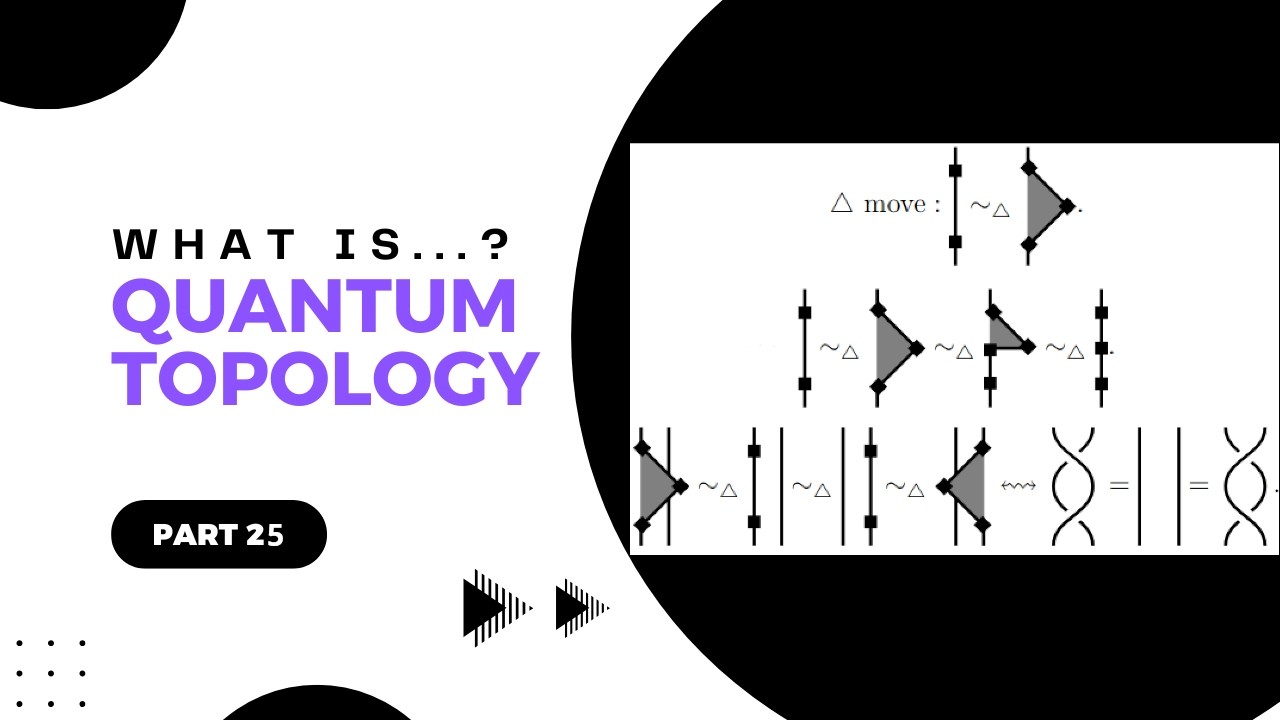
Okay, welcome everyone to this continuation of quantum topology. Who wants to know about quantum topology? That's an excellent question. Um, I don't know, but we'll do it anyway. Uh, so today I would like to tell you about why people care about quantum topology. Essentially, essentially. So it all boils down to Well, let's try it this way. Uh, the good old Reidemeister moves. — [snorts] — Let's try it this way. No, not fit width, fit page. Much [snorts] better. Why is this not working properly? Who knows? Uh, much better. So, um, the Reidemeister moves there are usually three of them and I will explain it in a second. We have some already here on the screen. Yeah, if you can zoom in here our little Reidemeister moves. Now it works. Excellent, that's pretty good. Sometimes my touch screen here had a little bit of an issue. That's what it is. We are all getting old, I guess. Um, so the top Reidemeister moves are stolen from Wikipedia and the bottom Reidemeister moves is how I like to think about them. And they're essentially the same, obviously, but for some reasons Wikipedia has those rectangular-shaped Reidemeister moves. Anyway, so there are three of them. And there's a fourth unspoken one, which is essentially um, some type of an isotopy, an isotopy relation, which you, if you want to, you can think about it like something like that. Yeah, isotopy, something like that. And you would have uh, a crossing slide along uh, something like something like this equals, so you can slide it now. So you still have this thing here, but the other one slides to the other side, right? So some isotopy relations of that type. And I usually going uh, and well, nobody usually points them out, but anyway. So they shape they change the type of the diagram, you see? They don't The Reidemeister moves change the type of the diagram. That's why they're separate. Anyway, so there's our type one, type two, type three, and type one is you undo a little kink. So if you have a little string, you can just pull it straight. The other one is even more obvious. Uh, you can just separate two strings if one of them is on top of the other. Um, the other takes a bit of staring, I guess, but it's actually also pretty easy. So there's this crossing here on top. Uh, sorry, on the bottom and this strand here goes on the top and you really just slide this crossing through. And the interesting thing is I haven't double-checked for the Reidemeister one move, but you don't need any other variations of these moves because any other variation, for example, where this string is on the bottom will follow from um, the attached moves. And don't worry about the orientation here, they don't actually play a role for what I'm going to say. But in my pictures I had just had them and I was too lazy to change it. Anyway, so there are three moves essentially and those hidden isotopies. And the big theorem of Reidemeister, which I'm going to sketch how you actually could prove that, so Reidemeister um, let's try to find that actually. Should have been like in the 1920s. There was a German mathematician called Kurt Reidemeister. That one. Uh, and yeah, so main work, you should expect mathematicians probably have main work around when they are 30. Should have been in the 19 right, 30 plus or minus, right? So it's like around this age range is uh, in the 1920s the famous Reidemeister moves. Probably has done way more, but I have no idea. So Reidemeister moves, Reidemeister moves. There you go. Reidemeister, that's where I stole those pictures from. Will you tell me from when this is actually Reidemeister? We have There you go. 1927. We can zoom a little bit to make it a little bit clearer. So it's kind of a nice thing. So it came up in 1927. So people were studying knots already before and apparently um, they are misnamed. I didn't knew that. Apparently in 1926 someone else did it uh, independently. That happens all the time, by the way. But anyway, so there are three local moves and before this really people had no idea how to study knot theory because of the following problem. Um, I have that picture on the next slide. So knots are really three-dimensional object. I really love this picture. I forgot where I stole it from. It's so perfect. Um, so knots are really these three-dimensional objects, as you can see here. But you usually just draw their two-dimensional shadows, but the shadow might vary a lot, right? And if you can't describe the equivalence on the shadows, you essentially have no chance to study knots. It's not quite true, but it does at least very difficult. Here's a similar picture of a knotted protein, I think. Uh, and again you can just somehow measure with a electron microscope in this case, like a two-dimensional shadow. So this question about how to describe two-dimensional shadows of knots is very important
Segment 2 (05:00 - 10:00)
and it turns out we are super lucky because you only have three moves ever. Yeah, and this funny isotopy thing. Um, so whenever you have something like you want to describe an invariant or something, you only need to worry about three moves. Um, it's pretty good, actually. Well, it's pretty good. So it's very important theorem. And it took a while, of course, to uh, really fly. So people usually people tend to ignore not Well, sorry. People ignored knot theory for a while and knot theory really become very im- important with Jones because the Jones polynomial is just so good. It's just so good. But anyway, um, people were clearly working on knot theory for a long time and this is kind of the main uh, theorem, the Reidemeister theorem. Kind of easy to remember, you just have three moves and yeah, it's not they're not too difficult, right? So um, the difficult part of the theorem is to prove that there are no other moves. Because that these moves holds I mean, that these moves are true is like uh, trivial. Almost you can just pull out your strings and just verify that this works or maybe you can do the mental gymnastics. Um, so my touch screen here, yeah? So the point is that two tangles are isotopic, so they're the same. If their projections are really are related by those moves, yeah? And you only ever have those moves. You have more complicated moves built out of those moves. And it doesn't matter, Reidemeister moves. So really great and this really reduces everything to the yeah, to just looking at pictures and those combinatorial equivalences. To do that in practice is not super easy, right? There's some cost you have to pay, but you can still do it. It's not too bad. In particular, if you want an invariant, as I said, it's pretty straightforward to just um, yeah, you need to usually just need to check three Reidemeister moves. So if you want to discover the Jones polynomial, your paper could be very short. You only would need to check three moves and of course discover the Jones polynomial, which is absolutely non-trivial. Um, it is pretty easy in 2026, obviously. You just ask Google or something. Uh, but at what is it, 40 years ago when Jones did this, it was absolutely non-trivial. It was a really big breakthrough. Jones polynomial is still among of the among which it's really on top of all of mathematics, essentially. It's one of the best things produced by mathematicians ever. Because it's somehow this mixture of being easy and powerful, somehow. Okay. And the way we describe it in quantum topology is we use algebraic models because we like categories and algebras and yeah, that's essentially what we like. We don't like anything else. Um, and the way I usually do this is I have this thing that I call the Brauer category because essentially Brauer did this first um, in the 1930s. Um, oh, while we're doing this, there is this mathematician Richard Brauer. Yeah, here you go. Richard Brauer. Yeah, and it works again. Uh, so roughly in the 1930s you would expect, whatever. Um, Brauer has done a lot, so um, uh, in particular in finite group theory. Oops, why did I click on this? I wanted to click on that. Brauer has done a lot, in particular in finite group theory. Um, but worked, for example, with Schur on various forms of representation theory in this case in the Brauer category. Usually describes uh, representation of orthogonal groups. But there's this version which I call the quantum Brauer category. The quantum really just means we take care of crossings. And here's the relation I was trying to draw and this is our Reidemeister move. And all of the other relations are already kind of built in into the quantum Brauer category because it's braided and pivotal. It's a very efficient description. It's braided and pivotal, so the Reidemeister two and three moves come for free. Pivotal already implies our little zigzag friend, for example, and then some interaction relations between crossings generated by one object and those relations. Yeah, and this is equivalent to um, tangles. Essentially, that's what it is. You can do it with orientations if you want. Um, and that's what we like in quantum topology, right? We have algebraic models for non-algebraic objects. That's the whole point. Right? So let me um, well, essentially you want to prove this statement, the quantum Brauer category is equivalent to the tangles, yeah? Or the oriented ones equivalent to the one with orientations. And equivalent as nice categories as you would expect them to be equivalent. And the only difficult part is essentially to prove the Reidemeister theorem, which of course you don't have to do it anymore. Reidemeister did it or as we just learned, someone else uh, was one of them Alexander? Let's check. One of them was Alexander. Um, someone else did it as well, but anyway. So you don't have to prove it anymore, but roughly the proof is actually uh pretty brilliant. So, you reduce it
Segment 3 (10:00 - 14:00)
to the case of well, combinatorial knots, where you just think of them as piecewise linear uh well, embeddings, right? Piecewise linear is where you lose a little bit, but let's just assume piecewise linear. So, you have those little vertices everywhere, and then piecewise linear parts between, right? So, uh vertex, linear, and whatever. And you define what is called a delta move or a triangle move. And triangle just means you can just push in a triangle, literally in three space, so there's nothing cutting through the triangle, right? That's the whole point. And then Reidemeister essentially shows that uh triangle equivalence is the same as what we're looking for, a knot equivalence. And so, you only need to analyze triangle equivalence. Yeah, here's one of them. This is just a silly isotopy. You pull out the string and you shrink it again, triangle equivalence. And then you have something like this. If you pull the triangle in front of another string, that's the same as uh doing that thing. Because now the triangle is in front. You can't push it through, that's kind of the rule of triangle, that's why I color the triangle in. It's really like a solid triangle. And this corresponds to that move. And if you want to draw now the other moves, um you're uh happy to do that. So, essentially it boils down to a few uh combinatorial checks of possible local moves on triangles, and you end up with the Reidemeister moves. Pretty cool cool Pretty cool way of proving it, actually. There are a lot of stupid details like, "Oh, why are piecewise linear knots the same as general knots? " Well, they are not, but let's just assume general knots means X, and then they are. Something like that. Um but not super important. More important is actually this idea of just combinatorializing the problem, which is kind of a crucial step that you hopefully eventually learn in your life, that combinatorics is easier than um essentially anything else you will ever meet. Not just in mathematics, but literally anything else. Uh but anyway, so then and then we get this really beautiful quantum topology type statement that we really like, that our algebraic thing here, whatever, the category, the braided pivotal category generated by one self-dual objects subject to those relations is the same as the topological objectors. Kind of the prototypical example of what quantum topology really likes to do. Right? Why is the theorem such a big deal? Oh my goodness, can I zoom in? Ah, better. One is the diagram. Of course, now we have can use our algebraic machine to study those knots, right? And then, if we play that nicely, and we hopefully do that very soon, then we get what people call quantum invariants, which is now a functor of our, let's say, a functor of our Brauer category here, uh because they're equivalent, let's just use that one, into something really algebraic, like vector spaces, right? Then you associate to every topological object uh a very rigid algebraic object, like a vector space or a map or something like that, right? A linear map, something very easy. And then you can hopefully take something like a determinant or trace or something, and you get [snorts] an invariant. And it turns out that that's how it goes. Turns out that's exactly how it goes, yeah? Um but before we do that, we actually have this idea of imposing something a ribbon. So, a ribbon is literally somehow um I don't have a really good explanation, maybe someone has. Um because when you do this quantum topology trick, you send the Brauer category into something algebraic, like vector spaces, you somehow always end up with an invariant for ribbons instead of uh knots. What is a ribbon? A ribbon is really uh a thickened knot, if you want. So, in instead of just having one knot, like this line, now you have two knots that run in parallel, essentially, up to some local intersection points, and then you the ribbon is literally just you have a now a surface in between. It's literally a ribbon, like you have a belt, take your belt, and now you can twist it and you knot it and whatever, and that's a ribbon. Turns out that we are really describing ribbons, not knots. But anyway, but this is then um the next step is where quantum topology without topology really starts, right? We send our quantum Brauer category or its ribbon version to something algebraic, and we get very excited and very happy. Or at least I get excited and very happy, whether you happy is uh very questionable. Anyway, I hope you enjoyed this video, and I'll talk to you next time.