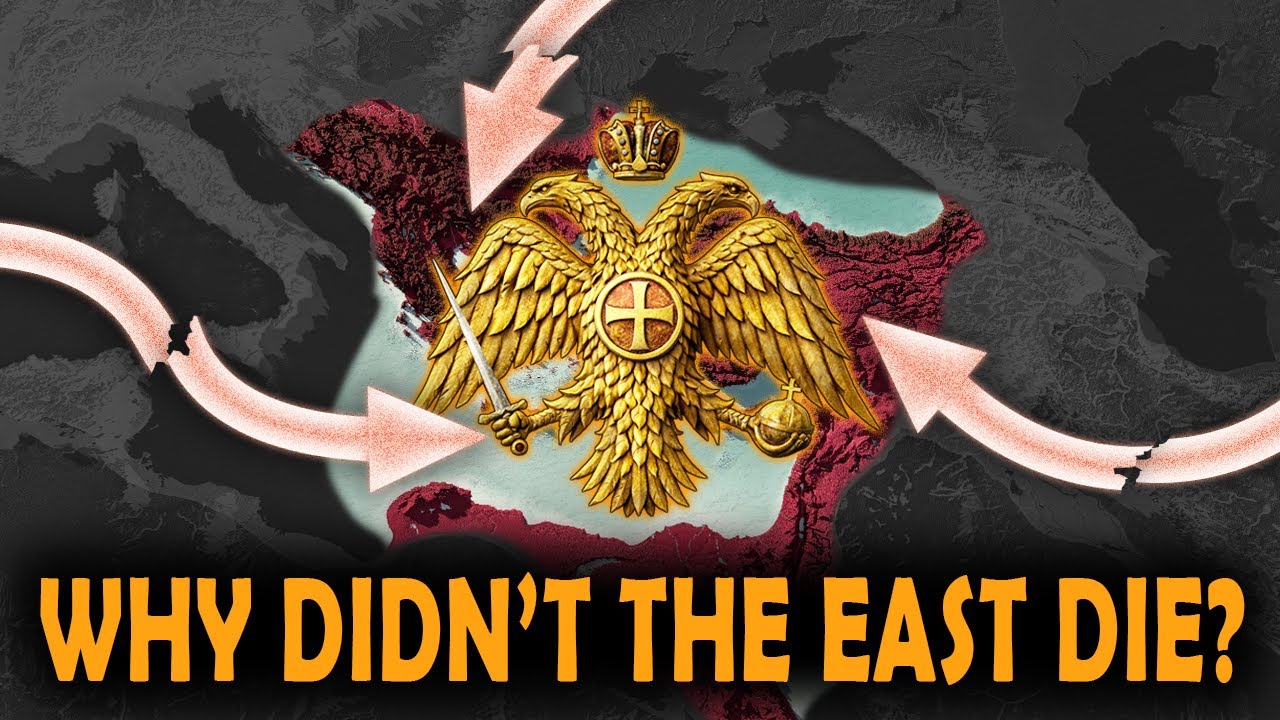
How did the Arabs Conquer HALF of the Byzantine Empire?
18:55

How did the Arabs Conquer HALF of the Byzantine Empire?

Knowledgia 27.05.2026 53 662 просмотров 2 286 лайков

Machine-readable: Markdown · JSON API · Site index

Поделиться Telegram VK Бот
Транскрипт Скачать .md
Анализ с AI
Описание видео
Try Abacus AI here: https://chatllm.abacus.ai/kwi Get EARLY ACCESS to our videos: https://www.youtube.com/c/Knowledgia/join https://www.patreon.com/c/Knowledgia ♦If you like Historical Maps, take a look here: https://knowledgia.co/ High-resolution digital and framed maps inspired by the stories on this channel. ♦How did the Arabs Conquer HALF of the Byzantine Empire? In the 7th century, the Byzantine Empire had just survived one of the most brutal wars in its history. After decades of fighting against the Sassanid Persians, Emperor Heraclius had recovered Syria, Palestine, and Egypt, but the empire was exhausted. Then, from the deserts of Arabia, a new power emerged... Within only a few years, Arab Muslim armies swept into the Levant, defeated the Byzantines at the decisive Battle of Yarmouk in 636, captured Syria and Palestine, and pushed toward Egypt. Jerusalem surrendered, Damascus fell, and Alexandria, one of the richest cities of the Mediterranean world, was eventually lost. ♦Consider to SUBSCRIBE: https://goo.gl/YJNqek ♦Our general knowledge channel: https://www.youtube.com/@MasteringKnowledge ♦Music by Epidemic Sound Big Thank you to: potatohistory-us, johnathondwigans, MohitAgrawal-d9n, Николай Димитров, Tobias Tron, Mahmoud Shahin, Justin Bourke, Augustus Caesar, Chaim laser Joshua Kerr, Slayer, John McKeon ,Michael Morale,Rory,Smithy3371, The Angry Celt, Paula Collins-Cook, Jonathon Dwigans #History #Documentary
Оглавление (4 сегментов)

Segment 1 (00:00 - 05:00)

In 1629, the Roman Empire had just won the greatest victory in its history. Within more than a decade, most of that empire would be gone. Syria, Palestine, Egypt, all of it torn away by an enemy Constantinople had barely bothered to watch. Men who had ridden out of the Arabian desert behind a single idea. By the time the Romans understood what was happening, the old frontiers no longer existed. This is the story of how Rome lost the east and how the empire that survived will never get a hold of these territories. By the 630s AD, the Roman Empire had been in a largely constant state of warfare for many years, both against external allies and whilst fighting civil wars, which had greatly strained its resources. Having fought his way to a costly victory over the Avars and Persians, the emperor Heracleus was now focused on the state's recovery, the Arab invasion. Heracles's rebuilding of the empire had three key phases. Firstly, to further ensure a smooth succession of power, he declared his son Heraclonus as Caesar in 632 AD, intending for him to rule jointly with his half-brother Constantine III, who had already been co-emperor for many years. Secondly, the Romans were now faced with the arduous task of rebuilding the administration of the territories that had been under Persian occupation for over a decade. This involved filling out civil posts that had long been vacant and sorting through the immense layers of bureaucracy involved in getting the economy functioning optimally and Roman law reestablished. Lastly, Heracles made strides in restoring religious unity in the empire which included a decree in 634 AD for all Jews to convert to Christianity which resulted in many conversions. Additionally, he continued efforts to bring the infighting between the Calcedonian and Monophysite sects of Christianity to an end. But as before, his more moderate approach ultimately failed to accomplish this. Heracles's effort would then be further disrupted by the oncoming Arab invasion. What came next would not be another broad war. It would be something the Roman world did not yet have a name for. The Romans had maintained a frontier with the Arabian Peninsula for several centuries and at the time were confident it did not present a serious danger. In the late 620s AD, there had been some Arab raids on the frontier of the empire, but nothing that suggested a largecale invasion was imminent. However, the unexpectedly rapid rise of Islam and the unification of the Arabs under the prophet Muhammad and then the first calip Abu Bakr would take the Romans by surprise. Under the new calip Umar, the Arabs attacked the Levant in 634 AD and also launched a simultaneous assault on the Sassinid Persians. Both empires were still recovering from a recent lengthy period of foreign and civil wars, only to now be faced with a fresh and skilled enemy under capable leadership. The Arabs were able to push into Roman territory. And it soon became clear these were more than just raiders. As the Arabs won a few encounters against the Romans and started to occupy cities, most notably Damascus. The Romans would even begin to cooperate with their old enemies, the Persians, on how to deal with this new threat to both of their empires. In 636 AD, Heracles dispatched a large field army against the Arabs, leds by the General Vahan, an experienced soldier of Armenian extraction, who had recently fought in the Persian war, as well as Theodore Trurius, a senior imperial official. This forced the Arab forces operating in Roman territory to consolidate in order to defeat this imminent threat led by Khaled Iban al-Wed, one of the most talented Arab commanders of the time who confronted the Romans at Yarmmuk. While the details of the battle are not entirely clear, it was evidently a long and hard-fought affair that lasted up to 6 days. At first, the fighting went favorably for the Romans, who were able to push the Arabs all the way back to their camps. However, at some point during the battle, the Arabs were able to outflank the Romans and being trapped

Segment 2 (05:00 - 10:00)

in a nearby Wadi. This led to a final round of desperate fighting as the Romans attempted to break out while the Arabs cut off their escape route, resulting in Vahan and Theodore's deaths along with that of much of their forces. In 6 days of fighting, the Roman East had lost the last field army standing between it and the invaders. What came next was not another battle. It was a collapse. The empires that lasted were run from a single chamber with the maps, the ledgers, and the advisers all sat in the same place. The clearer the picture, the steadier the rule. That principle is what made today's sponsor stand out. This video is brought to you by Abacus AI. Abacus AI works like that chamber. One dashboard gives you access to the leading frontier models. ChatGBT, Claude, Gemini, Grock, Deepseek, and Root LLM, which will automatically choose the best model for your request. The way a ruler would call on the right specialist or use the right tool. Alongside it sit image and video generators, including Flux and Sora 2 and a presentation builder. The piece I keep coming back to is Deep Agent. Give it a task and it coordinates multiple models and tools to carry it out from research and presentations to small apps it can deploy. It connects to Google Drive and Slack and surprisingly it's only about $10 a month which is far cheaper than paying for multiple AI tools separately. Check out Abacus AI by using the link in the description and pinned comment. fall of the Roman East. With the disaster at Yarmmuk and the fact that the empire was still recovering from previous wars, the Romans no longer had any major field armies to send against the Arabs, and they began a full retreat from Syria. Some Roman officers also chose to negotiate their own peace terms with the Arabs. The Persians were fairing no better as in 637 AD they suffered a disastrous defeat of their own at the battle of Kadisa which precipitated further Arab advances into the east. To make matters worse, there were continuing tensions with the Avars in the Balkans and the recent defeats had weakened confidence in Heracleus' leadership. Though it was unsuccessful, it was yet another sign of the instability within the empire and its decline in strength. By 640 AD, the Arabs had conquered the entirety of the Levant and pushed into Armenia while also threatening Anatolia. The important province of Egypt fell in 641 AD after the patriarch of Alexandria Cyrus negotiated a surrender for which he was recalled by Heracleus and exiled. Similarly to the recent war with Persia, the Romans were also forced to retreat into Anatolia where the new frontier with the Arabs would be drawn. Heracles would die not long after these events in February 641 AD. Despite his herculean efforts to stabilize the empire in the early 7th century and the victory over Persia, his reign is also remembered for the failure to defeat the Arabs and the subsequent loss of territory that had been won back with great effort only a short time before, leaving him with a rather mixed legacy. With Heracles dead and the Arab tide still rising, the empire that remained would spend the next half century fighting not to win but simply to exist. Struggle for survival. Heracles was succeeded by Heraclonus and Constantine as planned. But in yet another stroke of ill fortune, Constantine died within just a few months. This led to Heracleus's young grandson, Constans II, becoming emperor in October 641 AD with the support of the army, forcing Heraclonus and his mother into exile. During Constanza's reign, the Arabs extended their operations into the Mediterranean, taking advantage of the many advanced port cities now under their control and the specialists and facilities within them to begin building a navy. Constand launched an expedition to retake the valuable province of Egypt in 645 AD. But although the Romans succeeded in securing Alexandria, they were driven out again the following year, marking the last time the Romans attempted to reconquer the province. The Arabs also continued to launch naval attacks of

Segment 3 (10:00 - 15:00)

their own, taking several islands off the southern coast of Anatolia, including Rodos and reaching the Strait of Boserus. Further east, the Arabs also overran the Sassinid Empire by 651 AD, destroying Rome's old rival. Constans sent a fleet to put an end to the Arab naval threat, but the Romans were defeated at the so-called Battle of the Masts in 655 AD. Fortunately for Rome, the Arabs were at the time also distracted by their own infighting as the califf Uman was assassinated the following year. Constan was thus able to negotiate a truce with the Arabs in 659 AD, relieving pressure on the eastern frontier. It was also likely that around this time that a new system of military organization and provincial administration was introduced to the Roman Empire known as the thematic system. The precise origins of this reform have long been a matter of debate, but it seems likely the truce negotiated with the Arabs by Constans enabled it to occur during a period of peace between 659 and 662 AD. As a military organization, the themes or themata in Greek were the descendants of the Roman field armies of late antiquity known as the cometenzis. However, the theme was also the designation of the district where these troops were stationed, which encompassed several of the old Roman provinces from late antiquity. Each themes commander, usually known as Stratagos, held full military and civil authority within his district. Greek had also by now become the Roman Empire's dominant language. Thus, Roman emperors had increasingly started to use the Greek term Basileos instead of the Latin title of Augustus to describe themselves. While the helanized version of Caesar or Kaisar continued to be used for junior co-emperors, this linguistic shift also occurred in the army where Latin had been used for orders and administration for centuries. Consequently, the themes were given helanized names derived from the field armies of old. For example, the army of the east orans became the theme known as anatolicon meaning of the orientals. There was also a change in how the Romans maintained their armies as thematic soldiers were largely supported by the government with land grants within their respective themes instead of the more traditional salaries. These changes took place alongside shifts in equipment and tactics that attempted to meet the new realities of warfare, and the thematic system would prove durable and effective for many centuries, undergoing further evolutions as territory was taken, lost, or reorganized. With the Arab frontier in Anatolia having been restabilized by this new system, Constans traveled to the western provinces in 663 AD, accompanied by troops from the upscion theme. In recent times, the empire had been relying a great deal more on the west to provide resources with the loss of most of the eastern provinces. The emperor may have also plans to introduce the thematic system to the west. But unfortunately, while he seems to have made progress in reorganizing the provinces, his popularity and hold on power gradually slipped. Ultimately, he was assassinated while taking a bath in Syracuse in 668 AD. Constans was succeeded by his son Constantine IV who immediately returned to Constantinople where he was faced with a rebellion by the commander of the Armeniaon theme as well as the troops in Sicily brought from the Obsician theme. Both rebellions were defeated but the instability encouraged the Arabs to renew their attacks. They raided as far as Sysicus, which they occupied in 670 AD, and even launched a direct assault on Constantinople itself 4 years later. Here, however, the Arabs were defeated by a Roman navy employing a new type of incendiary weapon known as Greek fire, the precise nature of which remains a point of debate, but was likely a form of Napa. The occupation of Sysicus and the siege of Constantinople finally came to an end by 678 AD after the Arabs suffered serious losses and concluded a 30-year truce with the Romans. While this victory yet again stabilized the frontier with the Arabs, the Balkans were invaded by a new and dangerous

Segment 4 (15:00 - 18:00)

enemy in 681 AD in the form of the Turk tribe known as the Bulgars, who conquered the Slavs settled in northern Thrace, which by now had slipped beyond effective Roman control. Constantine led an army to drive the Bulgars out, but was defeated in battle, leading to the Romans also losing their outposts along the Black Sea coast. Constantine was thus forced to negotiate and sign a peace treaty with the Bulgars, who would become a major power in the Balkans that the Romans would often have to contend with for centuries to come. Constantine himself would die shortly after these events in 685 AD and was succeeded by his son Justinian II. The new emperor was victorious in a campaign against the Slavs in the Balkans in 689 AD during which he was able to secure the route between Constantinople and the major city of Thessaloni in northern Greece which had long been targeted by Avar and Slavic attacks. After his victory, he forcibly resettled many Slavs in Anatolia and enrolled them in the Roman army, hoping to use them in a campaign to restore Roman control in Armenia. Unfortunately for Justinian, these plans were thwarted as the Slavic soldiers proved unreliable and in their first battle with the Arabs at Sephostopolis in 692 AD, most of them deserted. Justinian was then deposed by the usurper Leontius in 695 AD, who mutilated the emperor by cutting off his nose, making him nominally unfit to rule before forcing him into exile in Carson in Crimea. The history of Rome throughout the 7th century AD had been marked by constant and bitter warfare against enemies both old and new, combined with costly civil wars and internal power struggles which led to the empire fighting for its very survival and seemingly coming to the verge of collapse forcing it to adapt and change in many ways. This resulted in the rise of a new Rome that was different in many ways from its antique counterpart. Hence, the 7th century is sometimes viewed as the true beginning of Baantium. Yet, though weakened, the Roman Empire had also managed to tenaciously hold out and even reform itself to better combat the new threats it faced in this period of rapid and often bloody change. Heracles had saved Rome from the Persians. He could not save it from what came after. The empire that survived the 7th century would last another 800 years, carrying Rome's name, claiming Rome's history, fighting under Rome's eagles. But it has reached a point of no return. From this point on, the rest of Roman history will be an endless struggle until its final demise. Make sure to subscribe and hit that bell button to be notified when the next episodes are live. Thanks for watching. If you'd like to help us keep creating, and get early access to our videos, behindthe-scenes content, and other perks, consider becoming a member right here on YouTube or joining us on Patreon. Every bit of support helps. And as always, thank you so much for watching.

Другие видео автора — Knowledgia

Ctrl+V

Экстракт Знаний в Telegram

Экстракты и дистилляты из лучших YouTube-каналов — сразу после публикации.

Подписаться

Дайджест Экстрактов

Лучшие методички за неделю — каждый понедельник