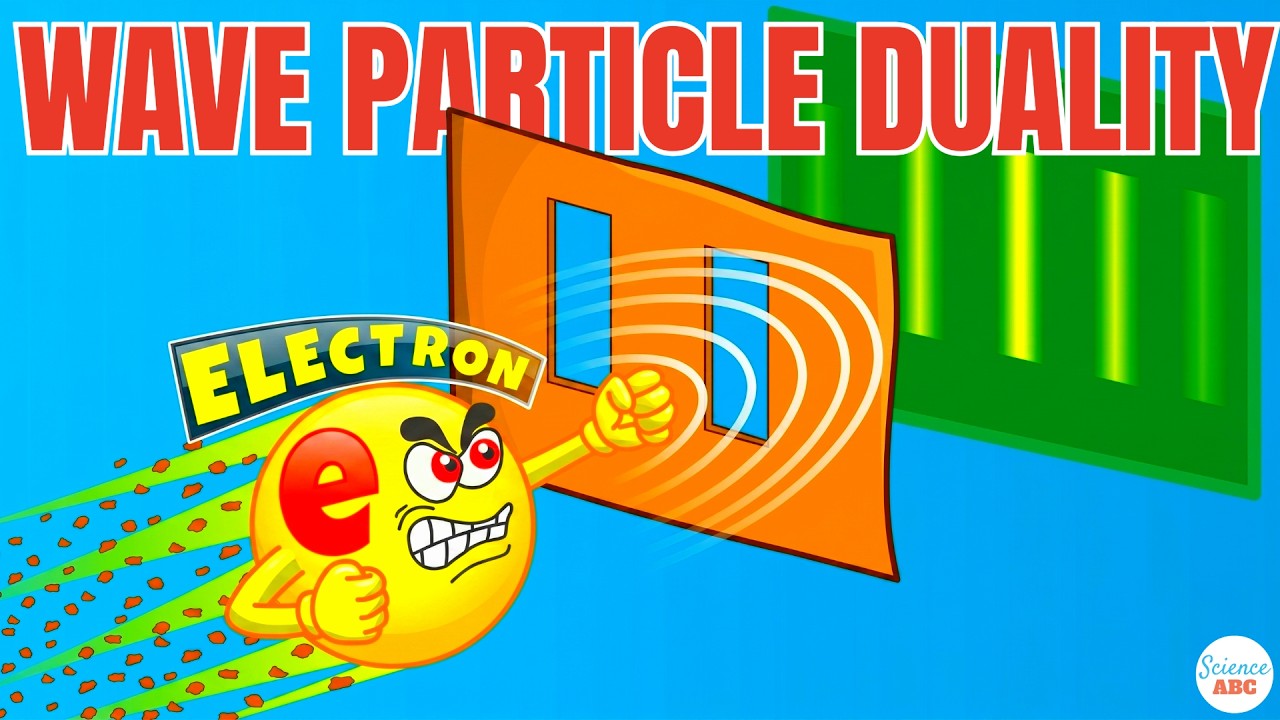
Double-Slit Experiment & Wave-Particle Duality Explained in Simple Words
5:05

Double-Slit Experiment & Wave-Particle Duality Explained in Simple Words

Science ABC 02.06.2026 1 562 просмотров 85 лайков

Machine-readable: Markdown · JSON API · Site index

Поделиться Telegram VK Бот
Транскрипт Скачать .md
Анализ с AI
Описание видео
The double-slit experiment and wave-particle duality, explained in simple words. Why does an electron behave like a wave when you don't watch it, and like a particle the moment you do? In this video, I have walked through Thomas Young's 1801 sunlight experiment, electrons that interfere with themselves, the "observer effect," and why Richard Feynman called this single setup "the only mystery" of quantum mechanics. Whether you're a curious student, a physics enthusiast, or someone who just wants to finally understand what quantum weirdness actually means, this explainer covers the experiment, the history, and the technologies it powers — electron microscopes, MRI scanners, lasers, transistors, and quantum computers. CHAPTERS: 0:00 – Introduction 0:38 – Tennis Balls vs Water Waves: A Simple Analogy 1:19 – Thomas Young's 1801 Experiment with Light 1:51 – Einstein, de Broglie, and Matter Waves 2:23 – Firing Single Electrons, One at a Time 2:52 – The Detector Changes Everything 3:24 – Real-World Tech: Microscopes, MRI, Transistors 3:55 – Quantum Computers and Qubits 4:10 – The Measurement Problem and Interpretations 4:40 – Reality Is Made of Possibilities WATCH NEXT: ▶ Quantum Mechanics Explained – https://youtu.be/p9pPjASnnxw ▶ Atomic Models Explained – https://youtu.be/v48u8hjqNBU ▶ Higgs Boson Explained – https://youtu.be/BiR1cPisge8 KEY TOPICS COVERED: • What the double-slit experiment is and why it matters • How tennis balls vs water waves explains particles vs waves • Thomas Young's 1801 light experiment and the interference pattern • Einstein's photons and de Broglie's matter waves • Why a single electron seems to pass through both slits at once • How a detector "collapses" the wave and restores particle behavior • Real-world tech built on wave-particle duality: electron microscopes, MRI, transistors, lasers • How qubits in quantum computers use superposition • The measurement problem and the Copenhagen vs many-worlds debate #DoubleSlitExperiment #QuantumMechanics #WaveParticleDuality #QuantumPhysics #Physics #ScienceABC REFERENCES: https://www.feynmanlectures.caltech.edu/III_01.html https://doi.org/10.1098/rstl.1804.0001 https://doi.org/10.1103/PhysRev.30.705 SUBSCRIBE for more science explainers! https://www.youtube.com/channel/UCcN3IuIAR6Fn74FWMQf6lFA?sub_confirmation=1 Follow us: Twitter: https://twitter.com/abc_science Facebook: https://facebook.com/sciabc Instagram: https://www.instagram.com/scienceabcofficial/ Website: https://www.scienceabc.com Copyright Science ABC. For licensing inquiries: admin@scienceabc.com

Оглавление (10 сегментов)

Introduction

The double slit experiment is a physics experiment that reveals something deeply strange about nature. When tiny objects like electrons or photons are fired at a barrier with two narrow slits, they produce a pattern on the other side that should be impossible if they were just small particles. Instead of landing in two neat clusters behind each slit, they create alternating bright and dark bands, a signature of waves interfering with each other. This single result tells us that the building blocks of the universe carry a dual nature. They behave like waves when no one is watching and like particles the moment you try to observe them. Physicists call this wave-particle duality. Think of it

Tennis Balls vs Water Waves: A Simple Analogy

this way. Imagine you are standing in a hallway throwing tennis balls at a wall with two vertical slits. The balls that make it through land in two neat piles behind the slits. Predictable. Now replace the tennis balls with water waves. Drop a stone into a pool and let the ripples pass through the same two slits. This time, the waves overlap on the other side. Where crest meets crest, the water surges. Where crest meets trough, the water goes flat. You get a striped pattern of alternating tall and calm bands. Tennis balls give you two stacks. Waves give you stripes. Remember this difference because it is the key to everything that follows.

Thomas Young's 1801 Experiment with Light

The story begins in 1801 with Thomas Young, an English polymath who was a physician by trade but taught himself optics in his spare time. At the time, Isaac Newton's view that light is a stream of tiny particles dominated physics. Young was not convinced. He punched two thin slits into a card, shown sunlight through them onto a screen, and saw alternating bright and dark bands, exactly like the water ripples. Light, he concluded, must be a wave. His result held for a century. Then in 1905

Einstein, de Broglie, and Matter Waves

Albert Einstein showed that light also arrives in tiny packets of energy called photons, when he explained the photoelectric effect. Light was somehow both a wave and a particle. In 1924, Louis de Broglie pushed the idea further and proposed that matter itself has a wavelength. Three years later, Clinton Davisson and Lester Germer proved him right. While studying electron scattering off a nickel target at Bell Labs, and the cleaned-up crystal produced unmistakable diffraction patterns.

Firing Single Electrons, One at a Time

So, what happens when you repeat Young's experiment with single electrons? You fire them one at a time with long pauses in between, so there is never more than one electron in flight. At first, each electron lands in a seemingly random spot. But as thousands of dots accumulate, they arrange themselves into the same striped interference pattern. A single electron, traveling alone, somehow behaves as if it passes through both slits and interferes with itself.

The Detector Changes Everything

Now comes the truly strange part. Put a detector next to one of the slits to watch which slit the electron actually goes through. The moment you do, the interference pattern vanishes. The stripes collapse into two plain stacks, just like the tennis balls. Look at the electron, and it behaves like a particle. Don't look, wave. Richard Feynman called this single experiment the only mystery of quantum mechanics. Everything bizarre about the quantum world is packed inside it.

Real-World Tech: Microscopes, MRI, Transistors

This is not just a strange laboratory curiosity. It is the foundation of technologies you use every day. Electron microscopes exploit the wave nature of electrons to image individual atoms, because electron wavelengths are up to 100,000 times shorter than visible light. The lasers and fiber optic cables, the MRI scanners in hospitals, and the transistors on every chip inside your phone, all depend on wave-particle duality. Quantum computers take it a step further.

Quantum Computers and Qubits

further. A quantum bit or qubit is held in the same kind of wave-like superposition as an unmeasured electron between two slits, allowing quantum machines to explore many possible solutions simultaneously before collapsing to a final answer.

The Measurement Problem and Interpretations

Despite its astonishing success, the double slit experiment raises a question physicists have debated for over a century. What does it mean for an electron to go through both slits at once? Dozens of interpretations exist, from the Copenhagen interpretation to the many worlds hypothesis, and none has been definitively proven. The measurement problem, why observation collapses the wave, remains one of the deepest open questions in all of physics. 200 years after Thomas Young

Reality Is Made of Possibilities

punched two slits into a piece of card in his living room, we still do not fully understand what his experiment is telling us. We only know that reality at its smallest scale is made of possibilities, not certainties, and that the universe seems to wait for a question before it commits to an answer.

Другие видео автора — Science ABC

Ctrl+V

Экстракт Знаний в Telegram

Экстракты и дистилляты из лучших YouTube-каналов — сразу после публикации.

Подписаться

Дайджест Экстрактов

Лучшие методички за неделю — каждый понедельник