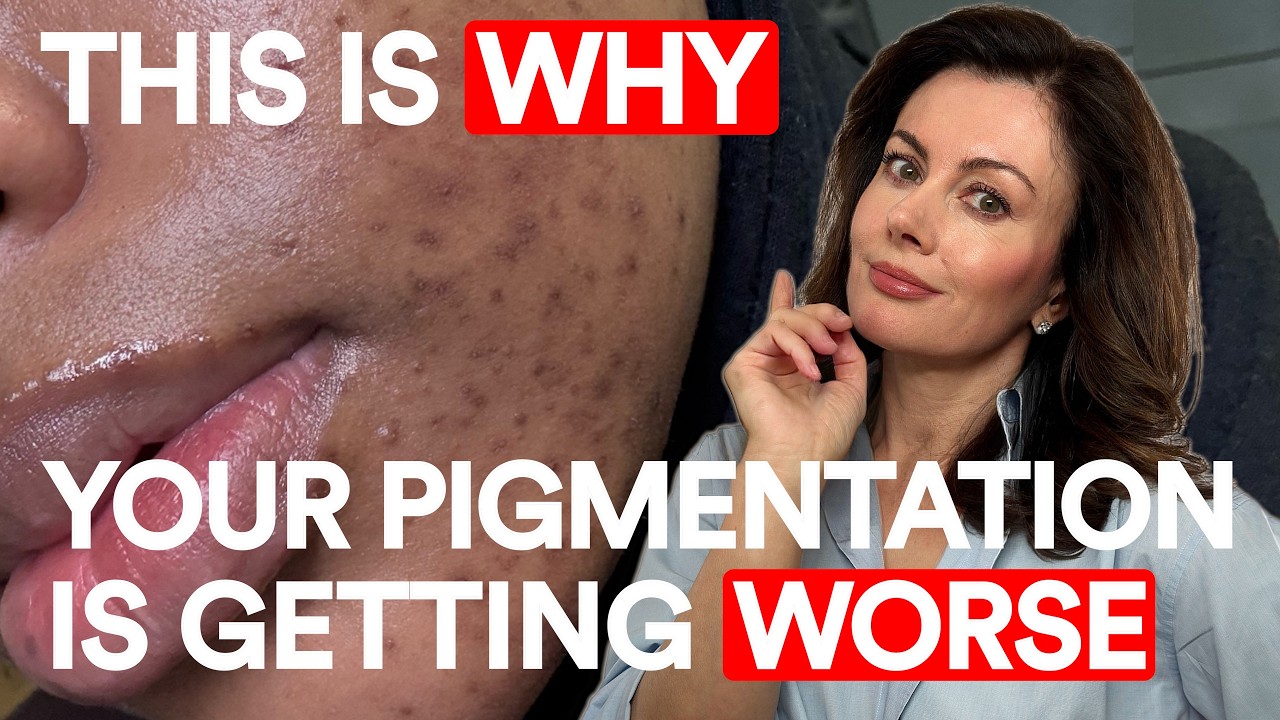
If you’ve been using vitamin C every morning and never skipping SPF - and your dark spots, melasma, or uneven skin tone still haven’t shifted the way you expected - this video is for you.
You’re not doing it wrong. The problem is that hyperpigmentation isn’t a single-step process. It’s a biological cascade with nine separate stages.
In this video, Dr Sam Bunting - cosmetic dermatologist and founder of Dr Sam’s skincare - breaks down exactly why the standard pigmentation routine has a ceiling, what melanogenesis actually involves, and what it means to treat the problem at the scale it deserves.
You’ll learn:
— Why vitamin C is valuable but limited in the melanogenesis cascade
— What sunscreen prevents vs what it cannot reverse
— The biological reason dark spots plateau even with a consistent routine
— What a complete approach to hyperpigmentation actually requires
This video is especially relevant if you’re dealing with:
— Post-inflammatory hyperpigmentation
— Melasma or hormonal pigmentation
— Age spots or sun-induced dark spots
— Uneven skin tone that hasn’t responded to standard actives
Mentioned in this video:
— Melanogenesis cascade
— Tyrosinase inhibition
— UV-induced pigmentation triggers
— Melanin transfer and cell turnover
Discover Flawless Brightly Pro - 8 actives to tackle the 9 pathways that cause pigmentation. https://drsambunting.com/products/flawless-brightly-pro-serum
📍 Learn more at drsambunting.com
📍 Follow Dr Sam on Instagram @drsamanthabunting
#hyperpigmentation #darkspots #melasma #vitaminCskincare #sunscreen #skincareforwomen #dermatologist #pigmentation #unevenskintone #skincareOver40
Оглавление (2 сегментов)
Segment 1 (00:00 - 05:00)
If you've been using vitamin C and SPF every single day and your pigmentation still there, here's why. Hi, I'm Dr. Sam and I've been helping patients achieve bright, clear skin for over two decades and that's what I want for you. Firstly, let me be clear. Vitamin C is a brilliant ingredient because it's a powerful antioxidant and is an essential part of any tool kit to reverse the signs of aging. However, whilst it does have the ability to slow the production of melanin, it is not as profoundly impactful as other more dedicated pigment suppressors. So, whilst it's part of a tool kit, it's not the whole story. That's because when I look at how pigmentation occurs, it's actually down to nine separate pathways that broadly speaking fall into three buckets. Upstream of the enzyme, at the enzyme, and we're talking about tyrosinase here, and then downstream. So, let's look at upstream. Firstly, you've got those triggers. Now, we're talking UV radiation, predominantly UVA. We're talking visible light. We're talking hormones. We're talking heat. We're talking inflammation. So, these are the upstream signals that tell your melanocytes to start producing pigment. Then you've got the production phase itself where tyrosinase is the rate-limiting step, meaning it's the bottleneck to ultimately generating melanin from the amino acid tyrosine. Now, tyrosinase is an interesting enzyme. It doesn't just catalyze one reaction, it catalyzes two, meaning it speeds up a chemical reaction. So, first we have a hydroxylation and then an oxidation. And these two steps can be hindered by different ingredients. So, ultimately, if you slow the enzyme down, you reduce the amount of effective pigment the skin produces. Now, then there's what happens to the melanin parcels after they've been produced. They get packaged up and they get shipped off into our keratinocytes, which are skin cells. And the reason why protecting our skin cells is so important is because our epidermis turns over every 28 to 40 days, meaning that it's actually a tissue that has a high rate of replication. That means we must protect the DNA at all costs. So, what happens is the melanin inside little parcels called melanosomes get sent out through the dendrites of your melanocytes and they get passed through into the keratinocytes where they form a kind of parasol around the nucleus so that if UV hits the cell, it gets absorbed by the melanin instead of your precious DNA. And that means less DNA damage. Good news for both the prevention of aging and skin cancer. So, like I said, vitamin C is doing good work preventing that oxidative stress that drives pigmentation in the first instance and slowing down a little bit of the melanin creation, not really targeting that central enzyme. It's not helping with preventing that distribution network and it's not really helping reduce the excitability of the melanocyte itself. So, what would I use in addition to vitamin C? Well, let's look at the overexcitable melanocytes in the first instance. It has to be azelaic acid. It's really excellent at targeting those overexcited melanocytes without harming the ones that are behaving normally. And in addition, it also targets the battery pack of the cell, the mitochondria. So, there's less energy available to make the tyrosinase molecule in the first place. Then we come on to the enzyme tyrosinase itself. Now, normally what happens is tyrosine, an amino acid, binds to a site on the enzyme like a key fitting into a lock, and then it gets converted through a couple of steps that ultimately delivers something called melanin. Ingredients that suppress this bind to the lock without allowing the key to turn. So, there's nowhere for the tyrosine to dock. Ingredients you might know that work in this way include hydroquinone, which is the gold standard and what we use on prescription in the clinic for severe hyperpigmentation. Now, it can be irritating, so we have lots of safer, easier to use alternatives that are available over the counter. So, think arbutin. Think hexylresorcinol. And azelaic acid also works in this way, too. Now, what I should mention is for tyrosinase to work, it needs to bind copper. So, guess what? We can block tyrosinase by blocking the binding of copper, too. And that's how kojic acid works. Now, we know that milk thistle has already reduced the amount of active tyrosinase available, but not only that, it also blocks the second irreversible enzymatic step controlled by tyrosinase. So, there's a lot going on in the melanocyte. Now, we come on to the delivery of the packets of melanin. These packets or parcels are called
Segment 2 (05:00 - 06:00)
melanosomes and they get passed along these tentacles called dendrites and they connect with neighboring keratinocytes, your skin cells, to deliver the melanin to where it needs to be to have its action. Now, niacinamide has the unique action of stopping the interaction from the dendrites with the neighboring skin cells. So, it really stops the delivery of those parcels into the skin cells. And then finally, we get on to the skin cells that have already received their burden of pigment. We can accelerate their removal by speeding up cell turnover, which is how things like retinoids help, but also ingredients like bakuchiol and exfoliating acids. Now, I don't know about you, but I'm quite tired going through all of that. There is a lot to pigmentation. So, if vitamin C and SPF have been your strategy so far, it's not that you're wrong, it's just that you're not completely there by targeting all those key steps in that really complex pathway in how pigmentation forms. The missing piece is targeted actives that work across those three key parts of the pigmentation pathway. Now, if you've got sensitive skin, you're wondering how you manage all this, please do stay tuned to my next video. So, hit the bell and make sure you're subscribed.