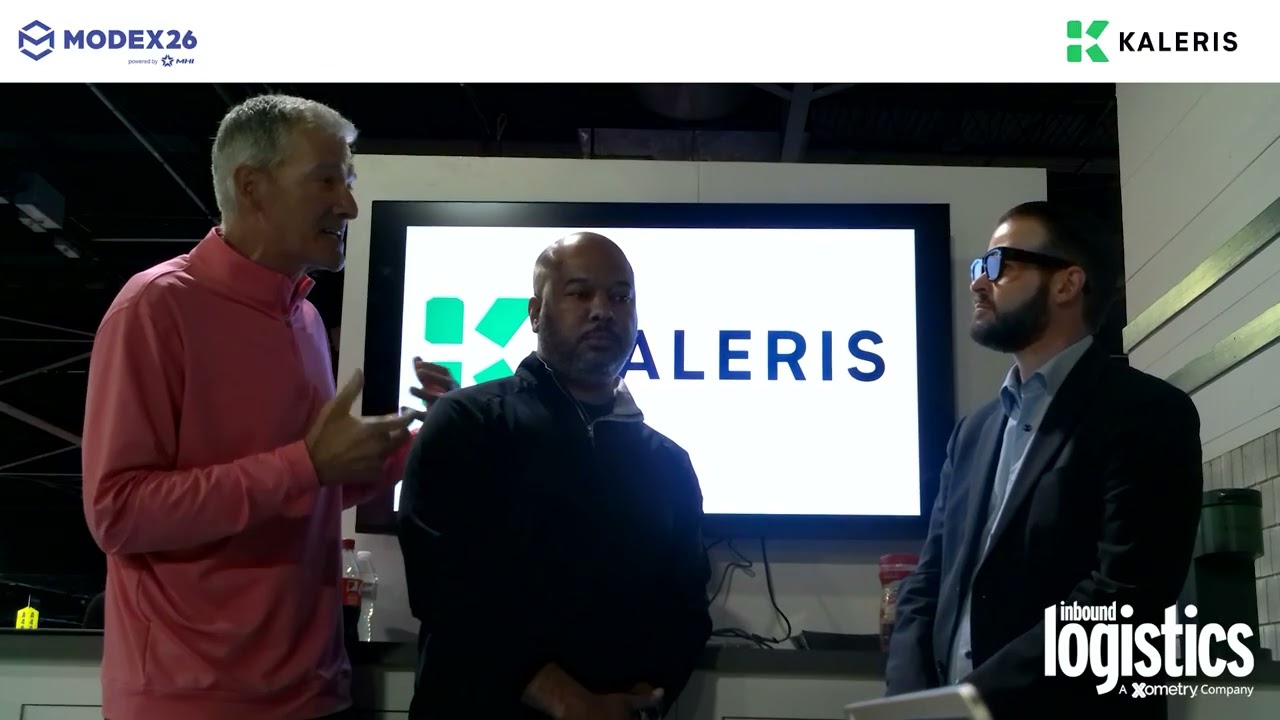
Inbound Logistics/MODEX 2026 Interview Series: Materials handling is evolving fast—where are the biggest changes happening? We spoke with leaders across the MODEX show floor to find out.
In this interview, Travis Langford, Regional Manager for @TERADYNEINC (parent company of @UniversalRobotsVideo ), gives his thoughts on the pain points customers are seeing this year, the advanced solutions and services at MODEX that would have seemed impossible just a few years ago, and the biggest mistakes companies make when they start their digital transformation journey.
Langford also gives us a deep dive into Universal's MiR MC600—which takes the popular UR20 cobot arm and adds the "legs" of an AMR—and explains how it handles heavy payloads.
This conversation is part of our MODEX 2026 Interview Series, featuring insights from leading supply chain and logistics technology providers.
#MODEX #materialhandling #supplychain #logistics #warehousing #distribution #tradeshow
Оглавление (2 сегментов)
Segment 1 (00:00 - 05:00)
Good afternoon. Joe Bondo with Inbound Logistics here at Modex 2026. Right now I'm talking to Travis Langford, regional manager of Pterodine Robotics, the parent company of Universal Robots. Travis, how are you today? — Good, Joe. Thanks. Well, Travis, what's the single biggest pain point your customers are bringing to you this year compared to two years ago? — So, two years ago, a lot of it had to do with labor stress surrounding uh labor stress or um gaining employees, right? Coming out of the pandemic. — Lately, it's been more about productivity gain. um how to adopt automation in order to get u more lift um from like rapid deployment localized systems that you can deploy yourself uh to to meet demand I would say. Yeah. — So I know it's early in the show Travis but looking around modex floor today what is one thing you see that would have been unthinkable even just 5 years ago? Well, dealing with var variability, I'd say is probably the number one thing. Um, in the logistics space and in distribution warehousing, um, you get a lot of different box sizes. You get what we'd call mixed skew, a lot of variability. Um, so utilizing visual feedback or force feedback, uh, to adapt to that variability. Um, you know, damage boxes, maybe different pallet sizes, um, and being able to handle that, you know, with the use of maybe AI or visual feedback, that kind of thing. Travis, what's the biggest mistake you see companies making when they start their digital transformation journey? — Oh, that's a good question. Um, a lot of it is adapting for automation or modifying your existing process for automation. So, uh, we've got kind of an old saying, you can design for automation from scratch or you can modify your existing process for automation. Now, we do a lot to help make that, um, ad adaptation as minimal as possible. Um, but having the expectation that you will have to alter maybe uh certain aspects of what you're doing with your business now in order to accommodate rapid deployment automation is an expectation I think a lot of people need to consider. — Travis, so we're looking at the MIR MC600. You've essentially taken the world's most popular cobot uh arm uh and given it uh the legs of an AMR. Why is this mobile cobbot a game changer for 2026? Oh, well, Joe, um, a lot of our customers, they're transporting components and they're transporting material and product all over their facilities. And so, putting an industrial or a collaborative robot on top of the mobile industrial robot gives them the flexibility to be able to retrieve those items or those totes or those components and then deliver them to other areas of the facility either to meet production demands or assembly demands or just simply to transfer components or parts. So, we're seeing the or we're looking at the UR20 uh arm on this unit. Usually, uh these cobots are for lighter tasks, but this handles heavy payloads. How does this system stay stable while a 20 kg arm uh is moving at full speed on a mobile base? — Yeah. Well, it's really anchored by um the weight and the stability of the MC600. So you've got um the UR20 on top capable of picking up around 45 lbs. Now the robot arm isn't going to be moving while the mobile industrial robot's moving. So while it's traversing uh the robot arm is stationary. Um it can transport its uh toad or its delivery to the end location and then once stopped the mobile uh the collaborative robot will then uh continue to move and offload or unload the mobile industrial robot. So a big hurdle for robotics is programming. Uh for the warehouse manager watching who isn't a coder, right? How simple is it to redeploy uh MC uh the MC600 from a palletizing task uh to a machine testing task? — Well, what you can do is take the existing mission set and then you can um utilize that as a as an additional mission and then make edits through a no code process of drag and drop a graphical user interface system. Um really what you need to do then is map the area after you've taken that mission and then duplicated it. And once you've got that map done um you could use the existing mission or program then to edit specifically for the machine tending from the palletizing application. — Dan, let's talk about pulse. Uh you're showing a fully connected palletizing to logistics workflow. uh instead of a robot just stacking a pallet and waiting for a human, how does this system hand off to finish work to the next stage of the warehouse? So being integrated with the mirror allows the pallet after it's completed to be moved to the next section for wrapping, labeling, handoff to whatever post-processing is necessary. So real world pallets are rarely perfect, right?
Segment 2 (05:00 - 05:00)
Uh boxes are crushed slightly off center. How does StackIt AI vision allow these robots to adapt to a messy reality without needing a human to step in and fix the stack? So with the stacket AI technology, it's taking a real world view of what I just messed with. So now it's gone up one layer, recognized the new box position, and it's picking that box position. So, yep. And the messy reality is versatility is king. So, here we've got a versatile, robust solution to deal with any of your processing needs. — Awesome, man. I appreciate it. Absolutely.