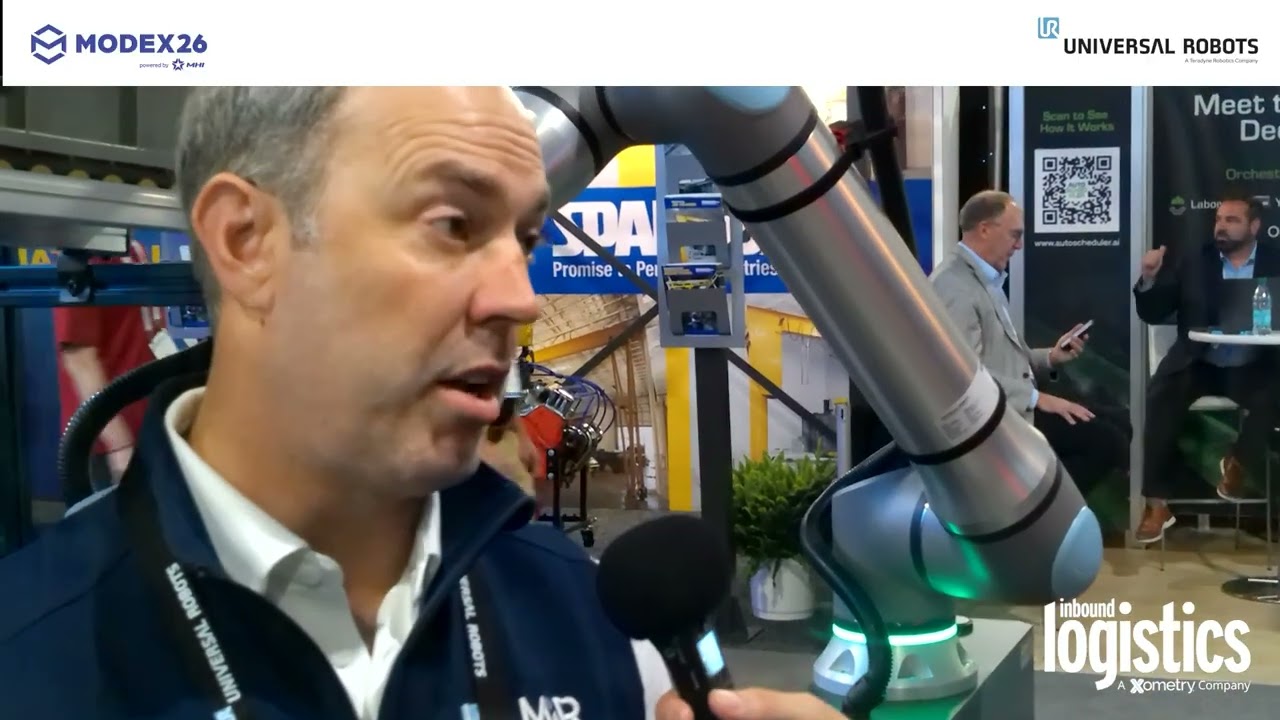
Inbound Logistics/MODEX 2026 Interview Series: Materials handling is evolving fast—where are the biggest changes happening? We spoke with leaders across the MODEX show floor to find out.
In this interview Darius Landrum and Eric Breen with Kaleris gives their thoughts on the pain points their customers are seeing this year, the advanced solutions and services at MODEX that would have seemed impossible just a few years ago, and the biggest mistakes companies make when they start their digital transformation journey.
Landrum and Breen also explain how Kaleris is using AI Gate Automation to turn a 15-minute manual check-in into a 30-second autonomous pass, discuss their products' benefits in cold chain environments, and tackle the question of when YMS, TMS, and TOS will finally speak the same language.
This conversation is part of our MODEX 2026 Interview Series, featuring insights from leading supply chain and logistics technology providers.
#MODEX #materialhandling #supplychain #logistics #warehousing #distribution #tradeshow
Оглавление (2 сегментов)
Segment 1 (00:00 - 05:00)
Good afternoon. This is Joe Biundo with Inbound Logistics Magazine and we are live on day two of Modex 2026. Right now, I'm speaking with Darius Landrum, senior product marketing manager, and Eric Green, director of enterprise sales at Colaris. Darius, Eric, how are you today? I'm doing great. Thanks for having us. Thank you. Thanks for coming. So, let's jump right into it. Eric, what is the single biggest pain point your customers bring it to you this year compared to two years ago? Well, I think the pain point hasn't changed. It's still efficiency but cost reduction. Okay. But now the tools are available now they weren't available two years ago that maybe even address those issues. So, with the advent of AI, computer vision, those type of tools are now how do I say, mainstream? But they're available. So, they're really going after it. So, that cost reduction, labor side, they're really going for it this time. Darius, look looking around the Modex floor today, what is the one thing you see that would have been unthinkable maybe five years ago? Yeah, two words, autonomous execution. Yep. Right? Five years ago it was all about visibility. Real-time visibility, where's my shipment right now? Today it's all about executing on that, right? Yep. — So, just yesterday Colaris announced AI gate vision, right? And that is all about, you know, uh clearing the gate, right? Clearing the gate, knowing being able to use OCR vision technology, uh to identify a trailer, verify its seal, and then coordinate that back to the TMS information that was sent to it, right? Sent to the YMS, right? So, five years ago, that would have been impossible. That was science fiction. So, today we're able to execute that in under 30 seconds. So, we we're talking a little bit about technology and advancements there. Eric, what is the biggest mistake you see companies making when they are embarking on this digital transformation journey? Well, in our area of supply chain, there's still a lot of old school methods being used. And so, we get a lot of uh I want to get all now. All I want everything. And they're where they're coming from where they want to go is that the gap is too big. Yep. So, they got requirements that have to come down, expectations have to come down a little bit, but also they have to start. A lot of companies get stuck in the decision paralysis. So, we have to get reasonable expectations, and then go for it. And then start get a plan, phase it out, work it in, aim for that end goal, but don't think you're going to get there in the first year. Start. Get going. So, Eric, the yard gate is often seen as, you know, the where the supply chain grinds to a halt. So, how is Clarus using AI gate automation to turn what's typically a 15-minute manual you will check in to a 30-second autonomous uh passing? Well, old school, put a couple guards in the gate, write everything down on a clipboard, put in Excel, 15 minutes, right? Yep. So, there's multiple ways to accelerate the gate. It can be the integration to a WMS system to bring in data, data integrity, data governance. Uh you can have the computer vision that, you know, Darius talked about. Bringing in cameras and computer to actually see the numbers on the trailer, bringing in data. It can be as simple as having the driver Bring it Have the driver check in before he even gets to the facility. Have all the data there. QR scan like you do at the airport. A lot of ways you can do that. It's a mix what's best. Depends on the gate itself. But, 15 minutes, that's old way of doing it. No one should do it that way anymore. We can always go towards a much higher velocity at the gate. Lots of ways to do it. Darius, in in the cold chain, every minute matters, obviously, right? So, how does your YMS talk to the TMS to ensure a refrigerated trailer receives priority for a dock door the second it hits the property? Yeah, that's a great question. When the cold chain, dwell time is the enemy of shelf life. Yep. Right? So, with our system the with our YMS and our TMS being integrated, as soon as a shipment hits that geo fence our system automatically knows priority level of that shipment. Right? So, then the system does not wait for a dispatcher to make a manual uh decision. It automatically chooses the optimal door for that shipment to go to. Eric, so you talked a lot about connecting nodes and loads, right? So, for a CEO or an executive watching this, what's the ROI of having one platform that sees the yard, the terminal, and the transport all in one view? Let me give you two examples. A simple one day-to-day example, and then a bigger picture one. The first example is if you're connected uh say you're an importer, containers, right? We're bringing in and there's a lot of places that container has to go, the different nodes, the you know, ocean, rail, truck
Segment 2 (05:00 - 06:00)
then to the warehouse. What are the free days left in that container? Someone's got to pay when it goes over free days. If you know because your data's connected and you know the available free days, you can attack and unload the ones that you know, shorter amount of time. Yep. And it really address the marriage problem very at a very granular level. A big picture of that is if you're connected and you're a large company, we have one customer that who actually talked about this is that by having the connected data and making decisions on exceptions, they can really get a grasp on the overall time it takes to bring products through the supply chain. This company said if they could save one day on supply chain just on the unit of trailer that or that product from factory to shelf is a half a million dollar a half a billion dollars — Wow. of free capital. Yeah. Where do you new warehouse, new manufacturing? That money can be used a lot of different places. So, having that connected data super important. Granular or big scale? So, Darius, as we look at the future of the autonomous supply chain, what is the biggest challenge in getting these different systems, whether it's the YMS, DMS, and TOS to finally speak in the same language? Yeah, really the biggest challenge isn't the data itself. The biggest challenge is the language, the dialect, right? So, the YMS, the TMS, and the TOS were all historically built independent of each other, and they all have their own separate language. How Kaleris is tackling that problem is we have what's called our execution and visibility platform or EVP. It's an execution layer that sits on top of those systems, because we do offer those at Kaleris independent of each other or integrated with each other. So, EVP is that translator that gets all of those systems talking to each other, and it's the connective tissue.