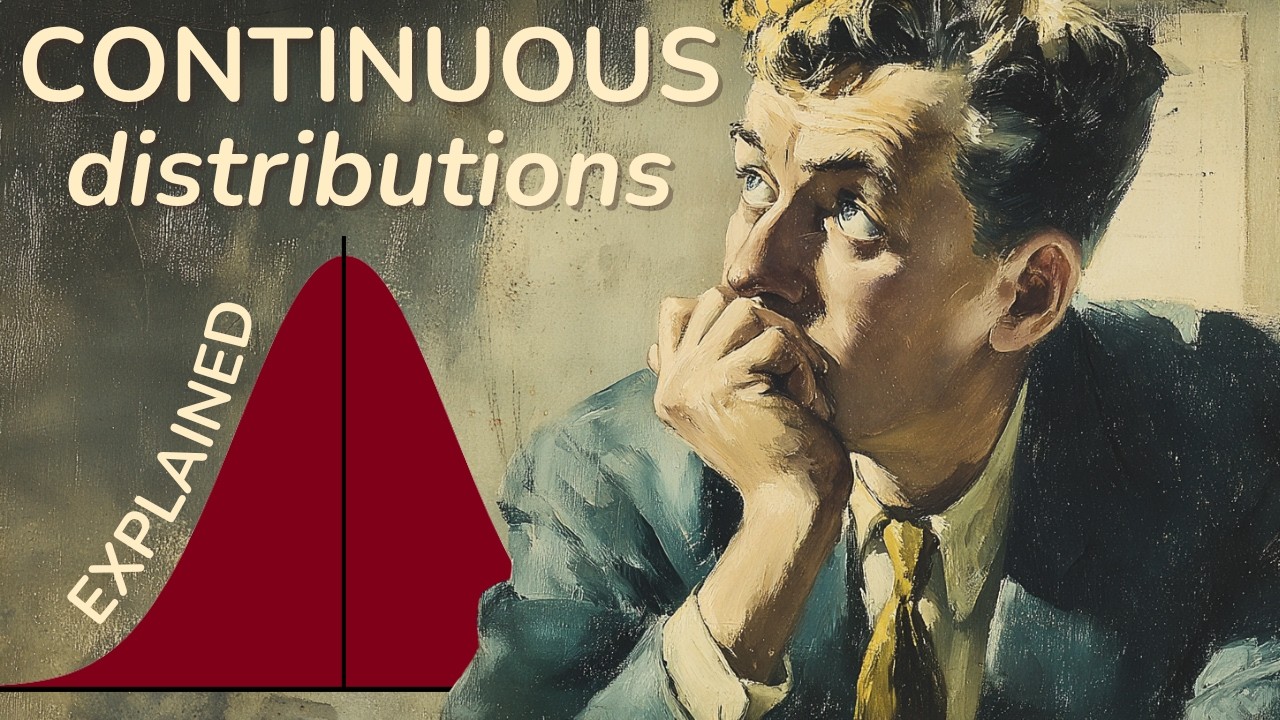
Probability Density Functions (PDFs) Explained Clearly | Continuous Random Variables
11:13

Probability Density Functions (PDFs) Explained Clearly | Continuous Random Variables

Socratica 04.05.2026 4 366 просмотров 218 лайков

Machine-readable: Markdown · JSON API · Site index

Поделиться Telegram VK Бот
Транскрипт Скачать .md
Анализ с AI
Описание видео
Probability Density Functions (PDFs) are essential for working with continuous random variables—but they can feel unintuitive at first. This lesson walks through the transition from discrete probability (probability mass functions) to continuous probability, where outcomes are infinite and probabilities behave differently. You will learn what a PDF is, how it works, and how to interpret probabilities over intervals. Topics covered: - Discrete vs. continuous random variables - Why probabilities “break” in the continuous case - What a Probability Density Function (PDF) really represents - Why probabilities at single points are zero - How to compute probabilities using areas under a curve This video is designed for students studying probability, statistics, or data science who want a clear, rigorous understanding of PDFs. We'd like to send a special thank you to our VIP Patrons at Patreon! Our patrons are the ones who make it possible for us to take the time to research, write, record, and edit these videos. Their support also makes it possible for us to invest in computers and software powerful enough to do the editing! Tracy Karin Prell Umar Khan Thomas Myers Michael Shebanow Marcos Silveira M Andrews KW Kevin B John Krawiec John-Michael Lewis Jeremy Shimanek Eric Eccleston and Christopher Kemsley are our VIP Patrons! 𝙅𝙊𝙄𝙉 this channel to get access to small Youtube perks like an owl emoji when you leave comments, fancy! https://www.youtube.com/channel/UCW6TXMZ5Pq6yL6_k5NZ2e0Q/join Thank you, kind friends! 💜🦉 𝘽𝙚𝙘𝙤𝙢𝙚 𝙤𝙪𝙧 𝙋𝙖𝙩𝙧𝙤𝙣 𝙤𝙣 𝙋𝙖𝙩𝙧𝙚𝙤𝙣: https://www.patreon.com/socratica 📚 𝙒𝙚 𝙧𝙚𝙘𝙤𝙢𝙢𝙚𝙣𝙙 (affiliate links): The Drunkard's Walk: How Randomness Rules Our Lives by Leonard Mlodinow https://amzn.to/4j9n0YP The Art of Statistics: How to Learn from Data by David Spiegelhalter https://amzn.to/3S9E46a How to Be a Great Student (from Socratica!) ebook: https://amzn.to/2Lh3XSP paperback: https://amzn.to/3t5jeH3 🎬 𝘾𝙍𝙀𝘿𝙄𝙏𝙎: Written & Produced by: Michael Harrison & Kimberly Hatch Harrison Edited by: Alivia Brown Music License from Soundstripe Code: PZNWNZ5CCHZS09Q8 🎓 𝘼𝘽𝙊𝙐𝙏 𝙊𝙐𝙍 𝙄𝙉𝙎𝙏𝙍𝙐𝘾𝙏𝙊𝙍𝙎: Michael earned his BS in Math from Caltech, and did his graduate work in Math at UC Berkeley and University of Washington, specializing in Number Theory. A self-taught programmer, Michael taught both Math and Computer Programming at the college level. He applied this knowledge as a financial analyst (quant) and as a programmer at Google. Kimberly earned her BS in Biology and another BS in English at Caltech. She did her graduate work in Molecular Biology at Princeton, specializing in Immunology and Neurobiology. Kimberly spent 16+ years as a research scientist and a dozen years as a biology and chemistry instructor. Michael and Kimberly Harrison co-founded Socratica. Their mission? To create the education of the future. Ready to 🧠 𝙇𝙀𝘼𝙍𝙉 𝙈𝙊𝙍𝙀 with Socratica? 📺 𝙎𝙪𝙗𝙨𝙘𝙧𝙞𝙗𝙚 for SMART videos in Math, Science & Programming: http://bit.ly/SocraticaSubscribe ▶️ 𝙋𝙇𝘼𝙔𝙇𝙄𝙎𝙏𝙎: Study Tips http://bit.ly/StudyTipsPlaylist Python http://bit.ly/PythonSocratica Chemistry http://bit.ly/Chemistry_Playlist Calculus http://bit.ly/CalculusSocratica Geometry http://bit.ly/GeometrySocratica #probability #ProbabilityDensityFunctions #ContinuousRandomVariables
Оглавление (3 сегментов)

Segment 1 (00:00 - 05:00)

Rolling a five with a pair of dice, flipping tails with a coin, drawing a nine from a deck of cards, studying probability starts with calculating the odds of common finite random variables. But when you transition to a world with infinite possibilities, the finite rules of probability become wobbly and break. Are you ready to move from the finite to the infinite? Let's learn how to measure probabilities of random variables with infinitely many outcomes. There are two classes of random variables, discrete and continuous. For a discrete random variable, you have an explicit list of outcomes, and you can assign a probability to each outcome. Probabilities cannot be negative, and the sum of the probabilities is one. The function that gives you the probability of each outcome is called a probability mass function, and it's traditional to use the letter P for this function. P for probability. For a continuous random variable, there are infinitely many outcomes. There are so many outcomes that the idea of a probability mass function doesn't make sense anymore. If you try to assign positive probabilities to all of the infinitely many outcomes, then their sum would always be larger than 100%. This is why we need a new mathematical tool for measuring probabilities for continuous random variables. Suppose there is a machine that generates a random real number between zero and 10. Let's assume this machine is fair. No number is more likely to be selected than any other. What's the probability of drawing each number? A first attempt at attacking this problem would be to pick a super small number epsilon to be the probability of picking each number. But since there is an infinite number of real numbers in this range, when you add up epsilon for all the numbers, you get infinity. And this happens regardless of how small epsilon is. For example, what if the probability of generating any number is one in a googol, which is 10 to the hundredth power? That's a pretty small epsilon. When you add up the probabilities for the first googol numbers, you get 100%. But there are still an infinite number of numbers left. So it doesn't work to assign a probability to each outcome like we did with discrete random variables, but fear not. Mathematicians created a solution that works wonderfully. Assign a number to each possible outcome. This number is not a probability. It's a value we call a probability density. This function is called a probability density function. The abbreviation PDF is more commonly used. Now be warned, this number is not a probability. It's a density. We'll be careful to use the phrase density instead of probability density to help avoid confusion. For example, let's assign a density of 1/10 to each real number in the range 0 to 10. Here is the graph of this PDF. Although the probability of a single outcome doesn't make sense, range of outcomes works. And to find the probability of a range, you find the area underneath the PDF graph over that range. For example, the probability of generating a number between 3 and 5 is the area under this graph between 3 and 5. This is a rectangle with a width of two and a height of 1/10. The area is 1/5, so the probability is 1/5. As a decimal, the probability is 0. 2, which is the same as 20%. You may remember from discrete probabilities like rolling dice or picking cards that the sum of the probabilities of all of the outcomes must be one or 100%. This is true for continuous probabilities as well. Every random number produced by this machine is between 0 and 10. Here we can check that the total probabilities comes to one by calculating the area under this graph from 0 to 10. This is a rectangle of width 10 and height 1/10. So, the area is one. This means the total probability is one or 100%. Let's say we have a different random number generator with a PDF whose graph looks like this. Here, the weight is 1/6 for numbers between -2 and -1 and between 1 and 2. The weight is 1/3 for numbers between -1 and +1. It is zero for all other numbers on the real number line. What is the probability of getting a number between -2 and -1? It's the area under this PDF graph between -2 and -1. Like before, this is a rectangle. The width is one and the height is 1/6. So, the area is 1/6, which is a probability of about 16. 7%. World is a big, — hot, random mess of data. And more data is generated every day. We need people

Segment 2 (05:00 - 10:00)

who understand probability to help make sense of it all. Would you like to join the effort? Then visit our website socratica. com and check out our courses. You can find the link below. What is the probability of picking a number between 5 and 10? Here, the density assigned to these numbers is zero. So, the region under the curve is a rectangle with a width of five and a height of zero. So, it's not really a rectangle, but please play along. The area of this squished rectangle is zero. So, the probability of our random number machine giving us a number in this range is zero. What is the probability of getting a positive number? The region under the PDF over all positive real numbers consists of two rectangles of different sizes. Both have width one, but the first rectangle has a height of 1/3, while the second 1/6. And because the density is zero above two, we can ignore this entire section. The combined area is 1/2, so the probability of getting a positive real number is 50%. One final calculation. What's the probability of getting any real number? This is the area underneath the entire PDF. Luckily, below minus two and above two, the density is zero, so we can ignore those parts. This leaves us with three rectangles. The two outer rectangles both have a width of one and a height of 1/6. The middle rectangle has a width of two and a height of 1/3. So, the three areas are 1/6, 2/3, and 1/6. If you add these together, you get one or 100%. This makes sense. Our machine generates random real numbers, and this is confirmed because the area under the PDF is one. This graph covers all possible outcomes, so its area is one. The examples we've seen have all been very blocky, but they were chosen so we could calculate areas easily. In the real world, however, most PDFs are curvy. The most famous of them all is the bell curve. Here is its graph, and here is the formula. If you calculate the area underneath this curve, you will get one. This curve describes a specific continuous random variable. You can think of it as a very specific random number generator. A remarkable number of random behaviors in our universe are described by this machine and this bell curve. It's also known as a normal distribution. So, when a random variable has a PDF that looks like this, you'll hear people say, "Well, it's normal. " To put it in general terms, the probability of this random number generator producing a number between A and B is the area underneath this bell curve from A to B. Since the graph is curved, you need to use a tool called integration from calculus to compute this area. The area is written like this. This symbol is a stretched out S for sum. At the bottom is the lower bound, which is the leftmost point of the region. At the top is the upper bound or rightmost point of the region. Inside you have the density function and this little dx. You can think of this expression as the area of a teeny tiny rectangle with a width of dx and a height being the density at that specific location. So conceptually, this expression says you are summing up the area of infinitely many small rectangles starting from A and ending at B. Even if you do not know calculus yet, you can use spreadsheets or software to calculate these areas, which don't forget, is the probability of getting a random number in this range. For both Microsoft Excel and Google Sheets, the formula is this. Norm. dist are there because this is a normal distribution. The S means this is a standard bell curve centered at zero with a typical width. These functions are actually giving you the area to the left of the input. So this expression is calculating the area from negative infinity to B and then subtracting off A. What's left over is the area between A and B. We are now ready to give the proper mathematical definition of a probability density function. Suppose you have a robot that yells out random real numbers. Because there are an infinite number of real numbers that vary smoothly, this is a continuous random variable. We cannot assign a probability to each outcome. Instead, we assign a probability density to each real number. This is done with a probability density function or PDF for short. We'll use the letter F for the function.

Segment 3 (10:00 - 11:00)

The input is any real number and the output is a density. The density can be zero or positive, but it cannot be negative. The area underneath this curve must be one. And finally, while you cannot find the probability for a specific number to be shouted by our random robot, you can find the probability that the number will lie in a specific range by computing the area underneath the PDF over that range. This is done using an integral, which is a tool from calculus. If you want to be an artisan, you can compute this integral by hand or just ask the nearest robot to help you out. Probability is a large subject, far too large to cover in a single video. Would you like to learn more? Then check out our probability and statistics course at socratic. com.

Другие видео автора — Socratica

Ctrl+V

Экстракт Знаний в Telegram

Экстракты и дистилляты из лучших YouTube-каналов — сразу после публикации.

Подписаться

Дайджест Экстрактов

Лучшие методички за неделю — каждый понедельник