The Language of Probability
7:26

The Language of Probability

Socratica 25.03.2026 4 769 просмотров 273 лайков

Machine-readable: Markdown · JSON API · Site index

Поделиться Telegram VK Бот
Транскрипт Скачать .md
Анализ с AI
Описание видео
𝙎𝙄𝙂𝙉 𝙐𝙋 for tastefully infrequent updates about our upcoming Probability & Statistics course. 💌 https://snu.socratica.com/probability-statistics-course Probability has a basic language used to describe the world of randomness. We use words like "probably", "chance", and "what are the odds" in everyday language. But to successfully learn probability you need to be comfortable with precise terms like "random variables", "discrete distributions", and "PDFs." Coincidentally, our friend and fellow #EduTuber @AlexDainisPhD has been researching what people mean when they use that qualitative language "likely," "probably," etc. How LIKELY is likely? ▶️ https://youtube.com/shorts/mGeFy-kzyjo?si=_2rQZm9o9-P8x_Zf We'd like to send a special thank you to our VIP Patrons at Patreon! Our patrons are the ones who make it possible for us to take the time to research, write, record, and edit these videos. Their support also makes it possible for us to invest in computers and software powerful enough to do the editing! Tracy Karin Prell Umar Khan Thomas Myers Michael Shebanow Marcos Silveira M Andrews KW Kevin B John Krawiec John-Michael Lewis Jeremy Shimanek Eric Eccleston and Christopher Kemsley are our VIP Patrons! 𝙅𝙊𝙄𝙉 this channel to get access to small Youtube perks like an owl emoji when you leave comments, fancy! https://www.youtube.com/channel/UCW6TXMZ5Pq6yL6_k5NZ2e0Q/join Thank you, kind friends! 💜🦉 𝘽𝙚𝙘𝙤𝙢𝙚 𝙤𝙪𝙧 𝙋𝙖𝙩𝙧𝙤𝙣 𝙤𝙣 𝙋𝙖𝙩𝙧𝙚𝙤𝙣: https://www.patreon.com/socratica 📚 𝙒𝙚 𝙧𝙚𝙘𝙤𝙢𝙢𝙚𝙣𝙙 (affiliate links): The Drunkard's Walk: How Randomness Rules Our Lives by Leonard Mlodinow https://amzn.to/4j9n0YP The Art of Statistics: How to Learn from Data by David Spiegelhalter https://amzn.to/3S9E46a How to Be a Great Student (from Socratica!) ebook: https://amzn.to/2Lh3XSP paperback: https://amzn.to/3t5jeH3 🎬 𝘾𝙍𝙀𝘿𝙄𝙏𝙎: Written & Produced by: Michael Harrison & Kimberly Hatch Harrison Edited by: Alivia Brown and Megi Shuke Music License from Soundstripe Code: EXOATJY9IIPBV422 🎓 𝘼𝘽𝙊𝙐𝙏 𝙊𝙐𝙍 𝙄𝙉𝙎𝙏𝙍𝙐𝘾𝙏𝙊𝙍𝙎: Michael earned his BS in Math from Caltech, and did his graduate work in Math at UC Berkeley and University of Washington, specializing in Number Theory. A self-taught programmer, Michael taught both Math and Computer Programming at the college level. He applied this knowledge as a financial analyst (quant) and as a programmer at Google. Kimberly earned her BS in Biology and another BS in English at Caltech. She did her graduate work in Molecular Biology at Princeton, specializing in Immunology and Neurobiology. Kimberly spent 16+ years as a research scientist and a dozen years as a biology and chemistry instructor. Michael and Kimberly Harrison co-founded Socratica. Their mission? To create the education of the future. Ready to 🧠 𝙇𝙀𝘼𝙍𝙉 𝙈𝙊𝙍𝙀 with Socratica? 📺 𝙎𝙪𝙗𝙨𝙘𝙧𝙞𝙗𝙚 for SMART videos in Math, Science & Programming: http://bit.ly/SocraticaSubscribe ▶️ 𝙋𝙇𝘼𝙔𝙇𝙄𝙎𝙏𝙎: Study Tips http://bit.ly/StudyTipsPlaylist Python http://bit.ly/PythonSocratica Chemistry http://bit.ly/Chemistry_Playlist Calculus http://bit.ly/CalculusSocratica Geometry http://bit.ly/GeometrySocratica #probability #discretedistributions #randomvariables
Оглавление (2 сегментов)

Segment 1 (00:00 - 05:00)

You talk about probability every day. There's a good chance of rain. What are the odds? Probably. But here's the problem. None of those sentences actually mean anything precise. In mathematics, if you use the wrong words, you get the wrong answers. In probability theory, every one of those ideas actually has a formal definition. So let's learn the official vocabulary. Suppose you roll a six-sided die. There are six possible things that can happen. You can roll a one, two, three, four, five, or six. Each of these is called an outcome. The collection of all possible outcomes is called the sample space. For a die, the sample space is simply one, two, three, four, five, six. Every outcome lives inside the sample space, and the sample space contains all possible outcomes. Nothing more, Now let's introduce some useful notation. Instead of describing the result of a roll with a sentence, we assign it a letter. Let D represent the result of rolling the die. If you roll a 4, we write D equals 4. Roll again and get a 1. D equals 1. The value refreshes each time you perform the experiment. That's why we call D a random variable. Because a die only has a finite number of outcomes, D is specifically a discrete random variable. If the die is fair, each outcome has probability of 1 sixth, about 0. 167. We can write the probabilities for all six outcomes like this, where p stands for the probability of the outcome. Here's the key idea. P is a function. You plug in an outcome, like d equals 4, and it returns a number between 0 and 1. That number is the probability of that outcome, a function that gives you the probability of the outcomes of a discrete random variable is called a probability mass function, or PMF for short. In a way of speaking, it places mass on each of those finite number of specific points. The more mass, the more likely the outcome. Now suppose the die is not fair. Do we describe this scenario the same way? Let's use a new random variable u for this unfair die. Maybe the probabilities look like this. Different probabilities. Different distribution. Still a discrete random variable. Still a PMF. Sometimes you'll see this written a slightly different way. Instead of p of d equals 1, you might see p sub d of 1, lowercase p subscript d, outcome inside parentheses. Both notations describe the same idea, the probability assigned to that outcome by that random variable's distribution. And once everyone knows which random variable you're talking about, you can shorten it even further. p of 1, p of 2, p of 3, and so on. For a random viewer, there are a few outcomes after watching this video. Subscribe to our channel. Visit our website. Buy a course. So, you may not realize it, but your behavior is a discrete random variable with its own probability mass function. A DRV with a PMF for short. So, pick your outcome and click somewhere below. Moving on. Going deeper. What is the probability of rolling an even number? Even isn't a single outcome. It's a collection of outcomes. Two, four, and six. So to find the probability of rolling an even number, we add the individual probabilities. The probability of rolling an even number is 0. 63. There's a distinction we should point out. Even is not an outcome. It's an event. An outcome is a single result. An event is a set of outcomes. More formally, subset of the sample space. Rolling an odd number. Rolling a prime number. Not rolling a 1. All of these are events. Thankfully, p doesn't just work on single outcomes. It works on events, too. In all our examples so far, they were discrete random variables. In other words, they all had a finite number of outcomes. But not all random processes work that way. Imagine throwing a dart at a dartboard. Where can it land? Anywhere on the board. Each landing point can be described by an x and y coordinate. Each pair of coordinates make up a single outcome. Since each throw of the dart will result in a different pair of coordinates, this is a random variable. Let's call this random variable b for board. Now the sample space is all of the points on the dartboard. Unlike the six faces of a die, there are infinitely many points on a dartboard. There's something more to recognize in this situation, a mathematical subtlety. The points on a dartboard vary smoothly across a continuum. There's no next point.

Segment 2 (05:00 - 07:00)

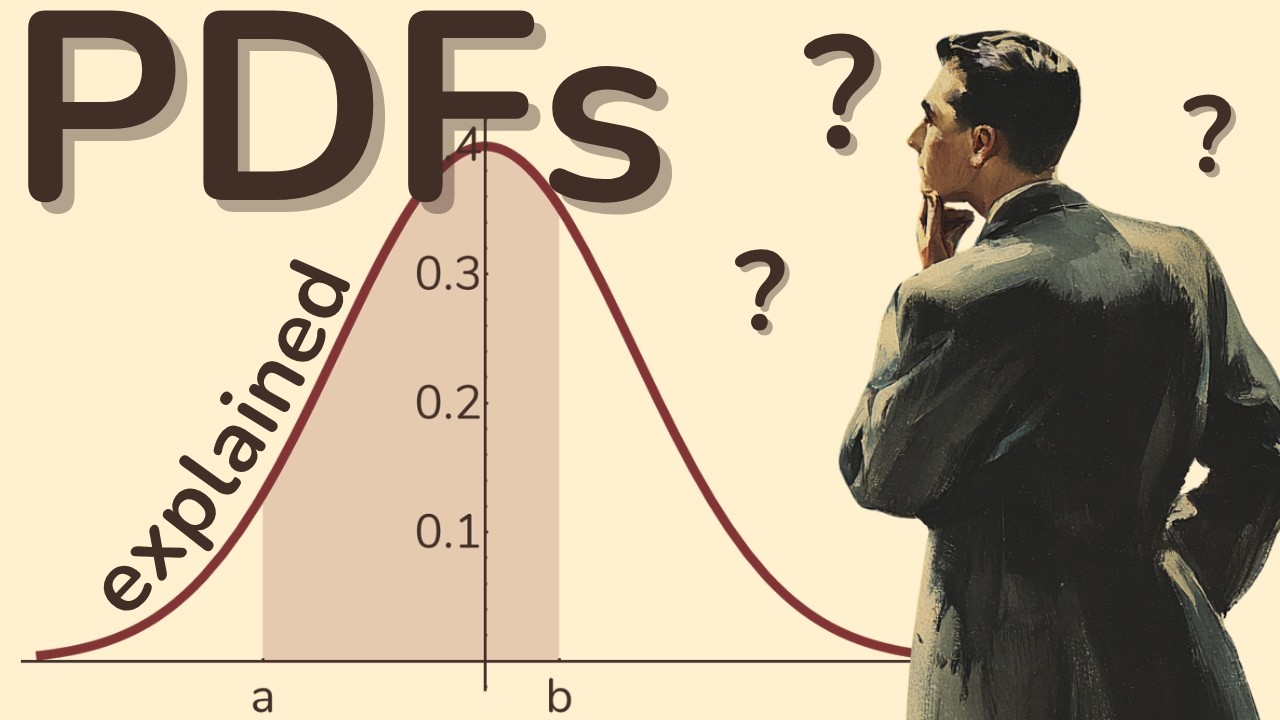
You can't list them one by one. This means the outcomes are not discrete. That's what makes this a continuous random variable. So how do we figure out probabilities when we have a continuum of outcomes, like the dartboard? You might think we can just assign a probability to each point, like we did for the six faces on a die. But there is a mathematical issue. There are infinitely many points on the dartboard, and in fact, an uncountably infinite number. If we tried to give each point a positive probability, they'd never add up to exactly one. Instead we approach this differently, rather than assigning a probability to each point, we assign a density. This density is not a probability. It's like a weight that shows which areas are more likely than others. To get a probability, you don't look at one point. You consider a region like a small square or a circle, and you combine the densities in that region. That's how we find the probability of the dart landing somewhere in that area. It can feel counterintuitive at first. Every single point has probability zero, but whole regions have non-zero probability. That's because we're dealing with a continuum, something we don't encounter in everyday counting. But that's why with continuous random variables, we use a probability density function, often written as f, because it's the density we integrate to find probabilities of regions. Returning to the dartboard, each dart player will have different skill levels and tendencies. So each dart player will have their own unique probability density function, PDF for short. This will be a function f with inputs x and y. And to find the probability of them landing a dart on any region of the dartboard, we use integration from calculus to combine these densities into a single probability. Now that you're equipped with some more precise language to describe probabilities, feel free to incorporate these terms when you're making small talk about random events. And don't forget to work Socratica into the conversation for super bonus cool points.

Другие видео автора — Socratica

Ctrl+V

Экстракт Знаний в Telegram

Экстракты и дистилляты из лучших YouTube-каналов — сразу после публикации.

Подписаться

Дайджест Экстрактов

Лучшие методички за неделю — каждый понедельник