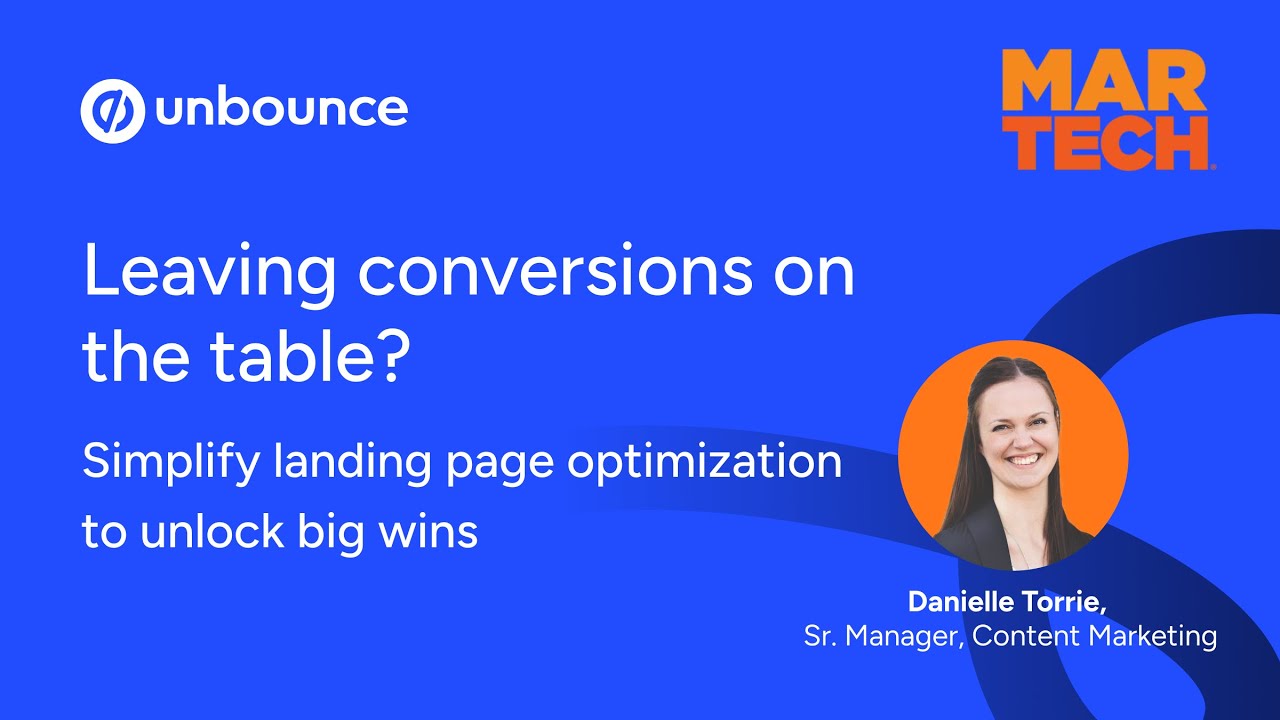
How to improve landing page conversion rate (simplifying landing page optimization)
25:52

How to improve landing page conversion rate (simplifying landing page optimization)

Unbounce 08.09.2025 348 просмотров 6 лайков

Machine-readable: Markdown · JSON API · Site index

Поделиться Telegram VK Бот
Транскрипт Скачать .md
Анализ с AI
Описание видео
Stop leaving conversions on the table! In this session, Danielle Torrey, Senior Manager of Content Marketing at Unbounce, breaks down the 2024 Conversion Benchmark Report analyzing over 57 million conversions. Discover how to simplify your landing page optimization strategy using data-driven benchmarks—not just generic best practices—to unlock big wins. Learn which channels convert best, the powerful impact of readability and mobile optimization, and get actionable tips for running more A/B tests that drive results. Whether you’re in SaaS, e-commerce, financial services, or beyond, these insights will show you how to optimize for devices, design, messaging, and copy that truly convert. **IN THIS VIDEO, YOU'LL LEARN:** 0:00 Introduction to Landing Page Optimization 1:15 What is Unbounce? 2:30 Overview of the 2024 Conversion Benchmark Report 4:00 Industry-Specific Conversion Insights 7:45 Mobile vs. Desktop Conversion Gaps 10:20 Mobile Optimization Tips 14:30 Unique Industry Benchmarks 17:00 Avoiding Over-complicated Optimization 20:45 A/B Testing Strategies and Examples 26:00 Designing Effective Experiments 29:30 Building a Culture of Experimentation 32:00 Closing and Resources 📈 RESOURCES & LINKS: ► Download the Unbounce 2024 Conversion Benchmark Report: https://unbounce.com/conversion-benchmark-report/ ► Grab the Paid Media Experiment Brief Template: https://unbounce.com/paid-media-experiment-brief/ ► The state of A/B testing in 2025: https://unbounce.com/state-of-a-b-testing-report/ ► Start your 14-Day Free Trial of Unbounce: https://unbounce.com/pricing/
Оглавление (9 сегментов)

Introduction to Landing Page Optimization

Hello everyone and welcome to our session on simplifying landing page optimization to unlock big wins. My name is Danielle Tory and I'm the senior manager of content marketing at Unbounce and I'm super excited to talk to you about how you can stop leaving conversions on the table. But first, I'd like to introduce you to Unbounce. Unbounce was founded in 2009 by marketers who were frustrated by having to wait on developers every time they needed to create a landing page. Fast forward to today, we now empower over 15,000 digital marketers and agencies to launch high-converting landing pages faster and in fewer steps, all without the help of designers or developers. We do this by putting everything you need to create, test, and optimize your landing pages in one place, including our drag and drop builder and conversion optimized templates, no code AB testing, and AI powered optimization. Unbounce's goal today and every day is empowering marketers to accomplish more with the budget and team that they already have. So with that in mind, today I'm going to talk about how you can use benchmarks to build your landing page optimization strategy. I'll help you identify simple AB test ideas that can unlock big wins. And finally, I'll

What is Unbounce?

show you how to run more tests more often by creating a culture of experimentation. So, let's start by taking a look at Unbounce's 2024 conversion benchmark report. This report is based on data from Unbounce's landing page platform from July of 2023 to July of 2024. And that data includes over 41,000 landing pages, over 464 million unique visitors, and over 57 million conversions. So, if you don't already have access to the report, you can find it in the dig deeper section, but don't take a look just yet because we are going to share some of the highlights with you here today. So, now I want to give you a sense of what you're going to find in this report. So, the report shares typical conversion rates for landing pages in your industry, but it also includes more specific benchmarks like which paid search and social channels convert best, how email traffic converts compared to other channels, whether more traffic is coming from desktop or mobile, and how that traffic converts, what reading level you should be writing for, and how long your landing page copy should be. So before we go into any more detail, I want to talk a little bit more

Overview of the 2024 Conversion Benchmark Report

about what a benchmark is and how it's different from a best practice. So when you think of best practices, you might think of generic advice like how long your headline should be or how many CTAs should be on your landing page. Those kinds of best practices are likely to be principles that maybe you're applying across multiple different areas of your marketing. But if you're trying to boost conversions or identify why a campaign is underperforming, they're not going to give you the guidance that you need. So today, when we're talking about benchmarks, really what we're talking about is datadriven evidence of what's working, which is going to help you identify what you need to test next. Then the insights that you get from testing are going to help you validate and surface new best practices that are specific to your campaign or go to market strategy that you can use to continue to fuel conversions. So now as marketers, we know that best practices and benchmarks that broadly apply across industries are a helpful starting point, but we also know that conversion behaviors vary significantly between industries. So that's really why industry benchmarks are so valuable. And Unbounce's conversion data is from nine different industries and 29 subcategories, including e-commerce, SAS, and education. And this industry data is really what sets the report apart from other resources that are out there because it gives you clear insight into what your competitors in your

Industry-Specific Conversion Insights

industry are doing to drive conversions. The industries that are featured in the report were based on the volume of landing pages created and conversions generated with unmounts. So this is also going to give you a sense of which industries are getting the most value out of the builder. Now to give you a sense of what information you're going to be able to find on your industry, let's take a quick look at some of the benchmarks in the report. So the graphs on the screen are showing you channel specific insights in health and wellness. And what this data can really do is help you get a sense of which channels to prioritize both in terms of effort and your budget allocation. So you can see on the left that email overall is leading the way with an 11. 4% conversion rate. And you can see that as well on the right that there's a breakdown of which paid social channels are performing best with Instagram leading the way with a 7. 7% conversion rate. So, say you've depprioritized email in your overall channel mix, or maybe you haven't invested much of your paid budget in Instagram before. These benchmarks might encourage you to shift your priority to email. Maybe look into new channels that you haven't explored before or potentially even put more budget towards an existing channel that you haven't prioritized previously. So in addition to that, you're also going to find data like reading level and how that impacts your conversion rate. So readability is based on a variety of factors, but sentence and word length have the biggest impact. So for health and wellness, you'll see that a fifth to seventh grade or easy reading level converts best at 10. 8%. And for context, that means your copy should be as simple as reading a Harry Potter book. So we also know that difficult words have and these are words that have multiple syllables for example have a really big impact on conversion rates and that this has actually continued to increase and when I say increase I mean the negative impact is that much more significant over the past few years as attention spans continue to decline and to give you a sense of how much attention spans have really declined um we see that from the science survey uh their report showed that attention spans have plummeted from 2. 5 minutes in 2004 to just 47 seconds in 2024. So this is crazy and our data is showing something very similar, but it's showing the impact of that on your conversion rate. So our data shows that difficult words are more likely to have a negative impact on your conversion rate, which is shown by a negative correlation between difficult words and conversion rates. And this negative correlation is 62% stronger than it was in 2020. So when in doubt, choose simple words and shorter sentences for your landing page copy. So let's dive in a little bit more to this industry specific data. And we're going to start with a bit of a battle of the industries. So we're going to look at financial services versus health and wellness. And we're going to look at mobile versus desktop traffic and the conversion rates from those devices. So in health and wellness we see that 87% of landing page traffic comes from mobile but the average conversion rate is 20% worse than desktop. So this is a huge missed opportunity in this industry and it's leading to major conversion loss. On the flip side we see that in financial services 80% of traffic is coming from mobile and mobile is converting 24% better than desktop. So what this tells us is that financial services is aligning their optimization efforts with the device type that's driving the most traffic whereas health and wellness might be underinvesting in

Mobile vs. Desktop Conversion Gaps

mobile relative to where they see their traffic coming from. So this is really our key insight here is a way to get better results with less is to make sure that you optimize based on where your traffic is coming from. And in case you're still not convinced, we saw that over 82% of all landing page traffic that came through our platform was from mobile devices, but desktop is still converting 8% better when all of that data is aggregated. That is a huge gap, which means that we can safely say that mobile optimization should be a priority in every industry. But as you saw with health and wellness, it may be more important in some industries than others. Now, let's talk about some simple mobile optimization tips so that you can start closing the conversion gap between desktop and mobile. So, first, we suggest focusing on one conversion goal. So, dual CTAs like buy now and learn more aren't typically best practice, but they're even less effective on mobile. So, we recommend keeping it simple and making it clear what action you want the user to take. The next one we have is reducing the number of links on your page. So, on desktop, it can be easy to jump between tabs and go back to previous pages, but on mobile, it's a lot more difficult, which means it's always best to use fewer links. That said, keep in mind that depending on what you're using your landing page for or what your conversion goal is, you may want to reduce all of your links to just the primary CTA on all pages to make sure that your visitors stay focused on your conversion goal. The third tip we have is creating a content hierarchy. So, this is all about prioritizing what information you want in key areas of your page. So, places like above the fold. And you want to reduce distractions that are going to be a lot more prominent on a smaller screen on a mobile device. So, when you're looking at these critical areas of your page, we suggest only including elements that are really supporting or reinforcing your conversion goal. And you should also avoid wasting prime mobile real estate like your hero section on unnecessary branding elements or distracting visuals. And last but not least, we recommend that you cut down your landing page copy. So when it comes to landing page copy, less is more, especially on mobile uh pages. So most industries that we analyzed were able to hit their benchmark with landing pages that had between 425 and 475 words. This is the benchmark across both desktop and mobile. So, it's safe to say that you should probably aim for the lower end of that at around 425, but as always

Mobile Optimization Tips

testing is a must here. So, here's one more tip for getting better results with the bud budget and team that you have. So, if your campaign is underperforming or perhaps you need to generate more leads to hit your quarterly goals, consider whether you can boost conversions through mobile optimization. And it might sound obvious, but I can tell you that this is a lever that marketers are not pulling often enough. As a content marketer, I also know that the instinct is often to produce more. But we can see from our benchmark data that there is a huge gap when it comes to mobile optimization. So imagine telling your team that they created a killer piece of content, but you lost hundreds or even thousands of conversions because your landing page wasn't mobile optimized. It's definitely not ideal. So, if mobile optimization still feels daunting, also remember that there are plenty of landing page templates that are out there that can give you a head start, Unbounce alone has over 100 mobile ready and conversion optimized templates waiting for you. So, let's look at a few more benchmarks that were truly unique to each industry. And really, we're enforcing the value of industry data here, but this is very much intentional. So, these are a few insights that really stood out in the report that show you just how different some industries can be and will also surface some opportunities that could help you get a leg up on some competitors. So, first in education, we saw that Twitter or X is the highest converting paid social channel, but it didn't even make the list in terms of top performing channels for any other industry. We also saw that while Google dominates in most industries when it comes to paid search, Yahoo actually wins in travel and hospitality with a 10. 3% conversion rate compared to 6. 9% for Google. And last but not least, in financial services, we see that email actually converts lower than paid search and paid social. And we only saw this come up in one other industry. Typically, email has been dominating. And these are just a few insights from the report. So, make sure that you dig in on your own and continue to uncover new things for yourself and let us know what you find. Now, before we share a few more landing page optimization tips, I want to ask I want you to ask yourself a question. Are you over complicating optimization? This is very common, but we're going to share a few different ways of how you can tell. So, first of all, if optimization always ends up leading to a massive copy or design overhaul. So, if you're changing your entire landing page and then testing a completely new version against an old version of that page, you're doing 10 times more work than you need to and you're probably not going to get the results or insights that you want. It is always going to be more effective to test one thing at a time. And this really helps ensure that you learn what you need to from every test and that you can cascade concrete learning learnings to other areas of your marketing. The next way you can tell if you're over complicating optimization is if there are too many cooks in the kitchen or too many steps in the process. And like anything, if you feel like optimization or testing is ownorous, you're probably not going to do it as often as you need to see results. And last but not least, if you take weeks or even months to build out your optimization strategy. Every time you test something, you're going to learn. And that means that building out a long-term optimization plan or roadmap really doesn't serve you. So that's where the saying what works today won't work tomorrow can also come in because when it comes to optimization context is everything. So you might be creating an AB testing hypothesis and when you're doing that you're making an assumption about what will work in a specific context and you're validating it through that test. So, if it takes weeks or months to create that optimization plan, your strategy might already be out of date. And now that you've checked your bias about how much you might be over complicating optimization and have a sense of what kind of data is at your fingertips in the report, let's talk about three more ways to translate these benchmarks or your own data into simple landing page optimization strategies. So the first tip we'll start with is

Unique Industry Benchmarks

how you can use multiple insights to create or validate your AB testing hypothesis. So these are always there's always going to be endless things that you can test. But if you can use benchmarks or even your internal data to help validate your hypothesis ahead of time, you increase your chance of success. And the reason for this is because you're actually able to get some form of early validation that what you're testing can have a significant impact on conversion. So using an example, let's look at a few benchmarks in financial services. But you could easily use your own data to guide or validate this. So first we see that 79% of all landing page traffic in this industry comes from mobile and converts 11. 2% better than desktop. So we already know that mobile is a really great device type for this industry. Second, we know that the top two paid social channels for financial services were Instagram with a 15. 5% conversion rate and YouTube with a 10. 8% conversion rate. And these channels are more visually driven and mobile first. And last, we know that landing pages written at a fifth to seventh grade reading level, again, which is writing simpler or as simple as Harry Potter, convert at 18. 1%. Which is higher than we've seen in any other industry for that reading level, which means that simple copy matters even more here. So, in financial services, all of this benchmark data is adding up to tell us that simple and visual campaigns will likely convert better. And depending on your campaign, you could actually validate this hypothesis by testing a few different things. You could look at creating a more visual hero section on your landing page or even just start by simplifying your copy. What's most important is that you only test one variable at a time. Our second tip is that sometimes the simplest optimizations are closest to the point of conversion. So that's exactly what online travel company Going did. Starting with the three-word change to their call to action. So ongoing's landing page, they tried out two different CTAs. Sign up for free versus trial for free, which is changing only three words. So trial for free was the winning variant, which led to a 104% increase in trial starts month over month. And the impact of this from going's perspective was that the experiment, as small as it was, legitimately changed the way that they were able to spend on media. Their conversion rate through paid channels is now higher than organic for the first

Avoiding Over-complicated Optimization

time ever. Our final tip here is to test your messaging to create trickle down effects. So, as an example, our product marketing and content team worked together to test which pillar of our value proposition for our AB testing product was most compelling. And your pillars highlight different aspects of your value proposition. And on the screen, you're going to see two of ours. So, on the left, you can see one that's focused on consolidation or being able to build and test your landing pages in one place. On the right, you can see one focused on speed, which is all about helping marketers launch experiments faster. So, this test was run on LinkedIn, and each ad copy variant was tailored to one of four pillars. And then the hero section of our landing pages were written to match the message that was in each of those ad variants. The rest of the landing page remained the same to make sure that we were isolating that variable. We found that speed or the variant on the right was the winning variant with a click-through rate that was 15% higher than the campaign average and the cost per click was 21% lower than the campaign average. The impact of this test is that we were able to cascade this insight down to other campaigns and areas of marketing, which is really what creates that trickle down effect of knowing what works. So, we've shared a few examples of what to test, including your hero section, CTAs, and product messaging, but there are countless ideas out there. So, we just wanted to share a few more. So, we have headlines, and like any category of testing, there are so many different options of what you can test. But one example would be to test a headline that has a stat versus one that doesn't. So for example, variant A could be 80% of marketers don't have enough time to test versus variant B without a stat that is just marketers don't have enough time to test. This is going to give you example of whether that data is impactful or not. And you can also test other areas. So we can look at your forms including things like where is that form on the page? Do you have a CTA button with an anchor link that goes to a different area of your page? is your form on the left or right section of your hero section and so on. You can also look at testing imagery. So depending on your brand, maybe you want to test product screenshots versus images with people or teams in them. And last but not least, we have social proof. So maybe you want to test a standalone quote or testimonial compared to a case study that has more specific data of outcomes from working with you. So there are so many ideas. Honestly, they are endless. And if you want to see more of ideas like this, we've included one of our blog posts with AB testing ideas in the dig deeper section. So now that you've seen a few examples of simple experiments, let's talk about how to actually design your experiments. So on the screen here, you'll see a table outlining a few different components of experiment design. So first we have your hypothesis, which is basically a statement that describes the assumption that you're looking to validate through your test. So for example, will a single CTA drive more clicks than a dual CTA? You can also see that we have KPIs which will define what success looks like. So you might look at things like click-through rate, ROI, scroll percentage on the page, or conversion quality. And knowing the primary KPI that you're looking to influence is helpful because it will help guide how you approach other aspects of your experiment or the strategy behind it. Third, we have the variable of what you're testing. So, this is a reminder that it's important to test one thing at a time, like your landing page headline or CTA. And last, we have traffic split.

A/B Testing Strategies and Examples

And this is where you decide how much traffic you want to send to each page variant. And remember, it doesn't have to be 50/50. So, if you're testing a riskier campaign concept, you actually might want to only send a smaller portion of traffic to that riskier concept. So this is really just a glimpse into how to start designing your experiments. But again, in the spirit of keeping things simple, we have created a templated paid media experiment brief which you can access in the dig deeper section that includes these terms and a lot more. And just to cap this off, one of the top concerns that we hear in this phase or in the experiment design phase is I don't have enough traffic to get statistically significant results. And this can really be heavily impacted by how you define your conversion goal. So this is one of the first things that we recommend that you consider. So for example, you may not have enough traffic to use purchases as your primary conversion metric, but you might be able to measure success based on micro conversions like time spent on page or clicks to a CTA. And ultimately micro conversions are secondary metrics where you naturally will see more volume and that ultimately will influence that primary conversion metric like purchase. So all of these ideas are great first steps towards building a landing page and testing optimization strategy, but the only way to make them stick is by building a culture of experimentation. So experimentation is all about breaking down the barriers that hold you back from testing in the first place. Barriers like how much time it takes, perceptions of how complex it is, or just simply not knowing where to start. So I'm going to share a few ways that you can create and reinforce a culture of experimentation. So first, when you're creating that culture, you're going to want to redefine what you test. So testing two completely different page variants with multiple different changes is going to be timeconuming, uninformative, and often ineffective. So we recommend that you stick to making small changes on isolated variables so you can clearly identify a winner in every test and confirm the insight or learning from that test. And this helps you create that culture of experimentation because you're going to get more out of it and it's going to be a lot more clear about the why behind your experiments. And next, remember that there's no such thing as a failed test. So inconclusive results really just mean that you haven't identified what impacts your conversion rate the most. So say if you test two different headlines on your landing page, you might find that there's no clear winner. And this really just tells you to move on and test a different element like your CTA copy, which might have a more significant impact on your conversion rate. And not last but not least, get the right tools to test. So like anything, if the process is overly complex or ownorous, your team likely isn't empowered to get it done. Marketers in nearly every function from product marketing to content to design and digital can benefit from testing insights, which means you can get so much out of it, but only if you're using a tool that is going to fit into your workflow seamlessly. And once you've created that culture, you're going to need to reinforce it. So you can do that by first of all celebrating testing, not results, because making time to test is a win in itself. You may also want to devote a small but consistent part of your budget to testing. And this is an example of how making it easy to test and building it into your workflow is more likely to make it happen. And last but not least, build testing into your campaign process and be proactive about what you want to test. So just to share a quick example of this, whenever we're launching a new content piece, we try to ensure that every ad variant ties back to a specific theme or topic that's in the content. This gives us a sense of what aspect of the content people are most interested in. So perhaps you'll find that one particular theme or topic gets really great engagement, but another gets more conversions. And that's going to help us optimize for distribution down the line. So as you build a culture of experimentation and flex your testing muscle, you'll make better decisions faster by minimizing your bias and validating any opinions or assumptions with data. And that is really how you win with testing. So thank you so much for joining us today. Be sure to check out the dig deeper section to find all the resources we've mentioned from the conversion benchmark report to the paid media experiment brief. And the goal of all of these is to help you start testing more effectively and more often. And if you want to try creating or testing your landing pages with Unbounce, you can start a 14-day free trial with us. And if you work at an agency, we recommend that you chat with one of our specialists to find out how Unbounce can help you scale your client campaigns. Thank you so much.

Другие видео автора — Unbounce

Ctrl+V

Экстракт Знаний в Telegram

Экстракты и дистилляты из лучших YouTube-каналов — сразу после публикации.

Подписаться

Дайджест Экстрактов

Лучшие методички за неделю — каждый понедельник