Get 10% off Soundstripe by using the offer code: FILMRIOT10 https://www.soundstripe.com/filmriot
Hosted by Justin Robinson
https://www.instagram.com/jrobproductions/
Monsters, Inc
Screenplay by: Andrew Stanton, Daniel Gerson
Original Story by: Pete Docter, Jill Culton, Jeff Pidgeon, Ralph Eggleston
Directed by: Pete Docter
Co-Directed by: Lee Unkrich, David Silverman
-----------------------------------------------------------------
*GOODIES*
The Film Riot + Smallrig Multitool!
Multi-Tool Kit (7-in-1): https://geni.us/7in1wrench
Multi-Tool Kit (10-in-1): https://geni.us/10in1wrench
COLOR GRADING LUTs:
http://bit.ly/buyFRluts
SOUND FX:
http://bit.ly/buyFRsfx
MUSIC:
https://bit.ly/storeFRmusic
VFX ASSETS:
http://bit.ly/buyFRvfx
-----------------------------------------------------------------
Оглавление (3 сегментов)
Segment 1 (00:00 - 05:00)
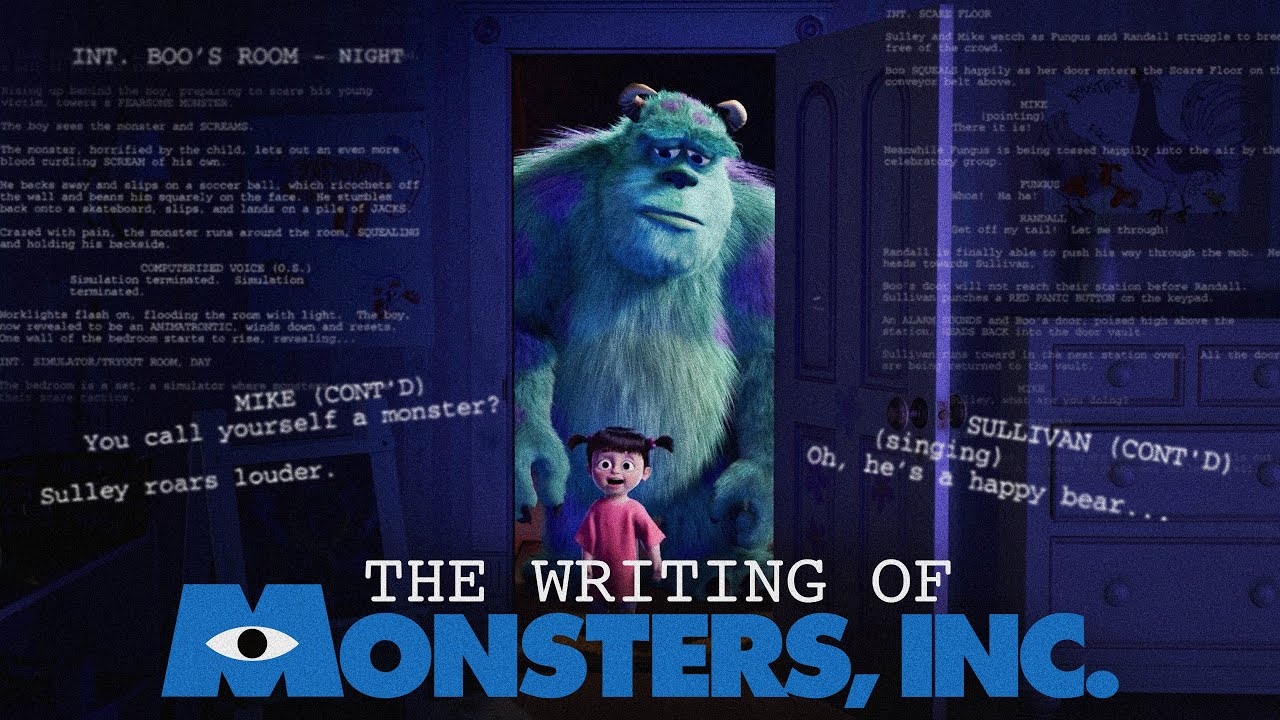
With today's workload, we're going to bottle our screams and laughter with Monsters, Inc., an animated lullabi from Pixar Studios. Monsters Incorporated. Original story by Pete Doctor, Jill Cutton, Jeff Pigeon, Ralph Eckleston. Screenplay by Andrew Stanton, Daniel Gerson. Spoilers ahead. Fade in. Interior. Little boy's bedroom. Night. — Night, sweetheart. Night, Mom. Sleep tight, kiddo. — The bedroom light clicks off. Soft moonlight illuminates the room. A little boy snuggles into bed as his parents' footsteps fade away down the hall. All is quiet. The closet door caks open. The boy looks around the room nervously, eyes growing wide. Suddenly, he spies a tentacle emerging from the closet. The boy turns away in fear, but a second look reveals it to be just a shirt sleeve. He relaxes back into bed. A dark shadow cuts across the bedspread. From under the bed, a pair of evil red eyes peer out. Rising up behind the boy, preparing to scare his young victim, towers a fearsome monster. The boy sees the monster and screams. The monster, horrified by the child, lets out an even more blood curdling scream of his own. [screaming] He backs away and slips on a soccer ball, which ricochets off the wall and beans him squarely on the face. He stumbles back onto a skateboard, slips, and lands on a pile of jacks. [screaming] — Crazed with pain, the monster runs around the room, squealing and holding his backside. [screaming] — Simulation terminated. — Work lights flash on, flooding the room with light. The boy, now revealed to be an animatronic, winds down and resets. One wall of the bedroom starts to rise, revealing interior simulator tryout room day. The bedroom is a set, a simulator where monsters practice their scare tactics. The first descriptive decision that intrigues me is the subtle and telling all is quiet action line at the end of the introductory block. Reason being, living a life of survival personally has turned me into a sentimental sucker for any narrative jargon indicative of the calm before the storm. So it begins. Now, not to be too dramatic, but if you were to tell me it was a dark and stormy night, count me in. You commence your tall tale with in a far away land. I'm also in to show you my cards for some insider baseball here if you want to win my heart over. Don't whine and dine me. Just once upon a time me. You know what I'm saying? — Once upon a time. — Although I will say long walks on the beach a close second. Obviously. In all seriousness though, these fantastical variations of verbiage commonly feel like that sweeping wind, warning of rain, similar to a prologue or — the beginning of a beautiful friendship. Now whether you think adjacent idioms are a cheat code, formulaic, overromanticized, or even propaganda, the fact remains that over time we as a society have been conditioned by the embedded connotations of these expressions to perk up as if we were elicited by Pavlov's theory. — What are you doing? To punctuate my point further, do me a favor and ponder that warm feeling of home when a holiday classic drops that it was the night before Christmas when all through the house not a creature was staring, not even a mouse. Like [snorts] in most cases that would awaken the child in you, right? Unless unfortunately you've lost your imagination or belief in magic, aka you grew up into a generic boring adult. Shame on you. Have a character arc. Let's go. Like words on the page, music is instrumental in conveying story. Your song selection can often make or break a moment. And that brings me to today's sponsor, Soundstripe. Their library isn't stock. It's a curated catalog of over 58,000 tracks by real artists. With Soundstripe, you're not just licensing music, you're getting access to creative tools that speed up your workflow. For me, finding music for a project can be one of the most frustrating aspects. At times you can find yourself spending far too long looking for a single track. So features like Soup, their AI powered search assistant, is incredibly helpful. It makes finding tracks a lot easier since you just describe the vibe of the scene or even drop in an image. And Soup refineses results in real time with natural conversation. And for users with enterprise teams, Soundstripe now includes On Brand, an AI tool that uses 500,000 plus consumer data points to recommend music that fits your brand and style perfectly. And with Soundstripe, every track is fully cleared and ready to use anywhere. YouTube, socials, broadcast, you name it. No confusing
Segment 2 (05:00 - 10:00)
exclusions, no takedowns, no gray areas, just simple bulletproof licensing so you can create and publish without worry. So check out Soundstripe at soundstripe. com/filiot and use the offer code film riot 10 for 10% off your first purchase. Update market and action. To distill my random rabbit trail down, phrases like these work as a psychological call to action, and it's a welcoming invitation that I gleefully accept. Entering Neverland. Nevertheless, in my humble opinion, this specific wording here bookends the initial paragraph with a promise that the silence will be short-lived. The closet door caks open. And if we're being honest, a creaky door is almost always a bit unnerving. This gives way to a sense of relatable dread since the scenario in which the call is coming from inside the house is a universally shared phobia. And this preliminary preamble creeps that anxiety into the audience's mind, akin to the tightening tension of a looming jump scare. — Do you see it? — What was that? Is there something on my closet? Is there a monster under my bed? It leans into incidental trust issues and accidental deception. Are my eyes playing tricks on me? From the get, this leadin imaginatively begs the question for the humans and monsters alike. What's behind the door? And by the story's completion, both camps realized that the answer is that they each had an overreaction to that petrifying inquiry. Comparable to the animatronic adolescent, not everything is as it seems, and it's not always as frightening as you might think or were led to believe. Scare tactics are just that, tactics. brainwashing ps instilled by the greedy power- hungry powers that be. As a whole, this first page not only quickly establishes the theme, it introduces us to the very space where these fearsome foe, including our beloved furry friend, endearingly played by the goodness of John Goodman, clock in and do their jobs. See, the end of page one leaves us with the idea that this is just another day at the office, a normal Monday morning, as it were. All is quiet until it wasn't. Not until they realized that their views were toxic and that their city could run on the energy of laughter instead of screams. And to top that off, that giggly fuel would be 10 times more potent. And throughout the following 121 pages, it took their greatest supposed worry, arriving in the form of a little cute blue BEAR [screaming] — to flip their world upside down, possibly destroy their careers, and change the course of history forever. Now, to play devil's advocate for a second, if the threat of banishment, prototypical promotional videos, and mining the troubled diaphragms of sleep-d deprived tikes wasn't enough evidence already, suddenly being responsible for innocent offspring will definitely expedite the long overdue epiphany that you're really a part of a cult. The bottom line is most folks, despite any given circumstance, don't fully register that they're being indoctrinated until after the fact. — Man, this is some — And subsequently, while we're on the topic of BS, everybody believes in some, including Pixar's Heroes. And yet, time and time again, movie after movie, the studio storytelling techniques routinely subvert the characters expectations by beautifully opposing their flawed way of thinking. Take Finding Nemo for instance, where a lightly toasted turtle assuredly consoled a grieving clown fish that he should set sail to his parental panic so that kids could grow up instead of stay put. Bob from The Incredibles realizes that he might be super, but he shouldn't be undercover at home. In Cars, Lightning McQueen's arrogance assumed that he didn't even need new tires prior to finally coming to his senses. He could go faster for longer and be happier with the fueling friendship of a pit crew. Woody's fragile feelings from the first Toy Story get the best of him until he discerns that his insecurity is the enemy, not Buzz. That space ranger is an ally. All of these actualized arcs and insights kickstart a life change, which is the sign of a true turning point. Be safe. — Marlin becomes a more balanced dad. — Now go have an adventure. — Mr. Incredible is more inclined to teamwork and being a family man. McQueen learns how to race rather than just win. And Woody's newfound clarity makes him a better sheriff, leader, and friend. In unison, it's a philosophy of perspective that's as applicable as it is universal. And now coming full circle back to Monsters Incorporated on the heels of their all is lost moment in Monstropolis. After Big Blue and that high octane, talkative two-legged booger stray from their teachings, disobey orders, and suffer the consequences. James P. Sullivan understands that fear can be a form of belief. The terrifying culmination of cognitive bias 101. And Sully's changed mind is made up.
Segment 3 (10:00 - 12:00)
— We were about to break the record. Sully, WE WOULD HAVE HAD IT MADE. — NONE OF THAT matters now. — He's speaking as a surrogate father figure in a way because he's putting Boo's needs above his own. He's trying to get her home and save her life from a slimy chameleon and a CEO that walks and sits at the same time. And though these characters are technically monsters, they share a human revelation, leveling the playing field. Everyone is afraid, and we all need to get over ourselves and take a long hard look in the mirror to see if the fruits of our labor are rotten. [screaming] But most importantly, the unencumbered and freely given giggle of a small innocent kid really is the sole source of electricity in this world. And it would be a difficult task to argue anything better. Now, in an effort to land this proverbial plane, I want to revisit the seed of the story that was creatively planted on page one. Like Beethoven, this prelude hits different notes, forbidding the failure of leaving the door open, setting up the opportunity for Sully's BFF to later enter, and then it lands some this is the path forward exposition that plays like the nightly news cycle. It's so quick and upfront that we just accept and receive it numb like usual before moving on. — What else is on? — Yeah, let's see what else. — Where's the TV guy? — And although openly broadcasting the story mechanics is a casebyase, scriptbyscript basis, Pixar reminds us that it's easier for the participants to play the game if they understand the rules first. In addition, it surprises us by defying tradition and delightfully demonstrates that contrary to popular belief, some monsters are a little jumpy, too. Boo. — Also, there's a rewarding call back in the closing section of this film where Flynn's rookie mistakes become his comedic calling card and signature move on the laugh floor down to those D-Day jumbo jack spikes on his butt. However, in the end, for me, the most pivotal and ingenious setup of this opener is paid off at the climax when the big bad boss and corporate overlord is caught on camera confessing and furthermore exposing his diabolical business plan in front of the staff. Armed with a bugeyed manner of betrayal, it flips the script, pun intended, and that's a satisfying choice I can't help but respect. I'll see you later. T