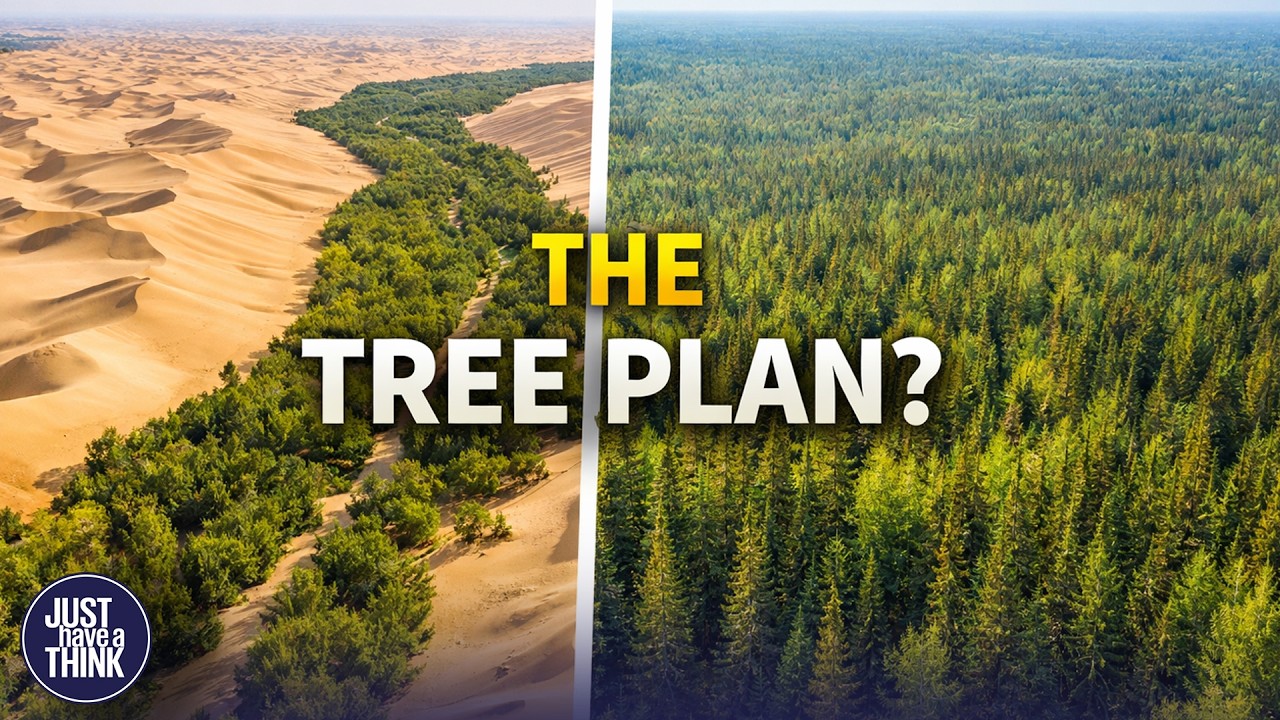
By around 2050, solar power is expected to become the world’s main renewable energy source, with a large share coming from big, ground-mounted solar farms. These things are cheap and efficient to build, which is great. The trouble is though, they’re often planned with little thought for the natural environments they’re moving into. According to one recent peer-reviewed study, if current trends continue, the world could install as much as eighty terawatts of solar power by mid-century, covering almost eight-hundred-thousand square kilometres of land, which is an area roughly the size of Türkiye. Changing land on this scale can alter local temperatures, moisture, and even wind patterns. Those microclimate changes can affect soil health, how carbon is stored or released from soils, how ecosystems function, and even the true carbon footprint of the electricity the solar panels produce. As governments try to tackle climate change while also protecting nature, solar power and soil carbon storage highlight a key opportunity: if it’s done right, then renewable energy and environmental restoration don’t have to be in conflict — they can influence and potentially support each other. Now a comprehensive new study is revealing how solar panels placed in previously desertified regions could be reshaping and regreening the very deserts they’re installed in. The challenge of course is whether such a remarkable transformation can be replicated across all sorts of different terrains and local climates in other parts of the world. Because if you get it wrong, you might find yourself with a bit of an environmental disaster on your hands. Hello and welcome to Just Have a Think There’ve been several studies over recent years trying to establish the effects of ground mounted solar panels, and we’ll have a look at one or two of them a bit later in the video. The paper I mentioned just now though, comes from researchers working at the Gonghe) Photovoltaic Park in Qinghai Province, in China. The team used a method known as Driving-Pressure-Status-Impact-Response or DPSIR to create an indicator system for evaluating the ecological and environmental effects in three areas – directly on the site of the panels, in the transitional zones around the edges, and in areas completely off-site, so that they could get a balanced view of what was happening. What is DPSIR exactly, I hear you ask. Well, that’s a very good question. I wondered that myself. So, I looked it up. The driving forces apparently relate to the underlying human needs that motivate change. So that’s stuff like energy demand, economic growth, population increase and land use change. Pressures relate to the direct stresses those drivers place on the environment via things like land conversion, greenhouse gas emissions, resource extraction and infrastructure developments. Then there’s ‘status’, which takes into account the current condition of the environment as a result of those pressures. So, that’s soil quality, biodiversity levels, temperature, moisture and vegetation cover. Impacts are the effects of those environmental changes on ecosystems, human health, and economic or social systems. And responses are the actions taken by society to prevent, reduce, adapt to, or correct the impacts. It turns out that DPSIR is widely used in environmental impact assessments, policy analysis, and sustainability studies because it provides a clear cause-and-effect structure that helps identify where ecological, social, and economic interventions are likely to be most effective. All of which seems sensible enough. In Gonghe County, the researchers found that the installation of a large solar farm did indeed bring about changes in soil health, moisture, local microclimate– all of which were in a positive direction. And there were even signs of increased biodiversity in the immediate vicinity. The researchers apply relative scores to each of the areas they studied. In true science-speak style, those numbers are referred to as ‘dimensionless composite indices’ representing a relative ecological–environmental performance index, scaled to a zero to one range, with zero being absolutely rubbish and one being totally super-duper. Zero-point-four-three-nine doesn’t mean that the soil is forty-four percent healthy though. In fact, it doesn’t really mean anything unless it’s viewed relative to the other two areas. But when you do THAT then you get an indication that the soil beneath the panels is noticeably more ecologically and environmentally healthy than the soil at the margins and the local soil away from the site. So, at least as far as these researchers were concerned, solar farms appear to be performing a dual role… generating energy and driving ecological restoration. That assertion does appear to be broadly backed up by other peer-reviewed studies carried out in various parts of the world in recent years, but with one or two important caveats. This study from February twenty-twenty-five applies a systemic review to eighteen separate global studies with a specific focus on that soil carbon sequestration challenge I mentioned a moment ago.
Segment 2 (05:00 - 10:00)
Scientists have spent years trying to understand how carbon is stored in soils, especially as climate change has made soil health more important. The authors of this paper explain that soil carbon comes in two main forms: inorganic carbon, which is mostly minerals like carbonates, and organic carbon, which comes from decaying plants, roots, microbes, and other biological material. Modern research focusses less on whether soil carbon is “easy” or “hard” to break down, and more on WHERE the carbon sits. And it’s an important distinction say the researchers. Particulate organic matter, or POM, breaks down relatively quickly. But so called ‘Mineral-associated organic matter’, or MAOM, binds to soil minerals and can stay locked away for decades or longer. That makes MAOM far more important for long-term carbon storage and climate goals. If we want solar developments to support carbon storage, then it’ll obviously be essential to think about how MAOM forms before a site is built. And, even with all the research carried out so far, that assessment is still not absolutely clear. Measuring soil carbon isn’t simple. It depends on factors like soil moisture, mineral content, nitrogen levels, and microbial communities. What is known quite well though is that moist soils are particularly good at forming very stable carbon structures. Crucially, solar panels affect dry and wet environments differently. That means there’s no one-size-fits-all model. It does appear that panels in desert regions tend to create microclimates that moderate light, reduce surface temperature and increase humidity directly beneath panels, all of which CAN support plant life and have a positive effect on vegetation patterns and diversity. We’re not talking about the instant greening of deserts here, but it’s becoming clear that solar infrastructures can modify local environmental conditions in meaningful ways. This study from the American Geophysical Union ran a simulation of extremely large solar arrays in the Sahara Desert and it found that changing land surface properties, including the reflectivity or albedo of the surface, could potentially increase rainfall and vegetation across an entire region. It’s important to balance excitement with caution though, because the scientific literature also highlights potentially negative or at least somewhat ambiguous outcomes. Research carried out in the Mojave Desert showed that large ground-mounted solar facilities there could threaten existing native plant populations, including the famous giant cacti. Those plants have evolved to survive and even thrive in the brutal conditions there, and they don’t take kindly to being shaded or having the soil composition changed underneath them. Another peer-reviewed study found that photovoltaic installations can alter soil microbial communities in ways that could be either beneficial OR stressful, depending on the context. The distribution of water and shading by panels affects where microbes flourish or decline, which means over time the soil function could be affected positively or negatively. So, even microclimate effects that sound beneficial on the face of it can potentially have quite complex ecological consequences that developers need to be mindful of. Lower albedo, for example, means more incoming energy is absorbed by the panels. That might be helpful for greening desert soil, but it can also create local energy gradients that might be harmful to the immediate microclimate. And if you’re not in a desert, you might actually want as much sunshine as possible to help your crops with photosynthesis. That challenge is being addressed with the development of semi-transparent panels at agricultural operations like the Campus Fruits Rouges site in France, where the panels replace the traditional plastic tunnels, allowing a carefully controlled fraction of sunlight to pass through to the plants below. Similar systems are appearing elsewhere in Europe. Swiss firm Insolight is deploying field agrivoltaic structures using a mix of opaque and semi-transparent panels, with projects planned across France, Italy and Switzerland. Peer-reviewed studies on tinted and semi-transparent photovoltaic panels show that splitting sunlight between crops and electricity can work surprisingly well. Crops don’t always need full sunlight — in some cases, moderated light reduces heat stress and water loss, while still allowing photosynthesis to proceed efficiently. What’s important here is that semi-transparent panels change the design philosophy. Instead of solar farms being something agriculture has to work around, the panels themselves become part of the land-management system — shaping light, temperature and moisture at ground level. Ground mounted solar farms might not be the right choice in every location in every part of the world. As we scale them up to meet our climate goals, we’re reshaping landscapes, which means scientific monitoring, ecological planning, and adaptive design must go hand-in-hand with energy policy. But if we can find the right balance of electricity production and efficient crop management, and even the greening of previously barren desertified regions in places like China and North Africa, then solar power doesn’t just replace fossil fuels — it helps reshape how we use land, food, and ecosystems in a warming world. No doubt you’ve got your own views on this one
Segment 3 (10:00 - 11:00)
so if your keen to share those views, or if you have direct experience working in the industry, then as always, the place to leave your thoughts is in the comments section below. That’s it for this week though. I must just say a massive THANK YOU to the thousands of folks who’ve subscribed since we started our little competition to win one of these Just Have a Think hoodies. I don’t sell these hoodies because I don’t do merchandise on this channel, but if you want a chance to win one, all you need to do is to leave a suggestion for a video topic down there in the comments section. And then when we get to seven hundred thousand subscribers, I’ll pick ten winners at random. So, if you haven’t already subscribed then clicking that little button will really help us get to our target as quickly as possible so you can find out if you’re one of the lucky ten. You can also help keep the lights on around here by joining the amazing group of people over at Patreon dot com forward slash just have a think who support me in making my weekly videos without having to resort to ads and sponsorship messages. And a special THANK YOU goes to the folks whose names are scrolling up the screen beside me here, all of whom celebrate an anniversary of Patreon support in January. Most important of all though, thanks very much for watching. Have a great week. And remember to just have a think. See you next week.