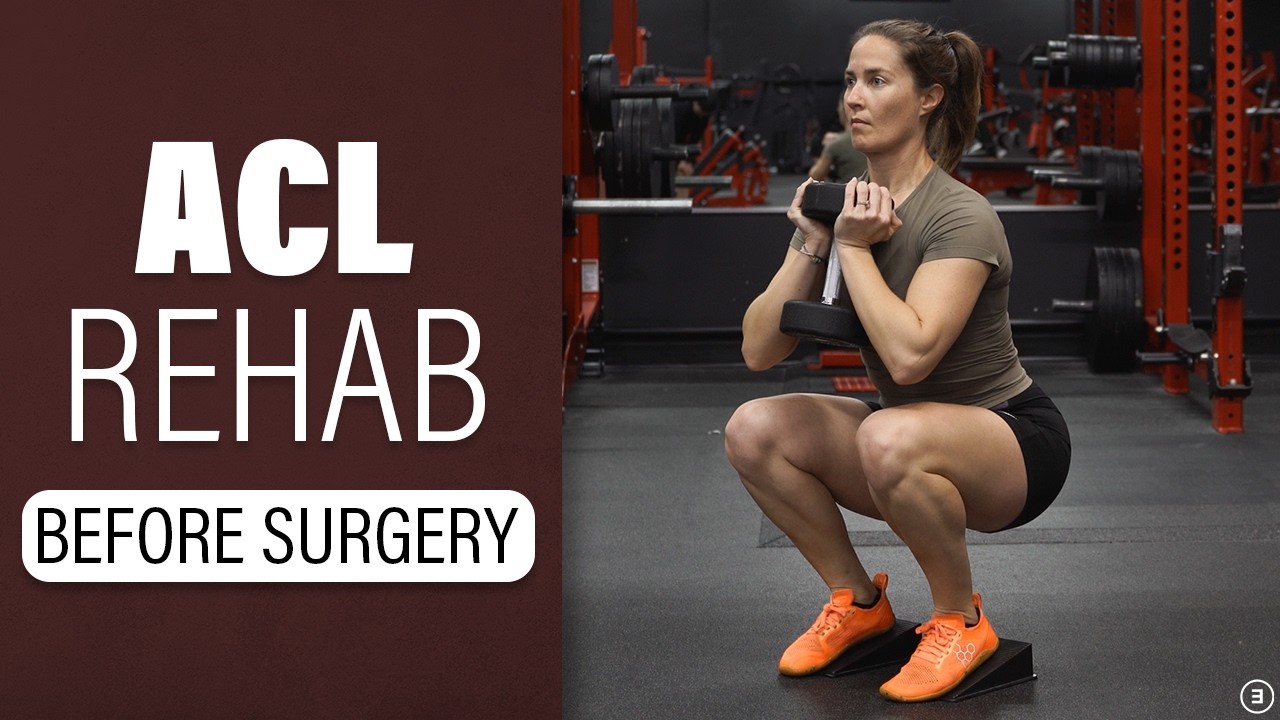
In this video, I'm going to tell you why you should be performing rehabilitation before you get an ACL reconstruction and provide you with step-by-step instructions on what to do. Many individuals are not given the option to start physical therapy before surgery or they schedule the procedure as quickly as possible with the belief that there is no time to waste. However, here are three reasons why you should consider initiating rehab before undergoing an ACL reconstruction. One, research has demonstrated that pre-operative function such as quadricep strength can affect long-term outcomes. Thankfully, research has also shown that pre-operative rehabilitation can improve long-term outcomes. Two, rehab helps you understand the expectations and goals after surgery, especially since many of the recommendations in this video are identical to the ones you'll receive after the procedure. This is also a good time to assess the strength of your uninjured leg as it'll be used as a benchmark for comparison throughout the rehab process. Three, successful pre-operative rehabilitation may influence you to choose a completely non-operative approach because believe it or not, not all individuals require surgery for their needs or goals. I'll discuss this in depth at the end of this video. As always, please consult with a medical professional before making a decision or initiating new exercises. This information needs to be tailored to your specific needs since recommendations may vary based on your unique circumstances. For example, if you had a complex knee injury rather than an isolated ACL rupture. With that being said, pre-operative rehab can be split into two phases. The primary goals of phase one are the same as the goals immediately after surgery. Manage pain and swelling. Restore knee extension range of motion. Restore knee flexion range of motion. Improve quadriceps function. And normalize walking. Let's start with managing pain and swelling. This is the most important consideration after the injury because getting your pain and swelling under control will make it easier to regain your range of motion, improve your quadriceps function, etc. Here are five tips. One, if you're given crutches, use them as instructed by your surgeon or physical therapist. Crutches are extremely valuable for temporarily offloading the knee when pain and swelling are at their worst. Two, if you're given a brace, don't consider it as a replacement for crutches. A brace is meant to provide stability, protection, and limit unwanted motion, but it doesn't offload the knee the same way. Three, don't overdo it initially by spending too much time on your feet. Excessive activity can increase pain and swelling. Four, feel free to ice, compress, and elevate as often as you want. Five, exercise, when done appropriately, can contribute to reductions in pain and swelling. For example, ankle pumps and quad sets, an exercise I'm going to demonstrate shortly, can be performed anytime you're sitting or lying down. A top priority before and after surgery is restoring your knee extension range of motion. There are two primary ways to do this. One, prop your heel for 10 to 15 minutes, four to six times per day to accumulate at least 1 hour of total time. The position might be uncomfortable, but it should not be unbearable. If you're lying on your back or sitting up, it's preferable to be on a firm surface like the floor. You can also do this in a chair if you can prop your leg on another chair or object. Over time, you can add a light weight to increase the stretch if needed. Two quad sets all day, every day. Straighten your leg as best you can. Then squeeze your quads, the muscles on the front of your thigh, by trying to push the back of your knee into the floor. Hold for 10 seconds. Relax and repeat for 10 repetitions. Initially, if this is painful and difficult, you can place a small towel under your knee for comfort and feedback. However, your body's natural tendency is to keep the knee flexed, so you wouldn't want to rely on the strategy for an extended period of time. To progress the quad set, you can incorporate the heel prop I just discussed. To increase the range of motion even further, use a strap and pull up on your foot to add a calf and hamstring stretch. You can also do a similar variation while seated at your desk, at the dinner table, on the couch, etc. Straighten your leg. Squeeze your quads for 10 seconds. Relax and repeat. The goal is to get your knee extension range of motion equal to your uninjured side, completely straight, or some degree of hyperextension. One thing you can look for is a heel pop, which refers to the heel slightly coming off the ground when performing a quad set. Restoring knee flexion range of motion is typically easier than restoring knee extension. There are a lot of ways to improve knee flexion, but these are my
Segment 2 (05:00 - 10:00)
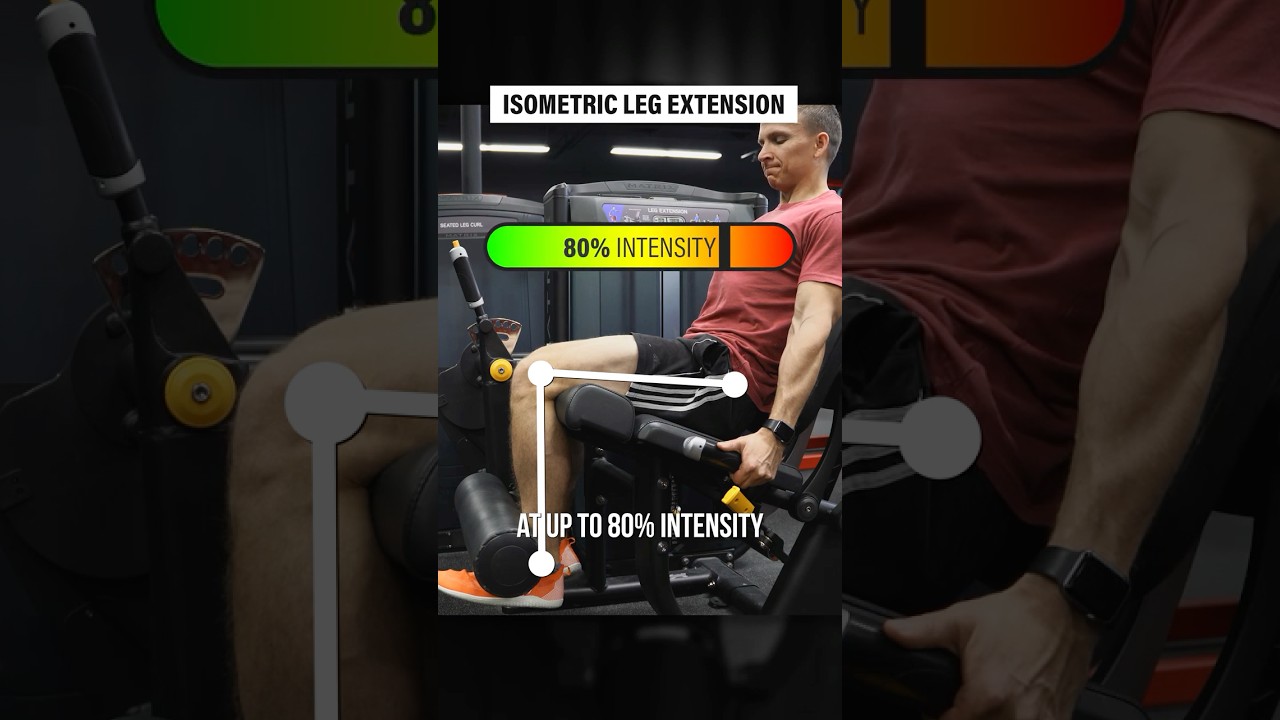
two favorite. One, heel slides. While lying on your back, slide your heel toward your butt. Hold the in position for a few seconds. Slowly straighten your knee and repeat. To assist the movement, wrap a towel or strap around your foot and slowly slide your heel toward your butt while gently pulling on the towel or strap to help bend your knee further. Heel slides can be performed for 10 to 20 repetitions. several times throughout the day. The second option, when it becomes tolerable, is a recumbent bike. Position the seat further back and begin with partial revolutions, moving your knee in and out of as much flexion as tolerable. Once you're able to complete full revolutions, gradually move the seat forward to expose the knee to more flexion. You can also follow a similar progression on an upright bike. Start with the seat at a higher level and do partial revolutions. As your mobility improves and you can complete full revolutions, move the seat down to further challenge and increase your knee flexion. For either option, you can start with 5 to 10 minutes and gradually do more over time. Once again, working on knee flexion might be uncomfortable, but it should never be unbearable. This is not something you have to force. The goal is to get your knee flexion range of motion equal to your uninjured side, which usually involves getting your heel to your butt or close to it. Next, improving quadriceps function. The quads effectively shut down after an ACL rupture, secondary to pain, swelling, and the nature of the injury itself. Two strategies to combat this are methods we've already discussed. One, managing pain and swelling, and two, quad sets as frequently as possible. When you've restored your knee extension range of motion and your function has improved, you can perform standing quad sets with external resistance by using a ball against the wall or a band anchored to an object. An important milestone is the ability to perform a straight leg raise without lag. Lag refers to a slight bend in the knee. Quad sets will help you achieve this milestone. Keep in mind that the primary action of the quadriceps is knee extension. Therefore, straight leg raises are not effective for improving quadriceps function beyond your very basic needs since they become more of a hip flexor exercise. Squats can help, but compensations are common in the presence of pain and swelling as a way of offloading the knee. For this reason, I recommend leg extensions. Leg extensions might not look functional, but the quads are the only muscles capable of extending the knee, and restoring their function is vital to long-term success. If needed, you can start with an exercise known as short arc quads. Lie on your back with a bolster under your knee while repeatedly straightening your leg for sets of 10 to 20 repetitions. If this is tolerable, you can sit up and do the same. Eventually, you can add weight or begin using a leg extension machine. You can also perform isometric leg extensions between 90 and 60° of knee flexion using a machine, strap, ball, or some other immovable object. These are just as effective, if not more effective in some instances for improving quad strength, muscle mass, etc. Aim for sets of 30 to 45se secondond holds. As with everything else, they should be tolerable. You don't need to push all out. I recommend trying them on your unaffected side first to get a feel for the movement. I also recommend that you gradually ramp up and down your effort so you don't accidentally get a spike in symptoms. If you're working with a physical therapist, they may use blood flow restriction training and or neuromuscular electrical stimulation in conjunction with leg extensions or other exercises you are doing as a means of improving quad function. If you've managed your pain and swelling, slowly weaned off your crutches, restored your knee extension range of motion, and have been actively working on your quadriceps function, normal walking should hopefully come naturally. There are exercises you can do to improve your tolerance to putting all of your weight on the affected leg, though. To start, you can practice weight shifting onto that side. Then you can progress to single leg balance. You might start by looking at yourself in a mirror, but you want to eventually take away that visual feedback. When you're ready, you can perform single leg balance with your eyes closed, with head turns, on an unstable surface, or while multitasking, like brushing your teeth, or juggling a ball. There's no limit to what you can do as long as it's safe and tolerable. But stick to the basics at first by building up to three sets of 60 seconds on a single leg comfortably. Marching over hurdles forward, backward, and sideways is another great option. Lastly, backward walking can help reinforce terminal knee extension and weight bearing. Like with everything else, you can begin with a few minutes
Segment 3 (10:00 - 15:00)
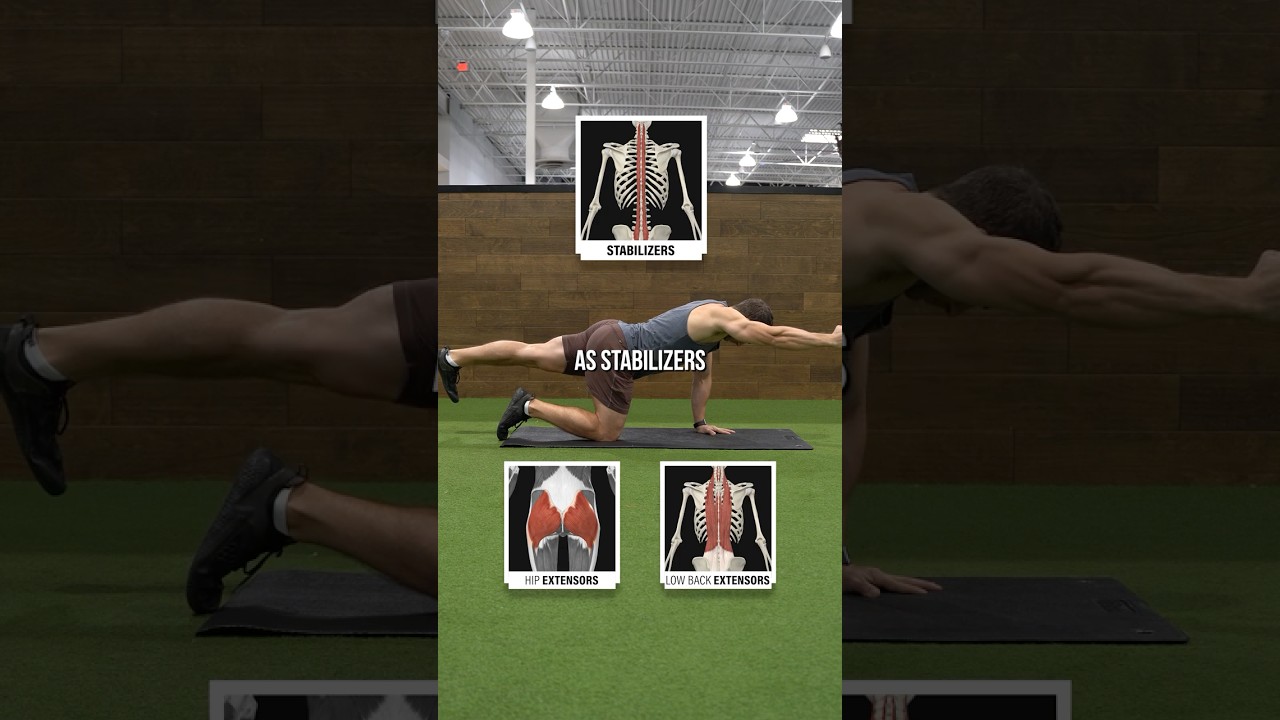
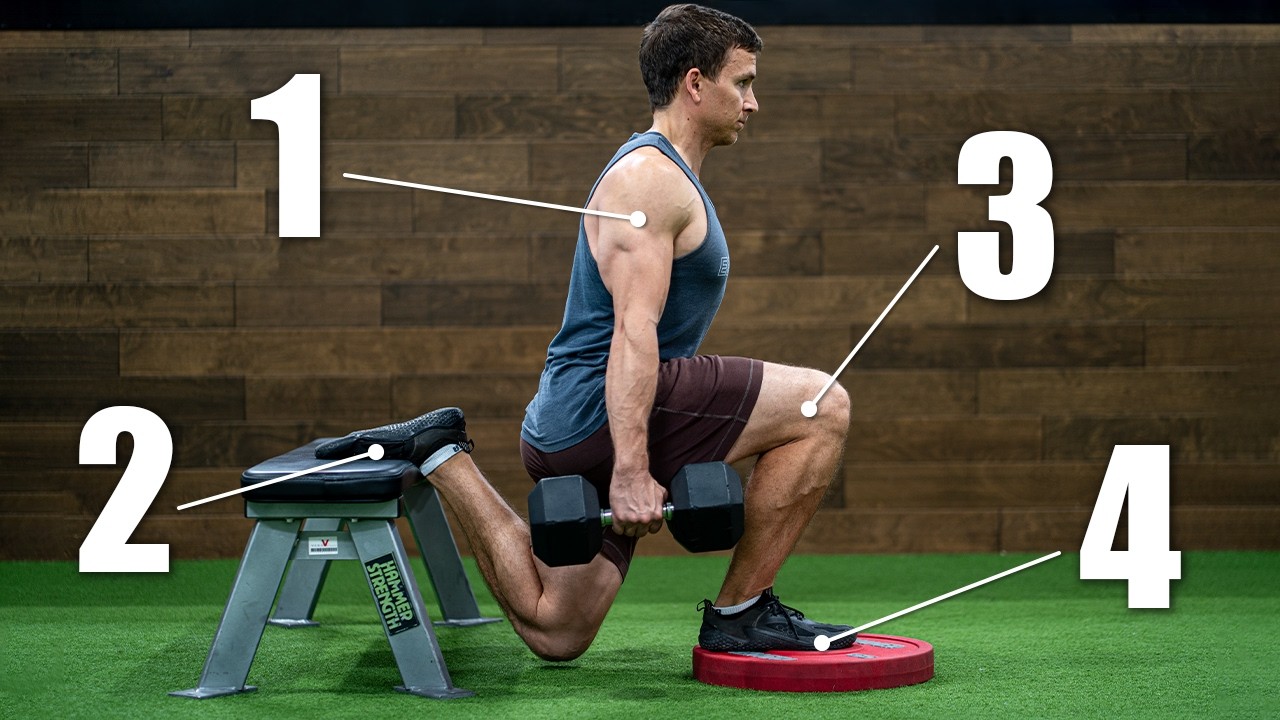
and gradually add more time. I've provided a lot of information up to this point, and there's still more to discuss, but programming these exercises doesn't need to be overly complicated. You just need to do the basics well and often. Assuming no restrictions, here are the four movements you should be doing daily. One, heel prop for 10 to 15 minutes, four to six times per day to accumulate at least one hour of total time. Two, quad sets for 10 repetitions of 10 second holds. You should be doing these as often as possible. Three, heel slides with a strap for 10 to 20 repetitions at least three to four times per day. four short arc quads or leg extensions for multiple sets of 10 to 20 repetitions or 30 to 45 second holds. As you progress through your rehab, your routine might start to look more like this. 10 minutes on a recumbent or upright bike. Quad sets with a strap. Heel slides through a larger range of motion. Seated leg extensions. Straight leg raises for three sets of 10 to 20 repetitions. Standing quad sets with external resistance. Single leg balance for three sets of 30 to 60 seconds. Backward walking or marching over hurdles for 3 to 5 minutes. Heel prop with weight. Keep in mind that doing more is not inherently better if you aren't mastering the basics and applying the same effort and intentionality into every movement you do. I understand that everyone wants to be further along in their rehab, but there's no benefit to skipping steps. Phase two is similar to what should be done following phase one after surgery, which includes muscle strengthening, movement training, and fitness reconditioning. In 2010, Itinadall developed a progressive five-week exercise therapy program that involved a minimum of two training sessions per week. Sessions included a warm-up such as using a stationary bike, treadmill or elliptical for 10 minutes, quadricep strengthening in the form of squats, seated leg extensions, and the leg press. Hamstring strengthening like hamstring curls on a ball or using a machine. Balance training with various devices. and eventually jumping, landing, and plyometric exercises. While comprehensive, I would suggest adding trunk exercises, additional hip exercises, and calf strengthening, as well as more exercise variety. Here's a general framework I recommend building up to two to three times per week. Optional 10-minute warm-up. Squat movement, hinge movement, knee extension, knee flexion, hip or trunk exercise, heel raises, balance. Here's a practical example. Monday, optional 10-minute warm-up, split squats, kickstand RDL's, single leg extensions, hamstring curls on a ball, single leg heel raises with a dumbbell, side planks, Y balance. Thursday, optional 10-minute warm-up, heel elevated goblet squats, single leg Roman chair hip extension, single leg extension isometrics, single leg prone hamstring curls, single leg hip thrusts, single leg heel raises with Smith machine, three-way RDL with knee drive. This is hard and it's a lot, but you wouldn't start here. This is an eventual goal. You would modify the exercise selection, intensity, volume, range of motion, etc. as needed. For instance, you wouldn't start with split squats or heel elevated goblet squats. Instead, you would probably start with mini squats and gradually increase the range of motion, weight, etc. Similarly, you would perform bridges before attempting single leg hip thrusts or double leg heel raises before trying single leg heel raises with weight. When appropriate, add one to two jumping, landing, and plyometric exercises at the beginning of each training session. And if that's not enough, don't forget to train the uninjured leg to maintain your strength and muscle mass. Some single leg exercise options include leg extensions, seated or prone hamstring curls, seated or standing calf raises, and the leg press. I haven't provided a timeline yet, but everything I'm describing would take at least 2 to 3 months, if not longer. I understand this may sound unreasonable if you're a competitive athlete with a strict timeline for returning to sport, especially considering that you'll be repeating this entire process after surgery. However, some individuals may purposely delay surgery for the reasons I listed at the start of this video. For others, they might not have a choice due to surgical weight times, financial barriers, etc. At the very least, the majority of people should initiate, if not complete, phase 1 prior to surgery. As always, discuss the potential risks
Segment 4 (15:00 - 18:00)
and benefits with your healthare team and family while reflecting on what you think is best for you. There's not always a simple right or wrong decision. For some people, the most difficult decision is determining whether or not surgery is necessary for their goals or needs. The Canon trial and the compare trial randomized individuals who tore their ACL into two groups. One group received early ACL reconstruction followed by rehabilitation, which is the usual standard of care. The other group was assigned to rehabilitation with the option of later ACL reconstruction if needed. What were the main takeaways from these two studies? And the group that was assigned to rehabilitation first, 50% ended up choosing to get surgery. The other 50% who didn't get surgery had outcomes that were similar to those who had the early ACL reconstruction. This research informs us that for some individuals, non-operative management is a viable option after an ACL tear. Similarly, a recent study by your housing at all in 2025 did a 10-year follow-up on patients who chose rehabilitation alone and concluded that despite being older and less active, participants had similar clinical, functional, sports participation, and osteoarthritis outcomes compared with those who chose early ACL reconstruction. Additionally, contrary to popular belief, research has shown that a fully ruptured ACL can spontaneously heal in some cases, including in many of the participants from the Canon trial. Recently, Phil Bayadall reported on the evidence of the high rate of healing in patients who were managed using the cross bracing protocol, which is a specific protocol developed by Australian surgeons Dr. Mvin Cross and Dr. Tom Cross. A randomized control trial is currently underway to determine its long-term efficacy compared to surgery. Based on papers by Grindamadol in 2018, Peterson at all in 2021, Vanderapodol in 2022, and yearhausen at all in 2025, you may be more inclined to choose nonoperative management if you're older, have good knee function without episodes of instability, are confident in your knee, had an isolated ACL rupture rather than a more complex injury, and weren't involved in level one sports prior to the injury, such as soccer or football. Despite my short discussion about healing, it doesn't necessarily have to factor into your decision. For example, if you're a 35-year-old individual who wants to return to pickle ball and your knee has been feeling great after 3 months of rehab, you might be more suitable for non-operative management. On the other hand, if you're a 20-year-old competitive college athlete who tore their ACL and injured their meniscus, you may be more inclined to choose an early ACL reconstruction. Regardless of your final decision, please don't base your choice only on this video. You should make an informed decision after discussing the options with your surgeon, physical therapist, and family members. Thank you so much for watching. If you enjoyed the video, please hit that like button, subscribe, turn on notifications, and leave any comments down below. If you are looking for a rehab or performance program, or you are interested in working with us one- on-one, visit our website at e3rehab. com. Peace.