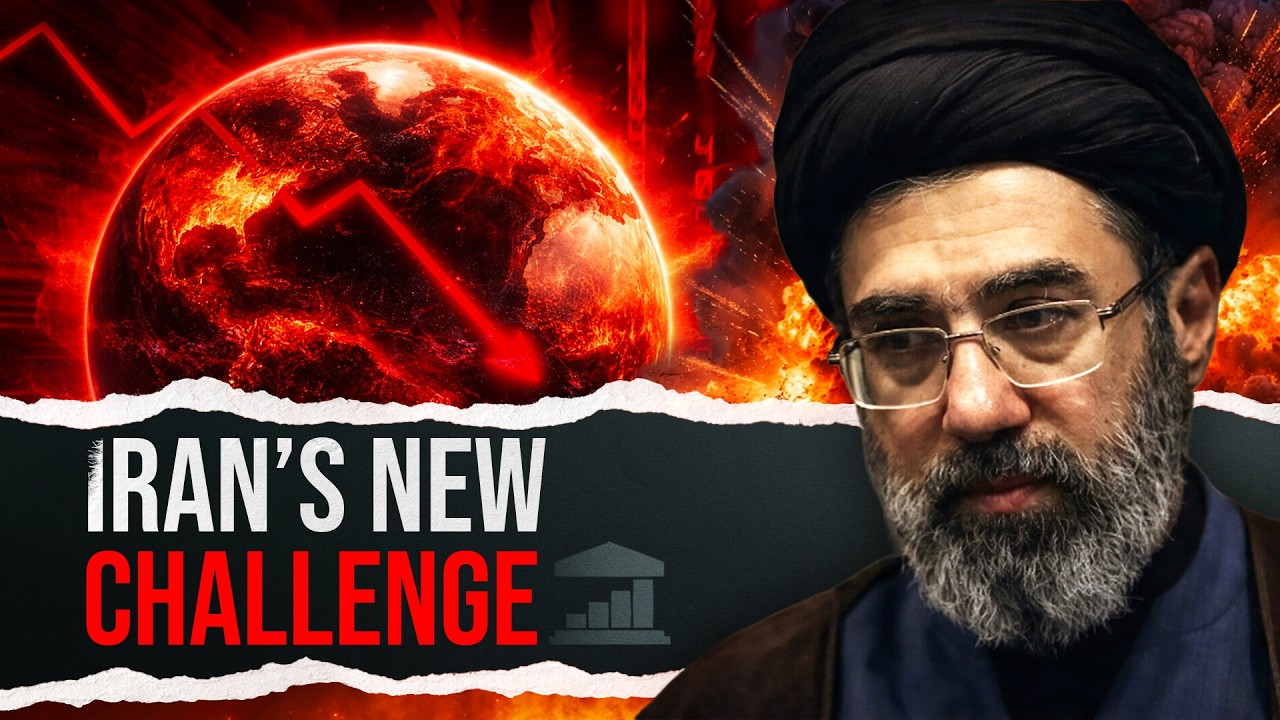
It's incredible. Israel has done it again. Ali Larijani, the secretary of Iran Supreme National Security Council has been eliminated. We're talking about the second most powerful person in the country in real terms. The former right-hand man of Ayatollah Ali Kami and ultimately the top authority in charge of the regime's security, both internal and external. This guy had more power and more room to maneuver than President Peskian himself. Well, to be fair, it's not like the president has that much sway anyway. And that's because Larajani was also the highest authority when it came to deciding Iran's foreign policy above even the foreign minister. As we've explained to you on several occasions, the power structure in this country is very peculiar. But the key point here is that we are looking at the most significant elimination in this war. Apart of course from the Ayatollah himself who lost his life during the initial attacks. And watch out because he hasn't been the only one. Another major figure within the regime has also been taken out in recent hours by Israeli missiles. I'm referring to Golam Raza Sulmani. And be careful, don't confuse him with Casims Sullemani, the Kuds force commander who was eliminated by the United States in 2020. This Sullemani was the top commander of the besiege militia, the all powerful internal repression apparatus that is absolutely crucial for keeping the Ayatollah in power. So yes, we're looking at another massive blow to Iran's leadership, which today is far weaker than it was yesterday. In fact, Israel hasn't slowed down at all. While we were preparing this video, we received confirmation of yet another casualty, the intelligence minister himself. This is getting wild. Of course, Iran's response was immediate. They launched several waves of missiles against Israel within just a few hours. In fact, there have even been reports of cluster warhead missiles falling on Israeli territory. missiles that as they approach their target release dozens of smaller projectiles that are almost impossible to fully intercept. Iran has fired deadly cluster missiles at central Israel in what it says is revenge for Israel's assassination of its security chief Ali Larajani. And yes, Iran must be running low on missiles and drones by now. In fact, launches have dropped significantly in recent days. But it seems they're still holding on to these more dangerous missiles for special occasions like this. Even so, the damage remains limited. And as you already know, this is not the real threat Iran still poses. But anyway, the point is that we're looking at two very high-profile eliminations that only add to the uncertainty. For some analysts, this brings us closer to the end. For others, it could make things even worse. So, as always on Visual Politic, we've been asking ourselves a few questions. What are these eliminations really aiming to achieve? Could they trigger an even more radical shift within the regime into Iran? Who exactly were these two men? And more importantly, how have the Israelis managed to take out two major figures like these within just a few hours? Well, then pay very close attention to what comes next because we might be about to witness a very significant shift within the regime. And I'll tell you right now, everything points to the fact that it won't be a shift for the better. Let's begin. But first, if you're interested in the world of investing, if you want to learn how to manage your savings, protect yourself against inflation, and figure out how to make money beyond your day job, I've got some news for you. At Visual Factory, we've created the Visual Factory Club, a newsletter where every week we send out free content focused on essential financial education, the ABC of what everyone should know to understand the stock market, financial markets in general, investment platforms, how to assess investment opportunities, and which markets may have more or less potential. Because, of course, if you want to invest your money so you're not at the mercy of your country's economic instability, you at least need to understand the basics of the financial world. In the Visual Factory Club, you'll learn all of this completely free of charge. Through the link below and this QR code, you can sign up for the club and start receiving the upcoming editions. What's more, when you sign up, you'll receive a dossier where I explain in a clear and simple way the most essential investment concepts, what multiples or the PE ratio are, what indices are, ETFs, derivatives, funds, EPS, you get the idea. After that, every week, you'll receive additional materials and market analysis to help you stay informed about what's going on. And by the way, the sooner you sign up, the better. Since we send each episode of the series by email and every edition is unique, if you're not subscribed, you might miss some of them and you won't be able to access them later. But with that said, let's get into the video. The first thing we need to understand in order to grasp what we're dealing with from here on out is who these two men really were and what kind of power they held. If you like, let's start with the bigger of the two, Ali Larijani. As I just mentioned, he was the secretary of Iran's Supreme National Security Council. And you might be thinking, okay, that sounds impressive, but what the hell does it actually mean? Well, he was essentially the strategic brain of the regime. The Supreme National Security Council is the body where absolutely everything important in Iran is decided when it comes to security and foreign policy. It's a place where the military, the Revolutionary Guard, several members of the government, and representatives of
Segment 2 (05:00 - 10:00)
the Supreme Leader all sit together. From there, the most critical matters are coordinated. From negotiating with other powers to preparing the country for conflict. In other words, it's the place where Iran decides how to play its cards. And Larani was the person connecting all those pieces. That's why he wasn't just another official. He was one of those figures without whom the regime will never be quite the same again. But do you know what? To understand it better, let's imagine power in Iran as a triangle. On one side, you have the Ayatollas. On another, the Revolutionary Guard, and on the third, the government. And in the middle, there's someone who connects and manages all that power so it doesn't fragment. Well, that someone was precisely this guy. On top of that, his profile was especially interesting because it combined two things that are rarely seen together. On the one hand, he was a man of the system, deeply tied to internal repression and with a hardline ideological profile. Although careful, he wasn't among the most radical, which doesn't mean he was moderate. Not at all. Larry Janney is considered the architect of the massacres that took place last January during the protests against the regime over the economic crisis. Massacres that left thousands dead. But at the same time, he was also reasonably pragmatic in foreign policy and relatively predictable. In fact, he did want to reach a nuclear deal in the Geneva negotiations, talks that were on the verge of securing major concessions from the Ayatollas before they collapsed when the United States and Israel went to war. Now, as I said before, this was a hardliner, but not one of the most radical figures. To give you an idea, he was even barred from running in several elections, largely because he was seen as too independent and uncomfortable for the regime's hardest factions. In fact, it has come to light just a few days ago during the selection of Mod Harour as the new supreme leader. Larajani tried to prevent this Kamaya Jr. from being chosen. Larajani was maneuvering to delay Kamune's election by the assembly of experts working with the former president Hassan Roani to either postpone the critical meeting of the assembly or find an alternative candidate. — The reason? Well, exactly what we told you in our last video. Maja is far more radical than his father and Larajani didn't like a profile like that. Let me be clear. This doesn't make him a saint or anything like that. The man was a real butcher with thousands of deaths on his hands. But the truth is the Iranian regime can be even more ruthless. And in fact, his elimination in a way strengthens the most radical factions within the regime, those pushing for a total and permanent war against the United States, Israel, and the West. Because there are even sectors now essentially advocating for a kind of jihad. After all, if someone willing to engage in dialogue with the enemy ends up like this, what's the point of negotiating again? The only solution is political victory, and that means forcing the United States to withdraw. But then why go after him? Well, I think we can say that Israel eliminated him primarily to make one thing clear. They have zero interest in trying to reach an agreement with the Ayatollas. They intend to go all the way. Either way, this operation leaves us at a particularly delicate moment. A window has opened for even greater radicalism. And yes, there are analysts who believe that Larajani's fall will deeply weaken the regime, bringing us closer to the end of this nightmare. But others say not a chance. That the death of this top figure is a heavy blow, but not a decisive one. — The killing of Ali Larajani weakens Iran, but at a cost. The regime is now less predictable. — According to these analysts, the regime's foundations remain solid. They'll quickly find a replacement and move forward. In fact, there's already a name being widely mentioned as a successor. And honestly, it's quite concerning because with him, things would go from bad to worse. I'm referring to Sed Jay Ley, the man hardline factions will now try to place at the head of the Supreme National Security Council visual politic. This is a much more ideological figure and far less inclined to accept any agreement to end the war or curb the nuclear program. They will substitute Lara Johnny with a madman who prefers martyrdom and will go to the end. This is the real danger left in the wake of this operation. But the story doesn't end here because at the beginning of the video we already mentioned that another major figure has also been taken out in recent hours. And now I'm referring to Golam Razer Sullemani, the head of the besieged militias. Because if Larajani was the one managing the country's major internal and external affairs, Sullemani was the man responsible for keeping the streets under control through fear. visual politic community. The besieged militias are no joke. We're essentially talking about a paramilitary force with between 600,000 and 1 million active members. A militia that is embedded everywhere with Iran's social fabric and made up of the most loyal among the loyal to the Islamic Revolution. In fact, to give you an idea, just before the war, the besiege had around 300 district bases in Thran alone, along with 3,000 small neighborhood bases spread across the country. And I say before the war because Israel and the United States have been heavily focused on striking besieges and small bases all across the capital with what objective? To make
Segment 3 (10:00 - 15:00)
Iranians gradually lose their fear of the regime's repressive apparatus until just a few hours ago led by Sullemani. In fact, this man's work has been key to keeping the system standing over the past few years, which have been especially turbulent due to the sheer number of protests that have taken place. Under his command, the besiege always followed the same pattern. Rapid, large-scale deployment of militias, brutal repression, and the use of lethal force with live ammunition, no restrictions. We're talking about a veteran of the Iran Iraq War, someone who joined the Revolutionary Guard in the 1980s and fought in some of the most important operations carried out by Iran. And over time, he rose through the ranks to become a key figure in internal security, coordinating both militias and regular forces. That's why his death is no ordinary loss. It's a direct blow to the system that keeps control inside Iran. But do you know what? There's something in all of this that we haven't told you yet. And it's going to impress you because all these operations targeting such crucial figures by Israel are anything but simple. They require a huge amount of intelligence and information data that comes from Mossad itself from opposition informants who reach out to the Israelis and also from sources within. And that's how figures like Larajani Sullemani or even Ayatollah Ali Kamune end up being taken out at the exact right moment and in the exact right place. Pay close attention to what we're about to tell you now because it's truly remarkable. The allseeing eye. — Let me ask you a question. How is it possible that Israel is able to take out one after another some of the most heavily protected figures in Iran? right in the heart of the country and in the middle of a war when security measures are supposed to be at their highest. How does an enemy infiltrate one of the most closed off regimes on the planet and strike with such surgical precision? Well, what we're seeing now is far from a one-off operation. This is something much deeper and far more established. Israel is operating with a network inside the country that has been built over decades. And in moments like this, it acts like a scalpel. The key to all of this has a name, infiltration. Because what we're looking at is an almost perfect combination of human intelligence, agents, and informants, and highly advanced technology. In other words, people and machines working together. The backbone of Israel's on the ground intelligence comes from the informance it has inside Iran. And when I say inside Iran, I mean even within the regime itself. On the one hand, as I mentioned, Mossad has managed to build a very extensive network of informants. And honestly, recruiting collaborators in Iran isn't as difficult as it might seem. Why do I say that? It's quite simple. Because the country is going through a very difficult economic and political situation, and because a large part of the population is opposed to the system, and Israel has known how to exploit that better than anyone. For years, Mossad has been placing pieces across the Iranian chessboard. officials, members of the security forces, and even people from the innermost circles of power. People who observe and listen and who, when the time comes, provide the Israelis with the key information needed to carry out lethal strikes like the ones we've been talking about in this video. In fact, take a look at this. The killing of Larajani was initially scheduled for Sunday night, but was postponed at the last minute. It wasn't until Monday afternoon that authorities received the vital intelligence that he would travel to one of his hideout apartments near Tan alongside his son as opposed to his normal residence. Some sources even suggest that residents in the area where Larry Jani was at the time of his death may have provided the final piece of critical information that made the operation a success. But what's most interesting is that this doesn't stop at the human factor. The other half of Israel's success lies in technology. Israel doesn't just have spies, it has access. Access to communications, access to surveillance systems, access to critical infrastructure. And that's something to pay close attention to. visual politic community. The level of penetration inside Iran is so deep that they have managed to hack security camera networks in Iran, interfere with supply chains, and even manipulate telecommunications infrastructure. Just think about what that means. It's not just knowing where your enemy is. It's knowing what they are seeing and what they're hearing. It's like playing battleship while being able to see your opponent's board. And when you combine those two elements, the infiltrated human network and technological dominance, the result is what we're witnessing. devastating precision operations. A clear example was the assassination of Hamas leader Ismael Hanier in 2024. A bomb planted inside a supposedly secure house in the most fortified and exclusive neighborhood in Thran, a place that was supposedly protected by the Iranian state itself. So, how on earth does an explosive get there? There's only one possible answer. Someone on the inside opened the door. And that's just one example. There are many more. Another case was the key nuclear scientist behind Iran's atomic program, Mosen Fagres. The regime's official version tried to downplay what happened, but everything points in the
Segment 4 (15:00 - 18:00)
same direction. Total vulnerability. In other words, severe security failures and a much deeper level of infiltration than Tran is willing to admit. But if there's one episode that truly sums all of this up, it's the one that marks the beginning of the 2026 war. The elimination of the Supreme Leader Ali Kamayi. We're no longer talking about just any target. We're talking about the most protected man in Iran, the center of power and the symbol of the regime. And yet, they knew exactly where he was, when he would be there, and even which part of the building to strike to ensure he would be eliminated. So, the question is, how on earth do they pull this off? Well, it appears that for around two decades, Mossad has had access to the electronic devices of K&A's inner circle. Two decades. That means years of tracking, analyzing routines, and identifying all kinds of patterns. On top of that, they hacked Tyran's surveillance cameras, allowing them to monitor his movements in real time. And as if that weren't enough, they also had agents on the ground confirming schedules, meetings, and even providing visual proof after the operation so Israel could verify the outcome. In other words, this is no longer just espionage. It's total environmental control. — We know everything about you. Israel pressures Iran's commanders with threatening calls. — But there's more. Israel has not only shown that it can infiltrate people or systems, it has also demonstrated that it can penetrate something even more complex, supply chains. Let me give you an example. Do you remember the explosive pages that detonated simultaneously in the hands and pockets of hundreds of Hezbollah members? Israel manipulated 5,000 devices that had been shipped to Lebanon and Syria over a period of months and detonated them in a coordinated way. At the end of 2024, it was the so-called Grim Beeper operation. To pull this off, they had to insert premodified devices into complex logistics networks. In other words, they altered them before they reached their destination and delivered them as actual weapons. All without anyone noticing a thing throughout the process. The immediate consequence, paranoia and distrust. Another weapon Israel uses very effectively against its enemies. And that same paranoia is now inside Iran's own security apparatus. Make no mistake about it, Iranian counter intelligence services have entered a spiral of extreme distrust. There are internal purges, arrests, and even executions. They are not holding back because they know the enemy is powerful and that it's everywhere. In fact, the latest execution for espionage was announced just a short while ago. The death sentence of a spy for the Zionist regime, who had been providing images and information about the country's sensitive locations to Mossad officers, was carried out this morning. Faced with the threat of Israeli hacking, Iran has chosen to revert to more analog and less connected systems. Sure, they're theoretically more secure, but this also comes at a cost. Poorer coordination. In other words, a clumsier system. And in a wartime context, that's not good news. The level of sophisticated infiltration that Israel has achieved inside Iran has become the Ayatollah's regime's greatest enemy. Because in the end, bombs and missiles carry out the attacks and eliminate key figures. But to get there, the essential weapon is everything we've just told you about. — Ali Cami, Larijani, Sullemani, and many others now know this all too well. Now then, at this point, with everything we've told you, what do you think? Do you believe that the elimination of such important figures could make the regime even more aggressive and radical? Do you think Israeli intelligence has become unbeatable inside Iran that its reach now has no limits? Well, then, leave your thoughts down below in the comments. But first, very importantly, if you enjoyed this video, don't forget to hit the like button and subscribe to the channel if you haven't already. That way, you won't miss any updates, and you'll also be helping us out a lot. As always, thank you so very much for being there. Take care. I'll see you in the next one.