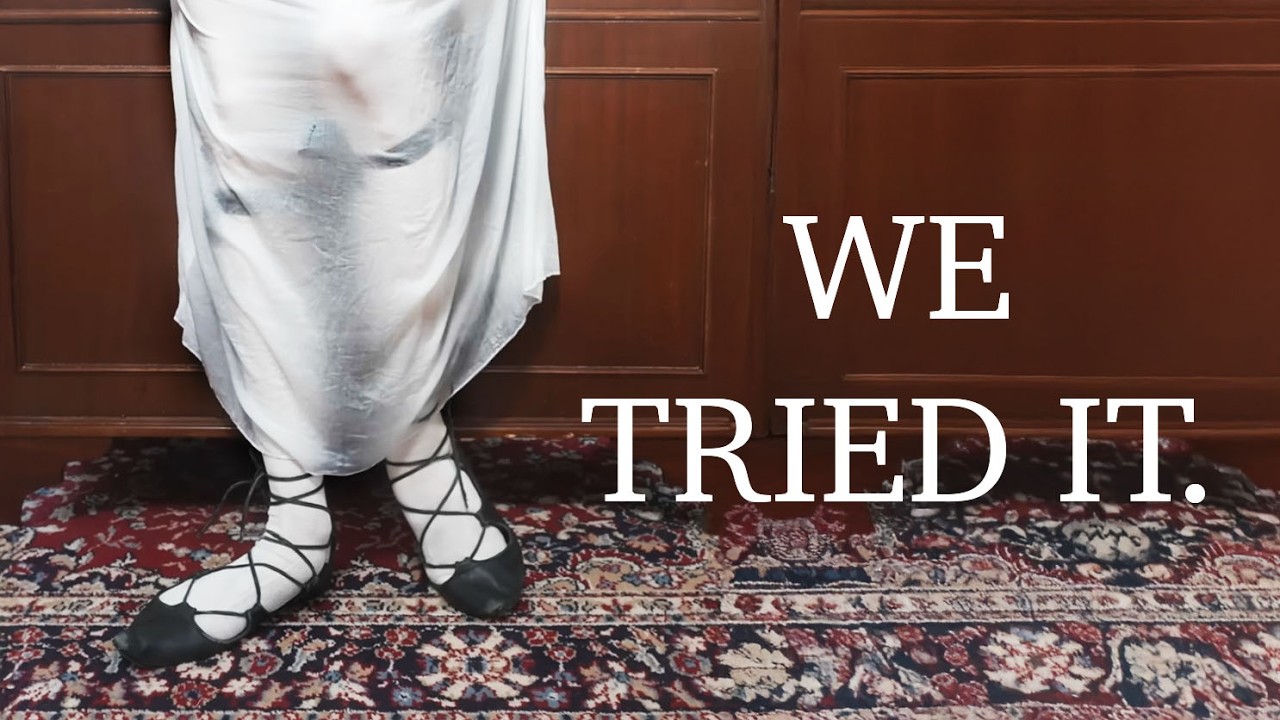
People have done some pretty horrible things for a costume. I don't know about this. Oh my god, it's cold. But like, why would you do this? This is a Regency wet t-shirt contest. — So, this is a really great way to get a really wrinkly gown. So, I am back here in the studio with the wonderful Hillary Davidson, Dr. Hillary Davidson, dress historian, archaeologist, associate professor at FIT, curator, connoisseur of Regency dress, and author of the now published guide to Regency dress, which we will conveniently product placement right here, and we will talk about later. But primarily, it's here to hide the taser, so those of you in the comments don't wonder why I'm It's not a taser. It's a microphone. — I promise no tasing happened. You know, no gets were injured in the filming of this video. This is probably the most pervasive myth I come across in Regency dress is this idea that women dampened their muslin dresses in order to make them cling to them. I have seen this everywhere. in books on jewelry that say almost nothing else about Regency dress. I've heard this in casual conversation. I have seen this in the work of professors whose work I love and respect and somehow they slip in the oh you know Regency dampened Muslims. — Yeah, I first learned it in my intro to costume history class at university like it's everywhere. — There's something about this absolute myth that just enchants people. Like people just love the idea of it — or ridiculous and people just love to laugh at history. Oh, how stupid they were. People have been repeating this myth without thinking about the logistics. It's just like, oh, they dampened their dresses. And you know, I'm a dress historian, so I'm like, really? How? How do you dampen it? How would you keep it damp over an evening? So, I want to see if it's actually possible to do what this great myth says women did. And I'm here just to be the the damn bee. So, putting myself back in the time, how would I do it? First of all, to take a muslin dress, immerse it in water, ring it out as best you can, and then put it on, which already seems like it's going to be difficult to get into. And also, are you just going to be trailing paths of water? — The second is you dampen the dress with some sort of sprinkling method. How do you get that even? Because they didn't have the spray bottles at the time. We could we can try sponging. — We do have a sponge. We can try that. And then the third one is dampening it when it's on someone and seeing again how can you do that? Does it become even? Do you just get like great spots of damp? And if you are at a ball or an evening out, how would you redampen? — Is someone just like walking around with a sponge redampening everyone? I just I cannot project a way that this would work logistically, but I want to try. Muslin in the period. The fabric that we're talking about is what is often in US English called mull. So it's a kind of fine usually white cotton fabric. The best is made and imported from India. And this kind of light cotton translucent fabric was really expensive and a luxury import. So we have some muslin and we're going to try just to see what the patterning is like. Yeah. We're going to try sprinkling and sponging and seeing what happens. Okay, at least we can see where that's coming through. We can see that it's making the fabric transparent, but it's not like it's not even. So, what is it going to take to make that — even? A lot of water, probably. — Yeah. But then it's going to be really drippy. — Yeah. Yeah. — So, like that's spotty. — Spotty. All right. So, what happens if we then m — That's better. — Okay. better, — but still kind of — need a lot of water. — Yeah. And now we've got stripes. — Okay, cool. Cool. — It's also got heavier. — Interesting. Yeah, the weight's going to change things a lot. — All right, so kind of wiping down, — but this is already dried quite significantly. Like whereas a minute ago it was really clinging, now it's just sort of it's just kind of damp. — We have a dress that you've made for us to try. I want to sponge wipe down — half of the front of it and then we'll see also what it takes for you to get into it. — Okay. Good. — All right. I'm excited. — This is based on a Marvelous gown that was recently sold at Carrie Taylor auction, but this is projected to be the sort of high fashion woman who would have worn a quote unquote wet gown in this very light white muslin. This fabric is not quite what we're looking at historically. So, we've got a wearable dress and then we have a correct fabric. The dress we'll be using for this experiment was constructed entirely by hand using pattern shapes
Segment 2 (05:00 - 10:00)
and sewing techniques that are appropriate to this turn of the 19th century period. There is a whole separate video on the construction if you missed that and would like to go take a look. If you would like to learn these essential hand sewing skills, whether for historical reconstruction or just, you know, for the purposes of constructing your own long-lasting clothes, might I suggest you check out Skillshare, who are sponsoring this video. Whether you're a hobbyist, a creative professional, or anyone interested in a craft and looking to level up your skill, Skillshare is a fantastic learning community full of creatively focused classes. I've even released a couple of classes myself which are detailed walkthroughs of important handstitching techniques, all of which are used historically and several of which were used in the creation of this experimental gown. What I love about Skillshare is I get to do the teaching in a lot more patient detail than the YouTube algorithm typically prefers. There are also a bunch of quick assignments associated with the classes because as with any craft, it is really important to get those muscles working and practicing the techniques yourself in order to really retain that information. This November, Skillshare have a super special offer that I'm very excited to tell you about because not only do you get your first month free trial, we all love those, but you also get 20% off your first paid month. Visit the link down in the description box below to check it out for yourself and happy learning. So, I think then what we're going to do is sponge wipe down — half of the front of it and then we'll see also what it takes for you to get into it. — Okay. — This is not going to be fun for you to try and get into. — I'm so excited. — Well, that's good. That's that's good. It could be a lot worse. — Okay. So, — we're starting to see the table underneath. Yeah, that's wet. — This is a Regency wet t-shirt contest. It — We do have a history of attracting the wrong audience from what we are intending to attract. Comment below if you're watching this just for the Regency wet t-shirt context. — Exactly. — All right, we have a half damp gown. — Burn a dead banner and the half damp gown. — Let's go. Let's do this. — Okay. So, here we have a really uh we could say damp, but I'm going to say clammy — gown. — It's not dripping wet, but it is cold. — So, even if you are like the most extreme fashionista at the time, you're wearing some sort of shimmese in English they use shift or smoke underneath and over that you put on some kind of breast support, corsets, stays, whatever it is. And then generally you put on a pett coat over that as well. But that's kind of the minimum that your average middle class or above Regency woman is wearing. — So all of these garments are being worn underneath every outer garment whether you're going to a ball or it's just everyday clothing — just hanging out at home. — I think it's then easier for us to misinterpret the myth because we're imagining, oh, you can just throw your sheer over gown on, dampen it, and it's going to cling to you all gorgeously. Mhm. — But historically that was less of a possibility to interpret it that way because they understand more that okay we've got all of these foundation layers going on underneath. — It's interesting. It's not actually cleaning. — It's no because the pett coat isn't wet. So I don't — Yeah, — it is crushing more. Like if I just crush that it's — So this is a really great way to get a really wrinkly gown. — Yeah. It's like it would just cling to the under fabric anyway. — Exactly. — It's not because of the water. — Not at all. And especially with like the Indian muslin that's got that slightly more fuzzy surface. That's what it like the clinging and the slight static electricity between the undergarments — is what's making it work anyway. But looking at this, — I could just be a difference between either side. — So let's see what happens then when we dampen on the body. Okay, — which will probably get through to the pett coat and that might give us more of a clean. — Oh, that's wet. This has soaked through my pett coat and my shift now. — So, what I'm seeing here is that it's actually making the whole thing stiffer because it's soaked through the pett coat and shift. It's lost a lot of its like soft — yes — fluid drapery and it's becoming just like — wet and a mass of fabric that is it's like papermâe. So what I'm taking away from this already is why would you bother? — Yeah. On the pre-dampened side it looks exactly the same and on the dampened on the body side it looks worse. So why would you bother? — Beats me. Are we dipping the whole dress? We're going to dip the whole dress and then see what happens when you put it on you. For science science. — This is the lighter, more kind of
Segment 3 (10:00 - 15:00)
actually muslin fabric. And this was the one that took 8 minutes to dry once it was dampened, not weted. So, if we take this fabric and use it as our example for a lighter dress, let's see what happens as well. First of all, it's like it really shrinks. — Yeah, it turns to nothing. — So, it's easier to rinse out, like ring out, but it's look at the wrinkles that weren't there before. It's certainly clinging to itself again. So, this is less drippy than I was anticipating. It's kind of absorbed more of the fabric. But if we take this as that is wet our dress and the water was warm and this is no longer warm. Um so I'm trying not to let this hit your skin but it's delicious. — I mean it's cleaning but again it's just clinging to the petticoat. It's soaked through completely. It's so wet and it's just gross and cold. — That's soaked through your — Look, it's clinging and it's beautiful. Gorgeous. Look at this wet Regency shoulder t-shirt action. — Regency women do not wear underpants. — That's Yes, that's a point. — Yeah. So, if you're like not wearing anything underneath as well and this was sheer, you're going to see everything. — Yeah. — It's not like you've got like a little pair of knickers on in to kind of cover up what you've got going on. — So, we are dunking the dress. Yeah. To see what kind of effect it gives and how damp it gets, how long it takes to dry off if this is the way. Um, so now we have the issue of like getting we put the water in and we have to get a lot of water out, which just snail trail all over the ball. — Yeah. I'm going to ring this out, which might give an interesting pleated effect, but I think is also going to be something that maybe you wouldn't want in your — Yeah. — ball gown. This is very long and very wrinkly. Ew. — It is clinking to itself. Um, but it is also dripping quite a lot. Cool. Cool. Cool. So, — do you think you can? — Yeah. Can you step through it? — Oh my god. Wait. This might be worse. But it's good to have both attempts here. — Okay. People have done some pretty horrible things for fashion, but I don't know about this. Oh, and now like all the lacing is wet. This feels horrible. Has it? It's already soaked through. — It's soaked through everything. — It's just a damp pee. — Oh, yeah. — Damp pee. — It's kind of splattering on the bottom and sticking to the floor. — I'm literally a mop. — Regency Roomba. — It's a weapon now. Should we take a walk? Should we go outside? Is that going to be the worst? Oh my god, this is horrific to walk in. I mean, it's clinging, but it's just not clinging nicely. — Floor is so wet, by the way. — Oh my god, it absolutely. it's cold. — Yeah. — Are we ready to open? — Yeah, let's go. It makes a sound. You sound like a busting le. This is horrible. And this is not even like winter. This is just a normal English day. — And your hem is filthy. It's picked up instantly everything that's on the ground. — Wow. Delicious. I'm so cold. It probably doesn't even look wet. — It doesn't look wet at all. If if I didn't know, I wouldn't know. — Zero out of 10. — You look so unhappy. Give me a little twirly twirl. — Wow. You can't tell it's wet at all. — But like, why would you do this? — Do you want to go inside? — Yeah. — Ew. E. the whole bit.
Segment 4 (15:00 - 20:00)
— Yeah. — Disgusting. — Wow. That is probably the worst hem that I've ever seen. — And when you think about how expensive a good muslin fabric was as well, why would you let that happen to it? — Oh my god. Look at all like all my hemming. — Mhm. — And it's just — Mhm. — Love that. Love that for us. — I'm warm again. — So, we have our still damp muslin. This is muslin we dampened earlier and it's still really — Yeah. This is the one that we fully immersed. — Yeah. — So, fully immersed muslin does stay wet for longer. It's now been like 25. — And it's it it feels pretty like almost the same as it was when we first dampened. I think what we've just discovered from putting the dampened dress on you is that it actually takes away lots of the qualities of the muslin that people desired the muslin because of. So it's kind of counteracts — the qualities rather than enhancing them. — Yeah. — I couldn't tell when you were wearing the damp dress that it was damp — except that it looked worse. — Yes. — And it definitely picks up more material when it's wet than when it's dry. So I think our verdict after the experiment is why — it's really misinterpretations of a couple of statements where people say they look as if their gowns were dampened, right? And it's become this kind of game of whispers where the sources say it's as if and then some costume historian in I don't know the early 20th century has gone they dampened Muslim gowns and then everybody just repeats this over and over again without thinking about the logistics. The verdict that Hillary has come to here is that the reference to wet gowns within the period itself are analogies. And this is likely derived from a newfound wonder at for the first time in generations really being able to see the real human figure underneath the dresses unobscured by large structures like bees and faringales. — The perception of nakedness is very different compared with how dressed people were before. So how people are perceiving that in the period of like everybody looks like they're naked. This is just comparative. — It stands to reason then that once we reach the 20th century where it becomes less of a given to be wearing skin layers of clothing, you know, we're not wearing full shift layers, the idea of the outer garment being wet can much more easily spark the imagination. if indeed we had women walking down the streets dripping wet and freezing cold. There's also the big question of why again there is no documentation, no written evidence, especially when it would have been such a recent and objectively ridiculous thing to be happening. — This is great for less great for you. — Yeah. Myth busted. — Damply busted. Moistly busted. — Moistly busted. moist myth busting. — Yes. — For those of you who wish to learn more about Regency fashion and about the potential myths around Regency fashion, Hillary has just come out with a new book, The Guide to Regency Dress. Like, this is the Bible. For those of you who like to do Regency dress and want to reproduce Regency dress, film and TV and theater costume designers, this is going to be an absolute godsend cuz I've written two books on Regency Dress previously, Dress in the Age of Jane Austin, Regency Fashion, and Jane Austin's Wardrobe. But I just want it to be an introductory volume for anyone who's interested in Regency dress from someone who's got no experience at all to museum curators who are trying to do really specific cataloging. So this is kind of the distilled essence of what I know about the nuts and bolts of Regency dress. Hillary is an academic. She's done extensive research in this period as well as others dress history in general. She's a really well-renowned and acclaimed — Thank you. academic in this field and the fact that she's written a very accessible book that is understandable and engaging to people who have never engaged with this subject at all. This is going to be an absolute staple. If you would like to go buy this book, uh we will have the link down in the description below for you. Uh enjoy. Oh my god. A friend. He naps in the courtyard sometimes. What are you doing? — Oh. Oh my god.