Throwback to 1800 When French Women Wore See-Through Gowns

Throwback to 1800 When French Women Wore See-Through Gowns

Machine-readable: Markdown · JSON API · Site index

Поделиться Telegram VK Бот
Транскрипт Скачать .md
Анализ с AI

Оглавление (5 сегментов)

Segment 1 (00:00 - 05:00)

There was a particular fashion in the Regency period, particularly in France, amongst a subset of highly fashionable women, affectionately called Le Merve. French people roast me in the comments. For the most delicate white see-through gowns made from the finest Indian muslin that draped and clung as if they were wet. One of these such gowns popped up on auction at Cary Taylor earlier this year. And when I tell you auctions are my favorite sporting event, I mean that watching the fight over this extraordinary gown was the highlight of my February. But just because I didn't have a spare £300,000 to play myself doesn't mean I can't still have my own scandalous Marvuse gown. So I decided to make one. The pattern for this gown is a combination between some similar Regency bodice shapes which I could find in Janet Arnold's Patterns of Fashion 1. And I did some self-drafting where the shapes in the book weren't quite right to this particular style of gown. Thankfully, the archive page on Carrie Taylor maintains a ton of beautiful close-up inside and detail images of the garments. So, I was really fortunate to have loads to work from. This bodice is really cleverly designed. There's a supportive underbodice which laces closed to help anchor the dress tightly to the body. Then there's a gathered over bodice which is attached at the side front area just below the straps which rests delicately over the top but it doesn't have to do any actual work to hold the bust in. This is secured and held closed with a drawstring at the waistline as well as at the top edge of the over bodice. Then I quickly mocked up the support bodice to see how it fit and to draft the overlay piece which sits on top of the under structural bodice. You'll see. With a corrected pattern, I can go ahead and start cutting out. Before we jump into the construction process, I first need to put on my spooky little detective hat for a second because I need to tell you about a really cool project I just did with this video sponsor, June's Journey, our favorite little Jazz Age themed hidden objects mystery game. This month, they are celebrating their 8th anniversary, which means naturally there's going to be loads of fun cool in-game events and special prizes and cool decorations. However, there is also a super cool special new mystery for you to solve. When I tell you there is a haunted hotel and a spectacular ghost mystery to be solved, I mean it because I went to that hotel. That hotel actually exists. And I may have joined them for a couple of episodes to do some ghost hunting along with the formidable ghost hunter Raven Thornne. We may or may not have had some uh spooky incidents that happened. There is going to be a whole special little episode series over on the June's Journey YouTube channel if you want to go and watch that. And I'm now very much looking forward to going into the game and playing through the mystery myself. And it's going to be interactive, so you will be able to hunt and search for clues and play along yourself, both in-game, of course, as well as the series airs. If you are not already a June Journey player, now is a very exciting time to start playing. You can download June's Journey for free by going to the link down below or by scanning the QR code on screen. Now, I think we have some Regency mysteries to go solve. Sadly, my fine, delicate muslin from India still has not arrived. Such are the treacheries of very, very international post. So, I'm using a lightweight English muslin, which although features a delightfully similar embroidery detail as the one on the reference gown, isn't quite as lightweight as the Indian muslin. It's more similar to a Cambridge muslin, which would have been one of the heavier muslins worn in this period. Oh well, I will just have to make another gown whenever that comes in. The construction for Regency gowns is fairly straightforward. A couple of short bodice seams and two long skirt seams, both backstitched and then turned and felled to finish the seams. As we have moved into the 19th century, however, dress makers started sing for tiny stitches. So, the back stitches I'm

Segment 2 (05:00 - 10:00)

using here are pretty much as small as I can make them without ripping the fabric itself. I'm taking up usually around two to three of the fine weave threads per stitch. Likewise, the arms eye hems, which I'm just doing now, are as absolutely narrow as I can make them. I've really only just rolled over the edge of the fabric until it's just doubled over and then I'm just felling that down. So, because the center front edges of the underbodice will need to be laced tightly together, and this is all made from the same very delicate muslin inside and out, the original gown has been faced with a heavier cotton reinforcement for about an inch. The three lacing ties, which come out and tie together at the center front, will be trapped inside this edge seam. So, the whole edge will be nice and secure and strong. Oh, at this point I must have heard one of the magpies outside and went to go give it some snacks. Although I think I accidentally summoned some crows instead. — Anyway, lacing Now that the center front edge is all put together, I can go ahead and hem the whole top edge of the bodice. The overbodice pieces will need drawstrings at the top and bottom, which is the top edge and the waistline. So, first I'm attaching a narrow strip of cotton tape to the top edge, which will be folded over another lacing tape and felled down, trapping that lacing tape inside to form a drawstring within its casing. The tape has already been anchored really tightly at the side edge, and it's just left free to draw out at the center front. I've also hemmed the two short front and back edges of the over bodice pieces. So now these can be stitched right on top of the underbodice at the shoulder straps to form the overlay.

Segment 3 (10:00 - 15:00)

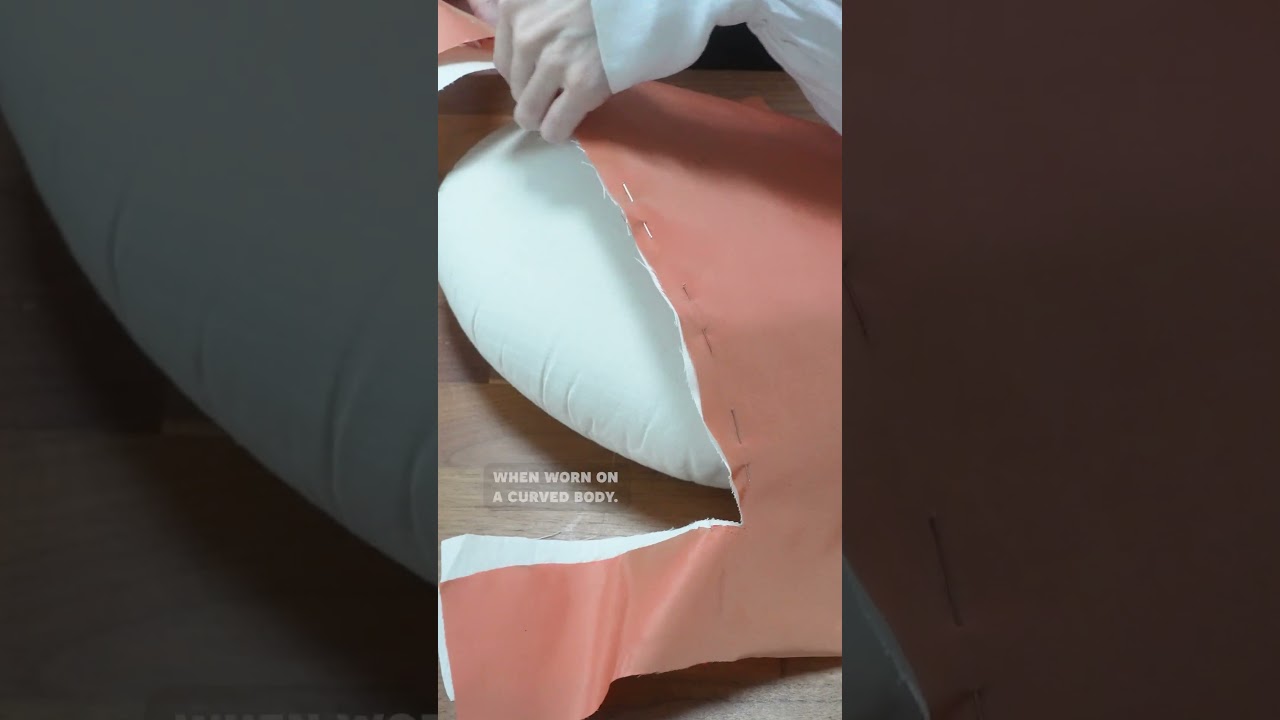
Regency bodesses are so tiny and yet probably require more construction hours than the skirts. This skirt is literally just a front and a back piece stitched together at the side seams. These seams are done with a combination stitch, which is half running stitch and half back stitch. Since they're not going to have to take as much strain as the bodice, we can sacrifice some strength in favor of speed here. Many skirts from this and earlier periods are literally just straight up running stitched. Because early 19th century is still the era before the dawn of the domestic or the commercial sewing machine, and skirt seams are long. The back of the skirt gets pleated up at the center back. And this pleading is admittedly a little weird. I needed to get about 3 ft of fabric pleated up. And the reference images shows a lump of pleat only about 4 in wide. Meaning that the pleat had to kind of double pleat on top of each other in a way that made production manager Marley ask, "Who hurt you? " when given the unfortunate task of having to iron this gown after later shenanigans. At least that's what I was getting just from looking at the photos. But there may be a more sensical pattern to the real thing. And of course, having gone back and looked at the photos again while writing the script, I've realized that the pleats aren't actually attached inside the waistband, which would have made a lot of sense and would have made my life a lot easier. But you know what? We move on. I think there's actually a really good reason for this wad of pleat at the back, though. Some gowns from this period still want a little bit of fullness or padding right at that center back point, which echoes back to a slightly earlier fashion of wearing a padded rump with late 18th century gowns. I think the original maker might have intended this wad of pleats to add a sort of padded bulk to the back. The front of the skirt attaches only to the over bodice. So across the over bodice, then passing on to the main bodice for the sides and back, leaving that under bodice free. Then it's just again some straightforward back stitching to get the bodice and the skirt attached. Except the pleats were an absolute chunk to stitch through, which I now know was not a thing that I was supposed to be doing. You know when you have those moments when you're making a historical garment where you're like, "This is so unnecessarily difficult. Like, I must be doing something wrong. I can't imagine why they would have done it this way. There is clearly a better way to do this. " Well, there probably is this. And in fact, I should have relooked at my images because this was not the way that they were doing this and for good reason. The pleats were probably just skipped over in the same way that you sort of skip over that underbodice. Would have made my life so much easier. But alas, I did not, of course, forget about the underbodice. This lower edge just got hemmed off as expected. Now, because this bodice is made from such a delicate fabric, and many areas curve around bias points on the weave, and so will be really prone to stretching out with wear, all the outer edges of the bodice are reinforced with some narrow cotton tape to keep them in shape. So, I'm just adding this to both the arm size and around the whole front strap and neck edge. The raw waist seam is likewise finished off with a strip of cotton tape just stitched over to enase that seam allowance. When the waist tape reaches the overbodice attachment point, however, I'm just anchoring another drawstring tape at either of these side points and running this underneath the casing tape to form the waistline drawstring. I am being very careful not to catch these drawstring tapes while I'm stitching because that will impede the function of the drawstring and I really don't want that. So every couple of stitches I am just giving it a little tug to make sure the drawstring still slides really smoothly and I'm not trapping that drawstring tape underneath within the casing. Finally, a hem. This was given a generous circa 1/2 in on the original, not just delicately roll hemmed like the rest of the garment, which I weirdly found more tedious to do than just the

Segment 4 (15:00 - 20:00)

narrow rolled hems. Got to actually make sure the turnings here maintain a relatively even width instead of just letting muscle memory do all the work, I guess. History is unfortunately a little bit clickbait though because although these gowns looked really light and see-through, in reality, the women wearing these gowns had many layers of clothing underneath. The gown on the mannequin at the auction is deceivingly scantily clad is really only displaying the overdress without all of her structural layers. Even to such high fashion events as wherever this marvelous gown would have been worn, a lady would be wearing her full set of undergarments. So as a base layer, she would be wearing a linen shmese and a pair of stockings on her legs. No further undies. This is the absolute skin layer historically. Despite anything you think you see, no you don't. Unless you are the YouTube monetization checker, in which case, yes, you do. Then we've got a pair of short stays, which really just acts as bust support in this period since we're not doing waist lines. There were also fulllength corsets worn in this period, but these corsets are very minimally, if at all, boned because again, we're really just going for bust support here. We're not going for waist reduction. Next is a petticoat, which in this period could include straps or a whole bodice since again we don't really do waist lines in fashionable garments of this period. And it's rather tricky to get a skirt to hover in the middle of the rib cage without slipping down. And then we have the gown. Our super fine Indian muslin has actually arrived by now. So, I did make this up into a little veil to finish off the look and so that we can really see the difference in weight. Imagine a whole gown just made out of this. It would have been gorgeous. These gowns were wispy, but as we now know, with a lot secretly going on underneath the surface, — but wait, I can hear a few of you more fashion history conscious viewers shout, "Weren't the dresses worn by less marvees wet? Isn't that the whole marvel behind them? Walking around sping wet and freezing cold, catching plague in the name of fashion. Well, let's just say that this long-standing piece of fashion history trivia was something that fashion historian Hillary Davidson desperately wanted to put to the test to determine whether in fact this is truth or myth. — Oh my god, it's gold. And so we have come full circle to the point of making this gown for the purpose of testing this very myth. — This is horrible, — which is something that you will be able to see right here on this channel. So be sure to subscribe if you would like to be notified to join us for that adventure. Thanks once again to June's Journey for sponsoring this video and for facilitating our ability to take on this fantastic project. Check out the link down in the description box below if that interested you. Also, as a special little bonus for those of you who have watched all the way to the end, I have a little surprise. If you've been following some of my social outlets over the past few weeks, you will know that I've been talking about releasing patterns. Our very first pattern is the Deerstalker witch hat, which is a project I did here on the channel years ago, but has been definitely a favorite here for quite a while. This little spooky deerstalker witch hat is hopefully a nice simple, easy to follow, easy to test, easy to draft pattern that we are officially releasing. It's just in time for a nice little spooky project for you to have for Halloween season or just generally the winter because these little ear flaps do great at keeping your face warm. It is for free over on Patreon and for the general public it will be a $5

Segment 5 (20:00 - 21:00)

download link down below. It's also $5 to join the Patreon. So, if you would like more perks, including the ability to chime in and in future vote on which patterns you would like to see happen next, as well as monthly vlog updates about what's going on in the workroom and weekly newsletters about all of the shenanigans that go down in the workroom. That is all once again down in the description box below for you to go have a look at. A super special thank you to all of you who are over on Patreon who helped to provide us the funding to get project materials, to work with other amazing crafts people and artists, and simply to just keep the lights on and the iron warm here in the studio. I very much appreciate it. Okay, bye. These stitches are as big as you. — It's going to be a very well educated caterpillar. — He's learning all about hand sewing. I'm not sure if he likes it yet. — Yeah. How would a caterpillar sew? He's the size of this pin head. He's like, "Please put me down. — What's going on here? " — Let's go. He's done. That's enough sewing for the day.

Другие видео автора — Bernadette Banner

Ctrl+V

Экстракт Знаний в Telegram

Экстракты и дистилляты из лучших YouTube-каналов — сразу после публикации.

Подписаться

Дайджест Экстрактов

Лучшие методички за неделю — каждый понедельник