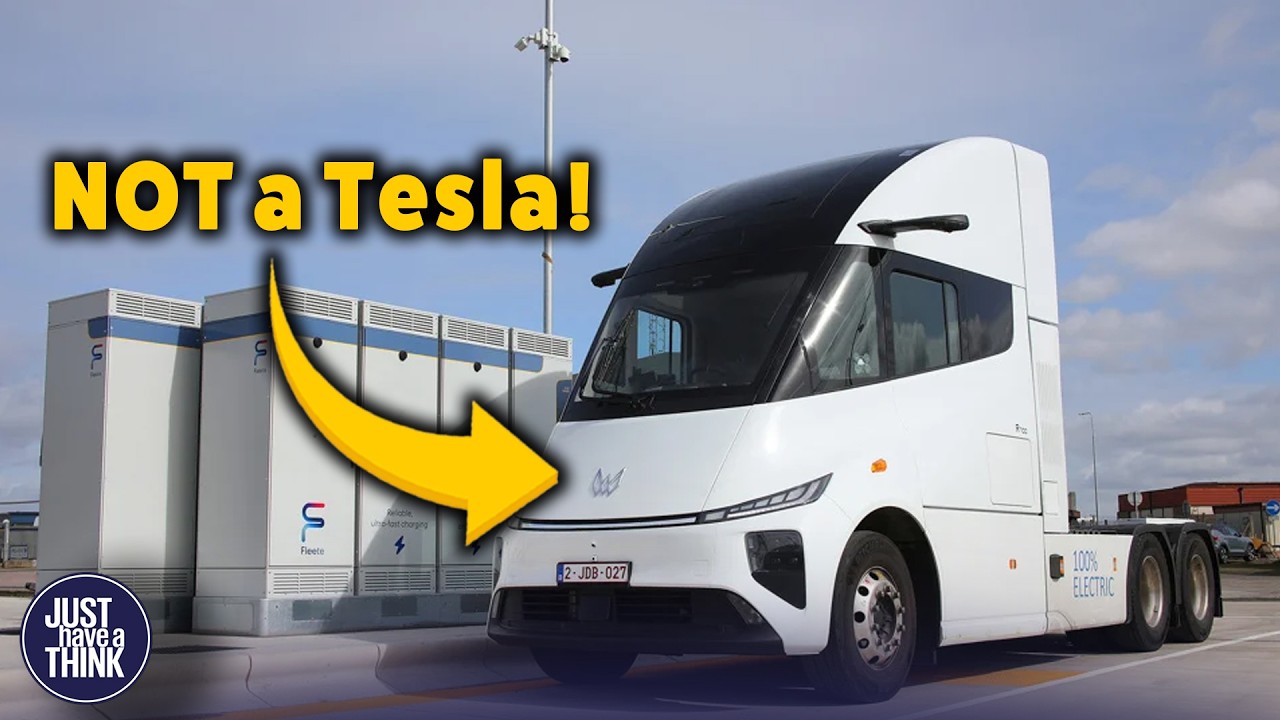
The conflict in Iran and the blockage of the Strait of Hormuz has unsurprisingly caused a global oil price crisis and a spike in interest in electric vehicles. But is the higher cost of diesel and gasoline really the only factor in the electric transition? A new report says no - it's much more complex and nuanced than that. And the transition was probably already primed and ready to accelerate anyway.
Help support this channel's independence at
http://www.patreon.com/justhaveathink
Or with a donation via Paypal by clicking here
https://www.paypal.com/cgi-bin/webscr?cmd=_s-xclick&hosted_button_id=GWR73EHXGJMAE&source=url
You can also help keep my brain ticking over during the long hours of research and editing via the nice folks at BuyMeACoffee.com
https://www.buymeacoffee.com/justhaveathink
Reference Links
Main research paper - The economics of the electric vehicle transition: demand, supply
chains, and innovation - Viet-Nguyen, Eliott and Harper
https://cep.lse.ac.uk/pubs/download/dp2164.pdf
Recent Michael Barnard article
https://cleantechnica.com/2026/01/22/the-assumptions-that-broke-china-india-and-the-end-of-fossil-growth-models/
Business Standard analysis
https://www.business-standard.com/world-news/china-electric-trucks-diesel-demand-outlook-ev-shift-iea-rystad-sci-125112500784_1.html
Recent article from The Driven website
https://thedriven.io/2026/02/10/how-battery-powered-truck-trailers-can-cut-diesel-use-by-up-to-50-pct/
Check out other YouTube Climate Communicators
Simon Clark:
youtube.com/user/SimonOxfPhys
ClimateTown:
youtube.com/channel/UCuVLG9pThvBABcYCm7pkNkA
Dr Gilbz
youtube.com/@DrGilbz
zentouro:
youtube.com/user/zentouro
Climate Adam:
youtube.com/user/ClimateAdam
Kurtis Baute:
youtube.com/user/ScopeofScience
Sarah Karvner:
youtube.com/channel/UCRwMkTu8sCwOOD6_7QYrZnw
Beckisphere: https://www.youtube.com/channel/UCT39HQq5eDKonaUV8ujiBCQ
Our Changing Climate :
https://www.youtube.com/channel/UCNXvxXpDJXp-mZu3pFMzYHQ
Оглавление (3 сегментов)
Segment 1 (00:00 - 05:00)
No doubt like me, you've been watching the developments in the Middle East with increasing incredility and concern over recent weeks. And if you drive an internal combustion engine vehicle, I guess you're probably wondering how much your next tank of fuel is going to cost you. That doubt appears to be leading more and more people towards considering an electric vehicle alternative. So much so that some commentators are suggesting that electric vehicles may be about to surge past a critical tipping point and accelerate into a transition that becomes increasingly unstoppable. But is that transition really only happening because oil prices are going up? Is that the only variable at play here? Are we really that fickle, my friends? Well, maybe not. Because new research suggests that the relationship between oil prices and electric vehicle adoption rates is breaking down and that we're now in what the research authors describe as a systemic path dependent transition. So what do they mean by that then? Hello and welcome to Just Have a Think. We've been hearing a lot about electric vehicles reaching a so-called tipping point over the last few years, haven't we? This idea that once adoption reaches a certain level, it becomes self- sustaining and the transition starts to accelerate under its own momentum. For those of us of a more climate orientated persuasion, it's certainly a very appealing idea. So, what's this systemic path dependent stuff all about then? Well, according to the authors of this new research from the London School of Economics or LSSE, the transition is not a simple technological one at all. Before we get stuck into all that though, I'm delighted to let you know that I will once again be hosting several discussion panels at the upcoming Everything Electric Live show up in Harriut on Friday the 8th and Saturday the 9th of May. There's all the usual brilliant stuff like test drives of all the latest electric vehicles, of which there are now, of course, about a gazillion to choose from. Plus, a whole arena full of experts to guide you through the process of choosing heat pumps, solar panels, battery energy systems, car chargers, and just about everything else you might be looking for to transform your home as part of the global energy transition. There's plenty of outdoor space, too, with great food zones and space for the kids to run around and have a bit of fun. A daily ticket costs £10 or you can get a 2-day ticket for £15. Plus, if you use my Just Have a Think discount code at the bottom of the screen, then you'll get 20% off those prices. What's not to like? So, scan the QR code or follow the link in the description section to grab your tickets while they're still available, and I'll hopefully see you there. So, let's start with the systemic part. First of all, when we talk about switching from fossil fuelpowered cars to electric cars, it's tempting to think of it as a straightforward replacement. One technology for another. Internal combustion engine out, electric motor in, job done. But the argument being made by the LSC researchers is that that's a far too simplistic piece of hopeium. They point out that electric vehicles don't exist in isolation. They sit at the center of a much larger system that includes all sorts of things like battery manufacturing, charging infrastructure, electricity grids, software platforms, global supply chains and of course government policy. All of those elements require fundamental change and they all interact with each other which means that change in one part of the system affects everything else. That's what the paper means by systemic, and it's why the EV transition behaves very differently from a simple product swap. In other words, it's not quite analogous with something like the change from physical film to digital film back in the '90s or from dumb phones to smartphones in the early part of this century. Even though both those examples are often quoted, those earlier transitions were primarily information technologies. Once the underlying technology crossed a certain performance and cost threshold, adoption accelerated extremely quickly because the infrastructure already existed, switching costs were relatively low and the product improvements were obvious and immediate to consumers. Which kind of leads us nicely to the path dependent part of the phrase I mentioned earlier. Essentially, the idea of path dependence is that the direction of travel today relies heavily on decisions made yesterday. In this case, that means early investments infrastructure, early policy decisions, and early industrial strategies all shape what becomes possible later on. Get those early steps right like our friends in the People's Republic of China appear to have done, and the transition accelerates. Get them wrong, like the rest of us here in the industrialized West have arguably done, and progress can stall. That's an important distinction, say the authors of this research, because it immediately challenges the idea of an inevitable, unstoppable transition. The transition
Segment 2 (05:00 - 10:00)
won't run on autopilot, they say. It depends entirely on the right conditions being maintained. In fact, one of the more sobering points in the paper is that EV adoption has not been a smooth upward curve at all. According to the authors, EV uptake has historically occurred in waves that stalled and revived. What we're seeing today is not the first surge of interest in electric vehicles. There have actually been several others over the last century or so, and most of them didn't last long. So, while current growth looks impressive, and in fairness, it is extremely impressive, history suggests that momentum can [clears throat] be fragile. Now, I don't think the researchers are making that point in any kind of attempt to be disparaging or to discourage people from diving into their new EV purchase. They're just suggesting that decision makers and especially our policy makers should not make the mistake of assuming the whole thing has taken on an unstoppable inevitability. I mean, it probably has in China, as I've just mentioned, and it certainly has in Norway, where a massive sovereign wealth fund, ironically funded largely by profits from oil and gas exports, has subsidized EV purchase prices to the extent that the country's now effectively completed the transition to electric vehicles. Other parts of Europe are now moving quite quickly as well. But in other regions, progress is much slower and in some cases barely underway at all. So the LSSE report is counseling caution. There isn't a single global tipping point. They argue there are multiple regional transitions happening at different speeds. So if this is a complex systemwide transition, what are the key forces driving it then? Well, the paper points out several, all of which are genuinely now starting to combine together to make a very compelling offer. Firstly, I suppose most obviously, there's cost. Not just the upfront purchase price, but the total cost of ownership. As EVs become cheaper to run and maintain, they become more attractive. Secondly, there's something the authors refer to as network effects. More EVs lead to more charging infrastructure. More infrastructure reduces barriers to market entry for individual EV buyers. That leads to more EVs, which enables more infrastructure. And hey, presto, we've got ourselves a classic feedback loop. Thirdly, the paper highlights complimentary technologies like grid capacity, smart charging, and digital platforms. All of which are essential to support the wider system. Last, but by no means least, there's policy. And here we're talking about subsidies, regulations, and industrial strategy. All of which play a crucial role, especially in the early stages of any market disruption. What's interesting about this list, though, is that while the price of oil is not completely absent, it's far from being the dominant factor. It's just one element of a broader mix. So, while the latest shameful shenanigans in the Middle East appear to be spiking interest in EVs for many domestic consumers, especially here in Europe, there are clearly several other fundamental foundations that have to be right as well. Which leads us neatly to supply chains, which is where the research paper offers its most cautious commentary and where I suspect many industry analysts would argue it provides incomplete and outdated arguments. Why? Well, because it highlights what it says is a growing reliance on critical minerals that are geographically concentrated like lithium, cobalt, and nickel. It's the same rather hated assertion that those of us who've been keeping an eye on EV progress have been hearing for years now. Those elements are essential inputs for many battery chemistries. The argument goes, their supply is not evenly distributed around the world. Their processing is dominated by China. Cobalt is dug out of the ground exclusively by millions of eight-year-old children in the Democratic Republic of Congo. And in any case, there's nowhere near enough lithium on the planet to make all the batteries we're going to need for a full electric transition, say the skeptics. That means we'll have major geopolitical risk, price volatility, and potential supply chain bottlenecks. Now, there are kernels of accuracy in all those statements, just like there are in all straw man arguments. And for critics of EVs, they've been historically the central planks of their assertion that the transition is simply swapping one dependency for another. What the paper doesn't fully capture, though, and what more recent developments are making increasingly clear is just how quickly the technology is evolving. The battery industry today looks almost nothing like it did just a few short years ago. Lithium phosphate or LFP batteries are now widely used in electric vehicles, particularly in China. They don't contain any cobalt at all and typically no nickel either. Instead, they rely on iron and phosphate, materials that are far more abundant and widely available. That reduces dependence on constrained supply chains, and it lowers cost. They don't
Segment 3 (10:00 - 13:00)
quite have the energy density of lithium-ion batteries that use nickel, manganese, and cobalt, which means range is slightly reduced, but they're cheaper. They're much safer because they don't have anything like the same thermal runaway propensity, and they last longer as well. So for most use cases, that trade-off makes perfect sense. And of course, we're moving beyond lithium itself now, aren't we? With the emergence of sodium ion chemistry that uses an element that's vastly more abundant and widely distributed all over the planet. Okay, lower energy density again, which limits their use in longrange vehicles. But for urban EVs, commercial fleets, and stationary energy storage, sodium looks like it could be a real winner. And most importantly, it demonstrates that the EV transition is not locked into a single set of materials. Engineers and developers recognized those limitations years ago, and they've been working tirelessly to overcome them with the result that the industry is now evolving at breathtaking speed. Which brings us right back to the central insight of this LSE paper, that we're dealing with an entire system here, and systems adapt. When constraints appear, systems respond, new technologies emerge, supply chains diversify, and innovations start coming out of the woodwork, so to speak. Essentially, the transition is not just about scaling what we already have. It's about re-evaluating and changing what's possible. So, where does that leave the tipping point concept then? Well, perhaps the better way to think about this is not as one single tipping point, but as a transition with tipping dynamics. In other words, we're starting to see positive feedback loops, technological thresholds are being surpassed, and key milestones are being reached where change accelerates. And I don't want to get all deep and profound on you here, but you could argue that this isn't just a transition from one type of car to another. It's really a transition from an entire fossilbased system to an electrifiedworked system. And those two systems behave very differently indeed. Fuel-based systems really are constrained by resource extraction and global supply chains as we're witnessing very painfully right now. Electrified systems are constrained by infrastructure and technology. But those constraints can often be minimized through innovation. So the EV transition is not a single moment of change. It's a complex evolving system that can accelerate if the conditions are right. Many of those conditions are now falling into place. Not in every part of the world admittedly, but enough to suggest that the transition is becoming more resilient and more capable of overcoming its own challenges. I've left a link in the description section to the LSE paper and a couple of other useful offerings from industry analysts so you can peruse them at your leisure. And I'm sure you'll have your own views on the whole EV transition question. So, as always, the place to leave your thoughts is in the comments section below. That's it for this week, though. A huge thank you, as always, to the amazing folks over at Patreon who make it possible to keep this channel free from all ads and sponsorship messages. And an extra special thank you to the folks whose names are scrolling up the screen beside me here. All of whom celebrate an anniversary of Patreon support in April. You can join them and get the chance to critique early access versions of all my videos and take part in monthly content polls and chat directly with me by visiting patreon. com/just have a think. Don't forget to like and subscribe if you found this video informative and useful. And most importantly of all, thanks very much for watching. Have a great week. And remember to just have a think. See you next week.