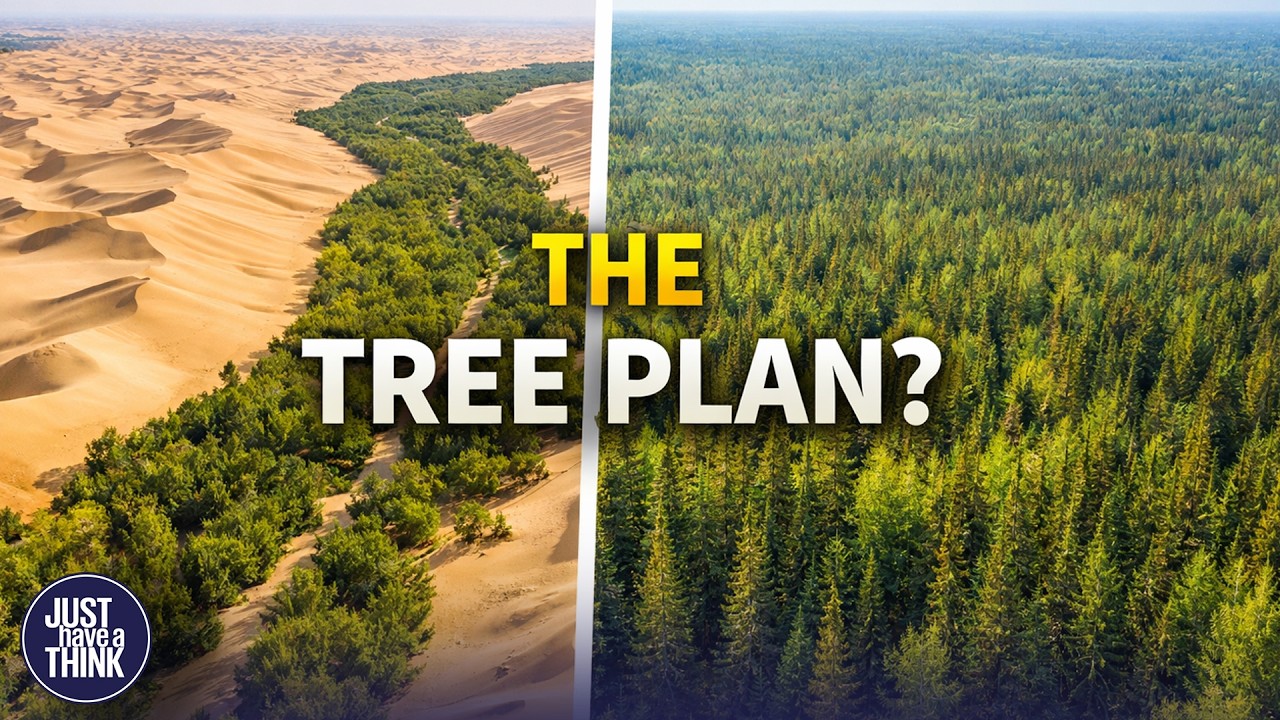
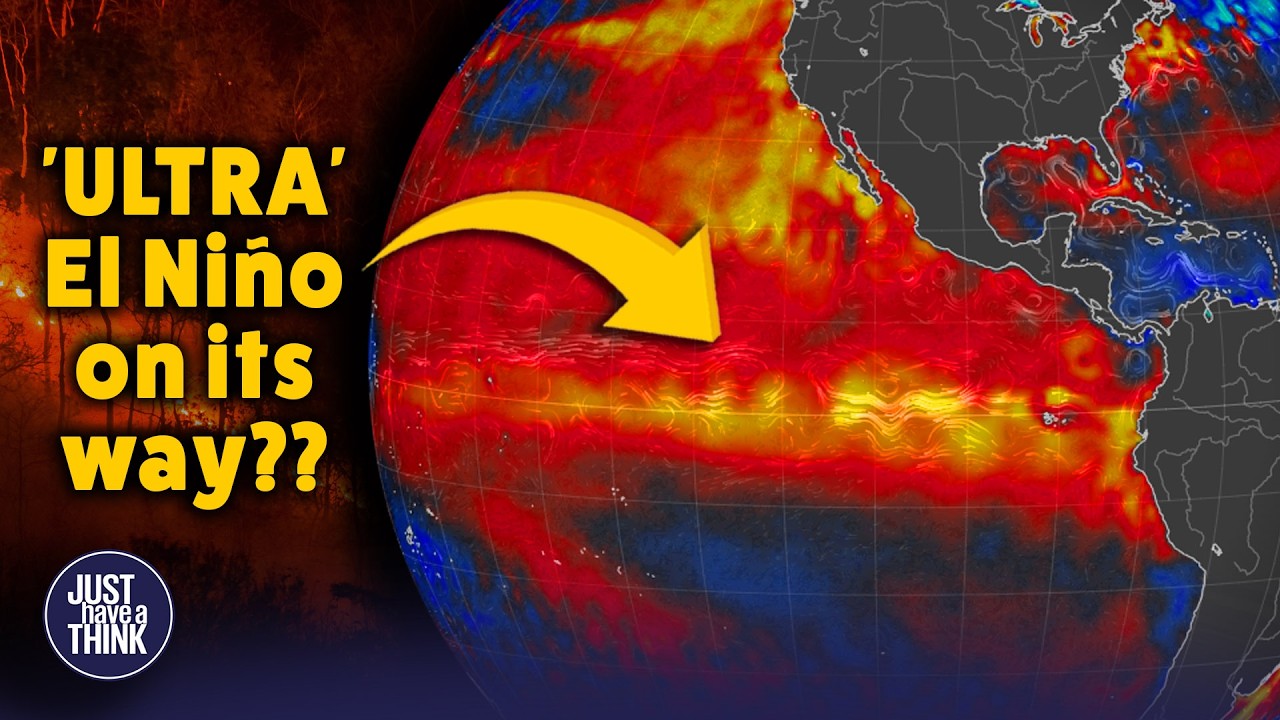
New research suggests that large scale reforestation and afforestation along Canada’s boreal forest edge has the potential to remove billions of tonnes of CO₂. But how does the science behind carbon sequestration, permafrost protection, wildfire risks, and the albedo effect stack up? And can massive tree-planting projects realistically help fight climate change—or are they just a temporary fix?
Help support this channel's independence at
http://www.patreon.com/justhaveathink
Or with a donation via Paypal by clicking here
https://www.paypal.com/cgi-bin/webscr?cmd=_s-xclick&hosted_button_id=GWR73EHXGJMAE&source=url
You can also help keep my brain ticking over during the long hours of research and editing via the nice folks at BuyMeACoffee.com
https://www.buymeacoffee.com/justhaveathink
Reference Links
Dsouza et al - Substantial carbon removal capacity of Taiga reforestation and afforestation at Canada's boreal edge.
https://www.nature.com/articles/s43247-025-02822-z
Ribbers et al - Boreal forests at risk
https://www.sciencedirect.com/science/article/pii/S1389934126000183
Canada's Tree Planting program
https://natural-resources.canada.ca/forest-forestry/2-billion-trees-program
Colorado State University report on climate related boreal changes
https://source.colostate.edu/the-worlds-boreal-forests-may-be-shrinking-as-climate-change-pushes-them-northward/
National Observer - Carbon loss in boreal forests
https://www.nationalobserver.com/2025/02/19/analysis/canada-forests-logging-wildfires-biomass-carbon-co2
Additional reading
https://www.optimistdaily.com/2026/03/chinas-great-green-wall-turns-taklamakan-desert-into-a-growing-carbon-sink/
Check out other YouTube Climate Communicators
Simon Clark:
youtube.com/user/SimonOxfPhys
ClimateTown:
youtube.com/channel/UCuVLG9pThvBABcYCm7pkNkA
Dr Gilbz
youtube.com/@DrGilbz
zentouro:
youtube.com/user/zentouro
Climate Adam:
youtube.com/user/ClimateAdam
Kurtis Baute:
youtube.com/user/ScopeofScience
Sarah Karvner:
youtube.com/channel/UCRwMkTu8sCwOOD6_7QYrZnw
Beckisphere: https://www.youtube.com/channel/UCT39HQq5eDKonaUV8ujiBCQ
Our Changing Climate :
https://www.youtube.com/channel/UCNXvxXpDJXp-mZu3pFMzYHQ
Оглавление (3 сегментов)
Segment 1 (00:00 - 05:00)
For decades, the Taklamakan Desert in western China was known as one of the most inhospitable landscapes on Earth. Locals sometimes translated its name as the place of no return. But recently, it's been appearing in headlines for very different reasons. Over the past 40-plus years, China's been carrying out one of the largest ecological engineering projects in human history, planting vast belts of trees and shrubs around the desert's edges as part of what's known as the Three North Shelterbelt Program, otherwise known as China's Great Green Wall. Billions of trees have been planted since the program began in 1978, and in 2024, officials announced the completion of a 3,000-km greenbelt encircling the desert. Satellite observations and ecological studies now suggest that parts of this formerly barren landscape are doing something remarkable. The vegetation growing along the desert's margins appears to be absorbing more carbon dioxide than the surrounding ecosystem emits, effectively functioning as a small regional carbon sink. In other words, land that was once considered a biological void is now measurably pulling carbon out of the atmosphere. Now, before I get too giddy and carried away, scientists do point out that projects like this one come with significant uncertainties around water availability and long-term ecosystem stability. But the Taklamakan Desert project certainly raises an interesting question. If you can do it in a desert, where trees really don't like growing at all, what if you tried it somewhere else, where they do like to grow? Well, as it happens, a group of researchers has just published a paper looking at the northern edge of Canada's boreal forest, and they reckon the potential climate mitigation up there could be absolutely enormous. Hello, and welcome to Just Have a Think. The paper in question was published in November 2025 in Communications Earth and Environment, and it examines the potential for reforestation and afforestation along the southern boundary of Canada's Arctic and boreal transition zone, sometimes referred to as the tiger. Before we get stuck into all that though, I'm delighted to let you know that I will once again be hosting several discussion panels at the upcoming Everything Electric Live Show up in Harrogate on Friday the 8th and Saturday the 9th of May. There's all the usual brilliant stuff like test drives of all the latest electric vehicles, of which there are now of course about a gazillion to choose from, plus a whole arena full of experts to guide you through the process of choosing heat pumps, solar panels, battery energy systems, car chargers, and just about everything else you might be looking for to transform your home as part of the global energy transition. There's plenty of outdoor space too with great food zones and space for the kids to run around and have a bit of fun. A daily ticket costs £10, or you can get a two-day ticket for £15. Plus, if you use my Just Have a Think discount code at the bottom of the screen, then you'll get 20% off those prices. What's not to like? So, scan the QR code or follow the link in the description section to grab your tickets while they're still available, and I'll hopefully see you there. Right, so it's probably worth a quick refresh on those two terms, reforestation and afforestation. The generally accepted principle is that afforestation can be defined as the planting of trees on land where there hasn't been forest for at least 50 years, whereas reforestation, as the name strongly suggests, is defined as the restoration of forest that used to exist naturally, but which were cleared at some point either by wildfires or by human beings. The restoration projects in Canadian boreal regions described in this latest study could reasonably regard it as a mix of afforestation and assisted natural regeneration along what's known as the tundra-tiger transition zone. According to the authors, around 6. 4 million hectares of land along this boreal edge are highly suitable for new tree growth. Using satellite forest inventory data and ecosystem carbon modeling, they estimate that planting trees across this area could remove approximately 3. 9 gigatons of CO2 from the atmosphere by the year 2100. To put that into context, Canada's annual greenhouse gas emissions are roughly 7 to 800 million tons of CO2 equivalent. So, 3. 9 gigatons or billion tons represents more than five times one year of Canada's emissions. And that's the conservative estimate. The authors also modeled a more ambitious scenario, expanding planting to roughly 32 million hectares of suitable land. In that case, the carbon removal potential rises to around 19 gigatons of CO2 by the end of the century. That's a lot of carbon dioxide, and it apparently wasn't a back-of-the-envelope calculation, either. The researchers combined high-resolution satellite data, forest inventory data sets, climate projections, wildfire disturbance modeling, and so-called Monte Carlo carbon budget simulations, which is scientific shorthand for exploring many
Segment 2 (05:00 - 10:00)
possible future scenarios, rather than just trying to predict one. The research didn't just estimate carbon in tree trunks, either. The model included whole ecosystem carbon, which includes soil carbon, which is particularly crucial in boreal systems. The boreal forests are not just a collection of trees, they're one of the largest terrestrial carbon stores on Earth, holding enormous amounts of carbon in soils and peat. According to the authors, the modeling incorporated tree growth rates under future climate conditions, fire return intervals, mortality rates, and long-term carbon accumulation data. And all of that is important to note because previous estimates of the effects of global tree planting have been criticized for being overly simplistic and optimistic, sometimes touted as a simple silver bullet to have solved our climate emergency. The authors of this new analysis argue that their modeling approach provides a more realistic estimate. So, why focus on the northern edge of the boreal forest? Well, because that's where climate change is already reshaping ecosystems. Warming temperatures and drought stress are already nudging the boreal tree line northwards into areas that were previously either tundra or only very sparsely vegetated. The study suggests that strategic planting in these transition zones could accelerate a natural ecological shift that's already underway. The other potentially huge benefit of a project like this one is the possibility to manage permafrost. Much of Canada's northern land sits on frozen soils that contain vast amounts of stored carbon and methane. And as I'm sure you already know, when the permafrost thaws, those greenhouse gases can be released. According to the authors, increasing tree cover could help insulate soils, reduce permafrost thaw, and potentially limit methane emissions. If that effect holds at scale, it could amplify the climate benefit beyond just the carbon stored in the trees. But again, while these appear to be very good models, they're still only models, aren't they? By definition, they contain assumptions, and they carry absolutely no guarantee of the desired outcome in the real world. It's also worth pointing out, if you hadn't already clocked it, that the 3. 9 gigaton figure is not annual removal. It's a potential cumulative carbon uptake that would unfold gradually over decades as the new trees grow and ecosystems mature. Carbon removal from tree planting is inherently slow. It can't substitute for rapid fossil fuel emissions cuts today. Even the authors acknowledge that reforestation should be viewed as a complement to, rather than a replacement for, deep decarbonization. And then there's those pesky wildfires. The boreal forest is naturally fire adapted. In other words, periodic wildfires are a normal part of the ecosystem, and many of the trees and plants have evolved to survive or even depend on those fires to regenerate and spread. But, climate change is increasing both fire frequency and severity across Canada. If newly planted forests get destroyed in increasingly frequent and more intense fires, then much of the stored carbon will instantly be released straight back into the atmosphere. Researchers have tried to incorporate these fire regimes into their modeling, but future fire [clears throat] behavior is highly uncertain, especially under high warming scenarios. So, while the modeling accounts for disturbance statistically, the real world may be messier. In fact, recent Canadian wildfire seasons have already turned the country's forests from a net carbon sink into a temporary carbon source in some years, which is a bit scary. There's also a broader scientific debate around high-latitude tree planting because of the famous albedo effect. Snow-covered tundra reflects a lot of sunlight back into space. Forests don't. So, planting trees in snowy regions could reduce the surface reflectivity or albedo, and that could potentially cause local warming. Some studies suggest that in certain Arctic regions, the warming effect of reduced albedo could partially offset the cooling benefit of carbon uptake. As usual with climate change, it's all a bit of a minefield. This study does focus on the boreal transition zone, though, as I mentioned earlier, rather than deep Arctic tundra. So, it's likely that this albedo reduction effect would be less dominant across that region. But, I suppose the most obvious question is can it actually be done? I mean, is it even realistically feasible for Canada to plant billions of trees across millions of hectares of remote northern land? Well, the Canadian government is committed to planting 2 billion trees by 2031. But, that apparently already faces logistical and funding challenges. Turns out planting in remote boreal zones is expensive. Who would have guessed it, hey? Plus there are questions about indigenous land rights and governance, seed supply and nursery capacity, long-term forest management, monitoring and maintenance, and ensuring ecological integrity. Afforestation at this scale isn't just
Segment 3 (10:00 - 12:00)
an environmental question, it's a political, social, and economic one. The authors of this study don't for a moment suggest it would be easy. They tacitly acknowledge that their research can only estimate theoretical carbon potential under suitable ecological conditions. Implementation in the real world of hard knocks and tough surprises, as Hugh Laurie once said, is another matter entirely. So where does that leave us then? Is this a serious proposition or just another ream of highly absorbent research grant paper? Well, I'm sure you can guess how the paper's authors would respond to that question. They say the targeted boreal edge reforestation really could represent a substantial carbon removal opportunity. But again, just for absolute clarity, it doesn't eliminate the need for rapid emissions reductions. Even the very most optimistic scenario in the research, which is the removal of 19 gigatons of atmospheric CO2, would still take 75 years of totally unbroken ideal conditions to achieve. In other words, tree planting may buy us a bit of time, but the laser focus should still be on eliminating the combustion of coal, oil, and methane gas. Plus the boreal forest itself is under increasing pressure from the very warming that those fossil fuels are causing. Not only increasing the risk of wildfires, but also from pests and drought. Under those worsening conditions, going to be a big enough job just protecting the existing forest, let alone planting millions of hectares of new growth. Having said that, the dogged determination of the people of China's Taklamakan region shows that these apparently impractical and slightly idealistic projects can be achieved with the right level of focus, resource, and political support. Now, no doubt you've got your own views on this one, or perhaps you've been involved in tree planting projects and you've got some insights you can share with us all. Either way, the place to leave your thoughts, as ever, is in the comments section below. That's it for this week, though. A huge thank you, as always, to the amazing folks over at patreon. com/justhaveathink who make it possible to keep this channel free from all ads and sponsorship messages. And I must just give a quick shout-out to some folks who joined recently with pledges of $10 or more a month. They are Child's Vein, Chris Quayle, Lawrence Johnson, Daniel Harper, Sophia Mendez, Liam O'Connor, Priya Shah, Marcus Delgado, and Hannah Becker. And of course, a massive thank you to everyone else who's joined since last time, too. Don't forget to like and subscribe if you found this video useful and enjoyable. And most importantly of all, thanks very much for watching. Have a great week, and remember to just have a think. See you next week.